
Skip to content
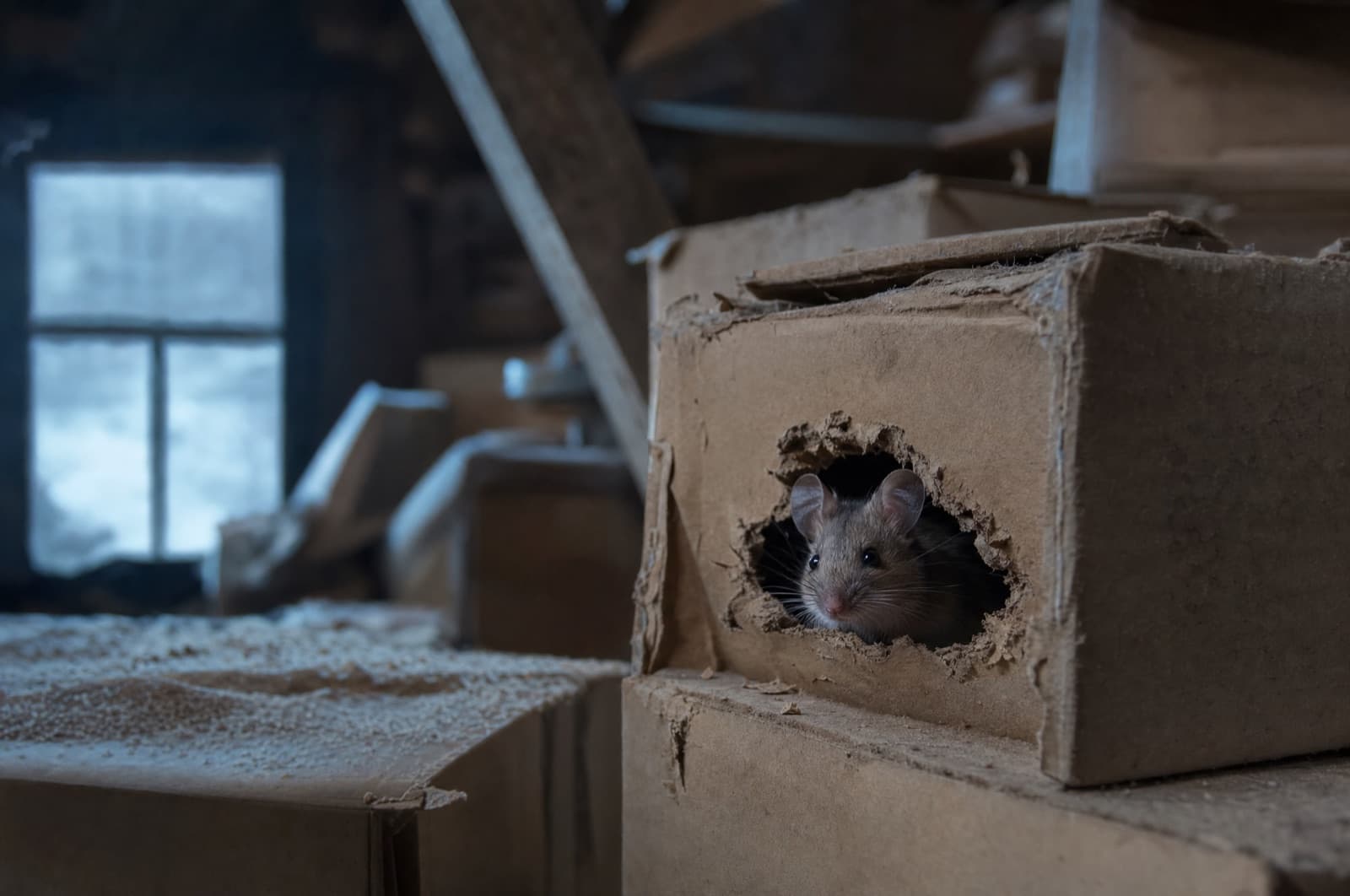
A house mouse in a gnawed cardboard storage box in a cold New Hampshire attic
Daniel Brady · NH-Licensed Pesticide Applicator · License #782664
Reviewed by Daniel Brady

Can insulation damage attract pests in winter?

It depends — the gaps attract, not the insulation itself
It depends on how you read "attract." Pests aren't drawn to damaged insulation by anything like a scent or signal it gives off.What actually happens is that insulation damage and pest entry tend to travel together: the small gaps and openings that let cold air, moisture and pests into an attic or wall cavity are often the same conditions that let insulation get torn up in the first place, and once rodents are inside, they readily shred loose insulation to use as nesting material — which keeps the cycle going rather than starting it.

At a glance

  • The verdict: It depends — the gaps attract, not the insulation itself
The honest answer

The short of it

The verdict
It depends — the gaps attract, not the insulation itself

Damaged insulation doesn't chemically lure pests, but the gaps that usually accompany it are entry points, and exposed insulation makes ready-made rodent nesting material.

What actually happens

The busted assumption

It depends

What people assume

"Torn or exposed insulation sends out some kind of signal that draws pests toward it." That's not how it works. Pests aren't responding to the insulation damage itself; they're responding to whatever opening let them find it, and once inside, they treat the exposed material as a convenient resource rather than a destination they were drawn to.

What actually happens

Purdue Extension documents that rodents nest in and shred fibrous insulation once they're inside a structure, using it as bedding material for their nests. The Internet Center for Wildlife Damage Management notes that rodent entry depends on small gaps, which often coincide with a deteriorated building envelope — the same conditions (aging construction, gaps around utility penetrations, deferred maintenance) that tend to produce both damaged insulation and pest entry points at the same time. The damage and the entry are correlated because they share a cause, not because one chemically signals the other.

What it means for you
Treat visible insulation damage as a symptom worth investigating, not the problem itself. Inspect the area for the gap or opening that's actually letting pests in — that's the thing to seal. If rodents have already been nesting in the insulation, addressing the entry point stops the cycle from continuing; the scope of cleaning up or replacing contaminated insulation belongs to /faq-pest-damage-and-risks, which owns repair-scope detail across the site.
In depth

The full picture

01

What "attract" actually means here

The question carries an assumption worth checking: that damaged insulation somehow calls out to pests the way an open food container might draw a scent trail. That's not what the evidence shows. Insulation itself — torn, compressed, or otherwise damaged — doesn't emit anything that draws pests from a distance. What draws pests is warmth, food, and an accessible opening, none of which insulation damage creates on its own.

Where the confusion comes from is real, though: insulation damage and pest presence are genuinely correlated in a lot of homes, just not for the causal reason people assume.

02

Why insulation damage and pest entry travel together

The correlation exists because both problems tend to share a root cause. The Internet Center for Wildlife Damage Management notes that rodent entry depends on small gaps, and those gaps are disproportionately found where a building envelope has already deteriorated — around aging utility penetrations, gaps in soffits, worn weatherstripping, deferred maintenance generally. Those same conditions are exactly where insulation is also most likely to be disturbed, whether by moisture intrusion, age, or a pest that's already gotten in through the gap.

Once a rodent is inside, Purdue Extension documents that it will actively shred and use fibrous insulation as nesting material, which compounds the damage over time and creates the visible, torn insulation homeowners often notice first — well after the actual entry point has been in use for a while.

03

What to actually do about it

The honest response treats damaged insulation as a signal to investigate, not the thing to fix in isolation. Look for the gap, crack or opening near the damaged area — that's very likely how pests are getting to it in the first place, and sealing it is what actually stops both problems. Simply replacing insulation without finding and closing that entry point tends to produce the same damage again.

If rodents have been nesting in the insulation for a while, the material may also be contaminated with droppings or urine, which raises a cleanup and replacement question rather than a pest-control one. That fuller scope — what a repair or replacement actually involves, and how to think about it without dollar figures — belongs to /faq-pest-damage-and-risks, which owns that material across this site; this page's job is the short winter verdict on the attraction question itself.

Key takeaways
5 points
  • Damaged insulation doesn't chemically attract pests — there's no signal or scent effect from the material itself.
  • Insulation damage and pest entry are correlated because they share a cause: gaps and deterioration in the building envelope.
  • Once inside, rodents actively shred fibrous insulation for nesting material, which compounds visible damage over time.
  • Treat damaged insulation as a symptom — find and seal the nearby gap rather than only replacing the material.
  • Cleanup and repair scope for contaminated insulation belongs to /faq-pest-damage-and-risks, not this page.
New Hampshire context

What this means for a New Hampshire attic

In Manchester, the first hard frost typically lands between October 19 and 29 (NOAA), and that's the window when rodents start testing the building envelope for a way indoors. House mice (Mus musculus) are active year-round and are the classic structure-invading commensal rodent, most likely to push inside as temperatures cool in the fall (ICWDM). On woods-adjacent and rural NH lots, the native white-footed mouse (Peromyscus leucopus) also moves indoors in the cold — it doesn't hibernate, though it may go torpid for a few days in severe weather.

Both species shred fibrous attic and wall insulation for nesting, so torn insulation in a New Hampshire home usually points to an envelope gap that opened before the frost window, not to the insulation attracting anything on its own. Because the Peromyscus group is the hantavirus-relevant genus in the Northeast (CDC), any contaminated nesting material should be ventilated and wet-cleaned rather than swept or vacuumed, which can aerosolize the virus.

  • NH-licensed #782664

    Southern New Hampshire

  • Family-owned

    Since 2017

  • Honest routing

    Even when it isn’t us

We serve these communities

ManchesterNashuaConcordDerryBedfordSalemHudsonAmherst

Find the gap. That's what's actually doing the attracting.

Sealing the opening near damaged insulation stops the cycle. If rodents are already nesting there, exclusion is precisely our job.

Follow-up questions

Frequently asked

Sources & citations(2)
  1. Purdue Extension — The House Mouse

    Rodents shred and nest in fibrous insulation once inside a structure

    extensionverified 2026-07-16
  2. Internet Center for Wildlife Damage Management — House Mouse Biology

    Rodent entry depends on small gaps, often coinciding with a deteriorated building envelope

    academicverified 2026-07-16

Written & reviewed by

Verified

Daniel Brady

NH-Licensed Pesticide Applicator · License #782664 (NHDAMF, RSA 430)

Daniel Brady is the New Hampshire–licensed applicator behind Anchor Pest Services, a family-owned pest control company serving the Manchester area since 2017.

Verify license

Last updated Jul 2026

Honest pest help for New Hampshire homes

It's the Gap, Not the Insulation.

We'll help you find the actual entry point, not just point at the torn insulation. Anchor Pest Services is most useful for exclusion once rodents have found their way in. Family-owned since 2017, NH license #782664, serving Manchester, Nashua, Concord and nearby towns.

  • Honest advice — we identify the actual entry point, not just the visible damage
  • NH-licensed applicators (#782664) — free inspection, same-day service
  • Rodent exclusion and winter pest control across southern and central New Hampshire

NH License #782664 · No obligation · We answer in person