
Skip to content
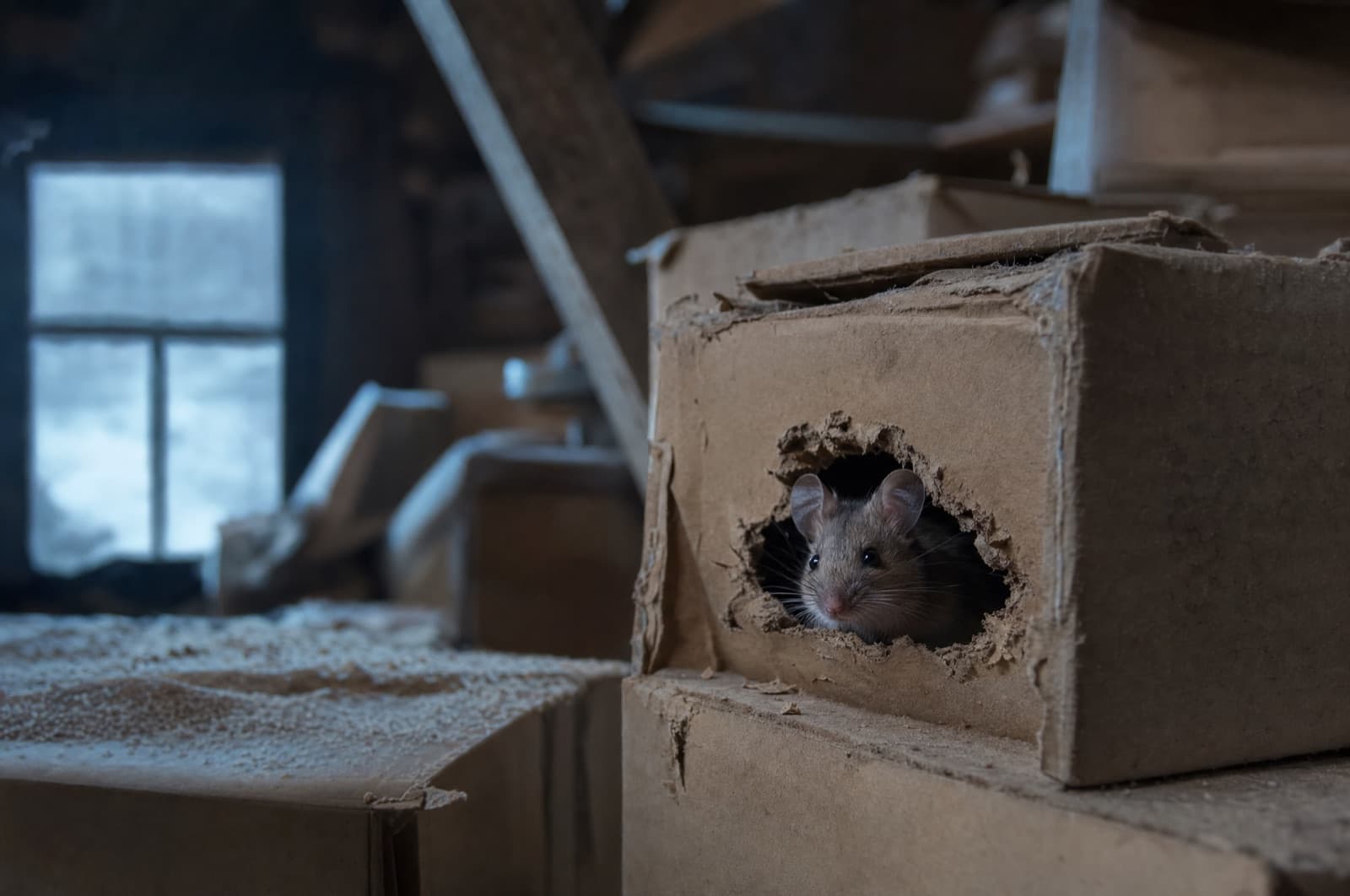
A house mouse in a gnawed cardboard storage box in a cold New Hampshire attic
Daniel Brady · NH-Licensed Pesticide Applicator · License #782664
Reviewed by Daniel Brady

What winter pests eat stored food in garages or basements?

It depends — but on a short, knowable list
It depends on what's stored, but the offenders are predictable rather than mysterious.Mice and rats target birdseed, pet food, and any dry goods, chewing through bags and thin plastic to reach them. Stored-product insects — Indianmeal moths and beetles such as sawtoothed grain beetles, flour beetles, and cigarette beetles — infest grains, cereal, dried fruit, nuts, birdseed, and dry pet food directly, sometimes arriving already inside the product from the store. Cold slows insect activity in an unheated garage, but a heated basement lets it resume, and rodents are more motivated to reach stored food in winter, not less.

At a glance

  • The verdict: It depends — but on a short, knowable list
The honest answer

The short of it

The verdict
It depends — but on a short, knowable list

Mice and rats go after any dry goods; pantry moths and beetles infest grains and pet food directly. Cold slows the insects but doesn't stop the rodents at all.

What actually happens

The busted assumption

It depends

What people assume

That a cold garage is 'too cold for bugs,' so anything dry stored out there is automatically safe. In reality, insect activity does slow in an unheated garage, but it resumes as soon as an infested product is carried into a warm basement or kitchen, where the insects continue developing and generating adults. Meanwhile the assumption doesn't apply to rodents at all — winter is documented peak season for rodents seeking indoor food and shelter, so cold weather makes the food-seeking behavior more urgent, not less.

What actually happens

Two distinct categories of pest target stored food, and they behave differently. Rodents 'contaminate far more than they eat' and are drawn to any unsecured seed or pet food (NPIC; CDC) — a rodent gnaws into a bag or thin container regardless of temperature, because cold doesn't reduce its need to eat or its incentive to find shelter near food. Stored-product insects — Indianmeal moths and beetles like sawtoothed grain, cigarette, drugstore, and flour beetles — 'live, eat, and grow inside stored products, such as birdseed, dry pet food, and dry food products,' and often arrive already infested from the point of purchase (University of Minnesota Extension; NC State Extension).

What it means for you
Store seed, pet food, and dry goods in glass or metal containers with tight lids — extension guidance across states treats heavy plastic as acceptable but not as reliable as glass or metal. Buy quantities you'll use up quickly rather than stockpiling months' worth in a garage. If you see webbing, small beetles, or larvae inside a food package, find and discard the source rather than spraying around it; freezing a suspect item at a hard freeze for several days is the extension-recommended way to kill eggs and larvae in an item you want to keep.
In depth

The full picture

01

Two different problems that look similar

It's easy to lump 'pests eating stored food' into one category, but rodents and stored-product insects are functionally different problems that happen to share a location. A rodent is an opportunistic forager: it doesn't need the food to already be damaged, it creates the damage by chewing its way in, and it does this regardless of season or ambient temperature because it needs to eat and it needs shelter, and a garage full of dry goods offers both.

Stored-product insects are a different mechanism entirely. Extension guidance consistently notes that species like the Indianmeal moth and sawtoothed grain beetle 'live, eat, and grow inside stored products,' and a meaningful share of infestations start before the product is even carried into the house — the eggs or larvae were already present in the package at purchase (University of Minnesota Extension; NC State Extension). Cold slows their development but a warm basement resets the clock.

02

Why 'it's cold out there' isn't the safety net people assume

The busted assumption behind this whole question is that an unheated space is inherently pest-safe for stored food. For insects, that's a half-truth — activity does slow, but dormant eggs and larvae aren't killed by garage-cold the way a hard freezer would kill them, and once that same bag of birdseed comes inside to a heated basement, development resumes. For rodents, the assumption doesn't hold at all: cold weather is precisely what drives rodents toward indoor food sources in the first place, which is the same seasonal mechanism behind winter being documented peak season for indoor rodent activity generally.

03

The fix that covers both problems at once

The same container upgrade solves both categories. Glass and metal containers with tight lids exclude a gnawing rodent completely and make it much harder for stored-product insects to infest a fresh package from the outside — though it won't undo an infestation that arrived already inside the bag. That's why buying smaller quantities more often, checking new purchases before they go into long-term storage, and freezing a suspect item before it joins the rest of the pantry are the practical extension-backed habits worth adopting alongside the container swap.

Key takeaways
5 points
  • Two categories of pest, two mechanisms: rodents chew their way into any dry goods; pantry moths and beetles infest grains and seed directly, sometimes arriving pre-infested.
  • Cold slows stored-product insects but doesn't kill dormant eggs or larvae — a warm basement resets their development.
  • Cold weather does not slow rodents down at all; if anything, it increases their motivation to reach stored food indoors.
  • Glass or metal containers with tight lids are the reliable fix extension guidance points to for both categories.
  • If you find webbing or larvae in a food package, discard the source; a hard freeze for several days kills eggs and larvae in items worth keeping.
New Hampshire context

What this looks like in a New Hampshire garage or basement

Manchester's first hard frost lands roughly October 19 to 29 in a typical year (NOAA), and that's about when outdoor rodents start pressing toward any warm, food-adjacent structure in earnest — an unheated attached garage counts, even though it feels cold to a person walking through it. Meanwhile a basement kept at normal indoor temperatures all winter is exactly the environment that keeps stored-product insects developing on schedule, unaffected by the season outside.

The practical takeaway for a New Hampshire household: don't treat 'it's in the garage, it'll be fine' or 'it's in the basement, it's not outside' as safety arguments for either pest category. The container is what matters, not the thermostat.

  • NH-licensed #782664

    Southern New Hampshire

  • Family-owned

    Since 2017

  • Honest routing

    Even when it isn’t us

We serve these communities

ManchesterNashuaConcordDerryBedfordSalemHudsonAmherst
The other half of this question

Want the materials answer rather than the storage answer?

This page is about the winter-storage scenario — your bins, decorations and stored food in an unheated New Hampshire garage or attic, and what actually holds. The damage guide answers the other half: what pests can and cannot chew across the whole house, what genuinely isn’t at risk, and what a repair actually involves.

Read the materials answer

Container swaps are yours. An active infestation is worth a call.

Glass and metal storage handles both rodents and pantry insects going forward. If you're already seeing regular rodent activity around stored food, that's worth a professional look.

Follow-up questions

Frequently asked

Sources & citations(5)
  1. University of Minnesota Extension — Pantry pests: Insects found in stored food

    Stored-product insects live and breed inside packaged goods; often arrive pre-infested; storage guidance

    extensionverified 2026-07-16
  2. NC State Extension — Common Pantry Pests and their Management

    Beetle and moth species list; pre-purchase infestation

    extensionverified 2026-07-16
  3. NPIC — Rodents

    Rodents contaminate far more than they eat; drawn to unsecured seed and pet food

    npicverified 2026-07-16
  4. CDC — Seal Up! Rodent control and exclusion

    Store feed and food in thick plastic, metal, or glass containers with tight lids

    govverified 2026-07-16
  5. Colorado State University Extension — Moths in the Home

    Indianmeal moth biology; freezing suspect items kills eggs and larvae

    extensionverified 2026-07-16

Written & reviewed by

Verified

Daniel Brady

NH-Licensed Pesticide Applicator · License #782664 (NHDAMF, RSA 430)

Daniel Brady is the New Hampshire–licensed applicator behind Anchor Pest Services, a family-owned pest control company serving the Manchester area since 2017.

Verify license

Last updated Jul 2026

Honest pest help for New Hampshire homes

The Container Fix Is Free Advice. The Source Is Our Job.

Swapping to glass or metal storage is something any household can do this weekend. Anchor Pest Services is worth calling when rodents are already established in a garage or basement. Family-owned since 2017, NH license #782664, serving Manchester, Nashua, Concord and nearby towns.

  • Honest advice — we'll tell you when a hardware-store fix beats a service call
  • NH-licensed applicators (#782664) — free inspection, same-day service
  • Rodent exclusion and winter pest control across southern and central New Hampshire

NH License #782664 · No obligation · We answer in person