
Is It a Ladybug or an Asian Beetle?
At a glance
- The short answer: Both — and here's which one you have
- How to tell: Behaviour, not colour — see The Split
- Where removal lives: We route it out — this hub owns identity
One animal, one honest answer
The verdict on Is it a ladybug or an Asian beetle?
"Ladybug" and "Asian beetle" are two names for one insect — and the one on your house each fall is essentially always the Asian one.
Native ladybug vs. the Asian lady beetle
Two names, one animal. Both columns always render — and they always converge on the same resolution. The tell is behaviour, not colour.
The native ladybug
(the one you're picturing)
- Lives and overwinters outdoors — leaf litter, under bark, under rocks
- Does not gather on houses or move indoors to spend the winter
- Some natives, like the pink-spotted lady beetle, occasionally wander in — but never in the numbers below
The Asian lady beetle
(Harmonia axyridis)
- Aggregates on sun-warmed walls each fall, then works into wall voids and attics
- Overwinters inside structures — a building substitutes for the rock crevices it uses in its native range
- Colour runs from pale yellow-orange to deep red, even fully black — colour alone is a weak tell, not a diagnosis
If it's clustering on or inside your house, it's the right-hand column. Both are ladybugs. Only one does this.
What's actually going on
Two names, one insect
Harmonia axyridis — the multicolored Asian lady beetle — is a genuine ladybug: family Coccinellidae, subfamily Coccinellinae, tribe Coccinellini. The Integrated Taxonomic Information System lists it as a valid, accepted species, Harmonia axyridis (Pallas, 1773), Taxonomic Serial No. 692602, and the standard peer-reviewed review of its biology states plainly that it "is currently placed in the tribe Coccinellini of the family Coccinellidae" (Koch 2003, Journal of Insect Science). It is not a look-alike from some other insect family — it is one particular introduced species among the many ladybug species found in North America.
Our own legacy site didn't treat it that way. It ran 52 "Asian beetle" pages next to 52 "ladybug" pages — the same roughly fifty questions, asked twice, once per name. Two of those old pages asked this exact question under two different titles: whether Asian beetles are a type of ladybug, and whether Asian lady beetles are the same as ladybugs. Both were answered as if the outcome were genuinely in doubt. It isn't, and it never was — which is the whole thesis of this page, sitting right there in our own old sitemap.
The one on your window? Essentially always the Asian one
Naming the family doesn't tell you which insect is actually in front of you, and that's a fair follow-up question — New England has dozens of native ladybug species. Here the evidence is unusually clean. Ohio State University Extension draws the contrast directly: Harmonia axyridis regularly seeks overwintering shelter in and around buildings, while native lady beetle species typically spend the winter in sheltered sites outdoors — leaf litter, under bark, under rocks. Citizen-science records put a number on that contrast: Harmonia axyridis accounts for 97% of ladybug observations submitted from houses to Cornell's US Lost Ladybug Project (Ramsey & Losey 2012, reported in Roy et al. 2016, Biological Invasions). In its native range this species overwinters in rock crevices on cliff faces; in New Hampshire, a light-coloured house is the nearest substitute, and it gathers there the way native species simply don't — most numerously, per UNH Cooperative Extension, on the sunny side of buildings on mild days from mid-September through early November, which is the window when the massing that answers this identity question actually appears.
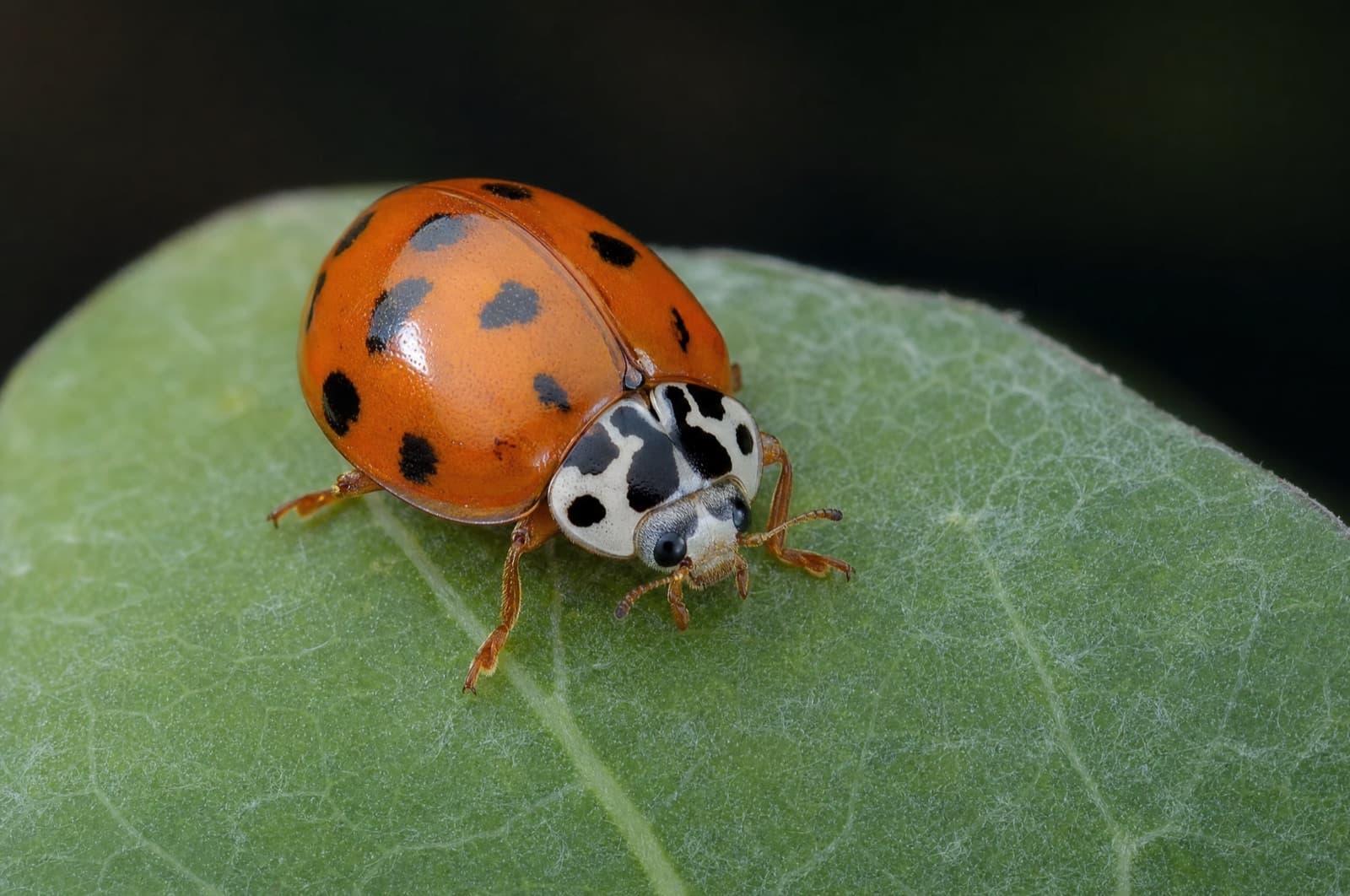
So if what's in front of you is clustered on a wall or working its way indoors in October, you don't need a colour chart — colour won't help much anyway, since Harmonia axyridis ranges from pale yellow-orange through deep red to fully black, and a native ladybug can look just as orange or just as spotted. The one physical cue worth knowing is the white patch on the pronotum, the plate behind the head, marked with a black "M" or "W" shape — UNH Extension and the wider literature treat it as more consistent than elytra colour. Beyond that, this page isn't the place for a full identification key; /pests carries a proper species profile for that.
Key takeaways
"Ladybug" and "Asian beetle" are two names for one insect — Harmonia axyridis is a true member of the ladybug family, Coccinellidae.
If it's aggregating on or inside your house, it's essentially always the Asian lady beetle: it accounts for 97% of Lost Ladybug Project observations submitted from houses.
Colour is a weak tell — this beetle ranges from pale yellow-orange to fully black. The one useful physical cue is the white pronotum with a black "M" marking.
This page replaces 6 of our own legacy pages that asked the same identity question under two different names.
These questions all land here
We asked this more than once, under more than one name, and printed more than one answer. There was only ever one — so here's what this page replaces.
We asked this question twice — once about "ladybugs", once about "Asian beetles" — and printed two answers. There was only ever one.
Looking to get rid of them?
This hub answers what it is — not how to remove it. Most people who land here actually want one of these next steps, so we hand you straight to the hub that owns it.
Same insect, same team either way.
Whether you call it a ladybug or an Asian beetle, if it's aggregating on your house this fall, we handle it.
Frequently asked
Sources & further reading(5)
- [1]Koch 2003 — Journal of Insect Science, "The Multicolored Asian Lady Beetle, Harmonia axyridis: A Review"
Taxonomic placement in tribe Coccinellini, family Coccinellidae
academicverified 2026-07-17 - [2]Integrated Taxonomic Information System — Harmonia axyridis (Pallas, 1773)
Valid taxonomic status, Taxonomic Serial No. 692602
govverified 2026-07-17 - [3]Ohio State University Extension — factsheet ENT-44
H. axyridis seeks overwintering shelter in and around buildings; native lady beetle species typically overwinter in sheltered sites outdoors
extensionverified 2026-07-17 - [4]Roy et al. 2016 — Biological Invasions, "The harlequin ladybird, Harmonia axyridis: global perspectives on invasion history and ecology"
H. axyridis accounts for 97% of ladybug observations from houses in the US Lost Ladybug Project (Ramsey & Losey 2012)
academicverified 2026-07-17 - [5]UNH Cooperative Extension — Multicolored Asian Ladybug fact sheet
New Hampshire specimen colour and spot-count range; white pronotum/black M marking as a more consistent cue than elytra colour; NH fall window (most numerous on sunny building sides mid-September through early November)
extensionverified 2026-07-17
Written & reviewed by
VerifiedDaniel Brady
NH-Licensed Pesticide Applicator · License #782664 (NHDAMF, RSA 430)
Daniel Brady is the New Hampshire–licensed applicator behind Anchor Pest Services, a family-owned pest control company serving the Manchester area since 2017.
Last updated July 2026
Honest pest ID for New Hampshire homes
One Insect, Two Names, Six Pages We Deleted
"Asian beetle" and "ladybug" aren't two animals — Harmonia axyridis is a true member of the ladybug family, and it's the one essentially always found aggregating on New Hampshire homes each fall. Family-owned since 2017, NH license #782664, based at 700 Harvey Rd in Manchester.
- NH-licensed applicators (#782664) — free inspection, same-day service
- We consolidated 6 of our own pages rather than keep two answers to one question
- Family-owned, Manchester NH, since 2017
NH License #782664 · No obligation · We answer in person
Your next step
- Fall guide
Fall Pest Control in New Hampshire
What matters before frost: the fall invader window, mice at the foundation, and what to seal first.
Read the answer - What to do next
When Are Asian Lady Beetles Active? NH Ladybug Timing
Read the answer - What to do next
How to Get Rid of Asian Lady Beetles
Read the answer - What to do next
What do Asian lady beetles look like indoors?
Read the answer - Also relevant
Asian Lady Beetle in New Hampshire: Honest ID & What to Do
Read the answer - Also relevant
Where Do Beetles Go In The Winter?
Read the answer