
Asian Lady Beetle in New Hampshire: Honest ID & What to Do
Also called Asian ladybug · Halloween lady beetle · Harlequin ladybird · Japanese lady beetle
The multicolored Asian lady beetle is a beneficial aphid predator in summer that becomes a fall invader in New Hampshire, clustering on sunny south- and west-facing walls and squeezing into wall voids to overwinter. It does not breed indoors, damage your home, or carry disease — but it can leave a yellow reflex-bleeding stain, deliver a faint pinch, and smell unpleasant when crushed. The fix is exclusion before October and vacuuming, not indoor spraying.
- Adult size
- ~7 mm long, 5.5 mm wide (1/4–3/8 in)
- Penn State Extension; UMN Extension
- Spot count
- 0–19 black spots; color yellow to red
- Color and spots are useless for ID — UMN Extension
- Key ID feature
- Black 'M' mark on white pronotum (behind the head)
- Ohio State University Extension, Ohioline ENT-44
- NH arrival
- Possibly arrived in New Hampshire fall 1993
- UNH Cooperative Extension
- Fall trigger
- First day over 64°F after a significant cold snap, mid–late October
- Ohio State University Extension, Ohioline ENT-44, citing Huelsman et al. 2002
- Lifespan
- Typically 1–3 months; up to ~3 years
- Ohio State University Extension, Ohioline ENT-44
The fall ladybug swarm — and why it's not a 'real' ladybug
Each October, thousands of beetles appear on sunny south- and west-facing walls across Manchester, Nashua, and communities throughout New Hampshire. Homeowners often assume they're the same native ladybugs that have always been in gardens. They're not — and the difference matters for how you respond.
The multicolored Asian lady beetle (Harmonia axyridis) was introduced to control agricultural pests and first appeared in New Hampshire around 1993. Unlike native ladybugs, it overwinters as an adult by squeezing into wall voids, attics, and tight crevices — often in enormous numbers. The invasion is triggered not by a calendar date but by the first warm afternoon after a sharp cold snap, usually in mid-to-late October near Manchester's first hard-frost window.
The key reframe: this beetle does not breed indoors, does not damage building materials, and carries no disease. The nuisances — a faint pinch, a yellow reflex-bleeding stain, and an unpleasant odor when crushed — are real but minor. Control is exclusion (caulking gaps before the trigger arrives) and vacuuming, not spraying.
How to tell an Asian lady beetle from a native ladybug
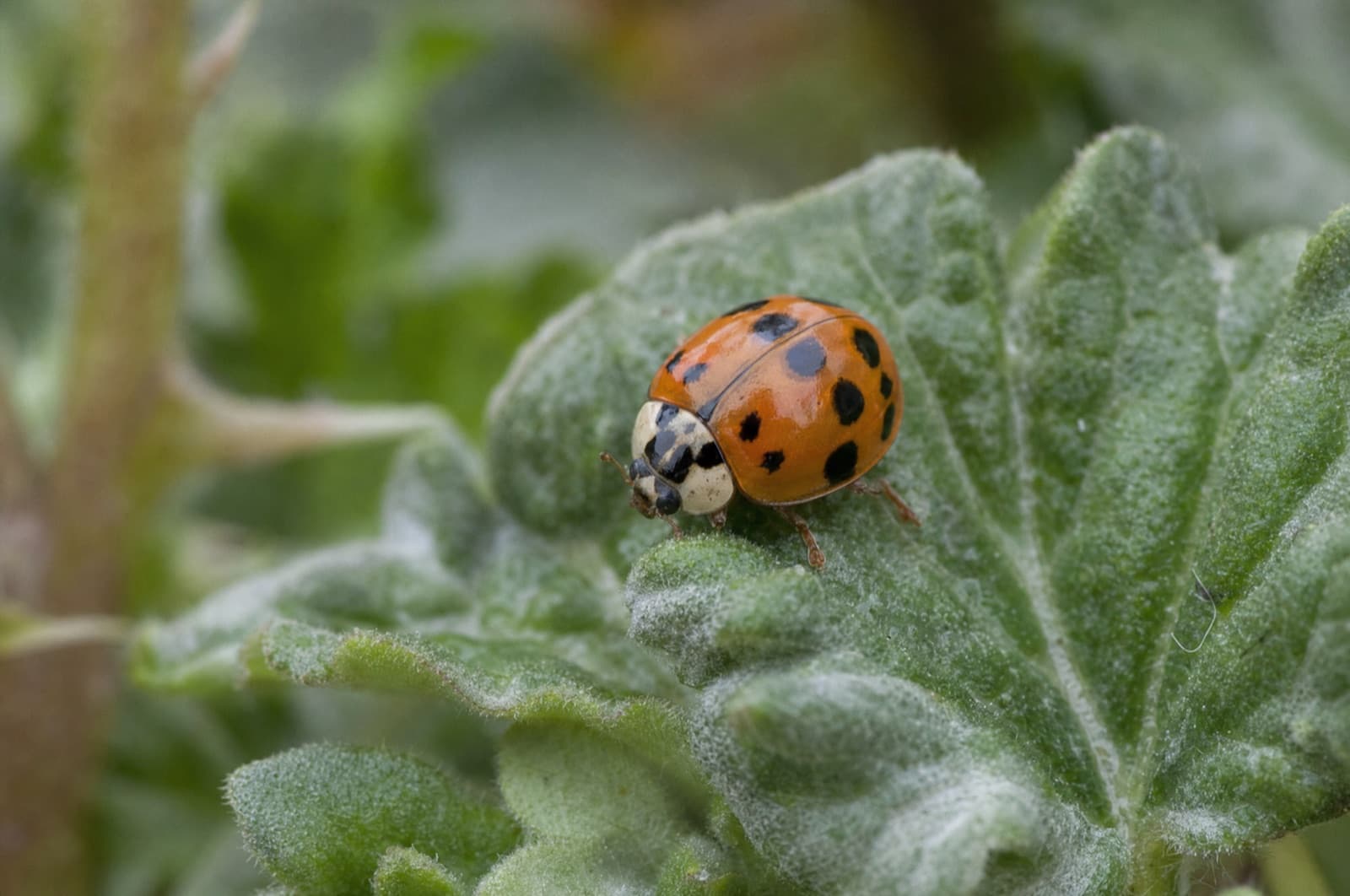
The single reliable feature is the pronotum — the shield-shaped plate behind the head — not the spots or body color. A bold black 'M' or 'W' on a white pronotum means Asian lady beetle. Native species lack this mark entirely. Color and spot count are useless for this ID: both the native and invasive species range from pale yellow to bright red and can have anywhere from zero to 19 spots.
Multicolored Asian lady beetle
- Scientific name
- Harmonia axyridis
- Family
- Coccinellidae
- Size
- ~7 mm long, 5.5 mm wide (1/4–3/8 in)
- Coloration
- Yellow-orange to red; 0–19 black spots; white pronotum with black 'M' mark
- Habitat
- Trees, shrubs, and crops (summer); south/west-facing walls, attics, and wall voids (fall/winter)
- Active season
- Spring through fall outdoors; aggregates on structures in October; emerges on warm winter days
- Diet
- Aphids and other soft-bodied insects — a beneficial predator in the garden
- Reproduction
- Eggs laid in clusters of ~20 on aphid-infested plants; egg-to-adult ~3–4 weeks
- Lifespan
- Typically 1–3 months; up to approximately 3 years
Native to eastern Asia; introduced and now established across North America including New Hampshire
The tells — key ID features
- Black 'M'-shaped mark on the white pronotum behind the head — look here first; don't rely on spots or color.
- Domed, oval body, slightly larger and more rounded than most native ladybugs.
- Color varies widely from pale yellow to bright red; spot count zero to 19.
- Fall aggregations cluster on sunny south- and southwest-facing walls.
- Releases yellow-orange fluid (reflex bleeding) from leg joints when handled or disturbed.
- Larvae are 'alligator-shaped' — black with orange markings and rows of tiny spines.
Size, to scale
~7 mm
About the size of a dried split pea (~7 mm); noticeably larger and more domed than native two-spotted or convergent lady beetles
Native lady beetles (nine-spotted, convergent)
How to tell — Native species lack the bold black 'M' on the pronotum; they overwinter outdoors in leaf litter and don't enter homes in swarms.
Carpet beetle
How to tell — Carpet beetles are much smaller (1.5–3 mm), have a mottled calico pattern, and are found near fabrics — not clustering on sunny walls in fall.
Boxelder bug / western conifer seed bug
How to tell — Both are fall invaders but are elongate and dark — very different shape from the domed, round Asian lady beetle.
Signs of a problem
Asian lady beetles announce themselves in fall and then again on warm winter days. These are the signs — and what each one means for timing your response.
Clusters of beetles on sunny exterior walls in October
What it means — They are scouting overwintering sites — seal entry points now; the window is open.
Beetles on ceilings and around windows on warm winter days
What it means — An overwintered population inside wall voids has woken; exclusion is too late this season.
Yellow-orange stains on light walls, curtains, or upholstery
What it means — Reflex bleeding from disturbed or crushed beetles — clean promptly to prevent setting.
A faint, unpleasant odor in a room
What it means — Defensive secretion from disturbed or dead beetles congregating in a void.
Beetles clogging window-unit air conditioners in fall or spring
What it means — A frequently missed entry route — remove and store window units before October.
Dead beetles accumulating on windowsills over winter
What it means — Confirms an indoor overwintering population; expect emergence in spring unless exclusion is completed.
The real risks, calibrated
Asian lady beetles are genuinely low-risk. Be honest about the minor nuisances, but don't overstate them — this is not a dangerous insect.
Faint pinch on contact
Low riskOnset: Immediate, when handled
A minor pinch; no venom and no wound of medical concern.
Reflex-bleeding stains
Low riskOnset: Immediate, on disturbance
Yellow defensive hemolymph can stain light rugs, upholstery, and curtains.
Unpleasant odor
Low riskOnset: Immediate, when crushed or massed
Defensive secretion is foul-smelling but harmless.
Allergic response in sensitive individuals
ModerateOnset: With heavy indoor populations over winter
Large populations can trigger allergic symptoms — sneezing, eye irritation — in sensitive people.
Nuisance aggregations
ModerateOnset: Each fall and spring
Tens of thousands can aggregate in wall voids and attics, emerging en masse on warm days.
Disease or structural damage
Low riskOnset: N/A
None — Asian lady beetles do not carry human disease and do not damage building materials.
DIY — what works, what backfires
Control is about exclusion before October and vacuum management indoors. Indoor spraying is neither recommended nor effective.
What actually works
- Seal cracks and gaps around windows, door frames, eaves, vents, soffits, and especially the south- and west-facing sides of the home before early October.
- Remove and store window-unit air conditioners before the fall trigger window; they are a major unscreened entry point.
- Repair or replace damaged window screens.
- When beetles appear indoors, vacuum them up using a vacuum with a bag (not bagless) and seal and discard the bag promptly to prevent the odor.
- Release vacuumed beetles outside if possible; discard if they would just re-enter.
What backfires
- Don't spray insecticides inside the home or directly on the exterior — indoor sprays do not reach the beetles in wall voids and are not recommended by extension services.
- Don't crush beetles — crushing triggers both reflex bleeding and the defensive odor.
- Don't expect repellents to clear them out; no registered repellent reliably prevents aggregation.
- Don't wait until beetles appear at windows — by then, exclusion is too late for this season.
Asian lady beetles in New Hampshire homes
Across Manchester, Nashua, Derry, and Bedford, the fall invasion typically begins in early-to-mid October, timed to the first warm afternoon after nights drop toward freezing — roughly the Manchester first-hard-frost window (about Oct 19, 50% probability; Oct 29, 80% probability, per NOAA 1991–2020 normals). Exclusion work should be finished by late September. Light-colored, south- and west-facing walls attract the largest aggregations. Per UNH Cooperative Extension, Asian lady beetles arrived in New Hampshire around fall 1993 and are now established statewide. A NH-licensed applicator (commercial applicator #782664, category F1) can treat exterior perimeters with a properly labeled, timed application before the trigger window.
Peak season
Late September through October (fall aggregation); warm winter days (emergence); April–May (spring departure)
You might actually have
- Boxelder bug (also clusters on sunny walls in fall, then overwinters indoors)
- Brown marmorated stink bug (same fall-invader behavior, also wall-void overwintering)
- Western conifer seed bug (similar fall swarming; elongate, brown, not domed)
We serve these communities
- NH-licensed applicator · #782664
- Same-day service
- Family-owned since 2017
Service Area Map
Southern New Hampshire
When to call a pro for Asian lady beetles
If you experience large, recurring fall invasions despite DIY sealing, or you want a professionally timed exterior perimeter treatment before the October trigger window, a licensed applicator can provide both exclusion assessment and a properly labeled perimeter barrier. Anchor Pest Services (NH #782664, F1) offers General Pest Control with a free quote and same-day service.
When to call a pro
- Large numbers enter each fall despite your own caulking and sealing efforts.
- You want a professionally timed exterior perimeter treatment before the fall trigger window.
- Beetles have established inside wall voids and are emerging heavily indoors on warm winter or spring days.
- You need an inspection to identify all entry points on a multi-story or complex structure.
Seal sunny walls before mid-October
Prioritize south- and west-facing walls, rooflines, and eaves — the surfaces that hold warmth and attract aggregations. Caulk gaps, install door sweeps, and replace worn weatherstripping.
Store window units before fall
Window air conditioners left in place through October act as an open door. Remove and store them by late September.
Vacuum, don't spray, for indoor stragglers
A vacuum removes individual beetles without triggering reflex bleeding or odor. Spray residuals indoors won't reach beetles in wall voids.
Not sure it's a multicolored asian lady beetle?
A licensed NH technician can confirm the species and tell you honestly whether it's a DIY fix or a job for a pro — free inspection, same-day service across Southern New Hampshire.
Frequently asked questions
Sources(9)
- [1]UNH Cooperative Extension — Multicolored Asian Ladybug Fact Sheet
NH arrival date, overwintering biology, control guidance
extensionverified 2026-06-30 - [2]UNH Cooperative Extension — How to Get Rid of Asian Ladybugs
NH control recommendations, exclusion timing
extensionverified 2026-06-30 - [3]Ohio State University Extension — Multicolored Asian Lady Beetle (Ohioline ENT-44)
fall trigger temperature, lifespan, pronotum 'M' ID, reflex bleeding
extensionverified 2026-06-30 - [4]Penn State Extension — Multicolored Asian Lady Beetle
size, nuisance aggregation numbers, why sunny walls attract them
extensionverified 2026-06-30 - [5]UMN Extension — Multicolored Asian Lady Beetles
color/spot range, spring departure, pronotum ID
extensionverified 2026-06-30 - [6]University of Maryland Extension — Multicolored Asian Lady Beetle
species biology and control overview
extensionverified 2026-06-30 - [7]Northeastern IPM Center — Multicolored Asian Lady Beetle
no disease / no structural damage, allergy notes, bite characterization
industryverified 2026-06-30 - [8]PMC — Allergenicity of multicolored Asian lady beetle (PMC524671)
allergic response in sensitive individuals
academicverified 2026-06-30 - [9]Old Farmer's Almanac — Frost Dates Manchester NH
Manchester first hard frost dates (Oct 19 / Oct 29)
encyclopediaverified 2026-06-30
Written & reviewed by
VerifiedDaniel Brady
NH-Licensed Pesticide Applicator · License #782664 (NHDAMF, RSA 430)
Daniel Brady is the New Hampshire–licensed applicator behind Anchor Pest Services, a family-owned pest control company serving the Manchester area since 2017.
Last updated 2026-06-30

New Hampshire pest control
Dealing with multicolored asian lady beetles in your home?
Anchor Pest Services identifies and handles multicolored asian lady beetle problems across southern and central New Hampshire. Family-owned since 2017, NH license #782664.
- NH-licensed applicators (#782664)
- Same-day service · free inspection
- Family-owned since 2017
Your next step
- Fall guide
Fall Pest Control in New Hampshire
What matters before frost: the fall invader window, mice at the foundation, and what to seal first.
Read the answer - What to do next
When Are Asian Lady Beetles Active? NH Ladybug Timing
Read the answer - What to do next
How to Get Rid of Asian Lady Beetles
Read the answer - What to do next
What Attracts Asian Lady Beetles to Your House?
Read the answer - Also relevant
Is It a Ladybug or an Asian Beetle?
Read the answer - Also relevant
Native Ladybug or Asian Lady Beetle — Which One Do I Have?
Read the answer