
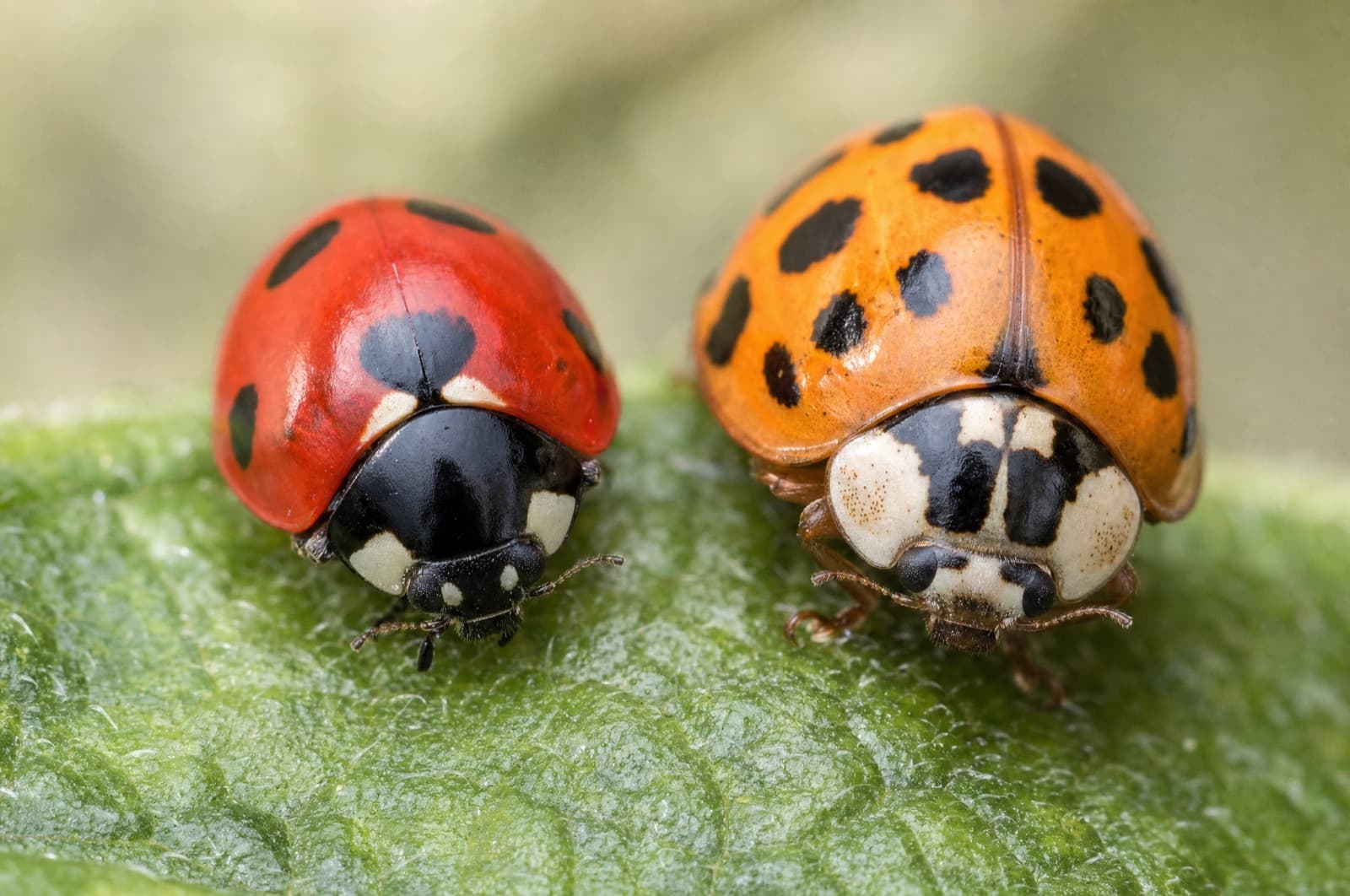
Native Ladybug or Asian Lady Beetle — Which One Do I Have?
At a glance
- The short answer: Both are ladybugs — the tell is behavior, not appearance
- How to tell: Behaviour, not colour — see The Split
- Where removal lives: We route it out — this hub owns identity
One animal, one honest answer
The verdict on Native ladybug or Asian lady beetle — which one do I have?
New Hampshire has native ladybugs, and it has the Asian lady beetle — and the one massing on your house each fall is essentially always the Asian one.
Native ladybug vs. the Asian lady beetle
Two names, one animal. Both columns always render — and they always converge on the same resolution. The tell is behaviour, not colour.
The native ladybug
(several New Hampshire species)
- Overwinters outdoors — leaf litter, loose bark, rocks, and garden debris
- A few, like the pink-spotted lady beetle, occasionally wander indoors — always in far smaller numbers
- Was already established in North America long before the Asian lady beetle arrived
The Asian lady beetle
(Harmonia axyridis)
- Stages on sun-warmed south- and west-facing walls each fall before moving indoors
- Overwinters inside structures — first recorded in New Hampshire in 1994, now common across New England
- Colour spans pale yellow-orange to deep red to solid black — a weak tell on its own
If it's aggregating on or inside your house in numbers, it's the Asian lady beetle. Both are ladybugs; only one overwinters in your walls.
What's actually going on
The real distinction: behavior, not appearance
New Hampshire has native lady beetle species of its own, and telling them apart from the introduced Asian lady beetle by sight is harder than most homeowners expect — but telling them apart by behavior is not. Native species spend the winter outdoors: in leaf litter, under loose bark, under rocks and garden debris. North Carolina Cooperative Extension describes native ladybugs as living outdoors and overwintering in "garden and landscape debris, not in our homes." A few natives, notably the pink-spotted lady beetle (Coleomegilla maculata), do occasionally wander indoors — UNH Cooperative Extension is explicit that it "invades homes in much lower numbers than the multicolored Asian ladybug" — but nothing close to the scale of what homeowners actually call in about each October.
Harmonia axyridis is a different case. First recorded in New Hampshire in 1994, it is now common across every New England state (UNH Extension), and Illinois Extension notes that homeowners "commonly encounter" it specifically trying to enter homes, not merely visit them. It stages on sun-warmed walls, then works through gaps into wall voids and attics, using a building as a substitute for the rock crevices it aggregates in across its native range. In New Hampshire that staging is seasonally sharp: UNH Cooperative Extension reports the beetles are most numerous on the sunny side of buildings on mild days from mid-September through early November, the window when homeowners actually see the massing that makes the identification obvious. That building-seeking behavior is not something native New Hampshire species do at scale, which is exactly why "is it aggregating on my house" answers the identification question more reliably than any side-by-side color comparison could.
Why this page isn't a species key
This page is deliberately a router, not a field guide. If what you actually want is a full identification key — the fine print separating look-alike species — /pests carries a dedicated Harmonia axyridis profile built for exactly that job. The one visual cue worth mentioning here, because leaving it out entirely would make this page less useful than it should be, is the white patch on the pronotum (the plate just behind the head) marked with a black "M" or "W" shape; UNH Extension and the wider literature treat that marking as more consistent than elytra colour. Beyond that single cue, resist building a mental checklist out of spot counts or shade of orange — as the next question in this hub explains, that road doesn't lead anywhere reliable.
Key takeaways
The reliable tell is behavior: a lady beetle aggregating on or inside a house in numbers is essentially always the Asian lady beetle.
Native New Hampshire ladybugs overwinter outdoors in leaf litter, bark, and garden debris — some wander in occasionally, always in far smaller numbers.
The Asian lady beetle was first recorded in New Hampshire in 1994 and is now common across New England.
This page replaces 3 of our own legacy pages that asked the same comparative question from different angles.
These questions all land here
We asked this more than once, under more than one name, and printed more than one answer. There was only ever one — so here's what this page replaces.
We asked this question twice — once about "ladybugs", once about "Asian beetles" — and printed two answers. There was only ever one.
Looking to get rid of them?
This hub answers what it is — not how to remove it. Most people who land here actually want one of these next steps, so we hand you straight to the hub that owns it.
Whichever one it is, we handle it.
If it's aggregating on your house this fall, it's essentially always the Asian lady beetle — and that's the one we're licensed to treat.
Frequently asked
Sources & further reading(5)
- [1]UNH Cooperative Extension — Multicolored Asian Ladybug fact sheet
First NH record in 1994, spread across New England, NH specimen colour/spot range, white pronotum/black M marking, and fall window (most numerous on sunny building sides mid-September through early November)
extensionverified 2026-07-17 - [2]Iowa State University Extension — "Ladybug, Multicolored Asian Lady Beetle"
Colour and spot-count variability of Harmonia axyridis
extensionverified 2026-07-17 - [3]UNH Cooperative Extension — Seasonal Insect Invaders of New Hampshire Homes fact sheet
Pink-spotted lady beetle invades homes in much lower numbers than the Asian lady beetle
extensionverified 2026-07-17 - [4]University of Illinois Extension — Good Growing: Ladybugs Everywhere
Homeowners commonly encounter H. axyridis specifically trying to enter homes
extensionverified 2026-07-17 - [5]North Carolina Cooperative Extension (Sampson County) — Asian Lady Beetles: Friend or Foe?
Native ladybugs overwinter outdoors in garden and landscape debris, not in homes
extensionverified 2026-07-17
Written & reviewed by
VerifiedDaniel Brady
NH-Licensed Pesticide Applicator · License #782664 (NHDAMF, RSA 430)
Daniel Brady is the New Hampshire–licensed applicator behind Anchor Pest Services, a family-owned pest control company serving the Manchester area since 2017.
Last updated July 2026
Honest pest ID for New Hampshire homes
One Comparison, Three Pages We Deleted
Native New Hampshire ladybugs overwinter outdoors; the Asian lady beetle is the one that stages on sunny walls and works into structures each fall. Family-owned since 2017, NH license #782664, based at 700 Harvey Rd in Manchester.
- NH-licensed applicators (#782664) — free inspection, same-day service
- We consolidated 3 of our own pages rather than keep two answers to one comparison
- Family-owned, Manchester NH, since 2017
NH License #782664 · No obligation · We answer in person
Your next step
- Fall guide
Fall Pest Control in New Hampshire
What matters before frost: the fall invader window, mice at the foundation, and what to seal first.
Read the answer - What to do next
When Are Asian Lady Beetles Active? NH Ladybug Timing
Read the answer - What to do next
What do Asian lady beetles look like indoors?
Read the answer - What to do next
How to Get Rid of Asian Lady Beetles
Read the answer - Also relevant
Asian Lady Beetle in New Hampshire: Honest ID & What to Do
Read the answer - Also relevant
Asian Lady Beetle in New Hampshire: Honest ID & What to Do
Read the answer