
Skip to content
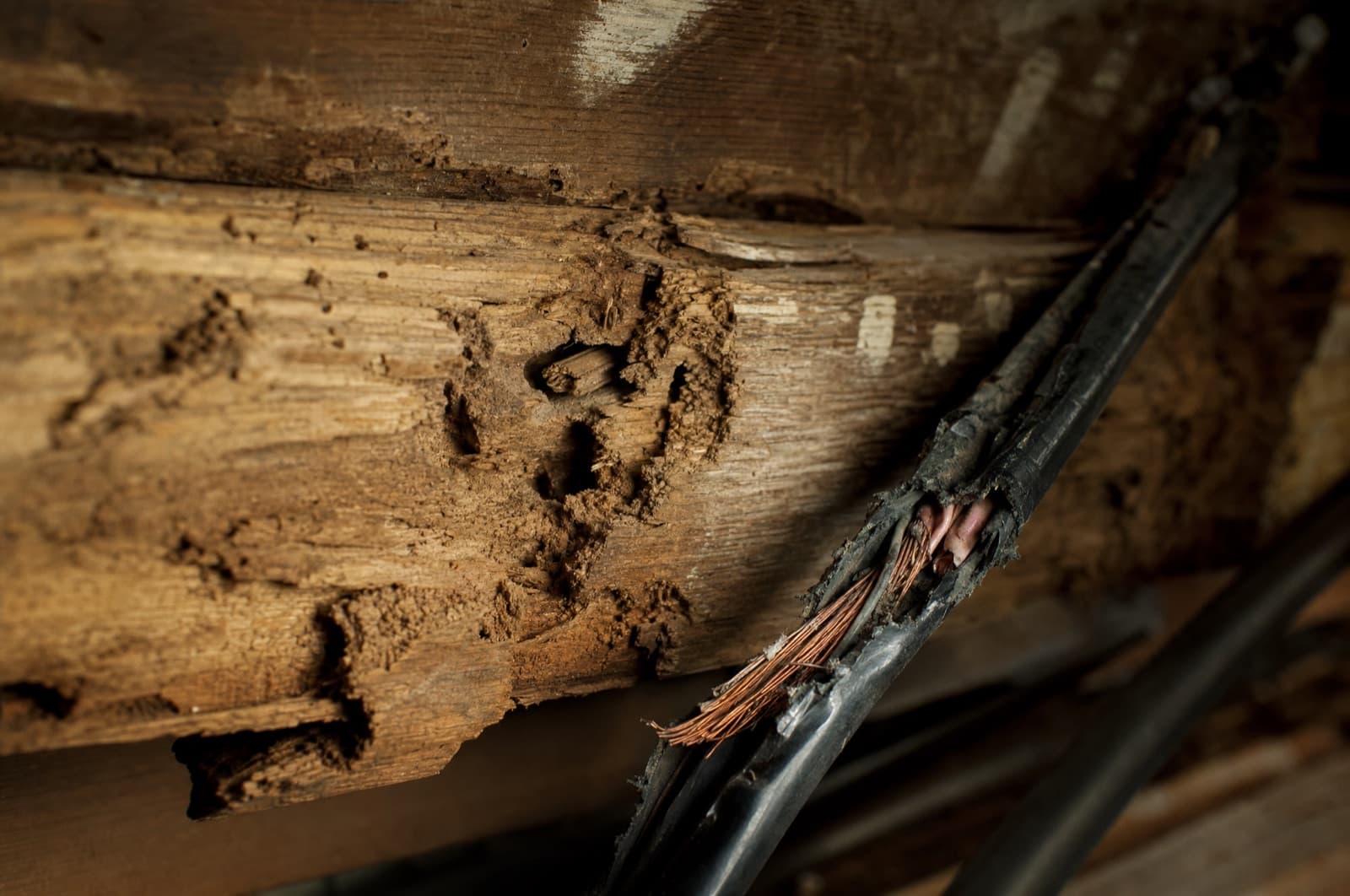
Pest damage evidence — a gnawed structural beam and a chewed electrical wire
Daniel Brady · NH-Licensed Pesticide Applicator · License #782664
Reviewed by Daniel Brady

Can beetles damage wood, grain, or stored goods?

Functional — two separate beetle problems, neither a fast structural threat
Yes, but these are two genuinely different beetle problems that pest-marketing copy tends to blend into one scary sentence. Wood-boring beetles — powderpost beetles and old-house borers — tunnel hardwood or softwood slowly, over months to years, and are bounded by wood moisture and age. Stored-product beetles, including flour beetles, sawtoothed grain beetles, and rice or granary weevils, infest dry pantry goods on a much faster cycle and can chew through cardboard or thin plastic packaging to reach food. Neither problem is a fast, whole-house threat: the wood side compounds slowly across years, and the pantry side ends the moment infested food is discarded and the rest is stored in sealed glass or metal.

At a glance

  • Can it?: Yes
  • How common: Routine
  • Hype: Overstated
  • Evidence: Well documented
The honest answer

The short of it

The verdict
Functional — two separate beetle problems, neither a fast structural threat

Yes, but it's two different beetle problems: wood-boring beetles slowly tunnel structural and furniture-grade wood, while separate pantry beetles contaminate stored food — neither works anything like the speed or scale of a termite colony.

The correction

What they claim vs. what the evidence supports

One shared severity track, two markers. The span between them is the hype delta — named out loud.

The claim — beetles damaging wood, grain, and stored household goods

That 'beetles' are a single, fast-moving threat to both your house and your pantry — often folded into the same alarming 'beetles destroying your home and food' framing used for termites.

Where the claim comes from: General pest-scare blog content that lumps wood-boring beetles and stored-product beetles together as one undifferentiated threat.

Severity, 0–100
Hype says60
35Evidence says
Hype delta25point gapWell documented
The evidence

These are genuinely two separate, well-documented problems with different mechanisms. Wood-boring beetles tunnel hardwood or softwood slowly, over years, and are bounded by moisture and wood age. Stored-product beetles infest dry pantry goods on a much faster cycle — roughly seven weeks per flour-beetle generation — that ends the moment infested food is discarded and containers are sealed.

The gap

Both problems are real, but neither is the fast, whole-house threat the blended framing implies — the honest fix for one is thrown-out food and a sealed container, and for the other, a slow, moisture-gated wood problem a professional can treat.

Damage assessment

What is actually harmed

Damage verdict
Functional — two separate beetle problems, neither a fast structural threat
FunctionalCan it?Yes
The specimen
Pest
Wood-boring beetles (powderpost and old-house borer types) and stored-product beetles (flour beetles, sawtoothed grain beetle, rice and granary weevils)
What is in question
Hardwood and softwood framing, furniture, and cabinetry (wood borers); dry pantry goods and their cardboard or paper packaging (pantry beetles)
How common
Routine
Evidence
Well documented
Mechanism

Wood-boring beetle larvae tunnel inside wood, feeding on starch and cellulose over months to years before adults cut exit holes and leave fine, flour-like frass behind — a slow, generational process. Stored-product beetles work by an entirely different, much faster mechanism: adults lay eggs directly in dry food or its packaging, larvae feed on flour, grain, cereal, or dried goods, and a flour-beetle generation completes in roughly seven weeks — fast enough that a forgotten bag of pantry goods can become heavily infested within a single season. Some pantry beetles can also chew through cardboard and thin plastic packaging to reach food.

Actually at risk4
  • Hardwood floors, trim, cabinetry, and furniture (from powderpost-type beetles)
  • Softwood framing lumber (from old-house borer-type beetles)
  • Open or lightly packaged dry goods — flour, grain, cereal, pet food, dried fruit, spices
  • Cardboard and thin plastic packaging that pantry beetles can chew through to reach food
Not at risk — despite the myth4
  • The building's structure from pantry beetles — they are strictly a stored-food problem and never touch wood, wiring, or framing
  • Food stored in glass or metal containers — pantry beetles cannot chew through either
  • Sealed, finished, or painted wood, which wood-boring beetles generally cannot lay eggs in
  • Any fast, whole-house structural failure — even the wood-boring side of this compounds over years, not weeks
Worst realistic case
A widespread pantry infestation requiring multiple products to be discarded, or a multi-generation wood-boring beetle infestation in untreated hardwood or softwood that needs professional treatment. Neither reaches a termite-scale structural event.

Assessed from: University of Minnesota Extension pantry pests; NC State Extension common pantry pests; Purdue Extension powderpost beetles (E-73); Mississippi State Extension old-house borer

The compounding clock

Does it get worse if you ignore it?

Over time
Compounds slowly

Two different clocks: pantry beetles compound fast within a food source but stop the moment it's discarded; wood-boring beetles compound slowly across years.

The timeline
3 stages
  1. WeeksReversible

    A pantry beetle infestation can complete a full generation — roughly seven weeks for flour beetles — inside an open or lightly sealed food container, spreading to nearby packages.

  2. MonthsReversible

    Wood-boring beetle larvae are tunneling inside wood with no visible sign yet; a neglected pantry infestation may have spread across several stored products.

  3. YearsReversible

    Wood-boring beetle damage becomes visible as adults emerge and leave exit holes and frass, after multiple generations tunneling the same piece of wood.

What stops the clock
For pantry beetles: discard infested food and store the rest in sealed glass or metal containers — this stops the cycle immediately. For wood-boring beetles: dry the wood, seal or treat it, and address any moisture source keeping it vulnerable.
Repair scope

Who actually fixes this

Scope, not dollars — the honest answer to “how expensive is it,” routed to the right trade.

Who fixes it
You — wipe it up
Effort
Minutes

The routine version of this problem is a pantry infestation, and that's a homeowner-grade fix: discard the infested product and switch to sealed glass or metal storage. The wood-boring beetle side is less common day-to-day and needs a different, professional response.

Route by symptom
  • Pest pro firstAn active wood-boring beetle infestation is found in structural lumber, flooring, or furniture — this needs professional assessment and treatment, not a pantry-style fix
Do not
  • Don't keep 'just in case' opened dry goods near a confirmed pantry beetle find — check everything nearby before restocking
  • Don't ignore fine, flour-like frass and small exit holes in wood furniture or trim — that's the sign a wood-boring beetle infestation is actually active
Where we help — and where we don't

Anchor treats active wood-boring beetle infestations in structural wood. Pantry beetles are a sanitation and storage fix you can handle yourself — we'd rather tell you that than sell you a visit for a bag of flour.

In depth

The full picture

01

Two beetle problems people lump into one

'Beetles are damaging your home and your food' is a single sentence covering two entirely different insects with different biology, different targets, and different timescales. Wood-boring beetles — powderpost beetles in hardwood, old-house borers in softwood — tunnel inside structural or furniture-grade wood. Stored-product beetles have nothing to do with wood at all; they infest dry pantry goods like flour, grain, cereal, and pet food. Treating them as one problem obscures the fact that each has its own, specific, and much less dramatic honest answer.

02

The wood-boring side: slow, moisture-gated, real

Powderpost beetles attack the starch-rich sapwood of large-pored hardwoods like oak, ash, and hickory, while old-house borers attack seasoned softwood framing. Both feed as larvae inside the wood for months to years, leaving fine, flour-like frass behind and only becoming visible when adults emerge through small exit holes. This is a genuine, well-documented concern — but it's slow, generational, and strongly tied to wood moisture and age, which is why a professional assessment focuses on moisture control and treatment rather than urgent, dramatic intervention.

03

The pantry side: fast, common, and entirely fixable without a pro

Stored-product beetles operate on a completely different clock. A flour beetle generation completes in roughly seven weeks, and because these beetles can chew through cardboard and thin plastic packaging, an infestation in one forgotten bag of flour or pet food can spread to nearby pantry items within a season. The honest, complete fix is homeowner-level: identify and discard every infested product, vacuum and wipe down shelves, and store remaining dry goods in sealed glass or metal containers that pantry beetles cannot penetrate. There is no structural or professional-treatment step required.

04

Why neither is a termite-scale threat

It's worth being direct about the ceiling on both problems. Wood-boring beetles work far more slowly than subterranean termites, which forage continuously from an underground colony rather than depending on a single piece of already-vulnerable wood — the honest comparison places wood-boring beetles as a real but bounded concern, not the hub's top structural threat. Pantry beetles never touch the building at all; their entire consequence is discarded food and a bit of cleaning. Neither beetle problem produces the fast, whole-house catastrophe that blended pest-marketing copy implies.

Key takeaways
5 points
  • 'Beetle damage' is really two separate problems: wood-boring beetles in structural or furniture wood, and stored-product beetles in pantry food.
  • Wood-boring beetle damage compounds slowly, over months to years, and is bounded by wood moisture and age.
  • Pantry beetles move fast within a food source — about seven weeks per flour-beetle generation — but stop entirely once infested food is discarded.
  • Food in sealed glass or metal containers is safe from pantry beetles; painted or sealed wood is largely safe from wood-boring beetles.
  • Neither problem approaches the speed or scale of a subterranean termite infestation.
New Hampshire context

What this looks like in New Hampshire homes

Anchor's pantry-beetle calls in southern and central New Hampshire almost always trace to a single forgotten bag of flour, birdseed, or pet food in a cupboard or garage, discovered once beetles start turning up on counters nearby. Wood-boring beetle activity is more often found in older homes with original hardwood flooring or in log and softwood-framed structures with a history of moisture — both genuine, professionally treatable concerns, but neither an emergency.

  • NH-licensed #782664

    Southern New Hampshire

  • Family-owned

    Since 2017

  • Honest routing

    Even when it isn’t us

We serve these communities

ManchesterNashuaConcordDerryBedfordSalemHudsonAmherstAuburnGoffstownHooksettLitchfieldLoudonMilfordBristol

Service Area Map

Southern New Hampshire

BristolPop. 3,200LoudonPop. 5,500ConcordPop. 43,900HooksettPop. 14,800GoffstownPop. 18,000AuburnPop. 5,700ManchesterPop. 115,600BedfordPop. 23,300LitchfieldPop. 8,500AmherstPop. 11,300DerryPop. 34,500MilfordPop. 15,700HudsonPop. 25,600NashuaPop. 91,100SalemPop. 30,000HQCityHover for info

Wood-boring beetle in furniture or framing? That's the half of this that needs a pro.

Anchor assesses and treats active wood-boring beetle infestations — pantry beetles, you can handle yourself with a sealed container and a trash bag.

Follow-up questions

Frequently asked

Sources & citations(4)
  1. University of Minnesota Extension — Pantry Pests

    Stored-product beetle biology, life cycle, and packaging vulnerability

    extensionverified 2026-07-16
  2. NC State Extension — Common Pantry Pests and Their Management

    Pantry beetle identification and sanitation-based management

    extensionverified 2026-07-16
  3. Purdue Extension — Powderpost Beetles (E-73)

    Powderpost beetle biology, hardwood host range, and structural significance

    extensionverified 2026-07-16
  4. Mississippi State Extension — Old House Borer (Bugs Eye View, Vol. 6 No. 30)

    Old-house borer softwood host range and moisture-dependent development

    extensionverified 2026-07-16

Written & reviewed by

Verified

Daniel Brady

NH-Licensed Pesticide Applicator · License #782664 (NHDAMF, RSA 430)

Daniel Brady is the New Hampshire–licensed applicator behind Anchor Pest Services, a family-owned pest control company serving the Manchester area since 2017.

Verify license

Last updated Jul 2026

Honest pest help for New Hampshire homes

Two Beetle Problems. One Needs Us. One Doesn't.

A pantry beetle find is a sanitation fix you can handle today — discard the infested food, seal the rest in glass or metal. A wood-boring beetle infestation in flooring, furniture, or framing is a different, genuinely professional job, and that's where Anchor Pest Services helps. Family-owned since 2017, NH license #782664, serving Manchester, Nashua, Concord and nearby towns.

  • Honest advice — we'll tell you when a pantry problem doesn't need a pro
  • NH-licensed applicators (#782664) — free inspection, same-day service
  • Wood-boring beetle assessment and treatment across southern and central New Hampshire

NH License #782664 · No obligation · We answer in person