
Skip to content
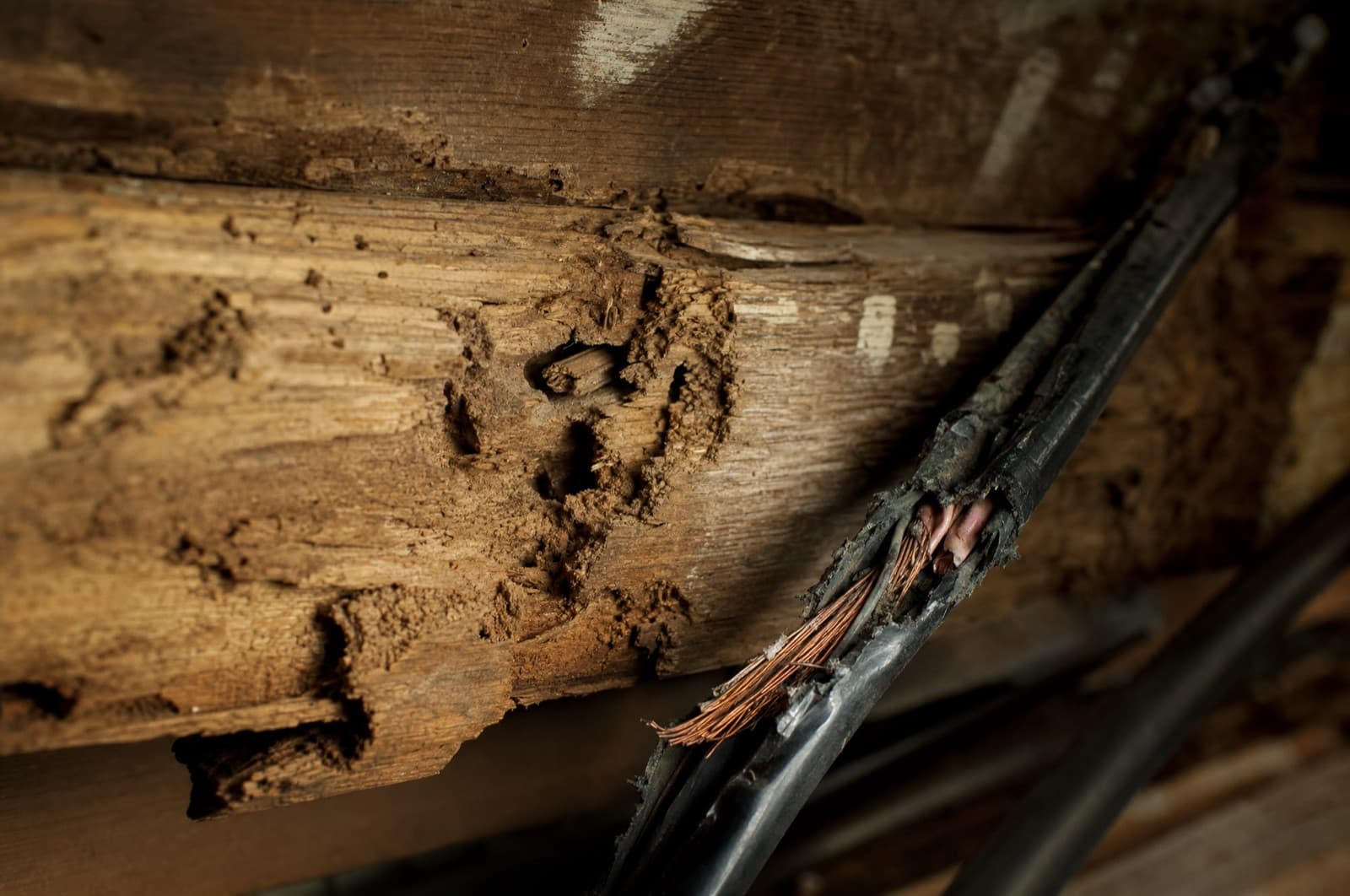
Pest damage evidence — a gnawed structural beam and a chewed electrical wire
Daniel Brady · NH-Licensed Pesticide Applicator · License #782664
Reviewed by Daniel Brady

Can carpenter ants hollow out wood beams?

Structural damage — real, but moisture-gated and slow
Yes. Carpenter ants can excavate extensive, smooth galleries inside a wood beam, and in a key structural timber that's a genuine problem worth taking seriously. But carpenter ants don't eat wood — they carve it out to build nest chambers — and they almost always start in wood that's already softened by a leak or chronic moisture, not sound dry lumber. University of Maryland Extension notes that nest sites rarely exceed a few square feet, and the process unfolds over years. The real defect to fix first is the water source, not just the ants.

At a glance

  • Can it?: Yes, but
  • How common: Occasional
  • Hype: Overstated
  • Evidence: Well documented
The honest answer

The short of it

The verdict
Structural damage — real, but moisture-gated and slow

Yes, carpenter ants can hollow out a beam — but almost always one that a leak already softened first, and the excavation is measured in years, not the fast 'eating' people picture.

The correction

What they claim vs. what the evidence supports

One shared severity track, two markers. The span between them is the hype delta — named out loud.

The claim — carpenter ants excavating and hollowing out structural wood beams

That carpenter ants 'eat' beams the way termites do and can hollow out a structural beam to the point of failure in a single season if left untreated.

Where the claim comes from: Pest-control marketing copy and DIY home-inspection blogs that use 'carpenter ants eating your house' interchangeably with termite damage.

Severity, 0–100
Hype says80
46Evidence says
Hype delta34point gapWell documented
The evidence

Carpenter ants excavate galleries with their mandibles to build a nest — they cannot digest cellulose and gain no nutrition from wood at all, unlike termites. University of Maryland Extension is explicit that while tunneling 'may cause serious structural damage if it occurs in key timbers,' nest sites 'rarely exceed a few square feet,' and colonies overwhelmingly establish in wood already decayed or water-damaged rather than sound dry lumber. The hollowing is real, but it's slow, moisture-dependent, and far more contained than continuous termite feeding.

The gap

They genuinely do hollow out wood — that part is true. What's invented is the termite-speed comparison: carpenter ants are secondary to a moisture problem, the excavated volume in any one nest is typically small, and the process takes years, not weeks.

Damage assessment

What is actually harmed

Damage verdict
Structural damage — real, but moisture-gated and slow
StructuralCan it?Yes, but
The specimen
Pest
Carpenter ants (Camponotus species)
What is in question
Wood beams, sills, and joists — specifically ones already softened by moisture
How common
Occasional
Evidence
Well documented
Mechanism

Worker ants use their mandibles to chew and eject clean, smooth-walled galleries through wood, leaving frass that resembles fine pencil shavings — no mud, unlike termite tunnels. Carpenter ants gain no food value from the wood whatsoever; the galleries exist purely as nest chambers and travel routes between them. Because sound, dry wood is dense and unrewarding to excavate, colonies overwhelmingly select timber that a chronic leak, condensation, or decay fungus has already softened — the ants are a signal of a water problem, not its cause.

Actually at risk4
  • Beams, sills, and joists with a history of moisture exposure — around roof leaks, plumbing leaks, or poor grading
  • Porch columns, deck ledgers, and window or door frames where water intrusion is common
  • A key structural timber, if a colony is allowed to expand in it undisturbed for years
  • Wood in direct or near-constant contact with damp soil
Not at risk — despite the myth4
  • Sound, dry structural lumber — carpenter ants rarely establish a primary nest in it
  • Concrete, steel connectors, and masonry foundations
  • The wood's caloric or nutritional value — nothing is being consumed, only removed and discarded
  • A beam's overall integrity from a single season of activity — nest sites 'rarely exceed a few square feet' per University of Maryland Extension
Worst realistic case
A key beam or sill significantly weakened after years of undetected activity at a chronic, unaddressed leak — a real repair, and one that matters structurally. It is not a beam failing in a season, and it doesn't happen in wood that has stayed dry.

Assessed from: University of Maryland Extension — Carpenter Ants; UNH Cooperative Extension — Carpenter Ants fact sheet; Ohioline HYG-2063 (gallery morphology)

The compounding clock

Does it get worse if you ignore it?

Over time
Compounds slowly

Compounds slowly, and only where moisture persists — the driver is the leak, not the ants' appetite.

The timeline
3 stages
  1. MonthsReversible

    Ants establish a satellite or parent colony in wood already softened by moisture; galleries are confined and usually invisible without opening the wood.

  2. YearsReversible

    The colony expands its galleries within the same wet timber, and pencil-shaving-like frass begins appearing at kickout holes. Still reversible if the colony is removed and the wood is dried or replaced.

  3. DecadesReversible

    The rare untreated endpoint: a key beam or sill develops serious internal hollowing after many years of a chronic, unaddressed leak. Still repairable, but by then it's a structural rebuild rather than a patch.

What stops the clock
Fix the moisture source — the leak or condensation problem — and eliminate the colony. Carpenter ants confined to wood that stays dry have nothing to gain, and the excavation stops advancing.
Repair scope

Who actually fixes this

Scope, not dollars — the honest answer to “how expensive is it,” routed to the right trade.

Who fixes it
Pest pro first
Effort
A project

The colony has to be eliminated before any wood repair is worth doing — a beam that's patched or replaced while ants remain active nearby is simply colonized again.

The right order
  1. 1
    Resolve the carpenter-ant colony (Anchor's lane)
  2. 2
    Identify and fix the moisture source — a roof leak, plumbing leak, poor grading, or condensation problem (a roofer, plumber, or general moisture correction)
  3. 3
    Have a licensed contractor assess and repair or replace the compromised beam
Route by symptom
  • Licensed contractorThe beam shows visible sagging, spongy wood, or you're unsure how much material has been removed — get a structural assessment before patching anything
Do not
  • Don't patch or refinish a beam while the colony is still active — you're sealing ants inside a timber that's still being excavated
  • Don't assume dry wood is at meaningful risk — if a beam has stayed dry, carpenter ants are very unlikely to have started there in the first place
Where we help — and where we don't

Anchor resolves the carpenter-ant colony — that's genuinely our work. We do not fix the leak and we do not repair or replace a structural beam; those are a roofer or plumber's job and a licensed contractor's job respectively, and we'll say so plainly rather than quote you for them.

In depth

The full picture

01

Excavation, not a meal

The fact that reframes this whole question is that carpenter ants do not eat wood. Termites digest cellulose with the help of gut protozoa; carpenter ants have no such digestive capability at all. What they do instead is chew wood into small pieces with their mandibles and carry it out of the nest, piece by piece, to hollow out chambers for the colony to live in. The material removed isn't food — it's debris, and it piles up outside the nest as frass that looks like coarse pencil shavings, sometimes with bits of insect parts mixed in.

That distinction matters because it changes what kind of threat this is. A pest that eats wood for nutrition keeps consuming as long as it's present and as long as wood remains. A carpenter ant colony excavates only as much space as it needs to house its workers and brood — which is exactly why University of Maryland Extension can say plainly that nest sites 'rarely exceed a few square feet.'

02

Why the wood was vulnerable in the first place

Carpenter ants are highly selective about where they nest, and the selection criterion is almost always moisture. Sound, dry structural lumber is dense and difficult to excavate, and it offers the colony nothing that softened wood doesn't offer more easily. UNH Cooperative Extension notes that carpenter ants 'strongly prefer damp wood for excavating' — which is why a colony inside a beam is, more often than not, a colony that moved into wood a roof leak, a plumbing leak, or years of condensation had already begun to rot.

This is the correction that matters most on this page: treating the ants without finding and fixing the moisture source solves half the problem. The wood stays hospitable, and either the same colony's satellite nests or a fresh colony finds it again.

03

How much a colony can actually hollow out

Within a single softened beam, a mature colony can produce a genuinely extensive network of clean, smooth-walled galleries — University of Maryland Extension is direct that 'tunneling may cause serious structural damage if it occurs in key timbers.' That's the honest, earned part of the fear, and it shouldn't be softened.

What should be corrected is the timeline and the scale people imagine. This isn't a beam eaten through in a season; it's a slow, cumulative process that plays out over years as successive generations expand the same or adjacent galleries in wood that has stayed wet. A single nest site rarely exceeds a few square feet at any given time — the damage that eventually matters comes from a colony (or successive colonies) working the same chronically wet timber for years, not from unusual speed or an unusually large single nest.

04

Structural — but the ants are the symptom

A carpenter-ant-hollowed beam belongs in the structural damage class alongside termites and powderpost beetles, and it deserves to be treated with the same seriousness once it's found in a key timber. But it is a slower, more localized, and more preventable version of that threat. Fix the leak, dry the wood, and remove the colony, and the process that got the wood to that point simply stops — there's no ongoing appetite driving it forward the way there is with a termite colony continuously feeding on cellulose.

That's also why the honest repair order matters: treating the ants without fixing the moisture just delays the same outcome, and replacing a beam without treating the ants risks handing the colony fresh wood to move into next door.

Key takeaways
5 points
  • Yes, carpenter ants can hollow out a beam — but they excavate it for a nest, they don't eat it, and they get zero nutrition from wood.
  • Almost every case starts in wood a leak, condensation, or decay fungus has already softened — sound dry lumber is rarely a primary target.
  • University of Maryland Extension: nest sites 'rarely exceed a few square feet' — the damage is real but contained, not sweeping.
  • The process takes years, not weeks, and it stops advancing once the wood dries out and the colony is removed.
  • Fix the moisture source first — treating the ants alone leaves the wood just as hospitable to the next colony.
New Hampshire context

What this looks like in New Hampshire homes

Southern and central New Hampshire's older housing stock — with porch columns, sill plates, and eave overhangs exposed to a long, wet spring and a snow-load winter — gives carpenter ants plenty of chances to find chronically damp wood. The classic local pattern is a porch column base or a sill plate near a downspout that's been discharging against the foundation for years, quietly staying wet long after the surrounding wood has dried out. Frass piles at a beam's kickout hole, especially after a New Hampshire winter has driven ants to shelter indoors, are usually the first visible sign a homeowner notices.

  • NH-licensed #782664

    Southern New Hampshire

  • Family-owned

    Since 2017

  • Honest routing

    Even when it isn’t us

We serve these communities

ManchesterNashuaConcordDerryBedfordSalemHudsonAmherstAuburnGoffstownHooksettLitchfieldLoudonMilfordBristol

Service Area Map

Southern New Hampshire

BristolPop. 3,200LoudonPop. 5,500ConcordPop. 43,900HooksettPop. 14,800GoffstownPop. 18,000AuburnPop. 5,700ManchesterPop. 115,600BedfordPop. 23,300LitchfieldPop. 8,500AmherstPop. 11,300DerryPop. 34,500MilfordPop. 15,700HudsonPop. 25,600NashuaPop. 91,100SalemPop. 30,000HQCityHover for info

Carpenter ants in a beam? Find the leak, then stop the colony.

Anchor resolves the ants — and we'll tell you plainly if what you're looking at is a moisture problem first.

Follow-up questions

Frequently asked

Sources & citations(3)
  1. University of Maryland Extension — Carpenter Ants

    Nest sites 'rarely exceed a few square feet'; tunneling may cause serious structural damage in key timbers; moisture preference

    extensionverified 2026-07-16
  2. UNH Cooperative Extension — Carpenter Ants fact sheet

    Carpenter ants 'strongly prefer damp wood for excavating'; do not eat wood as termites do; NH structural-pest status

    extensionverified 2026-07-16
  3. Ohio State Ohioline — Carpenter Ants (HYG-2063)

    Gallery morphology; clean, smooth-walled galleries with no mud; frass composition

    extensionverified 2026-07-16

Written & reviewed by

Verified

Daniel Brady

NH-Licensed Pesticide Applicator · License #782664 (NHDAMF, RSA 430)

Daniel Brady is the New Hampshire–licensed applicator behind Anchor Pest Services, a family-owned pest control company serving the Manchester area since 2017.

Verify license

Last updated Jul 2026

Honest pest help for New Hampshire homes

We Stop the Ants. We'll Tell You If It's Really a Leak.

Carpenter ants almost always move into wood that's already wet. Anchor Pest Services resolves the colony — and we'll say plainly when the real fix is a roofer, a plumber, or a contractor rather than another pest visit. Family-owned since 2017, NH license #782664, serving Manchester, Nashua, Concord and nearby towns.

  • Honest advice — we name the moisture problem instead of just treating the symptom
  • NH-licensed applicators (#782664) — free inspection, same-day service
  • Carpenter ant and structural pest control across southern and central New Hampshire

NH License #782664 · No obligation · We answer in person