
Skip to content
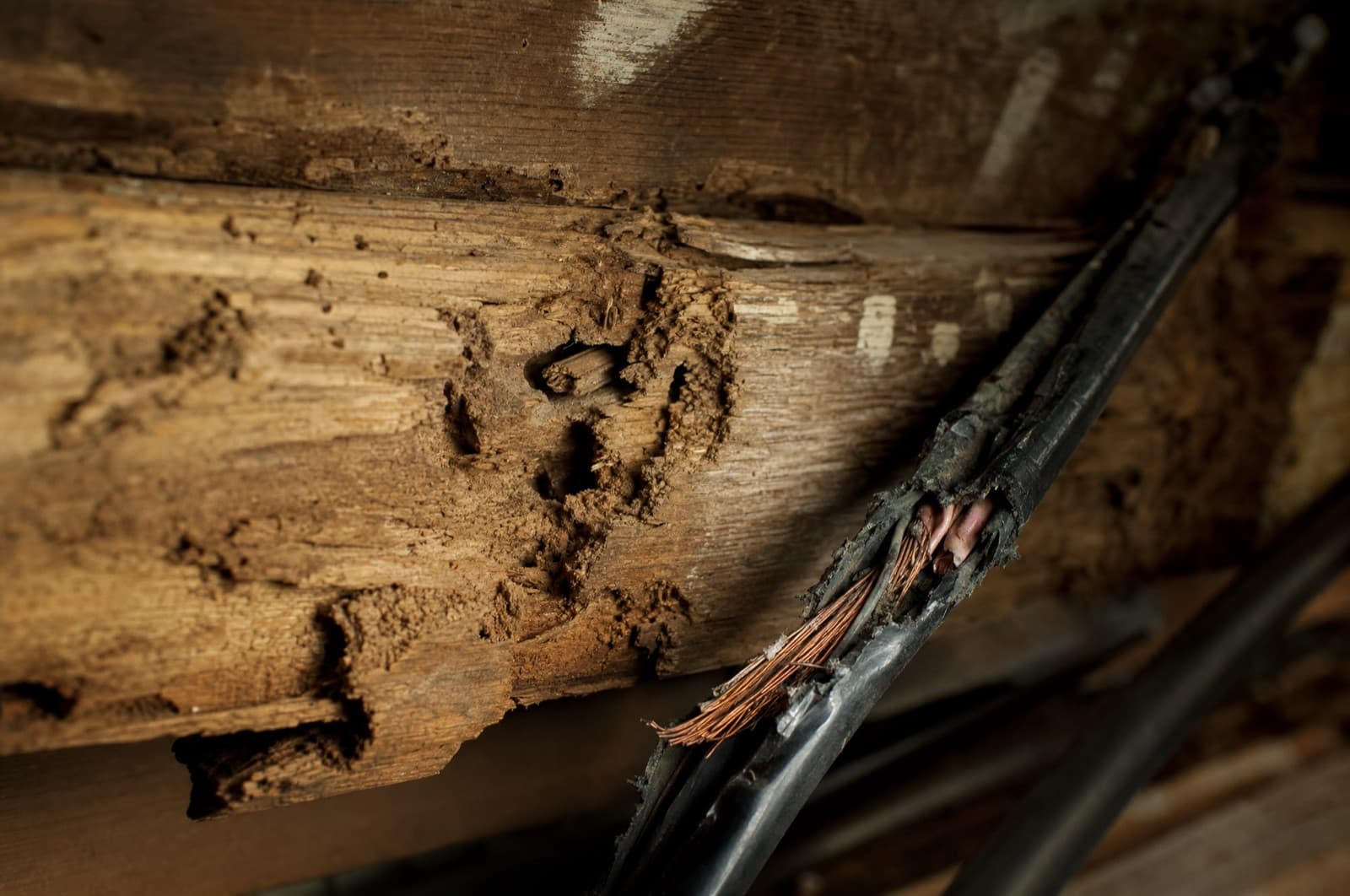
Pest damage evidence — a gnawed structural beam and a chewed electrical wire
Daniel Brady · NH-Licensed Pesticide Applicator · License #782664
Reviewed by Daniel Brady

Can mud dauber nests stain walls or eaves?

Cosmetic — and static
Rarely, and only barely. Mud daubers are solitary, non-aggressive wasps that mold wet mud into small pipe-organ-shaped tubes on siding, eaves, soffits, and porch ceilings, provisioning each cell with a paralyzed spider before sealing it shut and moving on. By the time you notice the nest, the wasp that built it is almost always gone. The tube itself is a dried mineral shell — it does not eat, dissolve, or degrade any siding material, and the only real property effect is a faint discoloration where it has sat for a season. Scrape it off and wash the mark; there is nothing to treat, nothing that escalates, and no reason to call a professional.

At a glance

  • Can it?: Rarely
  • How common: Routine
  • Hype: Overstated
  • Evidence: Well documented
The honest answer

The short of it

The verdict
Cosmetic — and static

A mud dauber tube is a dried mud shell built by a solitary wasp that has already left — it can leave a faint mark, but it will never spread, worsen, or need anything more than a scrape and a wipe.

The correction

What they claim vs. what the evidence supports

One shared severity track, two markers. The span between them is the hype delta — named out loud.

The claim — mud dauber nests attached to siding, eaves, and soffits

That a wasp nest stuck to your house — mud dauber included — is a property hazard requiring prompt professional removal, implicitly lumping a solitary mud nest in with an aggressive social-wasp colony.

Where the claim comes from: Pest-control blog posts and 'wasp nest removal' marketing that treat every nest sighting, regardless of species, as an equally urgent call-now situation.

Severity, 0–100
Hype says40
8Evidence says
Hype delta32point gapWell documented
The evidence

Mud daubers are solitary — no colony, no group defense — and Purdue Extension notes they 'very rarely sting, and then only if mishandled.' The nest is dried mud glued to a surface; it does not degrade siding of any kind, and once a cell is provisioned and sealed the female generally moves on for good, which is why most nests homeowners find are already vacated.

The gap

This is one of the most over-dramatized nest sightings in pest marketing: it's a dried mud shell from a wasp that rarely stings and has usually already left. There is no damage story here worth an urgent call.

Damage assessment

What is actually harmed

Damage verdict
Cosmetic — and static
CosmeticCan it?Rarely
The specimen
Pest
Mud daubers (organ-pipe, black-and-yellow, and blue mud daubers)
What is in question
Vinyl, wood, fiber-cement, brick, and aluminum siding, eaves, soffits, and porch ceilings
How common
Routine
Evidence
Well documented
Mechanism

The female mud dauber collects wet mud in her mandibles and molds it into tube-shaped cells, provisioning each with paralyzed spiders as food for her larva before sealing it and starting the next cell. The finished nest is glued to the surface by that same dried mud — it is not grown into the surface, and there is no digestive or chemical mechanism by which the nest degrades siding, wood, or masonry underneath it.

Actually at risk2
  • A faint surface discoloration or mud smear where a nest has sat, unwashed, for a season or more
  • Rare cosmetic blockage of a vent louver, gutter corner, or an unused motor housing if a dauber builds inside one
Not at risk — despite the myth4
  • Vinyl, wood, fiber-cement, brick, or aluminum siding material itself — no source documents mud daubers degrading any siding type
  • Structural framing or sheathing behind the siding
  • Paint or finish integrity beneath a removed nest
  • Occupants — Purdue Extension describes mud daubers as very rarely stinging, and only if directly mishandled
Worst realistic case
A cluster of several tubes left in place for years, producing a slightly more visible dried-mud stain that a putty knife and a garden hose still remove in minutes. Occasionally a nest blocks a small vent or motor housing. That's the ceiling — no rot, no structural concern, nothing beyond appearance.

Assessed from: Purdue Extension E-253 (mud daubers, solitary, rarely sting); University of Maryland Extension (mud dauber biology); UNH Cooperative Extension wasp/hornet guidance

The compounding clock

Does it get worse if you ignore it?

Over time
Static — never worsens

Static — a finished mud dauber tube is a dried mineral shell that will look the same in ten years as it does today.

Now
Ever

The nest is inert dried mud once the female seals the last cell and leaves; there is no living colony maintaining or expanding it, no organic decay process acting on cured mud, and no mechanism by which a vacated tube spreads, softens, or grows. A different mud dauber may build an adjacent tube the following season, but each nest is an independent, self-contained structure — one old tube does not turn into more damage on its own.

What stops the clock
Nothing needs to stop it — it already has. If you want it gone for appearance, scrape it off and wash the mark; there is no urgency and no pest to resolve first.
Repair scope

Who actually fixes this

Scope, not dollars — the honest answer to “how expensive is it,” routed to the right trade.

Who fixes it
You — wipe it up
Effort
Minutes

There is nothing to repair. A mud dauber nest is a homeowner-grade cosmetic removal — a putty knife or scraper to pop the dried mud loose, then mild detergent and water on any residual stain.

Route by symptom
  • Nobody — nothing to repairThe nest is out of the way and you're fine leaving it — mud daubers rarely sting and there is no damage clock running either way
Do not
  • Don't spray insecticide at a nest you can simply scrape off — mud daubers are beneficial (they prey on spiders, including black widows) and very rarely sting
Where we help — and where we don't

This is one of the few pages on this hub where the honest answer is that you don't need us. Mud daubers are solitary, essentially harmless, and cause no damage worth treating — we'd rather tell you to grab a scraper than sell you a visit you don't need.

In depth

The full picture

01

What a mud dauber nest actually is

Mud daubers are solitary wasps — no colony, no workers, no group defense. A female collects wet mud, usually from a puddle edge or damp soil, and molds it into a cluster of narrow tubes, often described as looking like small pipe organ pipes. She stocks each cell with paralyzed spiders as food for a single larva, seals it, and typically starts the process again nearby or moves on entirely. Purdue Extension (E-253) describes them as building alone and noted for being 'very rarely' a sting risk.

By the time a homeowner notices the finished nest — a gray or brown clump of dried mud on siding, an eave, a soffit, or a porch ceiling — the wasp that built it has usually already completed her work and left. What's left behind is not an active hazard; it's a finished structure with nothing living in it most of the time.

02

Why it doesn't damage the wall it's glued to

The mechanism matters here. A mud dauber nest is attached to a surface with dried mud, the same way a swallow's mud nest sticks to a barn beam — it's glued on, not grown into the material or chemically bonded to it. There is no acid, no enzyme, and no excavating mouthpart at work the way there is with a wood-boring beetle or a termite. The nest simply sits on top of whatever it's stuck to.

That means there's no mechanism by which the nest itself degrades vinyl, wood, fiber-cement, or aluminum siding underneath it. The worst realistic outcome is a faint discoloration where the mud has sat, unwashed, for a season or longer — and that washes or scrapes off along with the nest, not after some separate remediation step.

03

The rare exception: a blocked vent or motor housing

The one place a mud dauber nest occasionally becomes more than cosmetic is when a dauber builds inside something functional rather than on an open wall — a dryer vent louver, a gutter downspout, or an unused motor housing in a stored vehicle or piece of equipment. In those cases the nest can partially block airflow or movement, which is a nuisance worth clearing, but it's still the same inert dried mud, just in an inconvenient spot rather than a damaging one.

04

Why 'wasp nest on my house' isn't one problem

Pest-marketing copy tends to treat any nest sighting as equally urgent, but a mud dauber, a paper wasp, a bald-faced hornet, and a yellowjacket colony are different animals with very different honest answers. Mud daubers are solitary and essentially harmless. Social wasps and yellowjackets are a genuine sting concern in high-traffic spots, and a yellowjacket colony that establishes inside a wall void is the one nest scenario in this cluster with a real, if uncommon, structural angle. If what you're looking at is a papery globe or open comb rather than a cluster of mud tubes, that's a different question — see the wasp and hornet pages for that answer.

Key takeaways
5 points
  • A mud dauber nest is a dried mud shell built by a solitary wasp — no colony, no group defense.
  • The wasp that built it is almost always gone by the time you notice the finished nest.
  • It never damages the siding, wood, or masonry it's attached to — the worst case is a faint stain.
  • It's static: an old tube looks the same in ten years as it does today.
  • The fix is a scraper and mild detergent, in minutes — this genuinely doesn't need a pest professional.
New Hampshire context

What this looks like in New Hampshire homes

Mud daubers are active across southern and central New Hampshire from late spring through early fall, building new tubes on sun-exposed siding, eaves, and porch ceilings near a mud or water source. Activity ends with the first hard frost — historically mid-to-late October around Manchester (NOAA) — and old nests from prior seasons are simply dried leftovers, not evidence of an ongoing problem. Anchor gets very few genuine service calls for mud daubers specifically, and that's the honest, correct outcome for this pest.

  • NH-licensed #782664

    Southern New Hampshire

  • Family-owned

    Since 2017

  • Honest routing

    Even when it isn’t us

We serve these communities

ManchesterNashuaConcordDerryBedfordSalemHudsonAmherstAuburnGoffstownHooksettLitchfieldLoudonMilfordBristol

Service Area Map

Southern New Hampshire

BristolPop. 3,200LoudonPop. 5,500ConcordPop. 43,900HooksettPop. 14,800GoffstownPop. 18,000AuburnPop. 5,700ManchesterPop. 115,600BedfordPop. 23,300LitchfieldPop. 8,500AmherstPop. 11,300DerryPop. 34,500MilfordPop. 15,700HudsonPop. 25,600NashuaPop. 91,100SalemPop. 30,000HQCityHover for info

Not every nest sighting needs a service call.

If it's mud, not paper, you likely just need a scraper — but Anchor is here for the nests that genuinely are a concern.

Follow-up questions

Frequently asked

Sources & citations(3)
  1. Purdue Extension — Mud Daubers (E-253)

    Mud daubers are solitary, very rarely sting, and are controlled by scraping the nest off

    extensionverified 2026-07-16
  2. University of Maryland Extension — Mud Dauber Wasp

    Mud dauber nest biology, mud-cell provisioning with paralyzed spiders, inert once vacated

    extensionverified 2026-07-16
  3. UNH Cooperative Extension — Controlling Wasps, Bees and Hornets

    New Hampshire wasp/dauber seasonal biology; solitary nesting behavior

    extensionverified 2026-07-16

Written & reviewed by

Verified

Daniel Brady

NH-Licensed Pesticide Applicator · License #782664 (NHDAMF, RSA 430)

Daniel Brady is the New Hampshire–licensed applicator behind Anchor Pest Services, a family-owned pest control company serving the Manchester area since 2017.

Verify license

Last updated Jul 2026

Honest pest help for New Hampshire homes

We'll Tell You When You Don't Need Us.

A mud dauber nest is dried mud from a solitary wasp that's usually already gone — there's genuinely nothing here for a pest company to treat. If what you're seeing is a papery nest instead, or an active colony near a doorway, Anchor Pest Services handles that safely. Family-owned since 2017, NH license #782664, serving Manchester, Nashua, Concord and nearby towns.

  • Honest advice — we tell you when a scraper is all you need
  • NH-licensed applicators (#782664) — free inspection, same-day service
  • Wasp, hornet, and yellowjacket nest removal across southern and central New Hampshire

NH License #782664 · No obligation · We answer in person