
Skip to content
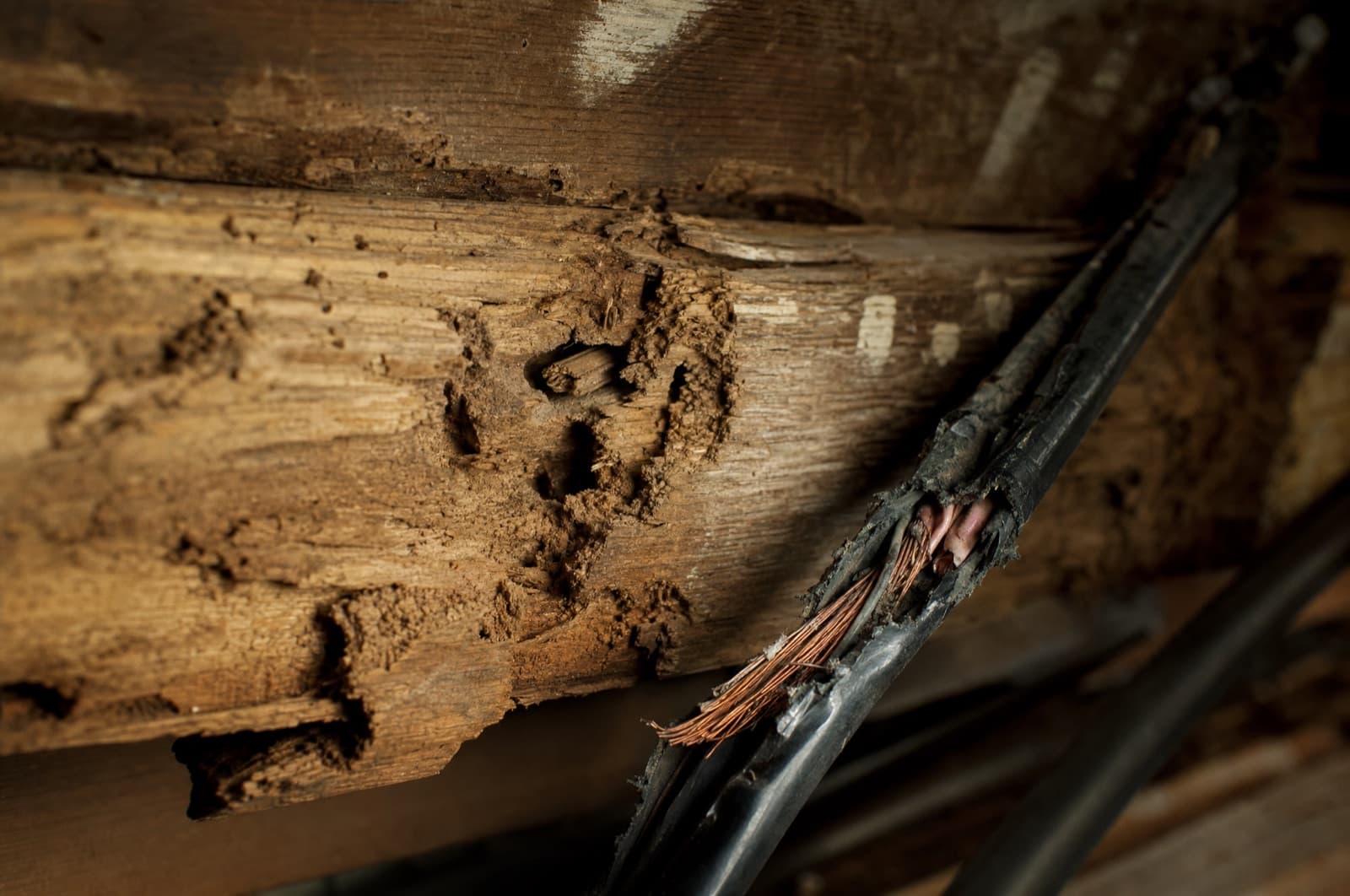
Pest damage evidence — a gnawed structural beam and a chewed electrical wire
Daniel Brady · NH-Licensed Pesticide Applicator · License #782664
Reviewed by Daniel Brady

Do pests increase insurance claims or repair costs?

Not covered — the mechanism runs the opposite way
Almost the opposite of what people assume: standard homeowners policies exclude damage from birds, vermin, rodents, or insects, treating it as preventable maintenance rather than a sudden, accidental peril — so pest damage rarely 'increases insurance claims' because most such claims are simply denied. The one real exception is a secondary covered peril: if rodent-gnawed wiring starts a fire, the resulting fire damage may be covered, even though the gnawed wiring and the rodent problem itself are not. Repair cost, in almost every case, falls on the homeowner and is answered by repair scope, not a claim.

At a glance

  • Hype: Wildly overstated
  • Evidence: Well documented
  • Who fixes it: Pest pro first
The honest answer

The short of it

The verdict
Not covered — the mechanism runs the opposite way

No — pests don't drive up insurance claims, because standard policies generally exclude pest and vermin damage entirely, treating it as preventable maintenance rather than an insurable loss.

The correction

What they claim vs. what the evidence supports

One shared severity track, two markers. The span between them is the hype delta — named out loud.

The claim — the assumption that homeowners insurance covers pest and vermin damage

That pest damage is the kind of thing homeowners insurance exists for, and that a homeowner facing chewed wiring, a termite finding, or rodent damage can simply file a claim and have it handled.

Where the claim comes from: General assumption reinforced by pest-marketing copy that implies coverage exists, plus confusion with genuinely covered perils like fire or storm damage.

Severity, 0–100
Hype says70
20Evidence says
Hype delta50point gapWell documented
The evidence

Standard policy language, including the widely used ISO HO-3 form, explicitly excludes damage caused by birds, vermin, rodents, or insects as preventable maintenance rather than a covered accidental loss. The Texas Department of Insurance states this plainly for consumers: if rodents and insects chew on a house, the policy won't pay for the repairs, because companies won't pay for damage that happens gradually over time.

The gap

The assumption runs backward. Insurance doesn't get triggered by pest damage — it's specifically written to exclude it, and that exclusion is one of the most consistent, well-documented facts in this entire hub.

Repair scope

Who actually fixes this

Scope, not dollars — the honest answer to “how expensive is it,” routed to the right trade.

Who fixes it
Pest pro first
Effort
A trade visit

Since the cost isn't going through an insurer, resolving the pest before any repair is what actually limits how much repair scope accumulates — the insurance conversation doesn't change that sequence at all.

The right order
  1. 1
    Resolve the pest first — nothing you repair stays repaired otherwise, insured or not
  2. 2
    Route the resulting repair to the trade that owns the damaged system: electrician for wiring, plumber for a chewed supply line, contractor for structural wood
  3. 3
    Keep documentation of pest resolution and repair regardless of whether a claim is ever filed — it matters for future disclosure even without an insurer involved
Route by symptom
  • Licensed electricianRodent-gnawed wiring is suspected — if it causes a fire, that fire damage (not the gnawing itself) is the one scenario where a standard policy's fire coverage may apply
Do not
  • Don't wait to resolve an active pest problem while hoping insurance will pay for the resulting damage — it almost never does
  • Don't file a claim expecting a chewed wire or a termite finding, on their own, to be covered — only a resulting fire or similar sudden loss might be
Where we help — and where we don't

Anchor resolves the pest side of the problem — exclusion, treatment, prevention. We don't handle insurance claims or represent homeowners to their carrier, and we'll tell a homeowner plainly, before they call their insurer, that a pest-damage claim is very unlikely to be paid.

Economics

What it does to value

Whether a pest problem will show up as an insurance claim, or drive up what a homeowner pays out of pocket.

Not covered
What is documented

The standard ISO HO-3 homeowners policy form excludes damage from 'birds, vermin, rodents, or insects.' State insurance regulators confirm this plainly for consumers — the Texas Department of Insurance states that if rodents or insects chew on a house, the policy will not pay for the repairs, because insurers do not cover damage that happens gradually over time rather than as a sudden accident. The one recognized exception is a secondary covered peril: if rodent-gnawed wiring causes an electrical fire, the fire damage itself may be a covered loss under the policy's fire coverage, even though the rodent activity and the chewed wiring that caused it are not covered.

Just a talking point

That having insurance means pest damage is 'handled' or that a homeowner facing an infestation has a financial backstop through a claim. This is the exact opposite of standard policy language, and repeating it sets homeowners up for a denied claim and an unpleasant surprise.

Disclosure

This matters for a home sale too: a buyer who discovers pre-existing pest damage after closing generally cannot expect an insurance claim to pay for it, which is one more reason a pre-purchase wood-destroying-insect inspection is the real protective step, not a policy.

Insurance

This is the cluster's single most important correction: standard homeowners insurance treats pest and vermin damage as preventable maintenance, not a covered accidental loss. The cost of pest damage is almost always the owner's, routed by repair scope — a trade visit or a project — not by a claim.

ISO HO-3 exclusion language (confirmed via Texas Department of Insurance consumer guidance); PestWorld/NFPA on the secondary fire-peril mechanism

In depth

The full picture

01

What a standard policy actually excludes

It's worth stating this without hedging, because it corrects a widespread and costly assumption: standard homeowners insurance, including the widely used ISO HO-3 policy form, excludes damage caused by birds, vermin, rodents, or insects. State insurance regulators are direct about this for consumers — the Texas Department of Insurance puts it plainly: if rodents and insects chew on your house, your policy won't pay for the repairs, because companies won't pay for damage that happens gradually, over time, rather than as a sudden accident. That's the entire mechanism in one sentence, and it applies regardless of which pest is involved or how the damage happened.

02

The one real exception: a secondary covered peril

There is a genuine carve-out worth understanding precisely, because it's the source of a lot of confusion. If a rodent gnaws through wire insulation and that exposed wiring causes an electrical fire, the fire damage itself can be a covered loss under a standard policy's fire coverage — fire is a classic sudden, accidental peril insurers do cover. But the rodent activity and the chewed wiring that caused the fire are not covered; only the resulting fire damage might be. That distinction matters: it means a homeowner should never assume rodent damage generally is covered just because one narrow downstream consequence sometimes is.

03

Why the assumption runs exactly backward

The claim this page corrects isn't that pests cause no cost — obviously they can. It's the specific belief that insurance is where that cost lands. In reality, the entire design of a standard homeowners policy treats ongoing, gradual damage — which is what pest damage almost always is — as something a homeowner is expected to maintain against, not something an insurer absorbs after the fact. That's why 'pests increase insurance claims' is the wrong frame entirely: pests overwhelmingly increase out-of-pocket repair scope, not claims, because the claims get denied at the door.

Key takeaways
5 points
  • Standard homeowners policies exclude damage from birds, vermin, rodents, or insects — it's treated as preventable maintenance, not a covered loss.
  • A state insurance regulator (Texas DOI) confirms this plainly: rodent- and insect-chewing repairs are not something a standard policy pays for.
  • The one real exception is a secondary peril — if rodent-gnawed wiring causes a fire, the fire damage may be covered even though the gnawing itself is not.
  • Pest damage cost is answered by repair scope (a trade visit, a project), not by an insurance claim, in nearly every case.
  • A buyer discovering pre-existing pest damage after closing generally cannot expect insurance to pay for it — a pre-purchase inspection is the real safeguard.

No insurance safety net — prevention is the real one.

Since standard policies exclude pest damage, resolving a problem early is what actually limits your repair scope.

Follow-up questions

Frequently asked

Sources & citations(2)
  1. Texas Department of Insurance — Five Things Your Home Policy Won't Cover

    State insurance regulator confirmation of the standard ISO HO-3 vermin/rodent/insect exclusion

    govverified 2026-07-16
  2. NFPA Research — Home Fires Caused by Electrical Failure or Malfunction (R. Campbell, 2019)

    Arcing is the leading factor in home electrical-failure fires — the primary-source basis for the rodent-gnawed-wiring ignition mechanism (and for the absence of any rodent factor in fire-cause data)

    fireverified 2026-07-16

Written & reviewed by

Verified

Daniel Brady

NH-Licensed Pesticide Applicator · License #782664 (NHDAMF, RSA 430)

Daniel Brady is the New Hampshire–licensed applicator behind Anchor Pest Services, a family-owned pest control company serving the Manchester area since 2017.

Verify license

Last updated Jul 2026

Honest pest help for New Hampshire homes

We Won't Tell You Insurance Has You Covered. It Doesn't.

Anchor resolves the pest problem before it becomes a bigger repair scope — because unlike a fire or a burst pipe, pest damage isn't something a standard homeowners policy pays for. Family-owned since 2017, NH license #782664, serving Manchester, Nashua, Concord and nearby towns.

  • Honest framing — no false insurance-coverage promises
  • NH-licensed applicators (#782664) — free inspection, same-day service
  • Structural pest resolution across southern and central New Hampshire

NH License #782664 · No obligation · We answer in person