
Skip to content
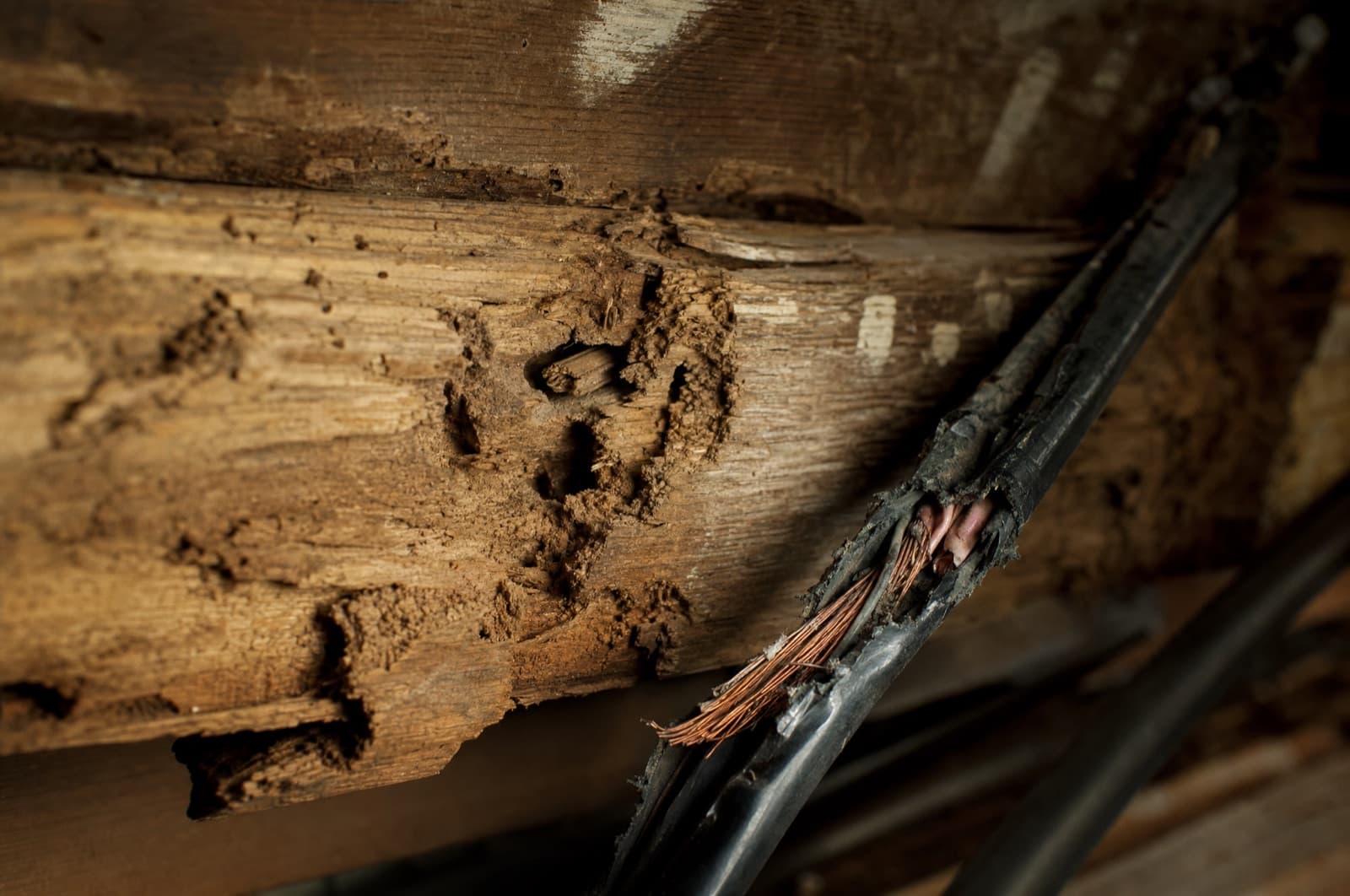
Pest damage evidence — a gnawed structural beam and a chewed electrical wire
Daniel Brady · NH-Licensed Pesticide Applicator · License #782664
Reviewed by Daniel Brady

Do spiders cause property damage?

No property damage — none at all
No, and this is one of the most confident answers in this hub: spiders cause no property damage of any kind. They have no chewing, boring, or excavating behavior, and no biological capacity to consume or degrade wood, wiring, fabric, drywall, or any other building material. What they leave behind — cobwebs and small dried fecal spots below where they rest — is purely cosmetic, and university extension entomologists classify spiders as beneficial predators of other household insects rather than a pest that needs treating for damage. A vacuum or a duster resolves the entire problem in minutes.

At a glance

  • Can it?: No
  • How common: Rare
  • Hype: Wildly overstated
  • Evidence: Well documented
The honest answer

The short of it

The verdict
No property damage — none at all

No. Spiders cause zero property damage — they don't chew, bore, gnaw, or corrode anything; cobwebs and fecal specks are dust and a wipe, not a repair.

The correction

What they claim vs. what the evidence supports

One shared severity track, two markers. The span between them is the hype delta — named out loud.

The claim — spiders and cobwebs causing property damage

That spiders and their webs threaten your home — cobwebs 'trap moisture' and cause structural damage, spider activity is framed as a 'sign of infestation' needing treatment, or spider presence somehow damages equipment or materials.

Where the claim comes from: Cleaning-service and pest-control marketing blogs that lean on vague damage language to sell a treatment for what is actually a purely cosmetic nuisance.

Severity, 0–100
Hype says42
2Evidence says
Hype delta40point gapWell documented
The evidence

University extension entomology sources are unanimous: spiders are beneficial predators of other household insects, and their only downside is cosmetic — dusty webs and small dried fecal spots. No source attributes any structural or material damage to spiders; they have no chewing, boring, or excavating biology and no digestive capacity for building materials of any kind.

The gap

The entire 'damage' premise is invented. A cobweb is dust. A spider spot is a wipe. There is nothing here to repair and nothing being harmed — full stop.

Damage assessment

What is actually harmed

Damage verdict
No property damage — none at all
No property damageCan it?No
The specimen
Pest
House spiders (and virtually every species commonly encountered indoors in New Hampshire homes)
What is in question
None — there is no material or system spiders act on
How common
Rare
Evidence
Well documented
Mechanism

Spiders are predators, not material-consumers. They have no wood-boring, gnawing, or excavating behavior, and nothing in their biology allows them to eat, dissolve, or otherwise degrade building materials. Their silk anchors to surfaces but does not penetrate or weaken them. What they leave behind is a pinhead-size liquid dropping that dries into a small surface stain. Because none of a spider's biology involves consuming or tunneling into structural material, there is no damage pathway for a spider to cause, period.

Actually at risk2
  • Appearance only — dusty cobwebs collecting in corners, garages, basements, and undisturbed spaces
  • Small, cleanable fecal spots on sills, walls, or surfaces below a spider's resting spot
Not at risk — despite the myth5
  • Wood framing, siding, and trim — spiders cannot chew or bore into any of it
  • Wiring, insulation, and building systems — no spider damages any of them
  • Drywall, plaster, masonry, and concrete — completely unaffected by any spider activity
  • Fabric, paper, stored belongings, and food — spiders don't eat or degrade any of them
  • The structural integrity of the building in any scenario involving spiders alone
Worst realistic case
An unsightly buildup of cobwebs and small fecal spots in an undisturbed garage or basement corner — solved with a vacuum, a broom, or a duster in a few minutes. There is no version of a spider-only scenario that escalates into a repair job.

Assessed from: University of Kentucky Entomology ENTFACT-623; UC IPM Pest Notes: Spiders; OSU Extension

The compounding clock

Does it get worse if you ignore it?

Over time
Static — never worsens

Static — a cobweb does not worsen, spread, or weaken anything, no matter how long it's left alone.

Now
Ever

There is no material being consumed or degraded, so there is nothing for time to make worse. An old web just collects more dust — it doesn't extend on its own, spread to new surfaces, or compromise whatever surface it's attached to. The only thing that changes over time is how dusty it looks.

What stops the clock
Nothing needs to be stopped — wipe, vacuum, or dust the web whenever it bothers you. A steady stream of brand-new webs in the same spot usually just means there's a supply of other insects nearby, which is worth noticing as a food-source question, not a damage one.
Repair scope

Who actually fixes this

Scope, not dollars — the honest answer to “how expensive is it,” routed to the right trade.

Who fixes it
You — wipe it up
Effort
Minutes

There is nothing to repair. A vacuum, broom, or duster removes webs, egg sacs, and fecal spotting completely — there is no pest to resolve first and no material that needs fixing.

Do not
  • Don't let anyone sell you a structural or 'infestation' scare story about ordinary house spiders — the biology doesn't support it
  • If you're dealing with a species of medical concern (rare in New Hampshire), that's a health question for a doctor, not a property-damage one
Where we help — and where we don't

Anchor can knock down webs and treat the perimeter for spiders as a nuisance service if you'd simply like fewer of them around — but the honest message on this page is that there is no property damage and no structural need behind it, and we won't manufacture one to sell a visit.

In depth

The full picture

01

The honest answer: no, and here's why

Spiders are predators. Every part of their biology is built around catching and eating other insects, not consuming or breaking down building materials. They have no incisors that grow continuously like a rodent's, no digestive enzymes for cellulose like a termite's, and no excavating mandibles like a carpenter ant's. There is simply no mechanism by which a spider could damage a wall, a wire, a joist, or a piece of fabric even if it wanted to — and it has no reason to want to in the first place. This is one of the clearest 'none' verdicts in pest control, and it's worth saying at full confidence rather than hedging it into a false middle ground.

02

What people actually worry about — and why it doesn't hold up

The claims that circulate tend to borrow damage language from pests that genuinely do cause it. 'Cobwebs trap moisture and cause structural damage' has no basis in entomological literature — a web is a fine mesh of dry silk, not a moisture barrier or a material that interacts chemically with paint or wood. 'Spider activity is a sign of infestation' inverts the actual relationship: spiders show up where other insects are already present as prey, so a spider is evidence you have a food source for them nearby, not evidence of a spider problem in its own right.

03

What a cobweb actually is

A cobweb is an abandoned or lightly maintained web that has stopped catching insects and instead collects airborne dust, which is why old webs look gray and thick rather than white and taut. University of Kentucky Entomology describes the practical downside of spiders plainly: their webs, fecal spotting, and discarded prey can become an unsightly nuisance, and a vacuum cleaner or broom effectively removes spiders, webs, and egg sacs. That's the entire physical reality — dust and a stain, both trivially cleanable.

04

This is one of the pages meant to say 'nothing is wrong'

This hub exists to correct fear-driven pest content, and an honest 'none' verdict is one of its central instruments, not an embarrassing exception to it. Spiders causing no property damage is exactly the kind of claim a pest company has a financial incentive to soften into 'well, it depends' — and exactly the kind of claim we'd rather state plainly. If a spider's only crime is a dusty corner, the honest advice is a duster, not a service call.

Key takeaways
5 points
  • No property damage of any kind — none, full stop.
  • Cobwebs are dust collectors; a vacuum, broom, or duster removes them completely.
  • Spiders have no chewing, boring, or digestive capacity for any building material.
  • New webs in the same spot indicate a nearby insect food source, not a damage risk.
  • There is nothing to repair here and no honest reason to treat spiders as a structural threat.
New Hampshire context

Where this shows up in New Hampshire homes

Basements, garages, and undisturbed storage corners are the most common places southern and central New Hampshire homeowners find heavy cobweb accumulation, simply because those spaces are cleaned least often and host the insect prey spiders are after. The verdict doesn't change with the setting — even a heavily webbed New Hampshire cellar is a cleaning task, not a structural one.

  • NH-licensed #782664

    Southern New Hampshire

  • Family-owned

    Since 2017

  • Honest routing

    Even when it isn’t us

We serve these communities

ManchesterNashuaConcordDerryBedfordSalemHudsonAmherstAuburnGoffstownHooksettLitchfieldLoudonMilfordBristol

Service Area Map

Southern New Hampshire

BristolPop. 3,200LoudonPop. 5,500ConcordPop. 43,900HooksettPop. 14,800GoffstownPop. 18,000AuburnPop. 5,700ManchesterPop. 115,600BedfordPop. 23,300LitchfieldPop. 8,500AmherstPop. 11,300DerryPop. 34,500MilfordPop. 15,700HudsonPop. 25,600NashuaPop. 91,100SalemPop. 30,000HQCityHover for info

Just want fewer webs around? That's a nuisance service, not a repair.

Anchor can knock down webs and treat the perimeter for spiders — purely for comfort. There's no property damage to fix, and we'll say so.

Follow-up questions

Frequently asked

Sources & citations(3)
  1. University of Kentucky Entomology — ENTFACT-623, Eliminating Spiders Around Homes and Buildings

    Spiders are beneficial predators; webs, fecal spotting, and discarded prey are cosmetic nuisances removable by vacuuming

    extensionverified 2026-07-16
  2. UC IPM — Pest Notes: Spiders

    Spiders are mostly beneficial because they feed on pest insects; pesticides are not generally needed

    extensionverified 2026-07-16
  3. OSU Extension — What Are All These Webs Showing Up Inside My House

    Cobwebs are inactive, dusty silk; common house spiders are benign

    extensionverified 2026-07-16

Written & reviewed by

Verified

Daniel Brady

NH-Licensed Pesticide Applicator · License #782664 (NHDAMF, RSA 430)

Daniel Brady is the New Hampshire–licensed applicator behind Anchor Pest Services, a family-owned pest control company serving the Manchester area since 2017.

Verify license

Last updated Jul 2026

Honest pest help for New Hampshire homes

No Damage Here — Just an Honest Answer.

Spiders don't damage property, and we're not going to pretend otherwise to sell you a service. If you'd simply like fewer webs and spiders around for comfort, Anchor Pest Services offers perimeter treatment as a nuisance-reduction option — family-owned since 2017, NH license #782664, serving Manchester, Nashua, Concord and nearby towns.

  • Honest advice — we say 'none' when the evidence says none
  • NH-licensed applicators (#782664) — free inspection, same-day service
  • Nuisance-pest perimeter service across southern and central New Hampshire

NH License #782664 · No obligation · We answer in person