
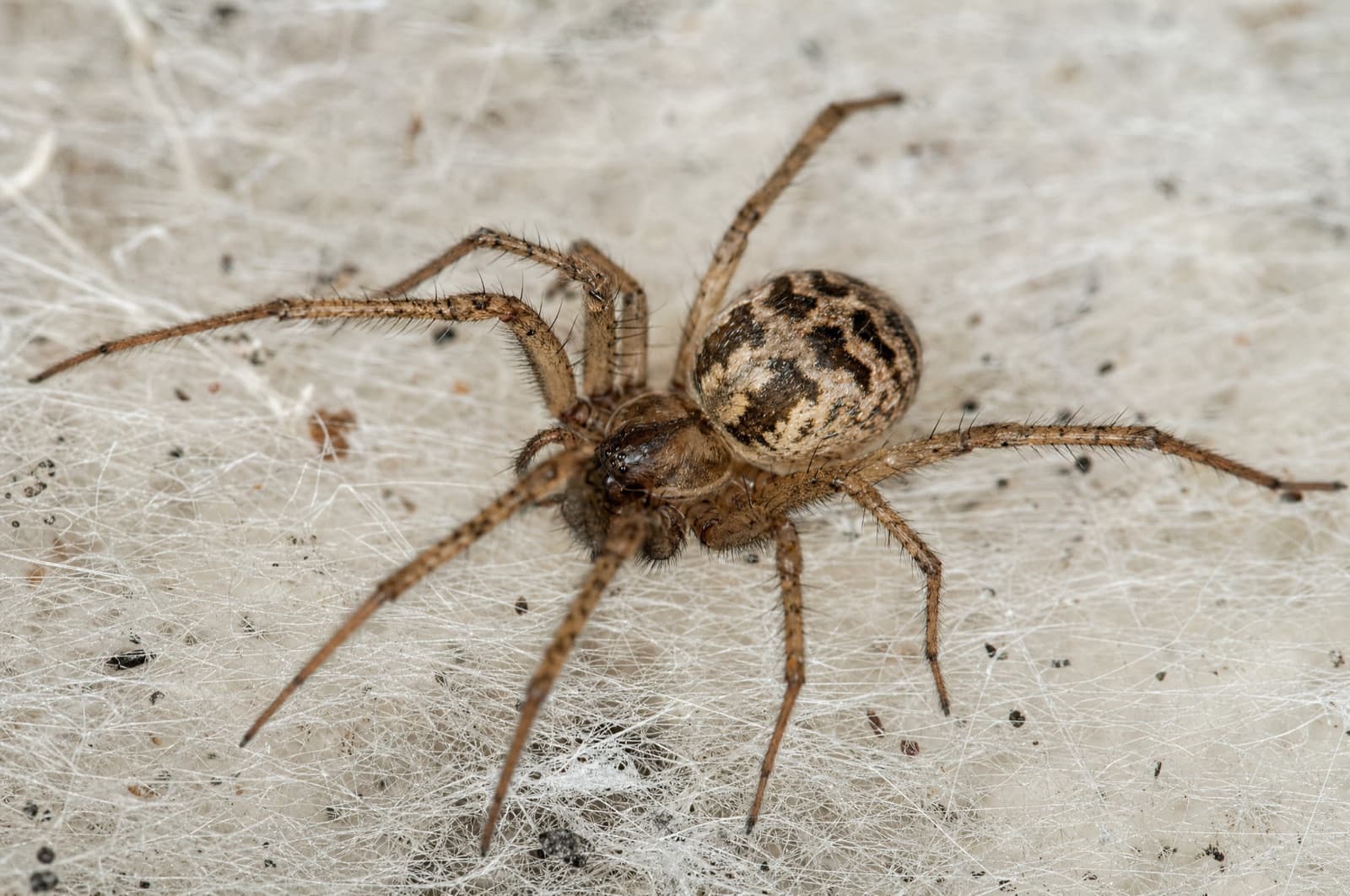
How to Get Rid of House Spiders
At a glance
- Difficulty: Beginner
- Time: An hour for an initial sweep; a few minutes on follow-ups
- Cost: Low — a duster or vacuum, some caulk
- Success: High — web removal and exclusion reliably keeps numbers down
Can you DIY House Spider?
The verdict on House Spider DIY
About as low-stakes as pest control gets — a genuinely simple, beginner-friendly job.
The American (common) house spider, Parasteatoda tepidariorum, is the tangle-web 'cobweb' builder found in corners, window frames, and ceiling junctions throughout New Hampshire homes. Penn State Extension notes it 'is not regarded as a medically important species' and, despite how commonly it populates houses, 'does not often bite.' The job is simply removing webs and egg sacs and closing the gaps new spiders wander in through — no chemicals required.
The 5 DIY methods — honestly graded
Every approach graded for this species, in IPM order — prevention first, chemistry late. Pick a method to see how it works, the steps, and what it actually takes.
Prevention / Exclusion
Works wellSealing gaps and cutting prey insects removes both the entry route and the reason to stay.
House spiders wander in through small gaps and set up cobwebs wherever prey insects are plentiful. Closing those gaps and reducing indoor insects removes both the access point and the incentive.
Best for: Reducing how often cobwebs reappear
Seal gaps
Caulk cracks around windows, doors, and utility penetrations.
Reduce prey insects
Address any indoor fly or gnat issues through sanitation and screening — fewer insects means fewer reasons for spiders to web up in a spot.
Tools & materials
Why DIY falls short here
Not scare tactics — the specific, proportionate reasons a home attempt can stall for this species.
New individuals re-web where prey is abundant
Without reducing prey insects and sealing gaps, cobwebs return in the same corners even after a thorough cleanout.
Egg sacs get overlooked
Leaving an egg sac behind during a web-removal sweep seeds the next generation right back in the same spot.
How risky is it, really?
An honest read — most nuisance species are genuinely low risk, and we say so.
American house spiders are genuinely harmless. Penn State Extension states plainly that the species 'is not regarded as a medically important species,' and given how commonly it's found in homes, it 'does not often bite' — a good sign that even close, constant contact with people rarely results in any incident.
- BiteRare
Not medically important; bites are rare and, when they happen, minor
Penn State Extension
- Cosmetic cobweb buildup in corners and window framesCommon
The actual nuisance — resolved with routine web and egg-sac removal
Penn State Extension
Persistent Cobwebs? We'll Find the Source.
House spiders are harmless, but persistent webbing usually points to a steady insect food source. Anchor Pest Services can inspect and address it across southern and central New Hampshire. Family-owned since 2017, NH license #782664.
Call a pro when…
- Webbing keeps reappearing quickly despite regular removal and sealing
- You want a broader inspection to identify what's drawing insects (and spiders) indoors
General Pest Control
A pro is rarely needed for house spiders — this is one of the simplest, lowest-stakes jobs in the hub. Consider one only if webbing is unusually persistent despite regular cleaning and sealing, which may point to a bigger insect-prey issue worth investigating.
Keep them out
- Do a routine sweep for webs and egg sacs in corners and window frames
- Seal gaps around windows, doors, and utility penetrations
- Address any indoor insect issues that provide a steady food source
House spiders in New Hampshire
American house spiders are common year-round throughout New Hampshire homes, building tangle webs in corners, window frames, and basement ceiling junctions. Webbing tends to accumulate most visibly through late summer and fall, making that a good window for a cleanout sweep ahead of the first hard frost, about October 19–29 in Manchester (NOAA).
Peak season
Year-round, most visible in late summer and fall
First-frost anchor
Manchester first hard frost ~Oct 19 (50%) / Oct 29 (80%), NOAA 1991–2020
Make sure it's a House Spider
Two quick detours worth taking — confirm the ID, then learn what drew it in so it doesn't come back.
Frequently asked
Sources & further reading(3)
- [1]Penn State Extension — Common House Spider
Not medically important; rarely bites despite prevalence
extensionverified 2026-07-13 - [2]Missouri Department of Conservation — Common House Spider
Species biology and behavior
govverified 2026-07-13 - [3]
Written & reviewed by
VerifiedDaniel Brady
NH-Licensed Pesticide Applicator · License #782664 (NHDAMF, RSA 430)
Daniel Brady is the New Hampshire–licensed applicator behind Anchor Pest Services, a family-owned pest control company serving the Manchester area since 2017.
Last updated July 2026
Other species you can tackle
Same category — the dot shows each one's DIY verdict at a glance (green = friendly, amber = doable with care, red = call a pro).
Professional Pest Control
Persistent Cobwebs? We'll Find the Source.
House spiders are harmless, but persistent webbing usually points to a steady insect food source. Anchor Pest Services can inspect and address it across southern and central New Hampshire. Family-owned since 2017, NH license #782664.
- Source-focused inspection
- NH-licensed applicators (#782664)
- Free inspection — same-day service across southern NH
NH License #782664 · No obligation · We answer in person
Your next step
- Book a NH pro
Spider Control in New Hampshire
Spider sightings peak in fall. We treat hiding spots and seal the gaps they use.
Book now - Also relevant
House Spider in New Hampshire: ID, Webs & Control
Read the answer - Also relevant
Spider Prevention: Cut the Food Supply, Not Just the Webs
Read the answer - Also relevant
When Are Spiders Most Active in the House? NH Spider Guide
Read the answer - Also relevant
Natural Spider Control: What Actually Works in New Hampshire
Read the answer - Also relevant
Spider Prevention: Cut the Food Supply, Not Just the Webs
Read the answer