
Skip to content
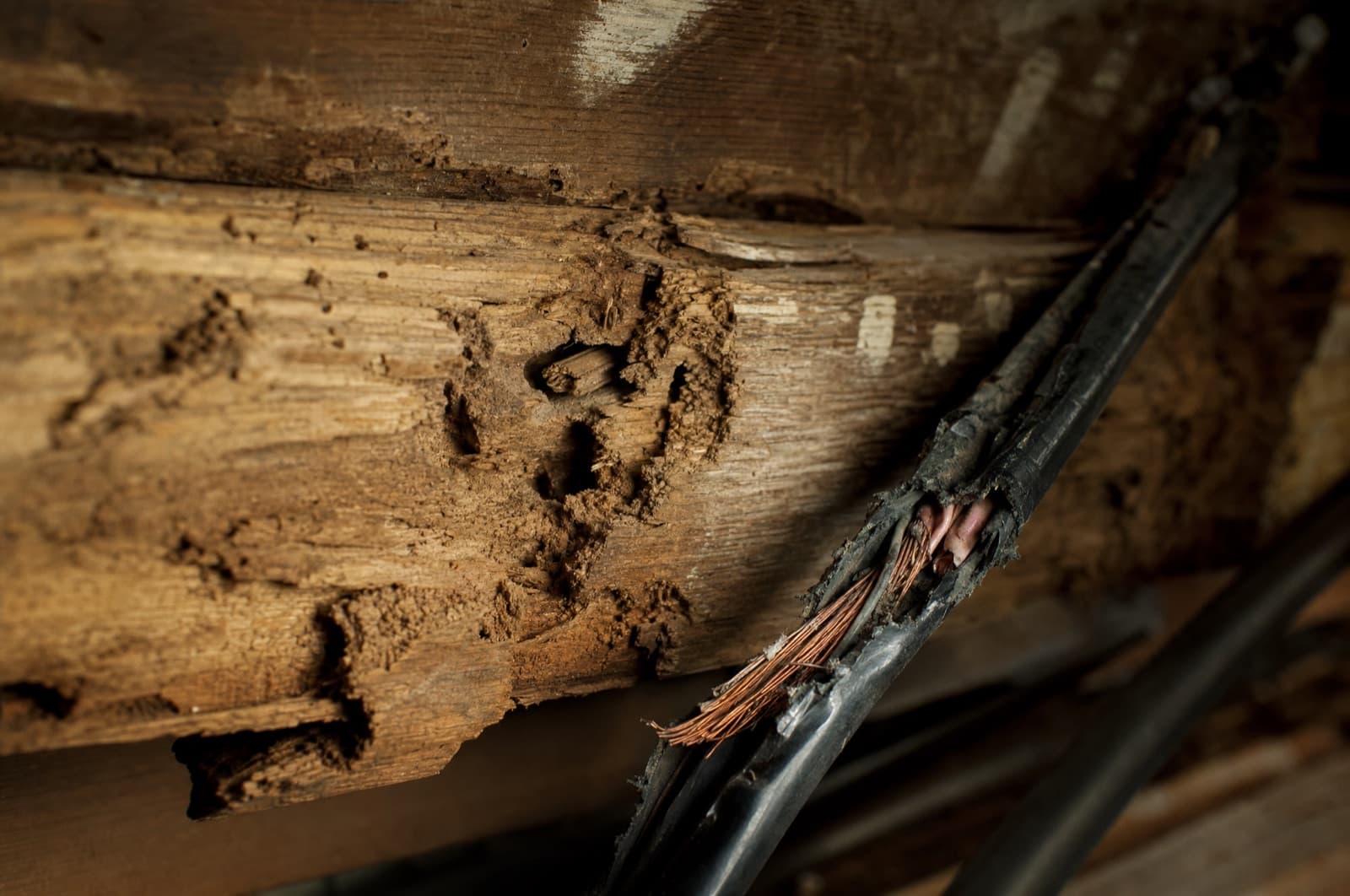
Pest damage evidence — a gnawed structural beam and a chewed electrical wire
Daniel Brady · NH-Licensed Pesticide Applicator · License #782664
Reviewed by Daniel Brady

Why do ants invade kitchens and bathrooms?

Negligible property damage — this is a nuisance, not a structural story
Ants invade kitchens and bathrooms because those rooms supply the three things a colony needs: sugary or greasy food, standing water, and moisture-softened harborage around sinks, drains, and leaks. A scout ant that finds a food source lays a chemical recruitment trail back to the nest, and that trail strengthens with traffic, which is why a few ants can become dozens within hours. Most household species — odorous house ants, pavement ants, so-called "sugar ants" — damage nothing; they're a hygiene and nuisance problem, not a property one. The one honest exception is carpenter ants, which excavate galleries in wood that's already moisture-damaged, and that's a different, structural conversation.

At a glance

  • Can it?: Rarely
  • How common: Routine
  • Hype: Overstated
  • Evidence: Well documented
The honest answer

The short of it

The verdict
Negligible property damage — this is a nuisance, not a structural story

Ants invade kitchens and bathrooms because those rooms supply food, water, and moisture — and for the vast majority of household ants, that invasion causes no property damage at all.

The correction

What they claim vs. what the evidence supports

One shared severity track, two markers. The span between them is the hype delta — named out loud.

The claim — seeing ants in the kitchen or bathroom and assuming it means infestation and damage

That ants in the kitchen or bathroom signal a serious infestation that is actively damaging the home, lumping every ant species together as a property threat.

Where the claim comes from: General pest-control blog copy that treats "ants inside" as a single alarming category rather than distinguishing species and behavior.

Severity, 0–100
Hype says45
15Evidence says
Hype delta30point gapWell documented
The evidence

The foraging behavior is genuinely real and well documented — trail pheromones reliably recruit workers to food and water within hours. But for the great majority of species homeowners actually see indoors, the honest outcome is nuisance and food-hygiene concern, not property damage. The one species that crosses into structural territory, the carpenter ant, does so only in wood that is already moisture-damaged, and that is a distinct, separately-handled case.

The gap

The invasion itself is completely real — pheromone trails, moisture-seeking, the works. What's overstated is jumping straight to "damage." For an ordinary trail of odorous house ants or pavement ants crossing your counter, the honest answer is that nothing is being harmed; only carpenter ants, and only in wood a leak already ruined, belong in the damage conversation.

Damage assessment

What is actually harmed

Damage verdict
Negligible property damage — this is a nuisance, not a structural story
NegligibleCan it?Rarely
The specimen
Pest
Odorous house ants, pavement ants, and other common household "sugar ants" (carpenter ants noted as the exception)
What is in question
Kitchen and bathroom food, food-contact surfaces, and — for carpenter ants only — pre-existing moisture-damaged wood
How common
Routine
Evidence
Well documented
Mechanism

A scout ant that locates food or water lays down a chemical recruitment (trail) pheromone on the way back to the nest; other workers follow and reinforce it, which is why a handful of ants can turn into dozens within hours of a spill or a damp sink being found. Most household ant nests are actually outdoors — in mulch, under pavement, or along the foundation — and what you see inside is a commuting line of foragers, not a nest itself. Moisture is as strong a draw as food: a leaking pipe or condensation under a sink is a prime attractant independent of any food source nearby. Carpenter ants work by an entirely different mechanism — they excavate (not eat) galleries for nesting, and they colonize wood that already has a moisture or decay problem, so their presence is really a signal of that underlying defect.

Actually at risk3
  • Food hygiene — open food, food residue on counters, and pet food bowls
  • Nothing structural for the ordinary household ant species
  • Moisture-damaged wood specifically, if carpenter ants are the species involved
Not at risk — despite the myth3
  • Dry, sound wood framing and cabinetry
  • Fabrics, appliances, wiring, and plumbing
  • The building's structure, for every common kitchen/bathroom ant species except carpenter ants in wood that's already wet
Worst realistic case
A persistent daily trail from an outdoor colony that keeps returning to the same counter or sink until the food source and moisture are removed — annoying and hard to ignore, but not property damage. Carpenter-ant galleries only develop where chronic moisture has already compromised the wood.

Assessed from: PMC Lasius niger trail-pheromone study; PMC Argentine-ant trail/thigmotaxis study; university extension/IPM foraging descriptions

The compounding clock

Does it get worse if you ignore it?

Over time
Static — never worsens

Static for the property — the trail intensifies with traffic, but nothing is being damaged while it does.

Now
Ever

For the ordinary household ant species that account for the vast majority of kitchen and bathroom sightings, no material or structural damage accrues no matter how long the trail persists — the colony is foraging, not consuming your home. The only thing that "compounds" is the visible nuisance and the food-hygiene concern, not property harm. (Carpenter ants are the named exception and are addressed on the structural/carpenter-ant pages, not here.)

What stops the clock
Wiping away the pheromone trail (soap and water or diluted vinegar), fixing the leak or condensation source that's supplying moisture, sealing the entry point, and baiting the colony so foragers carry bait back to the nest.
Repair scope

Who actually fixes this

Scope, not dollars — the honest answer to “how expensive is it,” routed to the right trade.

Who fixes it
You — wipe it up
Effort
An afternoon

There is nothing to repair for an ordinary kitchen or bathroom ant trail — this is a cleaning-and-baiting task, not a structural or trade job.

The right order
  1. 1
    Wipe the visible trail with soap and water or diluted vinegar to erase the pheromone signal
  2. 2
    Fix the leak, drip, or condensation source supplying moisture
  3. 3
    Seal the entry gap where ants are coming in
  4. 4
    Set bait stations along the trail so foragers carry it back to the colony
Route by symptom
  • PlumberThe moisture driving the ants is an active leak under a sink or around a bathroom fixture
  • Pest pro firstTrails keep recurring after about two weeks of cleaning and baiting, or the species turns out to be carpenter ants in damp wood
Do not
  • Don't spray-kill only the visible workers — that leaves the colony intact and the trail returns within days
  • Don't ignore a recurring damp spot under a sink just because the ants seem to have gone away
Where we help — and where we don't

Ant control, perimeter defense, and carpenter-ant work are genuinely Anchor's lane. The plumbing leak that's drawing them in the first place is a plumber's job, not ours — we'll tell you that rather than treat the symptom on repeat.

In depth

The full picture

01

What ants are actually looking for

Kitchens and bathrooms are the two rooms in a house that reliably offer the three things an ant colony needs: sugary and greasy food residue, standing or dripping water, and moisture-softened material to nest in or travel through. That combination is what pulls foragers in, not any particular fondness for tile or countertops.

Moisture deserves equal billing with food here, and it's the part people underrate. A condensation-damp cabinet under a bathroom sink, or a slow drip behind a kitchen faucet, is often a stronger draw than a crumb on the floor — which is why ants sometimes show up in a spotless kitchen with a hidden plumbing issue.

02

Why a few ants become dozens by evening

The mechanism is chemical, not coincidental. A single scout ant that finds food or water lays down a recruitment (trail) pheromone on its way back to the nest. Other workers detect and follow that trail, reinforcing it further with their own deposits as they travel back and forth — a positive-feedback loop documented in trail-pheromone research on species like Lasius niger and Argentine ants. That's why a trail that starts as one or two ants at breakfast can be a steady line of dozens by dinner: it isn't a new invasion each time, it's the same recruitment signal getting stronger.

It's also worth knowing that most of the colony you're worried about isn't inside your house at all. The great majority of common household ant nests are outdoors — in mulch beds, under pavement slabs, or along the foundation — and what you see on the counter is a commuting line of foragers, a small visible fraction of a much larger, unseen colony.

03

The honest damage answer: almost none

This is the part worth saying plainly, because so much generic pest content skips it: for the species that account for the overwhelming majority of kitchen and bathroom ant sightings — odorous house ants, pavement ants, and the various species lumped together as "sugar ants" — the honest damage verdict is negligible to none. They don't eat wood, they don't chew wiring or fabric, and they don't weaken anything. The cost is food hygiene and annoyance, not repair.

The one genuine exception is the carpenter ant, and it's worth being precise about why it's different. Carpenter ants don't eat wood the way termites do — they excavate galleries to nest in it — and they specifically colonize wood that already has a moisture or decay problem. In other words, a carpenter ant sighting is really a signal that a leak or chronic dampness has already done the underlying damage; the ant found the defect, it didn't create it. That's a genuinely structural conversation, but it belongs to a different pest and a different page, not to the ordinary kitchen ant trail most people are actually asking about here.

Key takeaways
5 points
  • Ants invade for food, water, and moisture — kitchens and bathrooms supply all three at once.
  • A recruitment pheromone trail explains why a few ants become dozens within hours; most of the colony stays outdoors.
  • For the common household species, the honest verdict is negligible-to-no property damage — this is a hygiene and nuisance issue, not a structural one.
  • Carpenter ants are the one real exception, and only in wood that a moisture problem has already damaged.
  • Wipe the trail, fix the moisture source, seal the entry, and bait the colony — that resolves the great majority of cases.
New Hampshire context

Ants in New Hampshire kitchens and bathrooms

Southern and central New Hampshire homes see ant foraging pick up through spring and summer as outdoor colonies expand, and again in early fall as cooling temperatures push some colonies to seek warmth and moisture indoors ahead of Manchester's first hard frost, historically around October 19 to 29. Older housing stock with basement bathrooms and older kitchen plumbing tends to generate more of the chronic condensation and slow leaks that draw ants in regardless of season.

If you're seeing a recurring trail in the same spot year after year, the moisture source — not the ants themselves — is usually the more durable New Hampshire-specific fix.

  • NH-licensed #782664

    Southern New Hampshire

  • Family-owned

    Since 2017

  • Honest routing

    Even when it isn’t us

We serve these communities

ManchesterNashuaConcordDerryBedfordSalemHudsonAmherstAuburnGoffstownHooksettLitchfieldLoudonMilfordBristol

Service Area Map

Southern New Hampshire

BristolPop. 3,200LoudonPop. 5,500ConcordPop. 43,900HooksettPop. 14,800GoffstownPop. 18,000AuburnPop. 5,700ManchesterPop. 115,600BedfordPop. 23,300LitchfieldPop. 8,500AmherstPop. 11,300DerryPop. 34,500MilfordPop. 15,700HudsonPop. 25,600NashuaPop. 91,100SalemPop. 30,000HQCityHover for info

Trail keeps coming back even after cleaning? Time to bait the colony, not just the counter.

Anchor handles ant colonies and carpenter-ant structural cases — the moisture source behind them is a plumber's fix, and we'll say so.

Follow-up questions

Frequently asked

Sources & citations(4)
  1. PMC4204274 — Trail Choice by Lasius niger Ants

    Recruitment/trail pheromone mechanism reinforced by worker traffic

    academicverified 2026-07-16
  2. PMC5431790 — Thigmotaxis Mediates Trail Odour Disruption (Argentine ants)

    Trail pheromone and thigmotaxis in household ant foraging

    academicverified 2026-07-16
  3. UNH Cooperative Extension — Ants in and around the home

    Household ant foraging behavior and moisture attraction; carpenter-ant distinction

    extensionverified 2026-07-16
  4. Penn State Extension — Carpenter Ants

    Carpenter ants excavate rather than eat wood, and colonize existing moisture-damaged wood

    extensionverified 2026-07-16

Written & reviewed by

Verified

Daniel Brady

NH-Licensed Pesticide Applicator · License #782664 (NHDAMF, RSA 430)

Daniel Brady is the New Hampshire–licensed applicator behind Anchor Pest Services, a family-owned pest control company serving the Manchester area since 2017.

Verify license

Last updated Jul 2026

Honest pest help for New Hampshire homes

We Treat the Colony. You Might Just Need a Faucet Fixed.

Most kitchen and bathroom ants cause no property damage — the honest fix is often cleaning, sealing, and a bait station. Anchor Pest Services steps in for a persistent colony or a confirmed carpenter-ant case; the plumbing leak drawing them in isn't our job, and we'll point you to a plumber instead of overselling. Family-owned since 2017, NH license #782664, serving Manchester, Nashua, Concord and nearby towns.

  • Honest advice — we say when it's a cleaning fix, not a pest-control job
  • NH-licensed applicators (#782664) — free inspection, same-day service
  • Ant control and carpenter-ant treatment across southern and central New Hampshire

NH License #782664 · No obligation · We answer in person