
Skip to content
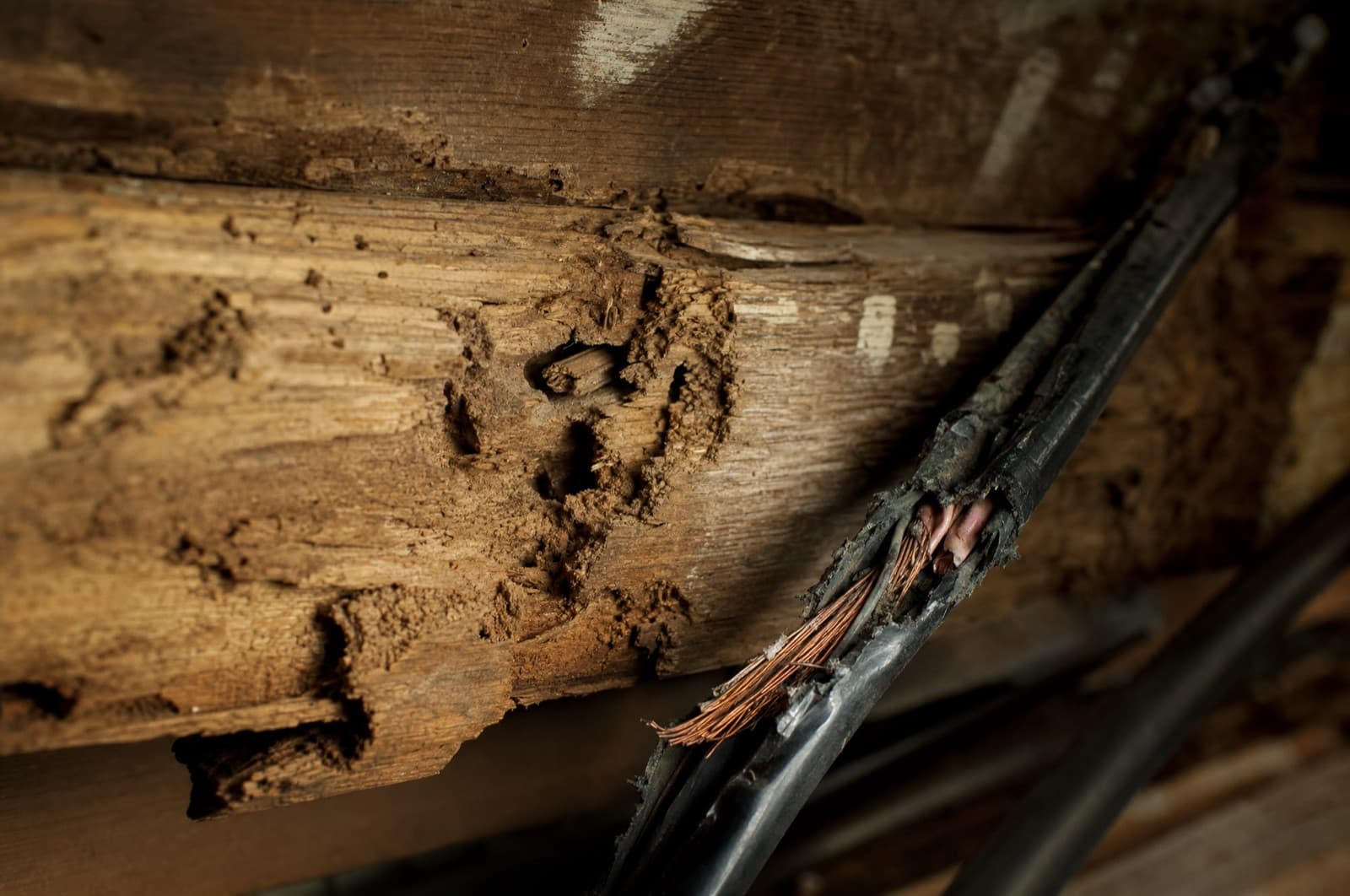
Pest damage evidence — a gnawed structural beam and a chewed electrical wire
Daniel Brady · NH-Licensed Pesticide Applicator · License #782664
Reviewed by Daniel Brady

Do ants cause structural damage or just nuisance?

Structural — but only carpenter ants, and only secondary to moisture
It depends entirely on which ant. Pavement ants, odorous house ants, and the other nuisance species you find on a kitchen counter cause no structural damage whatsoever — they're a food and cleanliness issue, nothing more. Carpenter ants are different: they excavate smooth galleries in wood to build nest space, and UNH Cooperative Extension calls them, alongside termites, one of New Hampshire's most troublesome structural pests. But carpenter ants do not eat wood the way termites do, and they overwhelmingly colonize wood that is already softened by a moisture problem. The honest structural story is the leak, not the ant.

At a glance

  • Can it?: Yes, but
  • How common: Routine
  • Hype: Overstated
  • Evidence: Well documented
The honest answer

The short of it

The verdict
Structural — but only carpenter ants, and only secondary to moisture

Most household ants are pure nuisance with zero structural role; carpenter ants are the real exception, and they excavate wood that's already wet, not sound dry lumber.

The correction

What they claim vs. what the evidence supports

One shared severity track, two markers. The span between them is the hype delta — named out loud.

The claim — ants excavating or 'eating' structural wood in a home

That ants — treated as one undifferentiated group — 'eat' your house's wood the same way termites do, silently consuming structural framing from the inside until it fails.

Where the claim comes from: Pest-control marketing copy and viral home-maintenance posts that borrow termite-level urgency for any ant sighting, regardless of species.

Severity, 0–100
Hype says75
38Evidence says
Hype delta37point gapWell documented
The evidence

The overwhelming majority of household ants — pavement ants, odorous house ants, and similar nuisance species — have no wood-damaging role at all. Carpenter ants are the one genuine exception, and even they do not digest cellulose: UNH Extension is explicit that 'carpenter ant workers do not eat wood as termites do, but excavate galleries to rear their young,' and that they 'strongly prefer damp wood for excavating.'

The gap

Carpenter ants are a real structural pest, but they're excavators working a wood-and-water problem you already have, not termites in a different costume. Flattening every ant sighting into 'my house is being eaten' overstates the 95% of ant calls that are pure nuisance and misdirects the real fix — the leak — on the rest.

Damage assessment

What is actually harmed

Damage verdict
Structural — but only carpenter ants, and only secondary to moisture
StructuralCan it?Yes, but
The specimen
Pest
Carpenter ants (the structural exception); pavement ants, odorous house ants, and other nuisance species (no structural role)
What is in question
Moisture-damaged sills, window and door frames, porch columns, and other softened structural wood
How common
Routine
Evidence
Well documented
Mechanism

Carpenter ants excavate clean, smooth galleries with their mandibles to create nest space for their colony — they cannot digest cellulose and gain no nutrition from the wood itself, so unlike termites they chew and eject wood rather than eating it. Galleries run with the wood grain, and the frass left behind at exit points looks like fine pencil shavings mixed with insect fragments, not the mud-packed tunnels termites leave. Crucially, carpenter ants overwhelmingly select wood that is already damp or decaying from a chronic leak, condensation, or grade contact; sound, dry structural lumber is rarely their primary target. Nuisance ants like pavement ants and odorous house ants forage for food and nest in soil, mulch, or wall voids — they have no gallery-excavating behavior in wood at all.

Actually at risk4
  • Sills, sole plates, and rim joists at a chronic moisture source
  • Window and door frames with failed flashing or caulk
  • Porch columns and deck ledger boards in prolonged ground or water contact
  • Bath and kitchen framing behind a slow plumbing leak
Not at risk — despite the myth4
  • Sound, dry structural lumber anywhere in the house — carpenter ants rarely target it as a starting point
  • Masonry, concrete foundations, and steel framing — no ant species excavates these
  • Anything a pavement ant, odorous house ant, or other nuisance species is nesting near — these ants cause zero structural damage regardless of colony size
  • Furniture, cabinetry, or finish carpentry that isn't chronically wet
Worst realistic case
A key sill, joist, or column significantly weakened after years of an undetected, chronic leak feeding a growing carpenter-ant colony — a real repair, but the endpoint of a long-neglected moisture problem, not a sudden ant attack on healthy wood.

Assessed from: UNH Cooperative Extension Carpenter Ants fact sheet; University of Minnesota Extension carpenter ants

The compounding clock

Does it get worse if you ignore it?

Over time
Compounds slowly

Slow and moisture-gated — carpenter-ant damage builds over years, and it stalls the moment the wood dries out.

The timeline
3 stages
  1. MonthsReversible

    A scouting colony establishes in an already-damp piece of wood — a sill, a window frame, a porch column — and begins a small satellite gallery. Frass appears at a tiny exit hole; the wood itself is barely affected.

  2. YearsReversible

    If the moisture source is never fixed, the colony expands its galleries through the softened wood, following the wettest, most decayed sections. University of Minnesota Extension notes this kind of damage 'occurs slowly, often taking years' to become significant.

  3. DecadesReversible

    In a worst-case, long-neglected scenario, a key structural timber that has stayed chronically wet for many years is significantly weakened by repeated colonization — a genuine repair, but the outcome of a decades-old water problem, not a fast ant infestation.

What stops the clock
Fixing the moisture source — the roof leak, the failed flashing, the plumbing drip, the grade sloped toward the foundation — removes the reason carpenter ants chose that wood in the first place, and resolving the colony stops any further excavation. Dry wood is simply not attractive to them.
Repair scope

Who actually fixes this

Scope, not dollars — the honest answer to “how expensive is it,” routed to the right trade.

Who fixes it
Pest pro first
Effort
A project

An active carpenter-ant colony has to be resolved before anyone patches or replaces the wood it's excavating, or the same timber gets re-colonized. But the ants are a symptom — the moisture source is the actual root cause and needs its own fixer.

The right order
  1. 1
    Resolve the carpenter-ant colony (Anchor's core work)
  2. 2
    Identify and fix the moisture source — a plumber for a leak, a roofer for flashing or shingles, or a grading fix for water pooling at the foundation
  3. 3
    Have a licensed contractor assess and replace any wood that's been structurally weakened
Route by symptom
  • PlumberThe moisture source is a supply line, drain, or fixture leak feeding the damp wood
  • RooferThe moisture is coming from a roof leak, failed flashing, or ice-dam water intrusion
  • Licensed contractorA sill, joist, or column has been structurally weakened and needs replacement or sistering
Do not
  • Don't patch or paint over a gallery entrance while the colony is still active — you're sealing ants inside wood they'll keep excavating
  • Don't replace the wood before the moisture source is fixed — new lumber in the same wet spot invites the same problem
Where we help — and where we don't

Resolving the carpenter-ant colony is squarely Anchor's work. We do not fix the leak or replace structural wood ourselves — we'll tell you plainly which trade does, because the ants come back if the water problem doesn't get solved too.

In depth

The full picture

01

Why 'ants' is the wrong unit of analysis

The honest answer to this question depends entirely on which ant is on your counter. Pavement ants, odorous house ants, and most of the other species homeowners see indoors are strictly nuisance pests — they forage for food, nest in soil or mulch or wall voids, and have no capacity to damage wood, drywall, or any other building material. Treating every ant sighting as a structural emergency is the single biggest distortion in this topic.

Carpenter ants are the genuine exception, and UNH Cooperative Extension is direct about their standing: alongside termites, they are among New Hampshire's most troublesome structural pests. That's a real, earned classification — but it comes with two honest qualifications that pest-marketing copy routinely drops.

02

They excavate. They do not eat.

The first qualification is mechanical. Termites digest wood cellulose with help from gut microbes and genuinely consume it as food. Carpenter ants cannot do this — they lack the digestive capability. UNH Extension states it plainly: 'Carpenter ant workers do not eat wood as termites do, but excavate galleries to rear their young.' They chew through wood fiber with their mandibles and eject it as they hollow out nest space, leaving behind frass that looks like coarse pencil shavings rather than eating the wood as sustenance.

That distinction matters practically, not just semantically. It means carpenter ants are working mechanically, at the pace their mandibles allow, rather than metabolically. It's slower, and it's driven by nesting need rather than a food source that keeps them coming regardless of wood condition.

03

The real headline: they need wood that's already wet

The second, more important qualification is that carpenter ants overwhelmingly select wood softened by an existing moisture problem. The same UNH fact sheet notes they 'strongly prefer damp wood for excavating' — a chronic roof leak, a failed window flashing, a slow plumbing drip, or grade sloped toward the foundation. Sound, dry structural lumber is rarely where a colony starts.

That makes the carpenter-ant sighting a diagnostic signal more than a standalone threat: if you have an active colony in a sill or window frame, you very likely have an undiagnosed water problem in that same spot. Resolving only the ants and never finding the leak means the wood stays attractive to whatever colonizes it next.

The pace also matters. This isn't the days-to-weeks urgency implied by a lot of ant-scare copy — University of Minnesota Extension describes carpenter-ant wood damage as occurring 'slowly, often taking years.' A homeowner who fixes the moisture source promptly has stopped the process at a genuinely early stage.

Key takeaways
5 points
  • Most household ants — pavement ants, odorous house ants, and similar species — cause zero structural damage. Only carpenter ants are a structural pest.
  • Carpenter ants excavate nest galleries; they do not digest or eat wood the way termites do.
  • They overwhelmingly colonize wood that's already softened by a moisture problem — a leak, failed flashing, or grade issue is usually the real root cause.
  • The damage compounds slowly, over years, not weeks — there's real time to act once a colony is found.
  • Fixing the moisture source is as important as resolving the ants; otherwise the wood stays attractive to whatever colonizes it next.
New Hampshire context

What this looks like in New Hampshire homes

Southern and central New Hampshire's freeze-thaw winters and humid summers create a steady supply of the moisture defects carpenter ants look for — ice-dam water intrusion at eaves and rooflines, condensation in unvented crawlspaces, and window flashing that fails after repeated freeze cycles. UNH Extension's ranking of carpenter ants alongside termites as a top structural concern reflects how often that combination of old housing stock and New England moisture shows up in inspections across Manchester, Nashua, and Concord.

  • NH-licensed #782664

    Southern New Hampshire

  • Family-owned

    Since 2017

  • Honest routing

    Even when it isn’t us

We serve these communities

ManchesterNashuaConcordDerryBedfordSalemHudsonAmherstAuburnGoffstownHooksettLitchfieldLoudonMilfordBristol

Service Area Map

Southern New Hampshire

BristolPop. 3,200LoudonPop. 5,500ConcordPop. 43,900HooksettPop. 14,800GoffstownPop. 18,000AuburnPop. 5,700ManchesterPop. 115,600BedfordPop. 23,300LitchfieldPop. 8,500AmherstPop. 11,300DerryPop. 34,500MilfordPop. 15,700HudsonPop. 25,600NashuaPop. 91,100SalemPop. 30,000HQCityHover for info

Carpenter ants in a sill or window frame? Find the moisture, then stop the colony.

Anchor resolves the carpenter-ant colony — the leak or flashing fix is a separate, equally important step we'll help you route correctly.

Follow-up questions

Frequently asked

Sources & citations(3)
  1. UNH Cooperative Extension — Carpenter Ants fact sheet

    Carpenter ants excavate rather than eat wood; strongly prefer damp wood; ranked with termites among NH's most troublesome structural pests

    extensionverified 2026-07-16
  2. University of Minnesota Extension — Carpenter ants

    Carpenter-ant wood damage occurs slowly, often taking years

    extensionverified 2026-07-16
  3. Penn State Extension — Carpenter Ants

    Nest expansion into building timbers rarely causes structural damage without a moisture problem present

    extensionverified 2026-07-16

Written & reviewed by

Verified

Daniel Brady

NH-Licensed Pesticide Applicator · License #782664 (NHDAMF, RSA 430)

Daniel Brady is the New Hampshire–licensed applicator behind Anchor Pest Services, a family-owned pest control company serving the Manchester area since 2017.

Verify license

Last updated Jul 2026

Honest pest help for New Hampshire homes

We Handle the Ants. We'll Tell You Where the Water Is Coming From.

Carpenter ants are a real structural pest, but they're chasing a moisture problem you already have — not eating sound, dry wood. Anchor Pest Services resolves the colony and helps you identify the likely moisture source; the roof, plumbing, or flashing repair itself routes to the right trade. Family-owned since 2017, NH license #782664, serving Manchester, Nashua, Concord and nearby towns.

  • Honest advice — we name the moisture problem, not just the ants
  • NH-licensed applicators (#782664) — free inspection, same-day service
  • Carpenter ant and structural pest control across southern and central New Hampshire

NH License #782664 · No obligation · We answer in person