
Skip to content
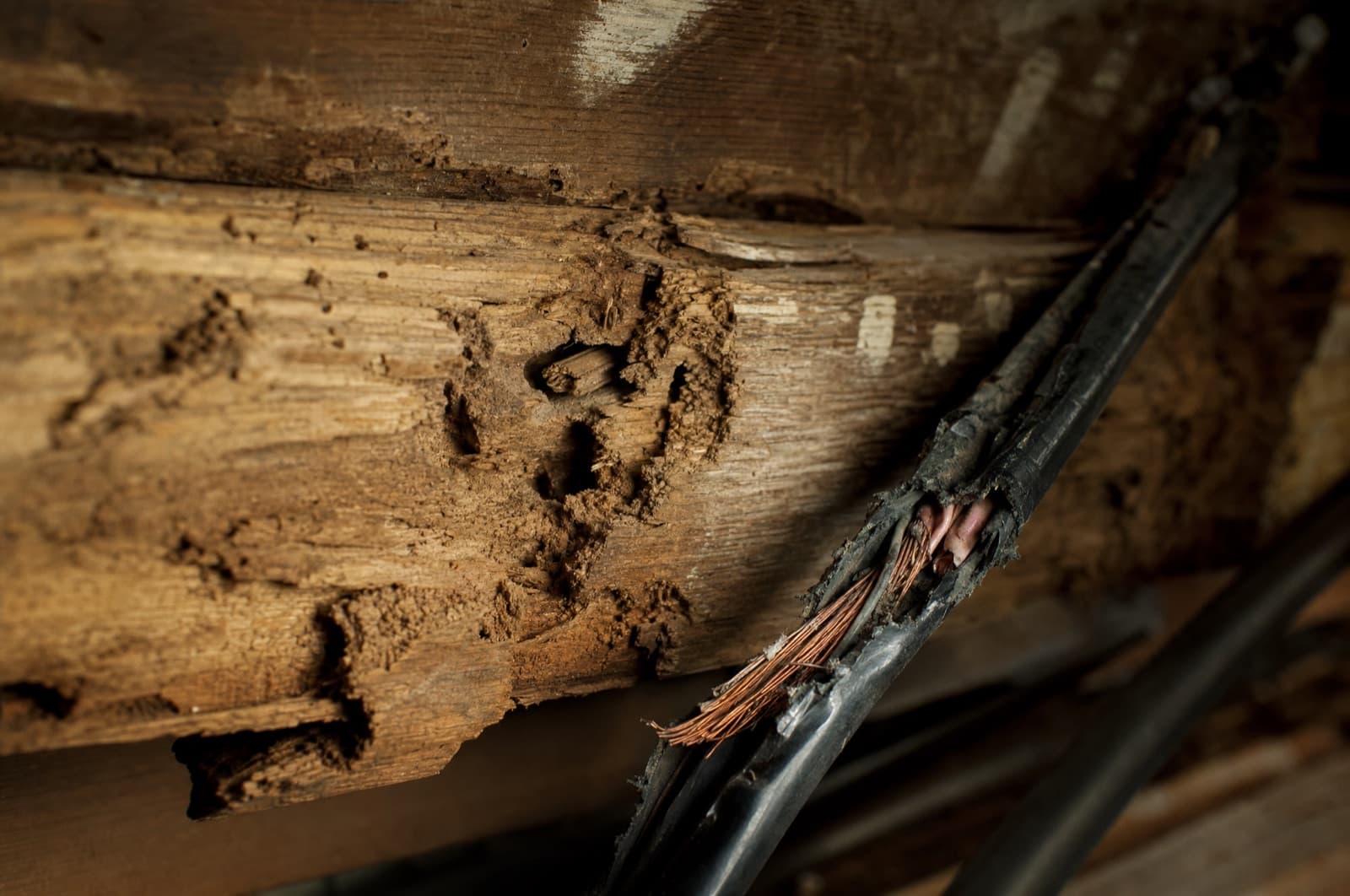
Pest damage evidence — a gnawed structural beam and a chewed electrical wire
Daniel Brady · NH-Licensed Pesticide Applicator · License #782664
Reviewed by Daniel Brady

Why do pests prefer moisture-damaged wood?

Structural (indirectly) — moisture is the shared root cause
Moisture-damaged wood is softer, easier to excavate, and often already partially broken down by decay fungi that pre-digest cellulose — making it more attractive and more nutritious to the pests that matter structurally. Carpenter ants overwhelmingly colonize wood that's already water-damaged. Powderpost beetles and old-house borers need elevated wood moisture to develop. Subterranean termites need high humidity to survive. Consumer pest-control copy tends to under-emphasize this; the honest, more useful answer is that moisture is the single addressable root cause behind most of the wood-destroying pests homeowners actually fear, and fixing it removes the shared driver.

At a glance

  • Can it?: Yes, but
  • How common: Routine
  • Hype: Understated
  • Evidence: Well documented
  • ~30% moisture

    Wood moisture content at which decay fungi generally begin

    USDA Forest Products Laboratory

  • 40-80% moisture

    Wood moisture range where decay fungi are most active

    USDA Forest Products Laboratory

  • below ~20%

    Wood moisture content that keeps wood largely protected from decay

    USDA Forest Products Laboratory

  • 10-12%

    Elevated wood moisture old-house borers need to complete development

    Mississippi State Extension

The honest answer

The short of it

The verdict
Structural (indirectly) — moisture is the shared root cause

Moisture-damaged wood is easier to excavate, supports decay fungi that partially pre-digest cellulose, and supplies the water several wood-destroying pests need directly — moisture is the master switch behind nearly every genuine structural fear in this cluster.

The correction

What they claim vs. what the evidence supports

One shared severity track, two markers. The span between them is the hype delta — named out loud.

The claim — how much moisture actually explains wood-destroying pest activity

That pests attack wood indiscriminately — any wood, anywhere, regardless of its condition — with moisture treated as a minor contributing factor rather than the central driver.

Where the claim comes from: General pest-control marketing copy that lists wood-destroying pests and their targets without emphasizing why some wood gets attacked and other wood doesn't.

Severity, 0–100
Hype says50
65Evidence says
Underrated — worse than you think15point gapWell documented
The evidence

Moisture is far more central than consumer copy usually credits. The USDA Forest Products Laboratory establishes that decay fungi require moisture and organic material to establish, generally beginning around 30 percent wood moisture content and most active between 40 and 80 percent — wood kept below roughly 20 percent is largely protected. UNH Cooperative Extension states carpenter ants 'strongly prefer damp wood for excavating.' Powderpost beetles and old-house borers both need elevated wood moisture to develop, and subterranean termites need high humidity. Peer-reviewed work in Nature Scientific Reports documents insect tunnels acting as entry points for fungal spores, creating a compounding cycle between decay and infestation.

The gap

Consumer copy under-emphasizes moisture; the honest answer elevates it. Moisture is the single most addressable root cause across nearly every genuinely severe pest in this cluster, and naming it clearly — rather than treating it as a footnote — is the single most useful thing this whole cluster can tell a homeowner.

Damage assessment

What is actually harmed

Damage verdict
Structural (indirectly) — moisture is the shared root cause
StructuralCan it?Yes, but
The specimen
Pest
Carpenter ants, subterranean termites, powderpost beetles, and old-house borers (as a shared moisture-driven group)
What is in question
Chronically wet wood near leaks, poor drainage, ground contact, or unventilated crawlspaces
How common
Routine
Evidence
Well documented
Mechanism

Moisture works on wood through two connected pathways. First, it enables decay fungi: the USDA Forest Products Laboratory's Wood Handbook establishes that fungal decay requires both moisture and organic material, generally beginning near 30 percent wood moisture content and most active between 40 and 80 percent, while wood kept below roughly 20 percent is largely protected. Decayed wood is softer and its cellulose is partially broken down, which is why carpenter ants — which cannot digest sound wood efficiently and gain no food value from wood at all — 'strongly prefer damp wood for excavating' (UNH Cooperative Extension), and why termites find partially decayed wood easier to consume. Second, moisture directly meets several pests' physiological needs: powderpost beetles and old-house borers require elevated wood moisture (roughly 10 to 12 percent or higher) to complete development, and subterranean termites require high humidity to survive away from direct soil contact. Peer-reviewed research in Nature Scientific Reports documents a compounding cycle where insect tunnels themselves become entry points for fungal spores, deepening the decay that then invites further insect activity.

Actually at risk4
  • Wood near chronic roof or plumbing leaks
  • Wood in poor-drainage areas or with inadequate grading away from the foundation
  • Wood in direct or near-constant ground contact
  • Wood in unventilated, humid crawlspaces or attics
Not at risk — despite the myth3
  • Dry, well-ventilated, sealed wood below roughly 13 to 20 percent moisture content — largely protected from decay fungi and much less attractive to carpenter ants, powderpost beetles, and old-house borers alike
  • Wood with no history of leaks, condensation, or ground contact
  • Concrete, steel, and masonry — moisture doesn't make these attractive to any wood-destroying pest, because they were never a target to begin with
Worst realistic case
A persistent, unaddressed leak driving a combined cycle of fungal decay plus carpenter-ant, termite, or beetle activity in the same timber over years — the compounding endpoint of ignoring the moisture rather than the pest.

Assessed from: USDA Forest Products Laboratory — Wood Handbook GTR-282, ch.14 Biodeterioration; UNH Cooperative Extension — Carpenter Ants fact sheet; Nature Scientific Reports (2022) — Quantifying wood decomposition by insects and fungi

Repair scope

Who actually fixes this

Scope, not dollars — the honest answer to “how expensive is it,” routed to the right trade.

Who fixes it
Pest pro first
Effort
A project

Resolving the pest without correcting the moisture source treats only half the problem — the wood stays exactly as hospitable to the next colony, generation, or infestation as it was before treatment.

The right order
  1. 1
    Stop the water first — identify and fix the leak, drainage issue, or ventilation problem (a plumber or roofer's job)
  2. 2
    Resolve the active pest — carpenter ants, termites, or beetles (Anchor's lane)
  3. 3
    Have a contractor replace or repair any wood the moisture and pest activity have genuinely compromised
Route by symptom
  • Licensed contractorThe affected wood shows visible sagging, softness, or hollowing, indicating the decay or excavation has progressed beyond a surface issue
Do not
  • Don't treat the pest repeatedly without ever addressing the moisture source — you'll be back for the same problem
  • Don't assume dry wood needs the same vigilance as damp wood — it's a genuinely lower-risk target for nearly every pest in this cluster
Where we help — and where we don't

Anchor resolves the pest — but we'll tell you plainly when the real root cause is a moisture source we don't fix. That's a roofer or plumber's job, and skipping it means the pest problem is likely to return even after a successful treatment.

In depth

The full picture

01

The master switch behind this whole cluster

If there's one fact that ties together nearly every genuinely severe pest covered across this hub's wood-destroying cluster, it's this: moisture is the shared precondition. Carpenter ants overwhelmingly colonize wood that's already water-damaged rather than sound dry lumber. Powderpost beetles and old-house borers both require elevated wood moisture to complete their development cycles. Subterranean termites need high humidity to survive outside direct soil contact. Even wasps, which merely scrape surface fiber for nest paper, prefer weathered wood that moisture has already begun to break down. None of these pests are choosing wood at random — they're all responding, in different ways, to the same underlying condition.

02

How moisture actually changes the wood

The mechanism runs through decay fungi. The USDA Forest Products Laboratory's Wood Handbook establishes that fungal decay requires moisture and organic material together, with decay generally beginning near 30 percent wood moisture content and running most actively between 40 and 80 percent; wood kept below roughly 20 percent moisture is largely protected. Once fungi establish, they partially break down the wood's cellulose structure — softening it physically and making its remaining cellulose more accessible. That's precisely why UNH Cooperative Extension can state that carpenter ants 'strongly prefer damp wood for excavating': the ants aren't targeting moisture for its own sake, they're targeting wood that moisture has already made easier to carve. The same softening effect makes partially decayed wood more digestible for termites, which is one reason infestations cluster so reliably around chronic leaks and poor drainage rather than appearing evenly throughout a structure.

03

A compounding cycle, not a one-time condition

This isn't a static relationship. Peer-reviewed research published in Nature Scientific Reports documents that insect tunnels themselves become entry points for fungal spores — meaning early insect activity can deepen the very decay that then invites further insect activity, in a cycle that reinforces itself over time. That's part of why a chronic, unaddressed leak tends to produce worsening pest activity in the same spot year after year rather than a single, contained event: the fungi and the insects are feeding each other's opportunity, and neither one alone fully explains the eventual damage.

04

Why this is the most useful correction in the whole cluster

Consumer pest-control content routinely under-states how central moisture is, usually mentioning it as one bullet point among many rather than the addressable root cause it actually is. The honest, more useful framing inverts that emphasis: fixing a leak, improving drainage, or ventilating a damp crawlspace does more to prevent carpenter ants, termites, and wood-boring beetles simultaneously than treating any single pest in isolation. Wood kept dry is a poor target for nearly everything in this cluster — which is exactly why naming the moisture problem, not just the pest, is the single most valuable thing a homeowner can take away from this entire subject.

Key takeaways
5 points
  • Moisture is the shared precondition behind nearly every genuinely structural pest in this cluster — carpenter ants, termites, powderpost beetles, and old-house borers alike.
  • Decay fungi require moisture to establish, and they partially pre-digest wood's cellulose, making it softer to excavate and more digestible.
  • Carpenter ants 'strongly prefer damp wood for excavating' (UNH Extension) — they overwhelmingly colonize wood a leak has already softened.
  • Insect tunnels can become entry points for fungal spores, creating a self-reinforcing cycle between decay and infestation.
  • Fixing the moisture source addresses the attractiveness of wood to nearly every pest on this list at once — it's the single most useful preventive step.
New Hampshire context

What this looks like in New Hampshire homes

Southern and central New Hampshire's wet spring thaw, heavy snow load, and older housing stock combine to keep certain spots — roof valleys, foundation sills near a discharging downspout, and poorly ventilated crawlspaces — chronically damp long after the surrounding structure has dried out. Those specific spots are where carpenter ant frass, termite mud tubes, and powderpost beetle activity most reliably turn up locally, and they're also exactly the spots a homeowner can check directly: gutters and downspout discharge points, grading away from the foundation, and crawlspace ventilation are the practical, addressable moisture sources behind most of this cluster's genuine structural risk in New Hampshire.

  • NH-licensed #782664

    Southern New Hampshire

  • Family-owned

    Since 2017

  • Honest routing

    Even when it isn’t us

We serve these communities

ManchesterNashuaConcordDerryBedfordSalemHudsonAmherstAuburnGoffstownHooksettLitchfieldLoudonMilfordBristol

Service Area Map

Southern New Hampshire

BristolPop. 3,200LoudonPop. 5,500ConcordPop. 43,900HooksettPop. 14,800GoffstownPop. 18,000AuburnPop. 5,700ManchesterPop. 115,600BedfordPop. 23,300LitchfieldPop. 8,500AmherstPop. 11,300DerryPop. 34,500MilfordPop. 15,700HudsonPop. 25,600NashuaPop. 91,100SalemPop. 30,000HQCityHover for info

Found frass, mud tubes, or soft wood near a leak? The moisture is the real story.

Anchor resolves the pest — and we'll tell you plainly when the leak needs a roofer or plumber first.

Follow-up questions

Frequently asked

Sources & citations(4)
  1. USDA Forest Products Laboratory — Wood Handbook GTR-282, ch.14 Biodeterioration

    Fungal decay requires moisture and organic material; decay begins near 30% wood moisture content, most active 40-80%; wood below ~20% largely protected

    govverified 2026-07-16
  2. UNH Cooperative Extension — Carpenter Ants fact sheet

    Carpenter ants 'strongly prefer damp wood for excavating'

    extensionverified 2026-07-16
  3. Nature Scientific Reports (2022) — Quantifying wood decomposition by insects and fungi

    Insect tunnels acting as entry ports for fungal spores; a compounding decay-and-infestation cycle

    academicverified 2026-07-16
  4. Mississippi State Extension — Old House Borer

    Old-house borer moisture requirements (roughly 10-12% wood moisture)

    extensionverified 2026-07-16

Written & reviewed by

Verified

Daniel Brady

NH-Licensed Pesticide Applicator · License #782664 (NHDAMF, RSA 430)

Daniel Brady is the New Hampshire–licensed applicator behind Anchor Pest Services, a family-owned pest control company serving the Manchester area since 2017.

Verify license

Last updated Jul 2026

Honest pest help for New Hampshire homes

We Treat the Pest. We'll Name the Moisture Problem Behind It.

Carpenter ants, termites, and wood-boring beetles almost always show up where wood has stayed wet. Anchor Pest Services resolves the active pest — and we'll say plainly when the actual fix starts with a roofer or plumber correcting the moisture source, not another pest treatment. Family-owned since 2017, NH license #782664, serving Manchester, Nashua, Concord and nearby towns.

  • Honest advice — we name the moisture problem instead of just re-treating the symptom
  • NH-licensed applicators (#782664) — free inspection, same-day service
  • Carpenter ant, termite, and wood-boring beetle treatment across southern and central New Hampshire

NH License #782664 · No obligation · We answer in person