
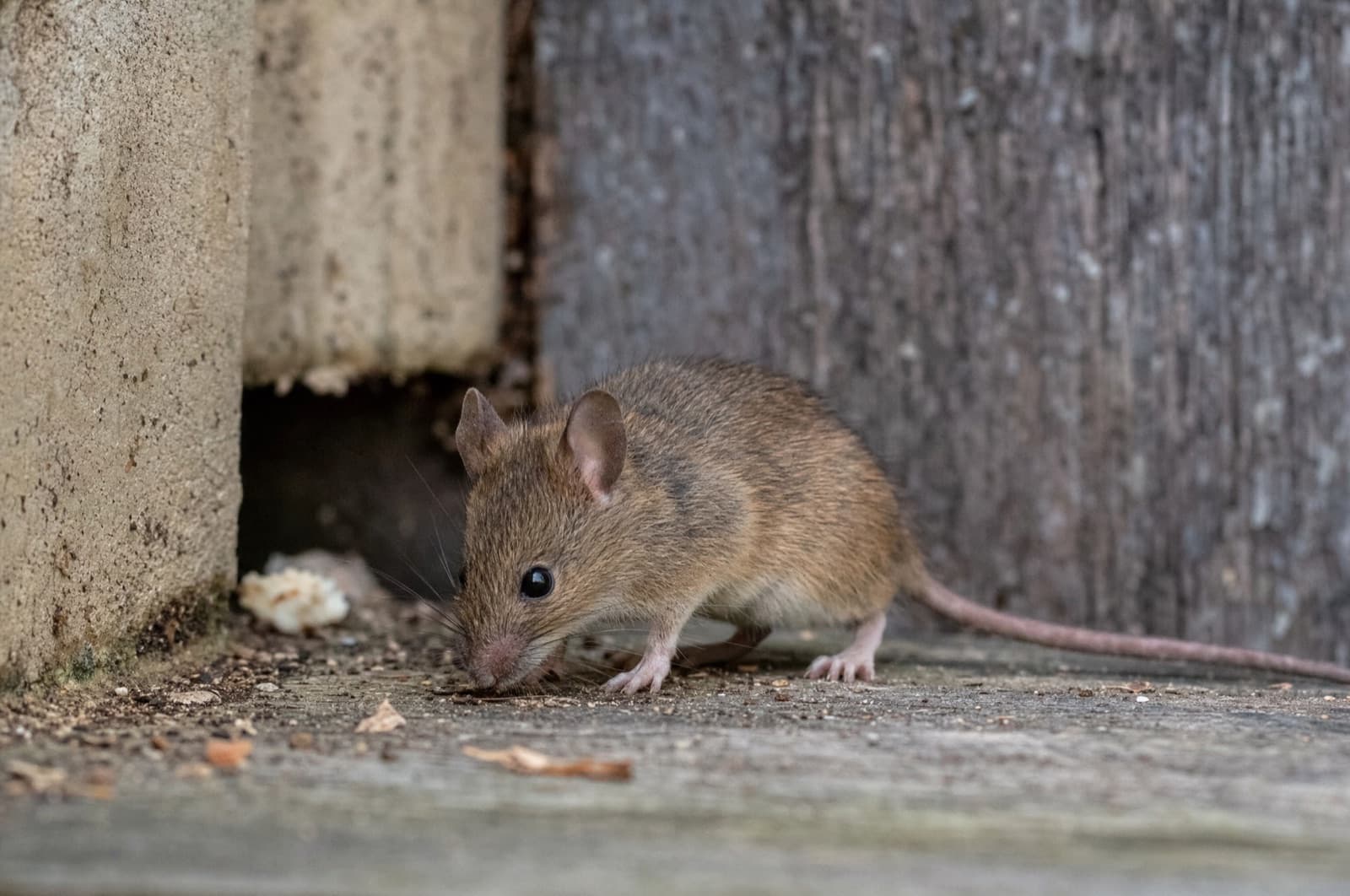
House Mouse in New Hampshire — ID, Signs & Control
The house mouse (Mus musculus) is the most common indoor rodent in New Hampshire — uniform gray-brown with a hairy tail and a musky ammonia smell. It does not carry hantavirus, but contaminates food, triggers allergies, and gnaws wiring. A fresh single-room sighting is a legitimate DIY job; droppings in multiple rooms signal an established population.
- Body size
- ~2.5–3.5 in body + ~3–4 in tail; ~0.5 oz
- UNL Extension G1105
- Droppings/day
- 50–75 (⅛–¼ in, pointed)
- UNL Extension G1105
- Entry gap
- Squeezes through openings ¼ inch or larger
- UNL Extension / CDC
- Reproduction
- 5–10 litters/yr of 5–6 young; matures in 6–10 weeks
- UNL Extension G1105
- Hantavirus?
- No — deer mice carry it, not house mice
- CDC
- NH presence
- Very common indoors statewide, year-round
- UNH Cooperative Extension
- Peak indoor season
- Fall — first hard frost ~Oct 19–29 Manchester
- NOAA 1991–2020
NH's most common indoor rodent — and how to ID it in under a minute
The house mouse (Mus musculus) is the most common indoor rodent invader in New Hampshire, active in every city Anchor serves and every season of the year. Uniform gray-brown, roughly the size of a AA battery, with a hairy (not scaly) tail about as long as its body and an unmistakable musky ammonia odor — that combination separates it from every other small rodent in NH.
The gnaw-mark decoder that sets this page apart: gnaw marks about 1/32-inch wide and clean dime-sized entry holes mean mouse; ⅛-inch marks and quarter-sized ragged holes mean rat. Mice also deposit 50–75 droppings per day, which is a useful gauge of how large the infestation is. Re-inspect 24 hours after cleaning up droppings — fresh ones confirm the infestation is still active.
The honest DIY verdict: a fresh, single-room sighting is a legitimate DIY job using snap traps along walls plus sealing every ¼-inch gap. But a female raises 5–10 litters of 5–6 young a year, so droppings in multiple rooms or recurring activity signals an established population that benefits from professional help. One important reassurance: house mice do not carry hantavirus — that is the deer mouse and white-footed mouse.
How to identify a house mouse
Two features separate the house mouse from NH's native deer and white-footed mice: its coat is uniformly gray-brown with no sharp bicolor pattern (native mice have a crisp white belly and a two-toned tail), and it carries a distinctive musky ammonia odor from urine marking. From rats it is separated by size alone — even a juvenile rat has a proportionally large head, wide feet, and a thicker scalier tail.
House mouse
- Scientific name
- Mus musculus
- Family
- Muridae
- Size
- ~2.5–3.5 in body + ~3–4 in tail; ~0.5 oz
- Coloration
- Uniform light brown to gray; belly slightly lighter but never crisp white
- Habitat
- Inside human structures — kitchens, wall voids, attics, basements, crawl spaces
- Active season
- Year-round indoors; outdoor activity declines in cold months
- Diet
- Prefers cereal grains but eats virtually anything available
- Reproduction
- 5–10 litters per year of 5–6 young; young reach reproductive maturity in 6–10 weeks
- Lifespan
- 9–12 months typical
Worldwide human commensal; ubiquitous across New Hampshire year-round
The tells — key ID features
- Uniform gray-brown coat with no sharp bicolor tail — the single best tell vs. native NH mice.
- Hairy (not scaly) tail about as long as the body.
- Large ears relative to head; pointed nose; long whiskers.
- Musky, ammonia-like urine odor — often the first sign noticed in a closed space.
- Slightly lighter belly but never the crisp white of a deer or white-footed mouse.
Size, to scale
~2.5–3.5 in body + ~3–4 in tail; ~0.5 oz
Whole body about the size of a AA battery; weighs about as much as two quarters.
Deer mouse
How to tell — Sharply bicolor tail (dark above, white below), crisp white belly and feet, large dark eyes, no musky odor — and it is the primary U.S. hantavirus carrier.
White-footed mouse
How to tell — White belly and feet, tail shorter and less distinctly bicolor than the deer mouse — the major NH Lyme disease reservoir.
Juvenile Norway rat
How to tell — Much larger head and feet relative to body; tail thicker and scalier; will grow far larger than any mouse.
Vole
How to tell — Stubby ~1-inch tail, small hidden ears, stocky blunt-nosed build — an outdoor lawn pest that almost never enters houses.
Signs of a problem
The gnaw-mark and dropping decoder is the fastest way to confirm house mice and gauge how serious the infestation is. Six signs to look for:
Pointed rice-grain droppings (⅛–¼ in, black)
What it means — Active feeding — 50–75 droppings per mouse per day gauges population size; re-inspect 24 hours after cleanup to confirm fresh activity.
~1/32-inch gnaw marks and clean dime-sized entry holes
What it means — Mouse, not rat — Norway rats leave ~⅛-inch marks and quarter-sized ragged holes.
Oily dark rub marks along baseboards and wall-floor corners
What it means — Established runway — mice follow the same paths repeatedly, leaving grease and fur marks.
Nighttime scratching or scurrying sounds inside walls or ceilings
What it means — Active nesting indoors; the pattern is faster and lighter than a rat's heavier movement.
Musky, ammonia-like odor in a closed space
What it means — Concentrated urine marking — the larger and more established the population, the stronger the smell.
Shredded paper, insulation, or fabric collected in a hidden area
What it means — A nesting colony is established inside the structure and likely breeding.
The real risks, calibrated
House mice do not carry hantavirus, but they pose real contamination, allergy, and fire risks that scale with population size.
Food and surface contamination
ModerateOnset: Within days of establishment
Droppings and urine contaminate stored food, countertops, and utensils; Salmonella and other pathogens can be mechanically transferred.
Asthma and allergy trigger
ModerateOnset: Ongoing with any active infestation
Mouse urine proteins and shed dander are significant indoor allergens, particularly aggravating asthma in children — documented by CDC.
Electrical fire from gnawed wiring
HighOnset: Unpredictable — can be months after entry
Mice gnaw wiring insulation continuously; this is a documented cause of residential fires. Have wiring inspected if mice are found in walls or attics.
Rapid population growth
HighOnset: Weeks
A single pair can produce dozens of offspring within months as young reach reproductive age in 6–10 weeks, making early action critical.
DIY — what works, what backfires
A fresh, single-room house mouse sighting is a legitimate DIY job — snap traps plus exclusion. Here is what works and what wastes your time.
What actually works
- Place wooden snap traps perpendicular to walls with the trigger facing the baseboard, at 6–10-foot intervals where droppings appear — mice travel along edges, not across open floors.
- Seal every gap ¼ inch or larger with copper or steel mesh plus caulk or expanding foam, focusing on foundation penetrations, pipe entries, sill plates, and door thresholds.
- Store all food (including pet food and birdseed) in sealed hard-sided containers to eliminate the food source driving the infestation.
- Re-inspect 24 hours after cleaning up droppings — fresh droppings confirm active infestation; none found suggests the mouse may have been a stray.
- Inspect and seal before the NH fall frost push (before October) rather than waiting until mice are already inside.
What backfires
- Don't use rodenticide bait stations near children, pets, or in areas where a poisoned mouse could die inside a wall and decompose.
- Don't rely on peppermint oil, ultrasonic devices, or dryer sheets — there is no peer-reviewed evidence these repel mice in real-world settings.
- Don't assume mice will leave on their own or hibernate in winter — they stay active and forage all year and will not self-evict.
- Don't trap without sealing entry points — trapping without exclusion simply replaces removed mice with new ones.
House mice in New Hampshire homes
Peak indoor pressure arrives in fall as NH temperatures drop around the first-hard-frost window — Manchester ~Oct 19–29 (NOAA 1991–2020); Concord ~Oct 3; Keene ~Oct 1. Mice exploit gaps in fieldstone and granite-block foundations common in older NH homes, sill-plate openings, and unweatherstripped door thresholds. Contrary to a common myth, house mice do not hibernate — they stay active and forage all winter, which is why a sealed home can still see fresh droppings after the first frost if a single entry gap was missed.
Peak season
Year-round indoors; fall invasion surge at first frost
You might actually have
- Deer mouse (bicolor tail, rural/wooded NH; hantavirus carrier)
- White-footed mouse (shorter bicolor tail; primary NH Lyme reservoir)
- Norway rat (much larger; burrows at foundations)
We serve these communities
- NH-licensed applicator · #782664
- Same-day service
- Family-owned since 2017
Service Area Map
Southern New Hampshire
When to call Anchor Pest Services for mice
A licensed rodent control technician can locate every entry point (not just the obvious ones), place traps in wall voids and attic spaces that homeowners cannot safely reach, and confirm through follow-up visits when the infestation is fully cleared — saving weeks of guesswork on an established population.
When to call a pro
- Droppings in multiple rooms or areas, indicating an established colony rather than a stray mouse.
- Recurring activity season after season despite repeated DIY trapping and exclusion attempts.
- Evidence in wall voids, attics, or crawl spaces you cannot safely or effectively access.
- Gnawed wiring discovered — both pest control and an electrical inspection are warranted.
Exclusion before the fall frost push
Inspect and seal every ¼-inch gap — especially along fieldstone or granite-block foundations, sill plates, and utility penetrations — before October when mice begin moving indoors.
Eliminate harborage near the home
Keep firewood stacked at least 20 feet from the house; remove debris, dense ground cover, and leaf piles that give mice shelter close to entry points.
Sanitation
Store food in sealed containers; clean up spills promptly; empty trash regularly; keep pet food dishes empty overnight.
Not sure it's a house mouse?
A licensed NH technician can confirm the species and tell you honestly whether it's a DIY fix or a job for a pro — free inspection, same-day service across Southern New Hampshire.
Frequently asked questions
Sources(6)
- [1]UNL Extension — Controlling House Mice (G1105)
body size, dropping rate, entry gap, reproduction, lifespan, gnaw-mark widths
extensionverified 2026-06-30 - [2]
- [3]Victor Pest — House Mouse Damage Identification
gnaw-mark and dropping scale description
industryverified 2026-06-30 - [4]UNH Cooperative Extension
NH seasonal context, sanitation-first control guidance
extensionverified 2026-06-30 - [5]NOAA Climate Normals 1991–2020 — Manchester-Boston Regional Airport
Manchester first hard frost ~Oct 19 (50%) / Oct 29 (80%)
govverified 2026-06-30 - [6]
Written & reviewed by
VerifiedDaniel Brady
NH-Licensed Pesticide Applicator · License #782664 (NHDAMF, RSA 430)
Daniel Brady is the New Hampshire–licensed applicator behind Anchor Pest Services, a family-owned pest control company serving the Manchester area since 2017.
Last updated 2026-06-30

New Hampshire pest control
Dealing with house mouses in your home?
Anchor Pest Services identifies and handles house mouse problems across southern and central New Hampshire. Family-owned since 2017, NH license #782664.
- NH-licensed applicators (#782664)
- Same-day service · free inspection
- Family-owned since 2017
Your next step
- Book a NH pro
Rodent Control in New Hampshire
Mice and rats move indoors every fall. We trap, seal entry points and keep them out.
Book now - Next step
Are Mouse Droppings Dangerous to Touch?
Read the answer - What to do next
Where Do Mice Go in the Winter? NH Mouse Timing Guide
Read the answer - What to do next
How to Get Rid of House Mice
Read the answer - Related guide
Deer Mouse in New Hampshire — Hantavirus & Safe Cleanup
Read the answer - Also relevant
What Are the Signs of a Mouse Infestation?
Read the answer