
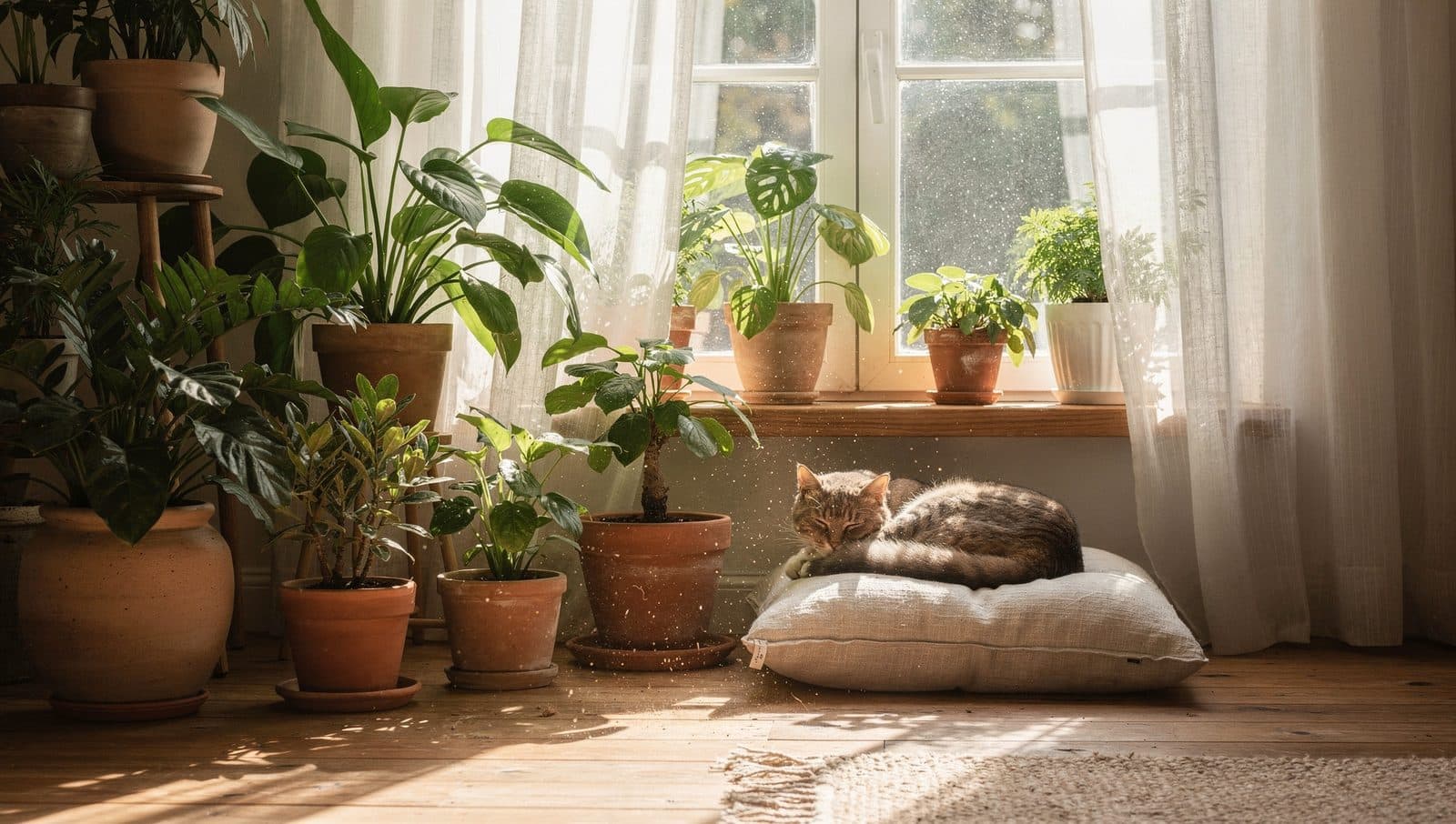
Are Leaf Pests Harmful to Pets?
The common sap-feeding insects on leaves — aphids, scale, mites, whiteflies — aren't considered significantly toxic to dogs and cats; the genuine pet hazards are certain caterpillars, Asian lady beetles, and pesticide residue.
At a glance
- The verdict: Low concern, with a few real exceptions
- Who fixes it: You
- Category: Health, Safety & Professional Service
The short answer
The small sap-feeding insects most people mean by "leaf pests" — aphids, scale, spider mites, whiteflies — aren't considered significantly toxic to dogs and cats, so this is mostly a low-concern question. The genuine hazards worth knowing are certain caterpillars, whose hairs and spines can irritate a pet's mouth and cause drooling or vomiting; Asian lady beetles, which can cause mouth ulceration; and, most importantly, the pesticides and baits people use on leaves and lawns. The ASPCA notes that eating caterpillars "can cause such issues as head shaking, pawing at the mouth, vomiting, diarrhea and irritation to the lips, mouth and throat." When a pet has eaten an unknown insect or a treated leaf, contact a vet or the ASPCA poison line.
Is this a risk to people or pets?
Health & safety
low concernWho's at risk: Curious dogs and cats that chew on insects, leaves, or garden debris, Pets in yards where caterpillars or Asian lady beetles are present, especially in late summer and fall, Pets in areas recently treated with a pesticide, snail bait, or rodenticide
- Let liquid pesticide sprays dry fully, and water in granular products, before letting pets back into a treated area
- Store snail bait, fly bait, and rodenticides where pets can't reach them
- Supervise pets around compost piles and unfamiliar insects or plants
- Don't assume a product labeled "natural" or "pet-safe" is automatically safe for pets to contact — it's an unregulated marketing term
- Don't give a pet any human medication without a veterinarian's direction
- Don't assume ordinary sap-feeding insects like aphids, scale, or mites are a poisoning risk
- Don't let pets into a freshly treated lawn or garden area until it's dry or watered in
Who actually fixes this?
Start here
You
Watching what your pet gets into in the yard, and storing pesticides and baits safely, is home supervision, not a pest-control job.
- Pest-control pro — You want pesticide or bait applied around the home in a way that keeps pets safely away from treated areas until they're dry or watered in.
The details, straight
The bugs on your leaves usually aren't the problem
Most of what people call "leaf pests" — aphids, soft scale, spider mites, whiteflies — are small, sap-feeding insects that aren't considered significantly toxic if a curious dog or cat eats one. A pet nosing around a plant with an aphid infestation is unlikely to have a toxic reaction from the insects themselves, though the ASPCA notes that eating any unfamiliar plant material can still cause ordinary vomiting or GI upset simply from the physical act of ingestion, not from a toxin.
The real exceptions: caterpillars, lady beetles, and what's in the spray bottle
The genuine hazards worth naming are more specific. Certain caterpillars have urticating or stinging hairs and spines that irritate a pet's mouth and digestive tract on contact — the ASPCA describes reactions including head shaking, pawing at the mouth, vomiting, diarrhea, and irritation to the lips, mouth, and throat. Asian lady beetles secrete a defensive compound that can cause mouth irritation or ulceration if eaten in numbers. And fireflies are specifically toxic to reptiles like bearded dragons. But the biggest real-world risk isn't the bugs at all — it's the pesticides, snail bait, and rodenticides people apply to control them, which are far more dangerous to a pet than the insects themselves.
What to do if your pet eats a bug (or a leaf)
For ordinary sap-feeding insects, watching for brief, mild GI upset is usually enough. If your pet has eaten a caterpillar or a lady beetle and is drooling, pawing at its mouth, or vomiting repeatedly, or if you suspect it's gotten into a pesticide or bait, call your veterinarian or the ASPCA Animal Poison Control Center at (888) 426-4435 — a consultation fee may apply. Don't wait to see if symptoms worsen if you know a bait or pesticide was involved.
Key takeaways
- Aphids, scale, spider mites, and whiteflies aren't considered significantly toxic to dogs and cats.
- Caterpillars and Asian lady beetles are the real insect hazards — mouth and GI irritation, not the ordinary sap-feeders.
- Pesticides, baits, and rodenticides are a bigger risk to pets than the insects they're meant to control.
- "Pet-safe" on a product label is a marketing term, not a regulated safety claim.
- Call a vet or the ASPCA Animal Poison Control Center at (888) 426-4435 for drooling, repeated vomiting, or known bait/pesticide exposure.
Worried about pesticides, not the bugs themselves?
Anchor applies treatments with label-directed precautions so pets can safely return to treated areas once dry.
Ask about pet-safe treatmentA note for New Hampshire pet owners
Fall leaf and yard cleanup in southern and central New Hampshire brings pets into more contact with caterpillars, lady beetles, and leaf piles as the first frost approaches (typically October 19–29 in Manchester). Anchor Pest Services applies pesticides with label-directed re-entry precautions to keep treated areas pet-safe once dry — but a specific ingestion concern is always a call to your veterinarian or the ASPCA poison line, not to us.
NH-licensed applicator #782664 (NHDAMF, RSA 430) · NEPMA member · family-owned since 2017.
Related questions
Sources(3)
- [1]ASPCA — Bad Bugs: What You Should Do to Keep Your Pets Safe
Caterpillars, Asian lady beetles, and fireflies as genuine pet hazards among insects
veterinaryverified 2026-07-14 - [2]ASPCApro — Fuzzy Green Poisoners: Caterpillar Toxicosis in Pets
Clinical signs of caterpillar ingestion in pets
veterinaryverified 2026-07-14 - [3]ASPCA — Tips for a Pet-Safe Yard and Garden
Pesticide/bait re-entry precautions and pet supervision around compost and unfamiliar plants
veterinaryverified 2026-07-14
Written & reviewed by
VerifiedDaniel Brady
NH-Licensed Pesticide Applicator · License #782664 (NHDAMF, RSA 430)
Daniel Brady is the New Hampshire–licensed applicator behind Anchor Pest Services, a family-owned pest control company serving the Manchester area since 2017.
Last updated 2026-07-14
Your next question
Honest pest help for New Hampshire homes
Pet Health Questions Are a Vet's Job — Safe Treatment Is Ours
We won't diagnose a pet health concern — that's always a call to your veterinarian or the ASPCA poison line. Where Anchor Pest Services genuinely helps is applying structural and yard pest treatments with label-directed precautions so your pets stay safe. Family-owned since 2017, NH license #782664, serving Manchester, Nashua, Concord and nearby towns.
- Honest advice — pet health concerns route to a vet, not a sales pitch
- New Hampshire license #782664 — free quotes, honest scope, no upsell
- Home and yard pest work across southern and central NH
NH License #782664 · No obligation · We answer in person
Your next step
- Book a NH pro
Pest Control Services
Licensed, family-owned pest control across southern NH.
Book now - What to do next
How to Get Rid of Asian Lady Beetles
Read the answer - Related guide
Is Leaf Mold Harmful to People or Pets?
Read the answer - Related guide
Can Leaf Pests Spread to My Home?
Read the answer - Related guide
What Time of Year Do Leaf Pests Appear?
Read the answer - Also relevant
Are They Dangerous to Dogs and Cats?
Read the answer