
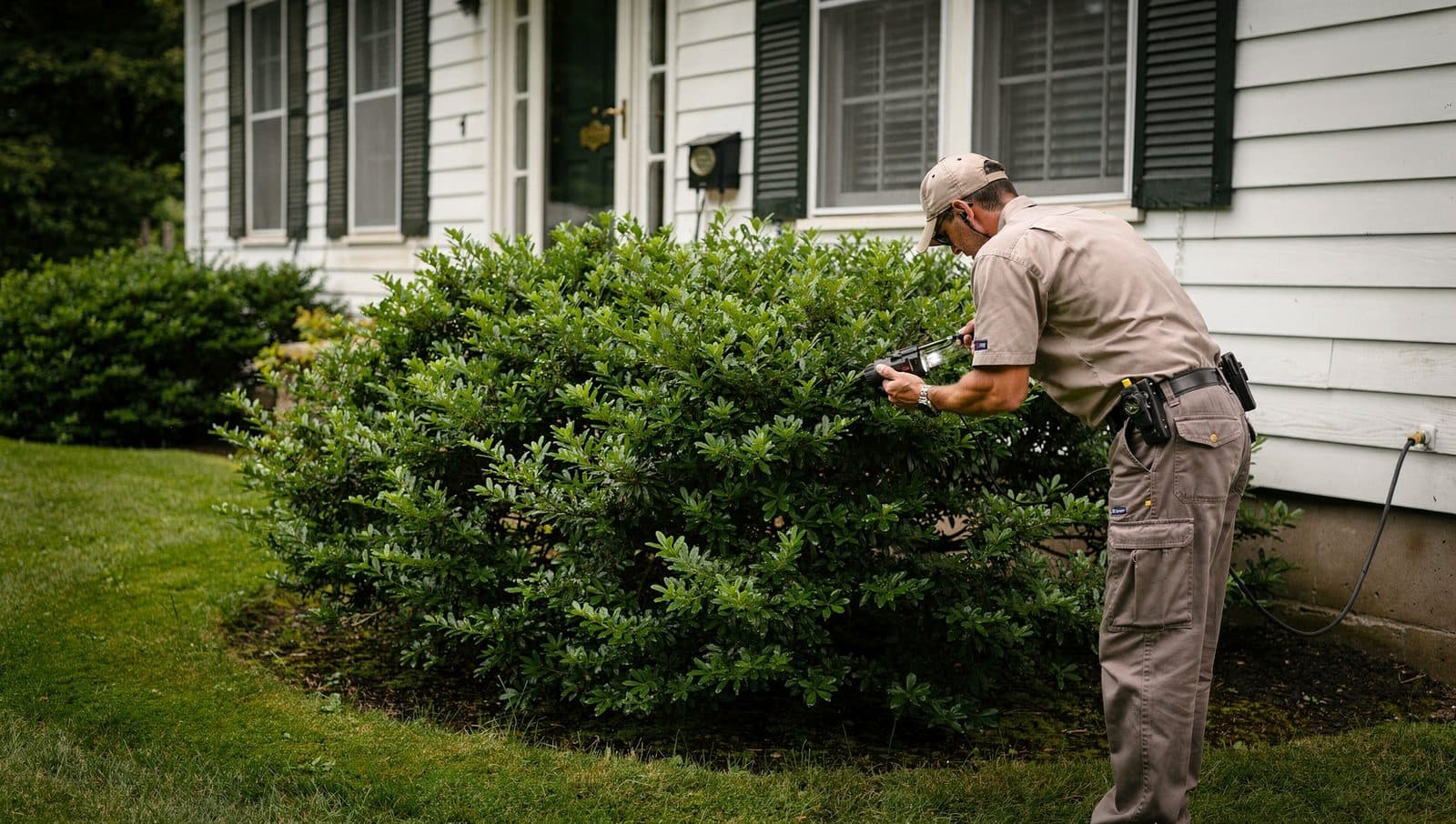
Can Professional Pest Control Help With Leaf Problems?
Professional pest control helps when leaves show a confirmed insect infestation or when yard debris is drawing pests toward your home — it can't fix a fungus, a watering mistake, or a nutrient deficiency.
At a glance
- The verdict: It depends — yes for pests, no for disease or care issues
- Who fixes it: UNH Extension
- Category: Health, Safety & Professional Service
The short answer
Sometimes — but for a lot of leaf problems, a general pest-control company is the wrong call. If leaves are damaged by insects or mites, or the real issue is pests moving toward your home from leaf litter and mulch, professional help genuinely fits. If the leaves have a fungal or bacterial disease, or the cause is watering, light, nutrients, salt, or frost, no pesticide fixes it — that routes to you, a garden center, UNH Cooperative Extension, or an ISA-certified arborist instead. Diagnosing which bucket you're in comes before deciding whether a pro is the right call.
Who actually fixes this?
Start here
UNH Extension
Since a large share of leaf problems turn out to be disease or a care mistake, the honest first step is confirming what you're actually dealing with — UNH Extension's identification services (or a basic pest-vs-disease-vs-cultural check) tell you whether a pro is even the right call before you book one.
- Garden center — It's a soft-bodied foliar pest like aphids, mites, or whiteflies — often a DIY fix with insecticidal soap or horticultural oil.
- Certified arborist — The plant in question is a tree showing dieback, trunk issues, or suspected disease.
- Pest-control pro — Leaves show a confirmed, spreading insect infestation, or pests are moving toward your home from leaf litter and mulch banked at the foundation.
The details, straight
Yes, for genuine pest damage and yard/structural risk
Professional pest control is the right tool when leaves show insect or mite damage that's spread beyond what DIY treatment can manage, or when the real concern isn't the leaves at all but what leaf litter and mulch are doing near your foundation. Removing mulch and leaf litter from building foundations reduces rodent harborage, and leaf litter and brush are a key tick-habitat feature — a Journal of Medical Entomology study reported by Cornell NYS IPM found that raking or blowing leaves into forest edges roughly tripled blacklegged tick nymph populations compared to areas without that leaf accumulation. That structural and yard-pest angle is where a professional genuinely adds value.
No, for disease and cultural problems — and that's most "leaf problems"
Disease and abiotic (cultural) problems are extremely common and frequently mimic pest damage: leaf spot, scorch, and chlorosis can all result from a fungal pathogen or from something as simple as de-icing salt exposure or fertilizer burn, according to University of Maine Extension's plant-pathology framework and university abiotic-disorder guidance. No pesticide, however well applied, corrects a watering schedule or fungal infection — spraying a disease or a care mistake wastes money and doesn't fix the underlying problem. This is the majority case, and an honest pest-control company will say so rather than treat it anyway.
The honest first step: find out which one you have
Because the pest-vs-disease-vs-cultural split determines everything else, identification comes before any decision about hiring a professional. Soft-bodied foliar pests are often a DIY-friendly fix with insecticidal soap or horticultural oil, while a tree showing dieback or trunk-level disease routes to an ISA-certified arborist rather than a general pest company. Confirming the cause first — through your own observation or a UNH Extension identification service — is what prevents paying for the wrong kind of help.
Key takeaways
- A pro genuinely helps with confirmed, spreading insect infestations and yard debris drawing pests toward the home.
- Disease and cultural (watering, salt, fertilizer) problems are common and no pesticide fixes them.
- Leaf litter/mulch removed from foundations reduces rodent harborage; leaf accumulation is linked to higher tick populations nearby.
- Trees with dieback or trunk disease route to an ISA-certified arborist, not a general pest company.
- Identify the cause first — it determines whether a pro is even the right call.
Not sure if your leaf problem is even a pest?
We'll tell you honestly if it's a disease or a care issue instead — before you pay for a visit that won't fix it.
Get an honest assessmentA note for New Hampshire yards
The tick-habitat and rodent-harborage risk from accumulated leaf litter is a genuine, seasonal concern in southern and central New Hampshire, especially as leaves pile up ahead of the first hard frost (typically October 19–29 in Manchester). That structural and yard-pest angle is where Anchor's help is real — routine leaf-disease or watering questions route to UNH Cooperative Extension instead.
NH-licensed applicator #782664 (NHDAMF, RSA 430) · NEPMA member · family-owned since 2017.
Related questions
Sources(5)
- [1]University of Maine Extension — Plant Pathology
Pest vs. disease vs. cultural framework
extensionverified 2026-07-14 - [2]MSU Extension — Abiotic Plant Disorders
Cultural causes that mimic pest/disease damage
extensionverified 2026-07-14 - [3]Texas A&M School IPM — Rodent Action Plan
Removing mulch/leaf litter from foundations to reduce rodent harborage
extensionverified 2026-07-14 - [4]Cornell NYS IPM — The Leaves Are Falling: Manage Wisely for Ticks
Leaf accumulation tripling nearby tick nymph populations
extensionverified 2026-07-14 - [5]Ohio State Extension — Hire an Arborist
Routing tree disease/dieback to an ISA-certified arborist
extensionverified 2026-07-14
Written & reviewed by
VerifiedDaniel Brady
NH-Licensed Pesticide Applicator · License #782664 (NHDAMF, RSA 430)
Daniel Brady is the New Hampshire–licensed applicator behind Anchor Pest Services, a family-owned pest control company serving the Manchester area since 2017.
Last updated 2026-07-14
Your next question
- Leaf FAQ
How do professionals treat leaf pests?
Read the answer - Leaf FAQ
What are the signs it’s time to call a pest expert for leaf problems?
Read the answer - Leaf FAQ
What should I expect from a professional leaf pest inspection?
Read the answer - Leaf FAQ
What’s the difference between leaf pest control and lawn pest control?
Read the answer
Honest pest help for New Hampshire homes
We'll Tell You When It Isn't a Pest Problem
Anchor Pest Services genuinely helps with confirmed insect infestations and the structural/yard-pest risk from leaf litter and debris near your home — and we'll route you elsewhere, honestly, when it's a fungus, a watering mistake, or a tree health issue. Family-owned since 2017, NH license #782664, serving Manchester, Nashua, Concord and nearby towns.
- Honest routing — we say when it isn't a pest-control job
- Licensed New Hampshire applicators, #782664 — free, no-pressure quote
- Structural and yard pest control for Manchester, Nashua, Concord and nearby towns
NH License #782664 · No obligation · We answer in person
Your next step
- Book a NH pro
Pest Control Services
Licensed, family-owned pest control across southern NH.
Book now - Related guide
Do Leaf Problems Mean My Soil Is Bad?
Read the answer - Related guide
What Are the Signs It's Time to Call a Pest Expert for Leaf Problems?
Read the answer - Related guide
Can Neem Oil Help With Leaf Problems?
Read the answer - Related guide
How Much Does Leaf Pest Control Cost?
Read the answer - Related guide
What's the Difference Between Leaf Pest Control and Lawn Pest Control?
Read the answer