
Are They Dangerous to Dogs and Cats?
At a glance
- The short answer: No — not toxic, but one real hazard is documented
- How to tell: Behaviour, not colour — see The Split
- Where removal lives: We route it out — this hub owns identity
One animal, one honest answer
The verdict on Are they dangerous to dogs and cats?
They aren't poisonous or venomous to dogs or cats — but a dog that mouths a cluster can get real, chemical-burn-type oral ulceration, and that's worth a vet visit.
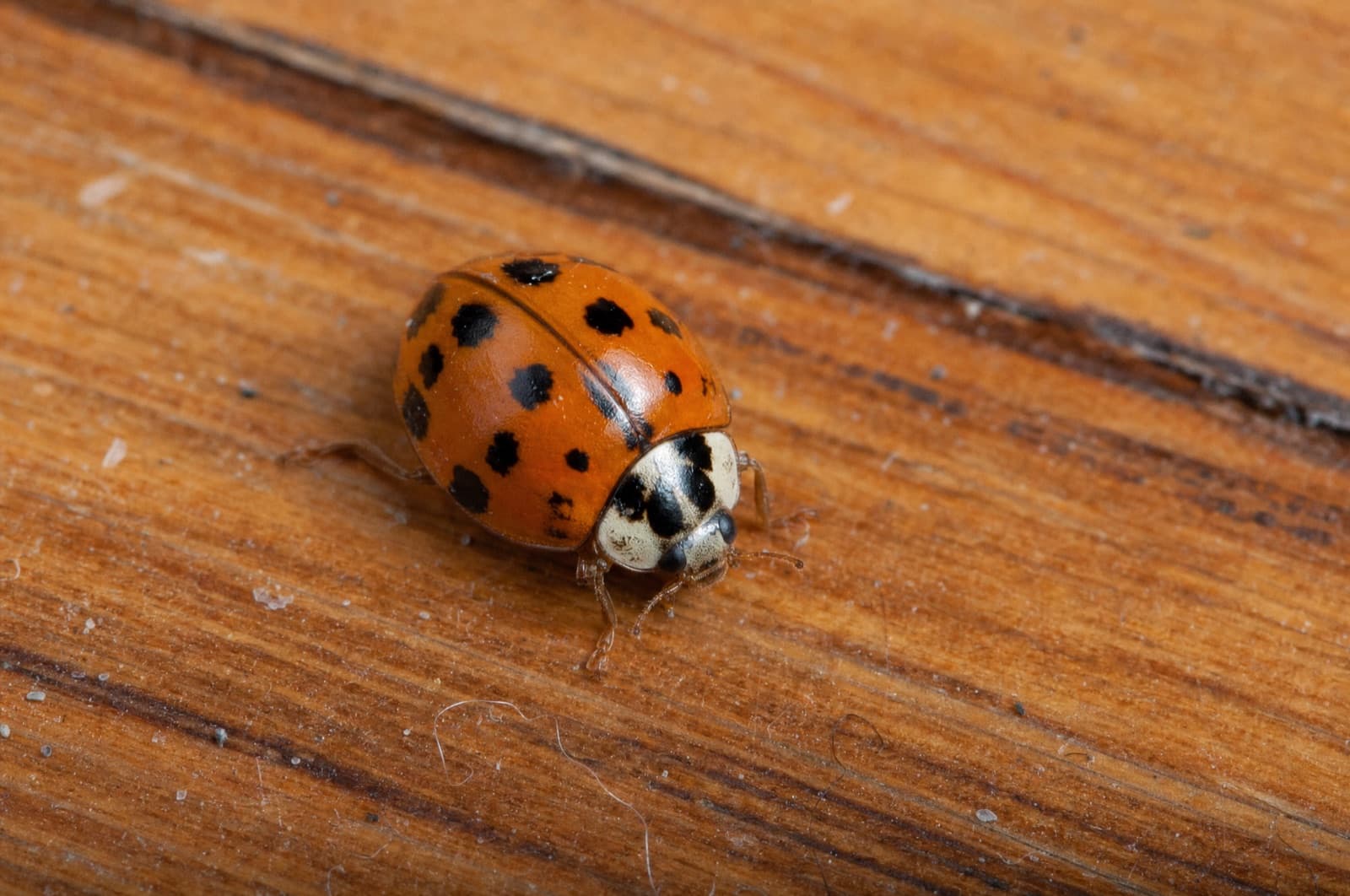
Native ladybug vs. the Asian lady beetle
Two names, one animal. Both columns always render — and they always converge on the same resolution. The tell is behaviour, not colour.
The native ladybug
(the one you're picturing)
- Carries the same general reflex-bleeding defense as other coccinellids, but rarely encountered by pets indoors in numbers, since it doesn't aggregate in houses
- Not a documented source of the oral-ulceration cases described for Harmonia axyridis
The Asian lady beetle
(Harmonia axyridis)
- The species behind the one published veterinary case of oral trauma in a dog, caused by its corrosive defensive fluid, not a toxin
- Colour runs pale yellow-orange to deep red to fully black — colour alone is a weak tell, not a diagnosis, and irrelevant to whether a given beetle poses this risk
Whichever name you use, the pet-safety answer is the same: no toxin, no venom, but a real, narrow mouth-injury risk exists if a pet bites into a cluster of them.
What's actually going on
Not a toxin — a corrosive defensive fluid, and the risk is real but narrow
The mechanism is the same reflex-bleeding defense that produces the beetle's yellow stain and foul smell (see the-smell-and-the-yellow-stain): when disturbed, the beetle exudes hemolymph from its leg joints, and that fluid is mildly corrosive rather than simply distasteful. The one formally published veterinary case, in the journal Toxicon, describes a six-year-old dog that presented with severe oral trauma after biting into a cluster of beetles: sixteen Harmonia axyridis were removed from the animal's oral cavity, which revealed damage consistent with a chemical burn, with beetles embedded in the mucosa covering the hard palate and requiring manual removal (Stocks & Lindsey). That case, and the veterinary commentary around it, is explicit that most animals spit the beetles out after one or two because of the foul taste, which is exactly why harmful encounters are described as rare rather than common. If a large number are swallowed, the same defensive chemistry can also irritate the digestive tract.
What to actually do — and what this page won't tell you to do
If a dog or cat shows drooling, pawing at the mouth, or visible distress after mouthing a cluster of beetles, the appropriate step is a veterinary visit, not a home remedy or a wait-and-see approach — oral chemical burns are a medical issue, and this hub does not give dosages, treatments, or first-aid steps for pets. The practical way to avoid the scenario entirely is limiting the size of an indoor aggregation in the first place, which is a removal question this hub deliberately routes elsewhere: /top-diy-methods/asian-lady-beetle covers that in full. Worth knowing for a New Hampshire household with a curious dog: UNH Cooperative Extension reports these beetles are most numerous on the sunny side of buildings on mild days from mid-September through early November, and it recommends sealing cracks and crevices to the outside before mid-September — closing the entry window ahead of that fall push is the most reliable way to keep a mouthful of them from ever ending up indoors. This page's job is narrower and more honest — say plainly what the documented risk actually is, and isn't, without either alarming pet owners or waving the concern away.
Key takeaways
Not toxic or venomous to dogs or cats — but one real, published hazard exists: corrosive defensive fluid causing oral ulceration if a pet mouths a cluster.
The one documented veterinary case involved sixteen beetles embedded on a dog's hard palate, described as a chemical burn, not poisoning.
Most animals spit the beetles out immediately because of the taste, which is why harmful encounters are documented as rare.
This page replaces 4 of our own legacy pages that split this question by pet and by species name instead of giving one honest answer.
These questions all land here
We asked this more than once, under more than one name, and printed more than one answer. There was only ever one — so here's what this page replaces.
Our old site split this question by which pet and by which species name — toxic to dogs, poisonous to cats, bite pets, dangerous to pets. One animal, one mechanism, one honest answer for both dogs and cats.
Looking to get rid of them?
This hub answers what it is — not how to remove it. Most people who land here actually want one of these next steps, so we hand you straight to the hub that owns it.
A rare risk is still worth reducing.
The oral-injury case is rare, but fewer beetles clustering on your home means fewer chances your dog finds a whole mouthful of them.
Frequently asked
Sources & further reading(4)
- [1]Stocks & Lindsey — Toxicon, "Acute corrosion of the oral mucosa in a dog due to ingestion of Multicolored Asian Lady Beetles"
Published veterinary case: sixteen beetles removed from a dog's oral cavity, revealing chemical-burn-type trauma
academicverified 2026-07-17 - [2]Schmidtberg et al. — Ecology and Evolution, defensive chemistry of Harmonia axyridis
Reflex-bleeding mechanism and the defensive hemolymph's chemistry
academicverified 2026-07-17 - [3]Iowa State University Extension — "Ladybug, Multicolored Asian Lady Beetle"
Colour and spot-count variability of Harmonia axyridis
extensionverified 2026-07-17 - [4]UNH Cooperative Extension — Multicolored Asian Ladybug fact sheet
Beetles most numerous on sunny sides of buildings mid-September through early November; seal cracks before mid-September
extensionverified 2026-07-17
Written & reviewed by
VerifiedDaniel Brady
NH-Licensed Pesticide Applicator · License #782664 (NHDAMF, RSA 430)
Daniel Brady is the New Hampshire–licensed applicator behind Anchor Pest Services, a family-owned pest control company serving the Manchester area since 2017.
Last updated July 2026
Honest pet-safety guidance for New Hampshire homes
One Real Risk, Stated Plainly — Not Four Different Answers
Not toxic, not venomous — but a documented, narrow oral-injury risk if a pet mouths a cluster. We'll tell you that plainly and send you to a vet, not a home remedy. Family-owned since 2017, NH license #782664, based at 700 Harvey Rd in Manchester.
- NH-licensed applicators (#782664) — free inspection, same-day service
- We consolidated 4 of our own pages rather than answer the same pet-safety question four different ways
- Family-owned, Manchester NH, since 2017
NH License #782664 · No obligation · We answer in person
Your next step
- Fall guide
Fall Pest Control in New Hampshire
What matters before frost: the fall invader window, mice at the foundation, and what to seal first.
Read the answer - What to do next
Do lady beetles bite or cause reaction?
Read the answer - Also relevant
Asian Lady Beetle in New Hampshire: Honest ID & What to Do
Read the answer - Related guide
Do Asian Lady Beetles Bite?
Read the answer - Also relevant
Are Leaf Pests Harmful to Pets?
Read the answer - Related guide
Is It a Ladybug or an Asian Beetle?
Read the answer