
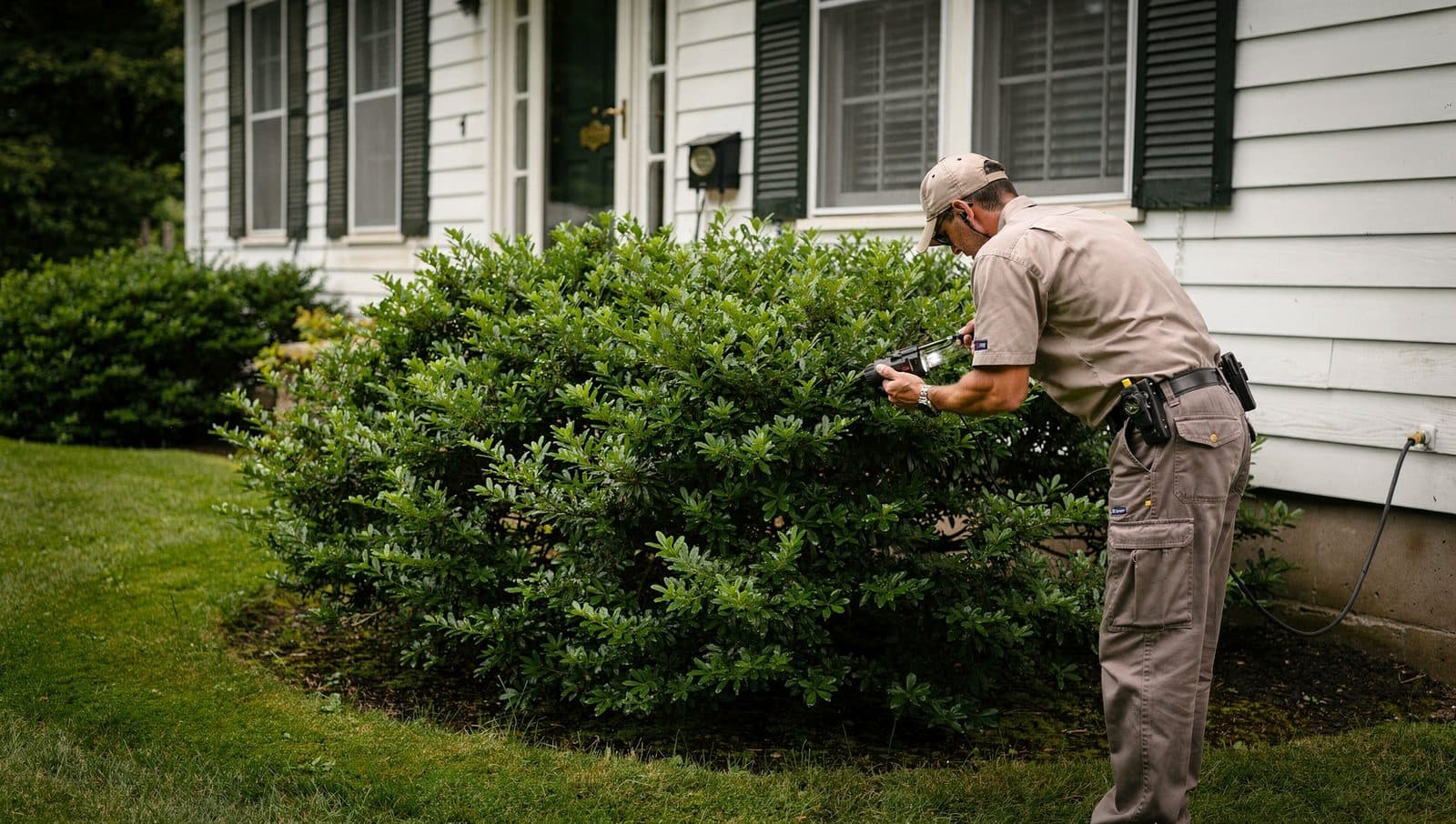
How Do Professionals Treat Leaf Pests?
Reputable professionals follow Integrated Pest Management — identify, monitor, set an action threshold, then use the least-risk targeted control — reserving broad spraying as a last resort, not a first move.
At a glance
- The verdict: IPM, not just spraying — and a lot of it is diagnosis
- Who fixes it: Pest-control pro
- Category: Health, Safety & Professional Service
The short answer
Reputable professionals don't just spray — they follow Integrated Pest Management, or IPM. The EPA describes a tiered approach: set an action threshold, monitor and correctly identify the pest, prevent where possible, and only then control with the most effective, lowest-risk method available. As the EPA puts it, sighting a single pest "does not always mean control is needed." For leaf pests specifically, that means confirming a pest is actually the cause, targeting soft-bodied insects with contact materials plus cultural recommendations, and reserving stronger controls for genuine, confirmed infestations rather than reacting to every sighting.
Who actually fixes this?
Start here
Pest-control pro
For a confirmed, genuine infestation, a professional applying IPM principles is the right process — correct identification first, then the most effective, lowest-risk control.
- You — The early steps — monitoring, correct identification, and treating a mild soft-bodied pest problem with insecticidal soap or oil — are things you can do yourself.
- UNH Extension — You need help identifying the pest, or ruling one out entirely, before any treatment starts.
The details, straight
Identify and monitor before treating anything
The first step in professional IPM isn't a spray, it's identification and monitoring. The EPA's IPM framework calls for setting an action threshold before any control step, meaning a single pest sighting doesn't automatically trigger treatment. The Northeastern IPM Center outlines this as a sequence: sample the area, correctly identify what you're finding, learn its biology, compare against a threshold, then choose an appropriate tactic and evaluate the results afterward. This front-loaded diagnostic work is what separates a professional IPM approach from simply spraying whatever is visible.
Least-risk control first, broad spraying last
Once a genuine infestation is confirmed, professionals reach for the least-risk effective option before escalating. For leaf pests, that typically means insecticidal soap or horticultural and neem oils on soft-bodied pests like aphids, mites, and whiteflies — contact-only materials that require thorough coverage of leaf undersides, have no residual effect, and must avoid application in heat or direct sun to prevent leaf burn. Broader pesticide applications are reserved for infestations that contact-only materials and cultural steps can't manage, consistent with EPA's guidance to use the most effective, lowest-risk approach available.
What this looks like for pests actually on leaves
Cultural recommendations — improving spacing and air circulation, adjusting watering timing, removing heavily infested material — are part of a professional's toolkit alongside any product application, not an afterthought. Efficacy matters here too: insecticidal soap and horticultural/neem oil genuinely work on soft-bodied pests with the coverage and heat caveats noted above, while something like vinegar sprayed on foliage is not part of any professional's toolkit — it's a non-selective contact acid that burns leaves and has no reliable effect on the actual pest, which is exactly why a licensed applicator wouldn't reach for it.
Key takeaways
- Professionals identify and monitor before treating — a single pest sighting doesn't automatically mean control is needed.
- IPM sets an action threshold, then chooses the most effective, lowest-risk control available.
- Soft-bodied pests (aphids, mites, whiteflies) are typically treated with contact-only insecticidal soap or horticultural/neem oil.
- Cultural steps — spacing, air circulation, watering timing — are part of the professional approach, not just products.
- Broad pesticide spraying is a last resort, reserved for infestations contact-only materials can't manage.
Want the IPM approach done right?
Identification and least-risk control first, broad treatment only when genuinely needed.
See how Anchor treatsA note for New Hampshire properties
Anchor's IPM approach in southern and central New Hampshire prioritizes accurate identification first — including recognizing when a leaf issue is actually a disease or cultural problem that routes to UNH Cooperative Extension or an arborist rather than a pesticide application. Where treatment is genuinely warranted, it follows the same least-risk-first sequence professionals use nationwide.
NH-licensed applicator #782664 (NHDAMF, RSA 430) · NEPMA member · family-owned since 2017.
Related questions
Sources(4)
- [1]EPA — Integrated Pest Management (IPM) Principles
Action thresholds, monitoring, and least-risk control sequence
govverified 2026-07-14 - [2]EPA — Introduction to Integrated Pest Management
IPM overview and control-decision framework
govverified 2026-07-14 - [3]Northeastern IPM Center — The Steps of IPM
Sample, identify, learn biology, threshold, tactics, evaluate sequence
extensionverified 2026-07-14 - [4]Clemson HGIC — Insecticidal Soaps for Garden Pest Control
Contact-only, no-residual, coverage, and heat/sun caveats for soft-bodied pest treatment
extensionverified 2026-07-14
Written & reviewed by
VerifiedDaniel Brady
NH-Licensed Pesticide Applicator · License #782664 (NHDAMF, RSA 430)
Daniel Brady is the New Hampshire–licensed applicator behind Anchor Pest Services, a family-owned pest control company serving the Manchester area since 2017.
Last updated 2026-07-14
Your next question
- Leaf FAQ
Can professional pest control help with leaf problems?
Read the answer - Leaf FAQ
What should I expect from a professional leaf pest inspection?
Read the answer - Leaf FAQ
What are the signs it’s time to call a pest expert for leaf problems?
Read the answer - Leaf FAQ
What’s the difference between leaf pest control and lawn pest control?
Read the answer
Honest pest help for New Hampshire homes
IPM First — Identification, Then the Least-Risk Fix
Anchor Pest Services follows the same Integrated Pest Management sequence professionals use nationwide: identify, monitor, and reach for the lowest-risk effective control before anything broader — applied to genuine structural and yard-pest problems around New Hampshire homes. Family-owned since 2017, NH license #782664, serving Manchester, Nashua, Concord and nearby towns.
- IPM-based approach — identification before treatment
- NH-licensed applicators (#782664) applying least-risk-first methods
- Structural, yard, and heavy-infestation work across southern and central New Hampshire
NH License #782664 · No obligation · We answer in person
Your next step
- Book a NH pro
Pest Control Services
Licensed, family-owned pest control across southern NH.
Book now - Also relevant
How Do Professionals Treat Yards for Ticks?
Read the answer - Also relevant
How Do Professionals Remove Rat Infestations?
Read the answer - Also relevant
What Techniques Do Professionals Use to Eliminate Hornet Nests?
Read the answer - Related guide
Can Professional Pest Control Help With Leaf Problems?
Read the answer - Related guide
How Much Does Leaf Pest Control Cost?
Read the answer