
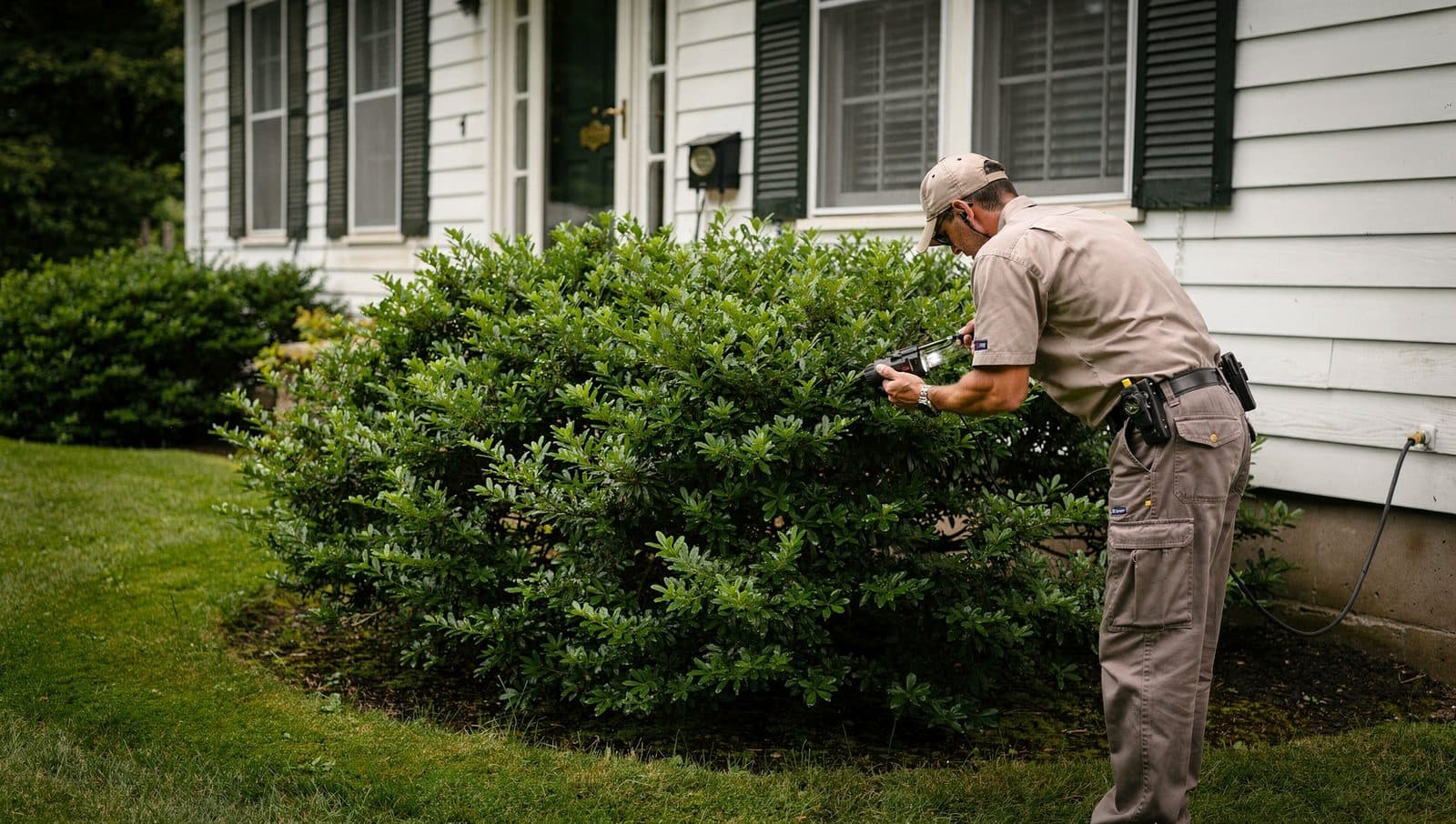
What Should I Expect From a Professional Leaf Pest Inspection?
Expect an inspection of your exterior, foundation, moisture conditions, and leaf-litter or gutter debris, an honest pest identification — or a finding that it isn't a pest at all — and a written report, not an automatic spray.
At a glance
- The verdict: A diagnostic walkthrough, not an automatic treatment
- Who fixes it: Pest-control pro
- Category: Health, Safety & Professional Service
The short answer
A professional inspection is an IPM-style assessment, not an immediate spray. Expect the technician to inspect the exterior and perimeter of your home, check the foundation and moisture conditions, look at leaf litter and gutter debris, identify any pest present — or determine there isn't one — and provide a written findings report with recommendations. A good inspection often concludes that the problem is actually a disease or a cultural issue and routes you elsewhere rather than selling a treatment you don't need.
Who actually fixes this?
Start here
Pest-control pro
A structured perimeter and foundation inspection — checking leaf litter, gutter debris, moisture, and entry points — is exactly the kind of assessment a licensed pest professional is trained to perform.
- UNH Extension — The inspection finds the real issue is a plant disease or a nutrient/watering problem — that routes to UNH Extension, not treatment.
- Certified arborist — A tree on the property shows dieback or trunk-level disease during the inspection.
The details, straight
What the technician actually inspects
IPM-based inspection guidance calls for looking at entry points, harborage areas, and food, water, and moisture sources, then correctly identifying any pests found and documenting the conditions that are attracting them. For a leaf-pest inspection specifically, that means a walk of the exterior and perimeter, a check of the foundation and surrounding moisture conditions, and a close look at leaf litter and gutter debris — since removing mulch and leaf litter banked against a foundation is a standard extension recommendation for reducing rodent harborage.
What you get afterward: a report, not just a sales pitch
A professional inspection should conclude with a written findings report and specific recommendations, not just a treatment quote. That report should honestly document what was found — including cultural fixes and referrals when appropriate, such as pointing you to UNH Extension for a suspected disease or nutrient issue, or to an arborist for a tree health concern. Accurate identification during the inspection is what prevents unnecessary pesticide use later.
Why "no pest found" is a legitimate, useful outcome
Termites need wood and soil contact plus moisture to become a structural risk — direct contact of soil, mulch, or leaves with the wooden parts of a house creates that entry point, but a dry leaf pile sitting mid-yard alone is not a termite magnet. A thorough inspection distinguishes between that kind of genuine conducive condition and a harmless leaf pile, which means an honest inspector can and should tell you when there's no real pest risk present, rather than manufacturing one to justify a service.
Key takeaways
- Expect a perimeter, foundation, and moisture check, plus a look at leaf litter and gutter debris.
- The inspection identifies any pest present — or honestly concludes there isn't one.
- You should receive a written findings report with recommendations, not just a treatment quote.
- Cultural or disease findings route to UNH Extension or an arborist rather than pest treatment.
- A dry, mid-yard leaf pile alone is not a termite risk — moisture and wood/soil contact are what matter.
Want an honest read on your foundation and yard?
Anchor's inspection checks leaf litter, gutters, moisture, and entry points — and reports honestly, even when there's no pest to treat.
Schedule an inspectionA note for New Hampshire homes
In southern and central New Hampshire, the inspection's foundation and leaf-litter check is most relevant heading into fall, when leaves and moisture accumulate ahead of the first hard frost (typically October 19–29 in Manchester). Anchor's inspections focus on that genuine structural and perimeter picture and report honestly on what's actually found.
NH-licensed applicator #782664 (NHDAMF, RSA 430) · NEPMA member · family-owned since 2017.
Related questions
Sources(5)
- [1]EPA — IPM in Buildings
Inspection basics: entry points, harborage, food/water/moisture sources
govverified 2026-07-14 - [2]Northeastern IPM Center — The Steps of IPM
Diagnostic sequence underlying a professional inspection
extensionverified 2026-07-14 - [3]Texas A&M School IPM — Rodent Action Plan
Removing mulch/leaf litter from foundations to reduce rodent harborage
extensionverified 2026-07-14 - [4]Mississippi State Extension — Termite Conducive Conditions
Termites need wood/soil contact plus moisture to pose a structural risk
extensionverified 2026-07-14 - [5]Purdue Extension — Termite Control
Wood/soil contact and moisture as termite entry conditions
extensionverified 2026-07-14
Written & reviewed by
VerifiedDaniel Brady
NH-Licensed Pesticide Applicator · License #782664 (NHDAMF, RSA 430)
Daniel Brady is the New Hampshire–licensed applicator behind Anchor Pest Services, a family-owned pest control company serving the Manchester area since 2017.
Last updated 2026-07-14
Your next question
Honest pest help for New Hampshire homes
A Real Inspection, With an Honest Report
Anchor Pest Services inspects the exterior, foundation, moisture, and leaf-litter conditions around your home and tells you plainly what we find — including when there's no genuine pest risk. Family-owned since 2017, NH license #782664, serving Manchester, Nashua, Concord and nearby towns.
- Written findings report, not a sales visit dressed up as an inspection
- NH-licensed inspectors (#782664) reading the real structural and perimeter picture
- Serving Manchester and surrounding southern and central New Hampshire towns
NH License #782664 · No obligation · We answer in person
Your next step
- Book a NH pro
Pest Control Services
Licensed, family-owned pest control across southern NH.
Book now - Related guide
Can Professional Pest Control Help With Leaf Problems?
Read the answer - Related guide
How Long Does It Take to Get Rid of Leaf Pests?
Read the answer - Related guide
Can Leaf Piles Attract Rats or Insects?
Read the answer - Related guide
How Much Does Leaf Pest Control Cost?
Read the answer - Related guide
Can Leaf Pests Spread to My Home?
Read the answer