
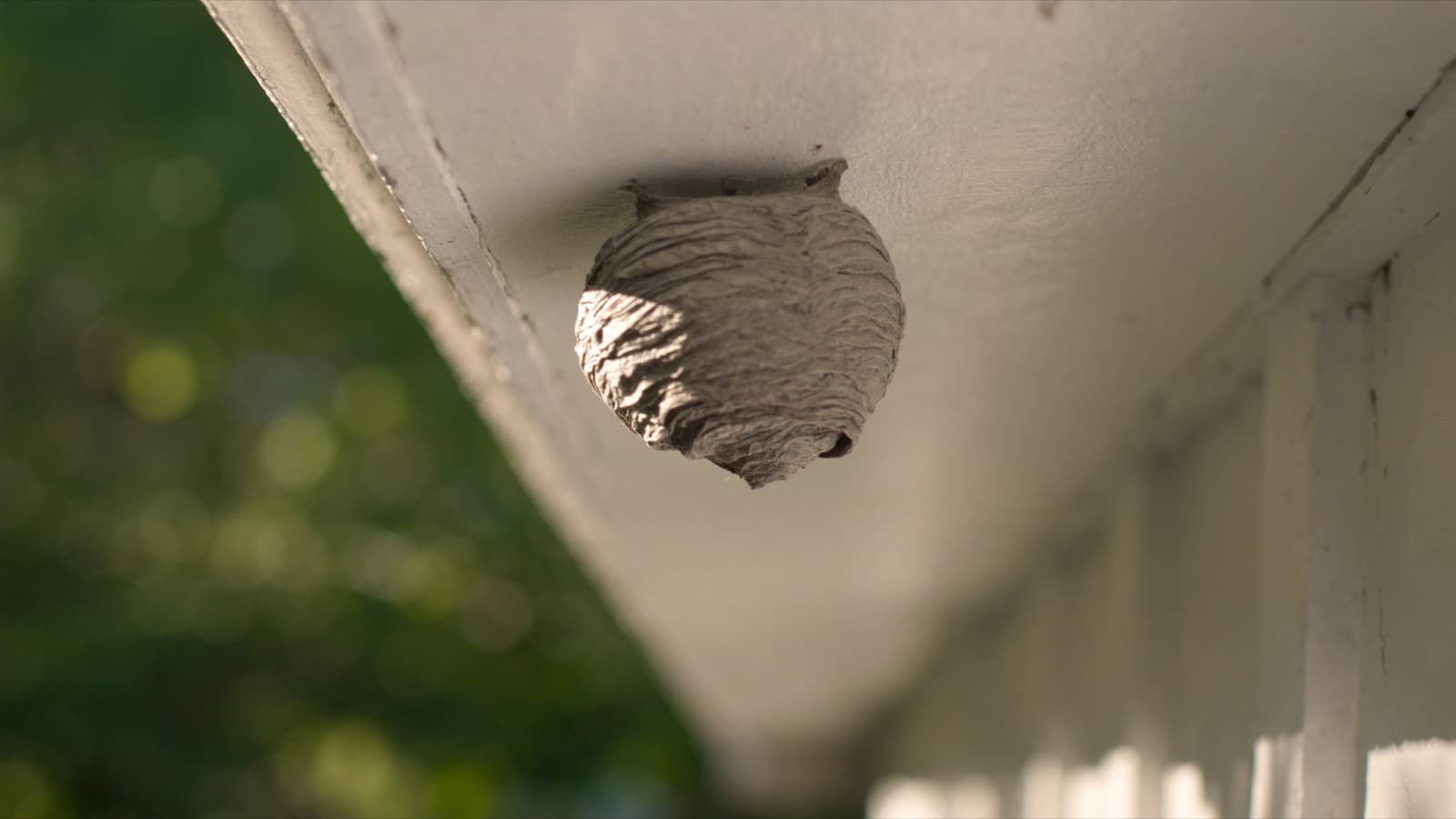
What Techniques Do Professionals Use to Eliminate Hornet Nests?
At a Glance
- The call: Distance, timing, and correctly targeted application — not a secret chemical. The advantage is training and equipment, not a product you can't buy.
- Your nest: Bald-faced hornet
Should you do this? It depends entirely on which nest
The generic question has no generic answer. Your nest is one row below — the others are the argument that this page isn't just selling you a “no.”
One question, six honest answers — one per nest.
- Mud dauber (solitary)
Solitary — no colony to defend, essentially no swarm response. Not on the router's danger end at all.
Go - Paper wasp — small, exposed, early-season nest
Low-to-moderate risk before workers hatch and while the nest is reachable — gear and timing genuinely earn their keep here.
Go with gear - Yellowjacket (aerial, ground, or unknown)
Large, coordinated colony defense; ground nests add vibration triggers and concealment.
No-go - Bald-faced hornetYour nest
Large aerial colony, aggressive when disturbed, often high off the ground.
No-go - European hornet
Concealed cavity nests plus nighttime activity defeat the usual safe-timing rule other species allow.
No-go - Any species, in October
By the time a sustained hard freeze has come through, the colony is already finished and the nest will never be reused.
Do nothing
“Is it safe to remove a wasp nest?” has no answer. “Is it safe to remove THIS nest?” has six.
Derived from: /top-diy-methods per-species verdicts (mud-dauber diy_friendly, paper-wasp doable_with_care, yellowjacket / bald-faced-hornet / European hornet pro_recommended) + /winter-pests-shift/wasps (colony dies at a sustained hard freeze; the nest is never reused).
Why you should doubt us on this
We make money when you call us — so here is a test that doesn't depend on trusting our word.
We make money when a hornet nest gets treated by us, and a page describing our own techniques in flattering detail is an obvious place to oversell how hard the job really is.
If it's a mud dauber, none of this applies — there's no colony, no timing rule, no gear requirement, and we say so plainly on our own DIY page. A small, exposed, early-season paper wasp nest is also a genuine DIY case with basic gear, not a professional-only job.
See the proof on Mud DauberHornets are different because of scale and concealment, not because we're dressing up a simple task: bald-faced hornet colonies can run several hundred workers in an aerial nest often high off the ground, and European hornets nest in hard-to-reach cavities and stay active later into the evening than most social wasps, defeating the safe-timing window that helps elsewhere.
The full picture
Assessment before any treatment
The first step is locating the nest and identifying every entrance, often through daytime observation from a safe distance before any treatment happens after dark. For concealed nests — in a wall void, attic, or hollow cavity — finding every opening matters, since a partial treatment can leave workers able to escape into a living space rather than outdoors.
Timing, gear, and application method
Treatment is typically timed for dusk or after dark, when most workers have returned to the nest and activity has slowed, using full protective equipment — a sealed coverall suit and a veil that covers the face. For an aerial nest, a targeted aerosol application is standard; for hornet nests in cavities or underground, an insecticidal dust delivered directly into the opening, often with an extension pole or bulb duster to maintain distance, is the more common approach, since it's better suited to reaching a colony that isn't fully visible.
What happens after treatment
Professionals often leave the physical nest in place after treatment rather than removing it immediately, since breaking the envelope open prematurely can scatter surviving workers. A follow-up visit, typically around a day later, confirms activity has stopped before entry points are sealed to prevent recurrence at that spot. This measured sequence — not a single dramatic step — is the actual professional advantage: correct timing, full gear, and the patience to confirm the job is finished before closing it up.
The honest line — Distance, timing, and correctly targeted application — not a secret chemical. The advantage is training and equipment, not a product you can't buy.
Key takeaways
- Assessment (locating all entrances) happens before any treatment, often via daytime observation.
- Treatment is typically timed for dusk or after dark, using full sealed gear and a veil.
- Aerial nests get targeted aerosol application; concealed or in-wall nests get insecticidal dust into the opening.
- The nest is often left in place after treatment, with a follow-up visit before sealing entry points.
Where to go next
Identification, sting treatment, per-species DIY viability, and nest-reuse facts each live on the hub that owns them. We route, we don't rebuild.
DIY viability by species
The router's source of truth — which nests are DIY-able.
Go thereIdentify the species
Tell the wasps, hornets, and lookalikes apart.
Go thereSting & allergy treatment
What to do about a sting or a reaction.
Go thereNest reuse & winter
The colony dies at frost; the nest is never reused.
Go there
Have a hornet nest that fits this description?
This is exactly the process our licensed technicians follow — assessment, timing, gear, and confirmed follow-up.
Frequently asked questions
Sources(3)
- [1]University of Kentucky Entomology — Wasp and Bee Control (ENTFACT-620)extensionverified 2026-07-17
- [2]Penn State Extension — Getting Rid of Paper Wasps, Yellowjackets and Other Stinging Insectsextensionverified 2026-07-17
- [3]UNH Cooperative Extension — Bees, Wasps and Hornetsextensionverified 2026-07-17
Written & reviewed by
VerifiedDaniel Brady
NH-Licensed Pesticide Applicator · License #782664 (NHDAMF, RSA 430)
Daniel Brady is the New Hampshire–licensed applicator behind Anchor Pest Services, a family-owned pest control company serving the Manchester area since 2017.
Last updated 2026-07-17
Before you touch it
See the process, then decide who does it
The technique is public. Doing it safely on a hornet colony is the professional part.
- Family-owned since 2017
- NH License #782664, category F1 (RSA 430, NHDAMF)
- Member, NEPMA
Your next step
- What to do next
How to Get Rid of Bald-Faced Hornets
Read the answer - Related guide
Is It Dangerous to Remove a Hornet Nest Without Professional Help?
Read the answer - Also relevant
Hornet Nest vs Wasp Nest — Telling Them Apart in New Hampshire
Read the answer - Also relevant
How Do Professionals Treat Leaf Pests?
Read the answer