
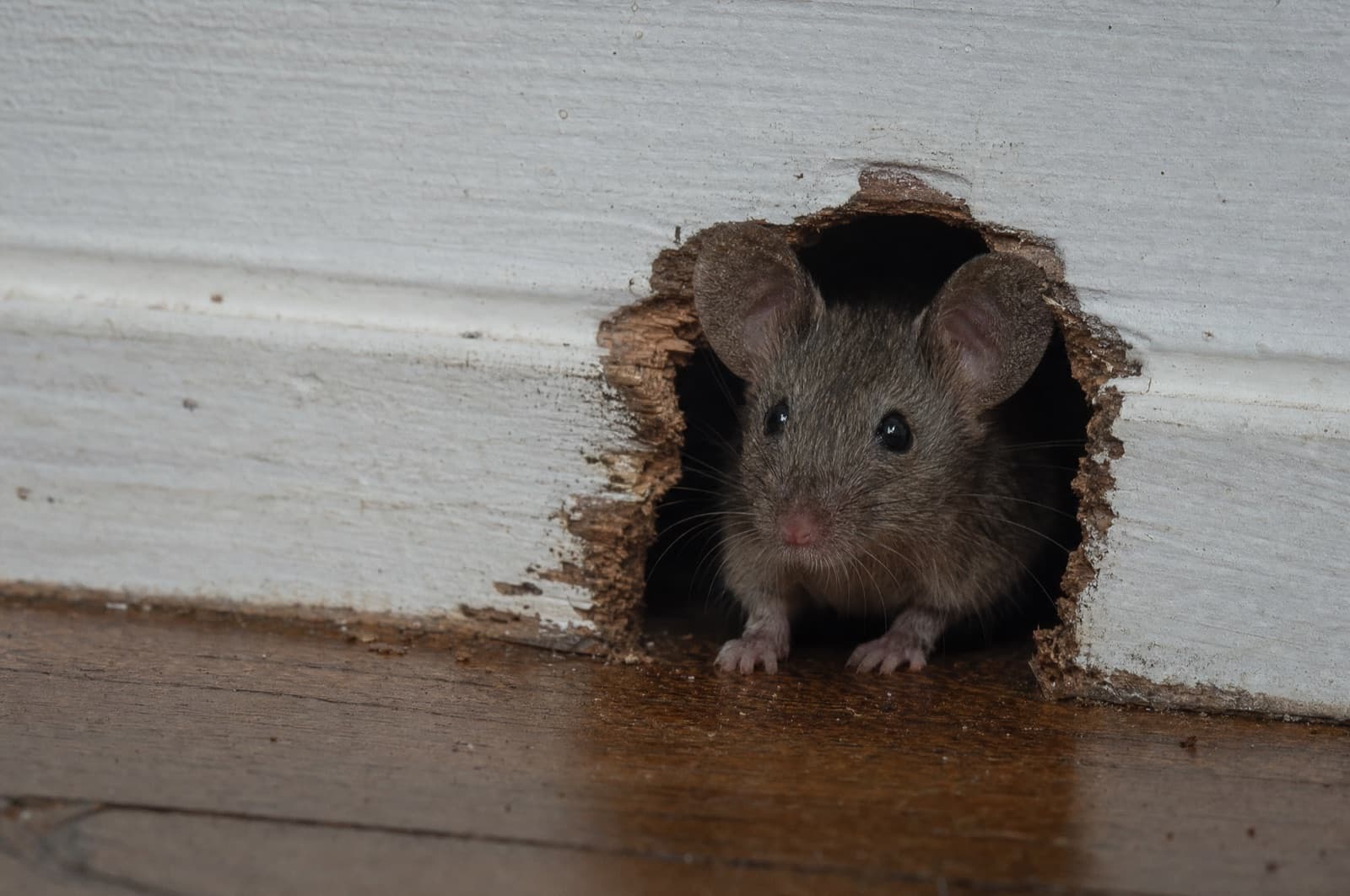
Can Mice Spread From One Apartment to Another?
At a Glance
- Short answer: Yes — via shared wall voids, ceiling/floor gaps, and utility penetrations.
- Key fact: A peer-reviewed multi-family housing study found infestations cluster in units sharing a wall or ceiling/floor.
- NH relevance: Older multi-unit buildings in Manchester, Nashua, and Concord commonly have unsealed shared utility chases.
- Action needed: Single-unit treatment rarely holds — coordinate with the landlord or property manager for building-wide sealing and trapping.
The short of it
Apartments are connected in ways residents rarely see. A peer-reviewed study of multi-family dwellings found mouse infestations were significantly more common in units sharing a common wall or ceiling/floor with other infested units — hard evidence that mice travel through shared structural voids. Mice also crawl along pipes and conduit, and since they fit through gaps larger than ¼ inch, every unsealed utility penetration between units is a potential doorway. That's why treating a single apartment while neighboring units go untreated so often fails.
Can Mice Spread From One Apartment to Another — By the Numbers
¼ in
Smallest gap a mouse can squeeze through
1
Peer-reviewed study (Insects) linking shared walls to shared infestations
5–10
Litters a house mouse can produce per year indoors
~20 ft
Typical house mouse home-range radius once settled
The full picture
The research: shared walls mean shared risk
Peer-reviewed work in multi-family dwellings, published in the journal Insects, found that units with mouse infestations were significantly more likely to share a common wall or ceiling/floor with other infested units. That correlation is strong evidence mice are moving through shared structural voids rather than each unit developing an infestation independently — and it should shape how a building responds.
How they actually move between units
The University of Nebraska Extension documents rodents crawling along pipes and electrical conduit and gnawing through a wide range of building materials, which turns plumbing and wiring chases into corridors between apartments. Because a house mouse fits through any gap larger than ¼ inch, every unsealed penetration around a pipe, vent, or cable run between units is a usable entry point — often invisible from inside a finished wall or cabinet.
Why single-unit treatment usually fails
Trapping and sealing your own apartment can knock down the mice currently inside it, but if an adjacent unit stays infested and shares a wall or utility chase, new mice re-enter on a rolling basis — especially given how quickly house mice breed (gestation of just 19–21 days, with females able to conceive again within a day of giving birth). Effective control in a multi-unit building coordinates trapping and sanitation across affected units at the same time, and seals shared penetrations in common areas and between units, not just within one apartment.
Whose job is it to fix
In a rental building, sealing shared walls, common-area penetrations, and building-wide sanitation issues is typically a landlord or property-management responsibility, not something a single tenant can resolve alone. Document what you find (droppings, gnaw marks, sighting locations) and report it in writing — building-wide coordination is the difference between a fix that holds and one that doesn't.
Bottom line — Mice cross between apartments through shared wall voids and utility chases, and peer-reviewed research confirms infestations cluster in connected units. A single tenant sealing only their own unit is fighting an uphill battle — lasting control requires simultaneous, building-wide trapping and sealing, typically coordinated by the landlord or property manager.
Mice moving between units?
Anchor coordinates building-wide inspections and sealing for landlords and property managers across southern NH multi-unit properties.
Why this matters in New Hampshire
Multi-unit housing stock across Manchester, Nashua, and Concord ranges from older triple-deckers to newer apartment complexes, and many older buildings have plumbing and wiring chases that were never sealed against rodents. Pressure rises heading into fall, ahead of Manchester's first hard frost (~Oct 19 at 50% probability, Oct 29 at 80%, NOAA 1991–2020), as mice seek warm indoor voids — making early-fall building-wide inspection especially worthwhile in shared-wall properties.
Key local data
Much of southern and central NH's older housing stock has fieldstone or rubble foundations and wood sill plates that give rodents ground-level entry (UNH Cooperative Extension exclusion guidance).
- NH-licensed applicator · #782664
- Same-day service
- Family-owned since 2017
Service Area Map
Southern New Hampshire
Frequently asked
Written & reviewed by
VerifiedDaniel Brady
NH-Licensed Pesticide Applicator · License #782664 (NHDAMF, RSA 430)
Daniel Brady is the New Hampshire–licensed applicator behind Anchor Pest Services, a family-owned pest control company serving the Manchester area since 2017.
Professional Rodent Control
Building-Wide Control for Multi-Unit Properties
Anchor Pest Services works with landlords and property managers to trap and seal across shared walls and utility chases — the only way multi-unit mouse control actually holds. Family-owned since 2017, NH license #782664.
- Same-day service across southern NH
- NH-licensed applicators (#782664)
- Free inspection — no flat-price guesswork
NH License #782664 · No obligation · We answer in person
Your next step
- Book a NH pro
Rodent Control in New Hampshire
Mice and rats move indoors every fall. We trap, seal entry points and keep them out.
Book now - Next step
Rodent Mites After Mice or Rats Are Removed
Read the answer - Related guide
Can Rats Travel Between Connected Houses?
Read the answer - Related guide
How Do I Get Rid of Mice in Walls?
Read the answer - Related guide
Can Mice Infestations Return After Treatment?
Read the answer - Also relevant
Can fall pests move between apartments?
Read the answer