
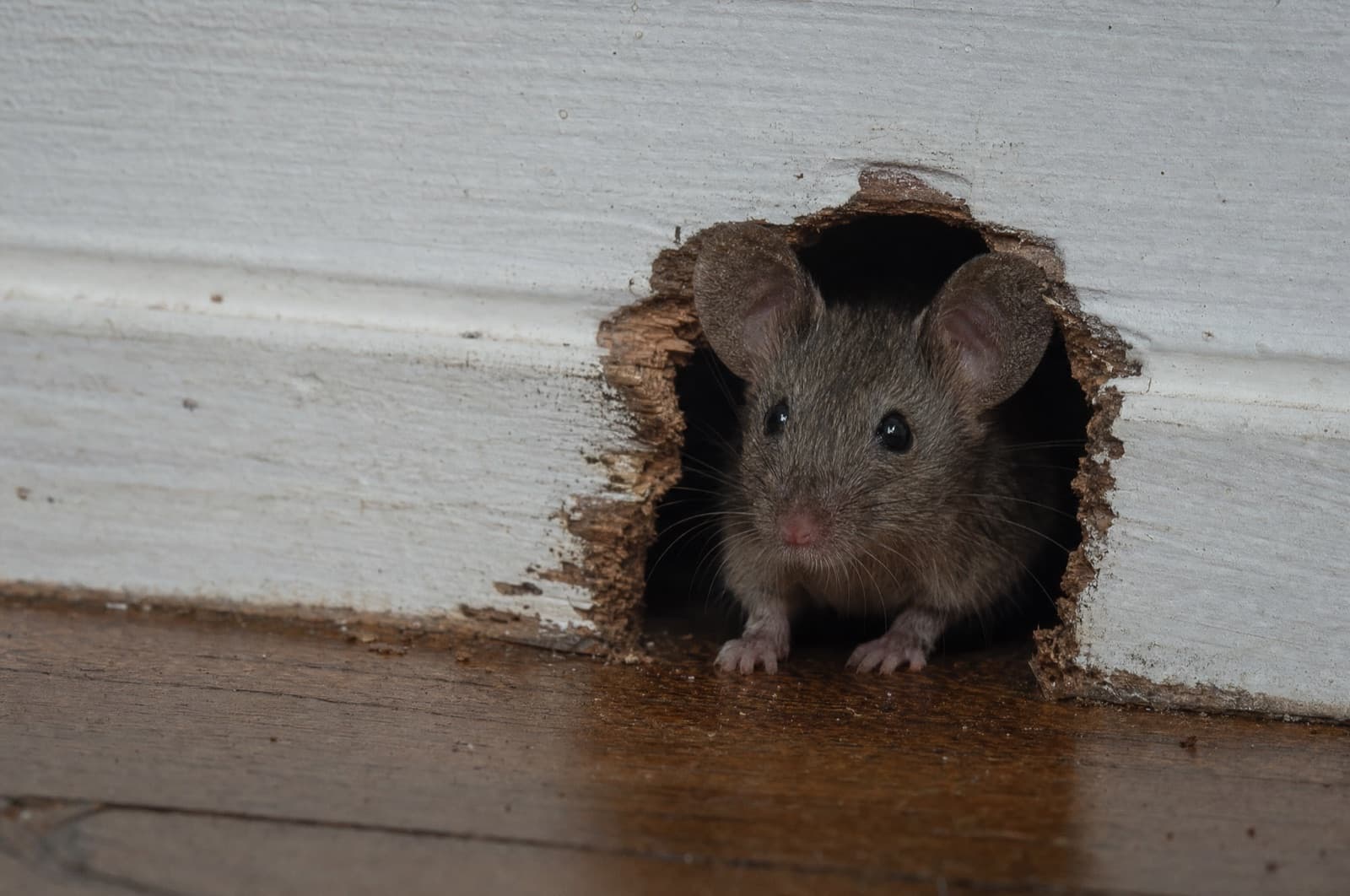
How Long Can Mice Live Inside a House?
At a Glance
- Short answer: Commonly 1–2 years indoors vs. 12–18 months or less in the wild.
- Key fact: Fast breeding (5–10 litters/year, maturity in 5–7 weeks) matters more than individual lifespan.
- NH relevance: NH's cold winters sharply cut outdoor mouse survival, raising the payoff for mice that get indoors before the first hard frost (~Oct 19).
- Action needed: Don't wait — a small population compounds quickly once established indoors.
The short of it
In the wild, most house mice don't live beyond 12–18 months, limited by predators, cold, and food scarcity. Protected indoors, mice commonly live around two years and can spend their entire life without ever going outside. But lifespan isn't the real driver of an indoor problem — breeding speed is. A female can produce 5–10 litters a year, with offspring reaching breeding age in just 5–7 weeks, so a couple of mice can become a real population well before any individual mouse's lifespan becomes relevant.
How Long Can Mice Live Inside a House — By the Numbers
12–18 mo
Typical wild house mouse lifespan
~2 yrs
Typical protected/indoor lifespan
5–10
Litters a female can produce per year indoors
5–7 wks
Time for offspring to reach breeding age
The full picture
Wild vs. indoor lifespan
The University of Michigan's Animal Diversity Web notes that in the wild, most house mice do not live beyond 12–18 months, worn down by predators, cold, and food scarcity. Protected mice — pets, lab animals, and mice living entirely indoors — average about two years and can occasionally live longer. Cornell IPM confirms house mice "can live outdoors if conditions are suitable, but can successfully live their entire life indoors," because a heated home removes the two biggest wild-mortality drivers: predation and cold.
Why breeding speed matters more than lifespan
A female house mouse can produce 5–10 litters a year of roughly 5–6 young each, and those offspring reach breeding age in just 5–7 weeks. That means a pair of mice that settle into a house in early fall can become a substantial population by mid-winter, all hidden in wall voids and attic insulation, well before any individual mouse's natural lifespan becomes relevant.
How this differs from the rat-survival question
This is a distinct question from how long rats survive indoors, where water access is the bottleneck for an individual animal. For mice, the driver isn't one mouse's endurance — it's how fast a protected colony compounds through breeding. That's why "a mouse can't survive long without X" is the wrong frame for mice; the right frame is how quickly a small intrusion becomes more than one mouse.
Bottom line — Indoors, a mouse commonly lives around one to two years — far longer than its 12–18-month (or shorter) wild lifespan — and breeds continuously the whole time. Because breeding compounds faster than most homeowners expect, treat the first confirmed signs as the time to act, not wait and see.
One mouse rarely stays one mouse
Indoor mice breed year-round on a fast clock. Anchor's licensed NH technicians remove the current population and seal how they got in.
Why this matters in New Hampshire
NH's long, cold winters sharply shorten outdoor mouse survival, which increases the payoff for any mouse that gets indoors before the season turns — practically, before Manchester's first hard frost, about October 19 (50%) to October 29 (80%), NOAA 1991–2020. Deer mice and white-footed mice, the region's hantavirus-relevant species, also mainly enter structures from fall through spring.
Key local data
Deer mice (Peromyscus) are the hantavirus-relevant species in NH; NH DHHS reports no confirmed case acquired in-state to date.
- NH-licensed applicator · #782664
- Same-day service
- Family-owned since 2017
Service Area Map
Southern New Hampshire
Frequently asked
Written & reviewed by
VerifiedDaniel Brady
NH-Licensed Pesticide Applicator · License #782664 (NHDAMF, RSA 430)
Daniel Brady is the New Hampshire–licensed applicator behind Anchor Pest Services, a family-owned pest control company serving the Manchester area since 2017.
Professional Rodent Control
The Question Isn't How Long Mice Live — It's How Fast They Multiply
A protected indoor mouse population compounds within weeks, not months. Anchor Pest Services traps what's inside and excludes what's trying to get in, before a small problem becomes a big one. Family-owned since 2017, NH license #782664.
- Same-day service across southern NH
- NH-licensed applicators (#782664)
- Free inspection — no flat-price guesswork
NH License #782664 · No obligation · We answer in person
Your next step
- Book a NH pro
Rodent Control
Book now - Next step
Rodent Mites After Mice or Rats Are Removed
Read the answer - Related guide
How Long Do Rats Survive Indoors?
Read the answer - Related guide
Can Mice Survive Winter in a House?
Read the answer - Related guide
How Do I Get Rid of Mice in Walls?
Read the answer - Related guide
Can Mice Survive Winter in a House?
Read the answer