
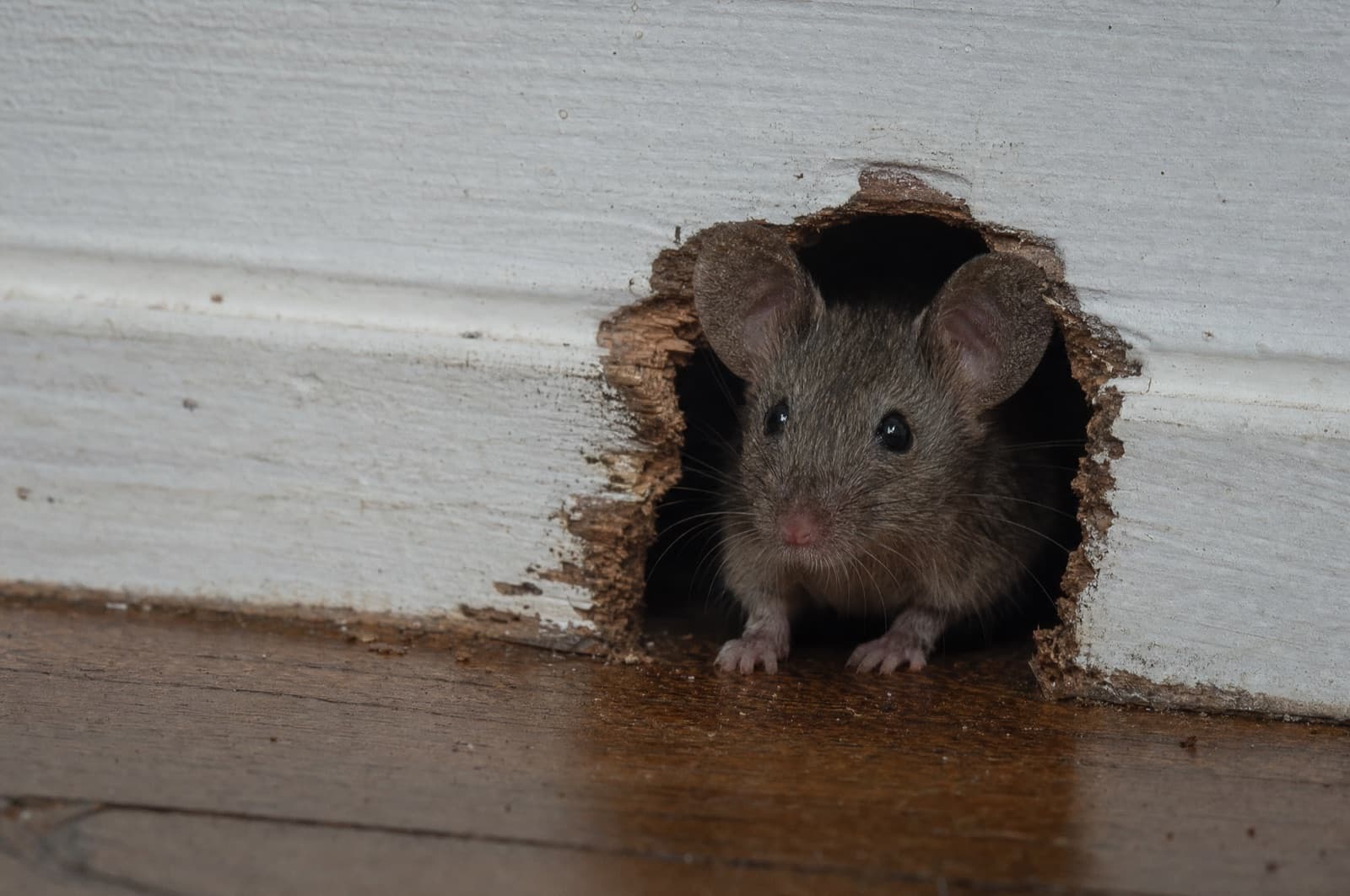
What Are the Signs of a Rat Infestation?
At a Glance
- Short answer: Capsule-sized droppings, 2–3 inch burrows, coarse gnaw marks, worn runways, and heavy night noise — daytime sightings are the most urgent.
- Key fact: Norway rat droppings run about ¾–1 inch, roughly triple the length of a mouse's.
- NH relevance: In NH, burrows appear along foundations and woodpiles as Norway rats seek shelter ahead of the first hard frost; roof rats are generally absent regionally.
- Action needed: Fresh burrows, dropping piles, or any daytime sighting mean an established population — move to professional control promptly.
The short of it
Rat evidence is a scaled-up version of mouse evidence, plus burrows. Norway rat droppings run about ¾–1 inch and blunt (versus a mouse's 1⁄8–¼ inch), active burrow openings are about 2–3 inches wide and kept clear of debris, and gnaw marks run about 3.5–4 mm wide. The single most urgent sign is a daytime sighting: because rats are nocturnal, seeing one in daylight typically means the population has outgrown its hiding capacity.
What Are the Signs of a Rat Infestation — By the Numbers
¾–1 in
Norway rat dropping length, blunt/capsule-shaped
2–3 in
Active burrow opening width near foundations
3.5–4 mm
Rat gnaw-mark width
Daytime
Sighting timing that signals a large, established population
What you're seeing — and what it means
Rat signs read like mouse signs, scaled up — plus burrows, which mice don't leave.
Capsule-shaped droppings about ¾–1 inch, often in piles
Far larger than mouse droppings; concentrated piles indicate a nest or feeding site nearby
Active burrow openings 2–3 inches wide near foundations, fences, or woodpiles
A hallmark Norway rat sign — clean, packed openings mean the burrow is in active use
Greasy rub marks and worn runways along beams, pipes, or baseboards
Repeated travel routes from oily fur; heavier and more visible than a mouse's version
Coarse gnaw marks about 3.5–4 mm wide
Rats gnaw through tougher materials than mice, including some plastics and soft metals
Heavy nighttime scratching, scrambling, or thumps
Noticeably louder than mouse sounds; often indicates rats moving within a wall or ceiling void
A rat seen during daylight hours
Rats are nocturnal — a daytime sighting typically signals a large, established, or stressed population
Bottom line — Fresh burrows, dropping piles, or a daytime sighting are urgent signs of an established rat population — don't wait on a couple of traps to catch up.
The full picture
Droppings and burrows
Droppings are the anchor sign: Norway rat droppings run about ¾–1 inch and blunt or capsule-shaped, per Cornell IPM — far larger than mouse pellets, and usually concentrated in piles near nests or along travel paths. Burrows are distinctive to rats, especially Norway rats: ICWDM describes active burrow openings about 2–3 inches wide, clean of debris, found next to walls and buildings, along fences, and under bushes and debris, often with a hard-packed runway leading to the opening and fresh soil fanned out nearby.
Rub marks, runways, and gnaw marks
Greasy rub marks — dark smears from oily fur along beams, pipes, and baseboards — and well-worn runways mark repeated travel routes, the same mechanism as mouse rub marks but heavier and more visible given a rat's size. Gnaw marks are coarse, roughly 3.5–4 mm wide for an adult rat, compared to a mouse's 1–2 mm, and rats can chew through tougher materials than mice can, including some plastics and soft metals.
Sound and the daytime-sighting red flag
Heavy nighttime scratching, scrambling, and thumps in walls or ceilings are common with rats — noticeably louder than typical mouse sounds. The single most urgent individual sign is a daytime sighting: because rats are nocturnal, Texas A&M School IPM notes seeing one in daylight typically means "a large population, scarcity of food, or illness within the population" — the colony has outgrown its ability to stay hidden.
Bottom line — Fresh burrows, capsule-sized droppings in piles, coarse gnaw marks, or any daytime sighting indicate an established rat population. Move to professional control promptly rather than relying on a couple of traps — rats reproduce and spread faster than a light trapping effort can keep up with.
Seeing burrows or daytime rat activity?
Those are urgent signs of an established population. Anchor's licensed NH technicians confirm it and move straight to elimination and exclusion.
Why this matters in New Hampshire
In NH, rat burrows tend to appear along foundations and under woodpiles as Norway rats seek shelter ahead of Manchester's first hard frost (~Oct 19 at 50% probability, ~Oct 29 at 80%, NOAA 1991–2020). Roof rats are generally absent from the region per Cornell, so a New Hampshire rat sign is almost certainly a ground-dwelling Norway rat — focus inspection at foundation level, not attics.
Key local data
Norway rats are established across New Hampshire's cities and towns (UNH Cooperative Extension); roof rats are essentially absent from the Northeast (Cornell).
- NH-licensed applicator · #782664
- Same-day service
- Family-owned since 2017
Service Area Map
Southern New Hampshire
Frequently asked
Written & reviewed by
VerifiedDaniel Brady
NH-Licensed Pesticide Applicator · License #782664 (NHDAMF, RSA 430)
Daniel Brady is the New Hampshire–licensed applicator behind Anchor Pest Services, a family-owned pest control company serving the Manchester area since 2017.
Professional Rodent Control
Burrows and Daytime Sightings Mean It's Time to Call
Anchor Pest Services identifies active burrows and runways, traps the resident population, and seals the entry points that let rats establish in the first place. Family-owned since 2017, NH license #782664.
- Same-day service across southern NH
- NH-licensed applicators (#782664)
- Free inspection — no flat-price guesswork
NH License #782664 · No obligation · We answer in person
Your next step
- Book a NH pro
Rodent Control in New Hampshire
Mice and rats move indoors every fall. We trap, seal entry points and keep them out.
Book now - Next step
Do Mice Avoid Traps After Seeing Others Caught?
Read the answer - Related guide
When Should I Call Pest Control for Rats?
Read the answer - Related guide
How Can I Tell If I Have Mice or Rats in My House?
Read the answer - Related guide
Where Do Rats Build Nests Around Homes?
Read the answer - Related guide
How Do Professionals Remove Rat Infestations?
Read the answer