
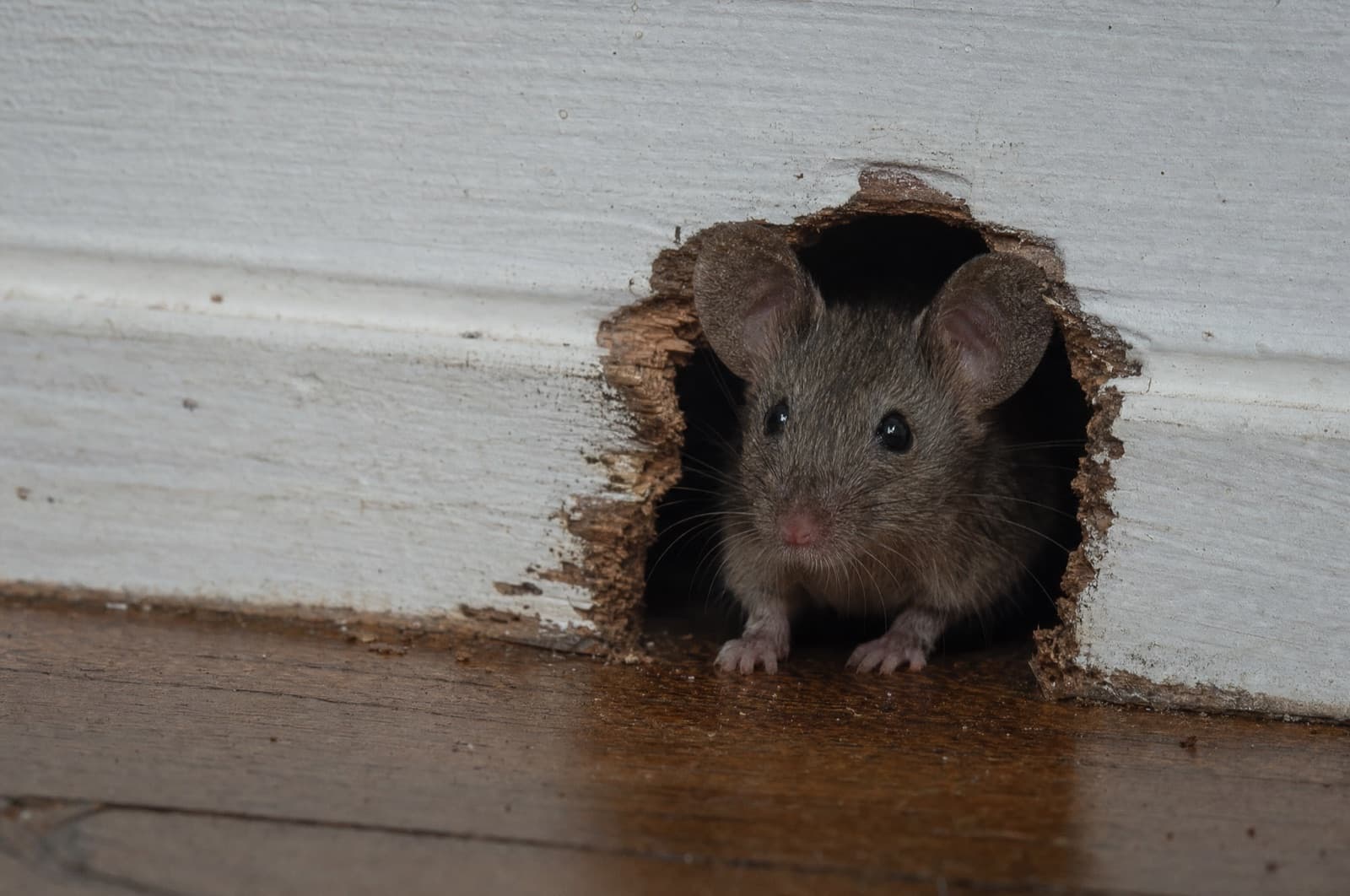
Where Do Rats Build Nests Around Homes?
At a Glance
- Short answer: Norway rats (NH's species): foundation burrows, woodpiles, basements. Roof rats (rare in NH): attics, above ground.
- Key fact: Active Norway rat burrow openings are about 2–3 inches wide and kept clear of debris.
- NH relevance: Roof rats are essentially absent from the Northeast — NH inspections should prioritize foundation perimeters, woodpiles, and crawl-space voids.
- Action needed: Fresh 2–3 inch burrow openings with loose soil along a foundation mean active rats — remove harborage and seal ground-level entry.
The short of it
Norway rats, the species found throughout New Hampshire, are ground-dwellers that dig burrows along foundations, under woodpiles, slabs, and debris, and nest in basements and crawl spaces indoors. Roof rats nest above ground — attics, soffits, overhead storage, and dense vegetation — but Cornell notes roof rats are generally not found in the Northeast. That makes the practical answer for NH homeowners simple: watch foundations, woodpiles, and debris, not attics.
Where Do Rats Build Nests Around Homes — By the Numbers
2–3 in
Typical Norway rat burrow opening width
Foundations
Primary outdoor nesting location for NH's Norway rats
Rare in NH
Roof rats are generally absent from the Northeast
Basements
Preferred indoor nesting area for Norway rats
The full picture
Norway rats: ground-level burrows
The Norway rat (brown or sewer rat) is a burrowing, ground-dwelling rodent. UC IPM notes its burrows "may be found along building foundations, beneath rubbish or woodpiles, and around gardens and fields." An active Norway burrow entrance is typically 2 to 3 inches across and kept clear of debris, often with a hard-packed runway leading to it and fresh soil fanned out at the opening. Indoors, Norway rats favor basements, crawl spaces, and lower floors, nesting in voids near a food source.
Roof rats: above ground, but rare in NH
The roof rat, by contrast, is an agile climber that prefers to nest in secluded areas above ground — attics, soffits, overhead garage storage, vine cover, and woodpiles — and only occasionally burrows, mainly in warm climates where Norway rats are absent. Cornell confirms roof rats are generally not found in the Northeast, which means for New Hampshire the practical target is the Norway rat and its ground-level burrows, not an attic-nesting roof rat.
Where to actually check in NH
Because Norway rats dominate the region, an NH inspection should prioritize foundation perimeters, woodpiles, debris piles, and basement or crawl-space voids near a food source, rather than the attic. Attic rodent activity in NH is more likely climbing mice or squirrels than roof rats.
Bottom line — Fresh 2–3 inch burrow openings with loose soil along a foundation or under a woodpile indicate active Norway rats — remove harborage like woodpiles and debris, seal ground-level entry, then trap.
Found a burrow along your foundation?
A 2–3 inch opening with fresh soil means active Norway rats. Anchor's licensed NH technicians confirm the species and clear the nest.
Why this matters in New Hampshire
Because roof rats are essentially absent in the Northeast, NH homeowners should focus on Norway rat burrows near foundations, especially as rats seek shelter around the first hard frost — about October 19 (50%) to October 29 (80%), Manchester, NOAA 1991–2020.
Key local data
Norway rats are established across New Hampshire's cities and towns (UNH Cooperative Extension); roof rats are essentially absent from the Northeast (Cornell).
- NH-licensed applicator · #782664
- Same-day service
- Family-owned since 2017
Service Area Map
Southern New Hampshire
Frequently asked
Written & reviewed by
VerifiedDaniel Brady
NH-Licensed Pesticide Applicator · License #782664 (NHDAMF, RSA 430)
Daniel Brady is the New Hampshire–licensed applicator behind Anchor Pest Services, a family-owned pest control company serving the Manchester area since 2017.
Professional Rodent Control
Know the Species, Know Where to Look
New Hampshire's rat problem is almost always a Norway rat with a ground-level burrow, not an attic-nesting roof rat. Anchor Pest Services confirms the species, finds the burrow or void, and clears it. Family-owned since 2017, NH license #782664.
- Same-day service across southern NH
- NH-licensed applicators (#782664)
- Free inspection — no flat-price guesswork
NH License #782664 · No obligation · We answer in person
Your next step
- Book a NH pro
Rodent Control
Book now - Next step
Do rodents count as fall invaders too?
Read the answer - What to do next
How to Get Rid of Norway Rats
Read the answer - Related guide
What Are the Signs of a Rat Infestation?
Read the answer - Related guide
Do Rats Move Indoors During Cold Weather?
Read the answer - Related guide
How Do I Get Rid of Rats Under a Deck?
Read the answer