
How Can I Tell If I Have Mice or Rats in My House?
At a Glance
- Short answer: Droppings, gnaw-mark width, footprints, and entry-gap size — read together, not one alone — tell mice from rats.
- Key fact: Dropping size is the single most decisive clue: ~1⁄8–¼ in (mice) vs. ~¾–1 in (rats).
- NH relevance: A positive "rat" read in NH is almost always a Norway rat; a "mouse" read may include hantavirus-relevant deer or white-footed mice, so handle droppings per CDC guidance.
- Action needed: Confirm with at least two independent clues before sizing traps or bait stations — wrong species ID wastes effort.
The short of it
Dropping size is the single most decisive clue: Cornell IPM puts mouse droppings at about 1⁄8–¼ inch with pointed ends, versus Norway rat droppings at about ¾–1 inch, blunt. Gnaw-mark width, footprint size, and the character of night noise corroborate it. Match at least two independent clues before committing to a control plan — the wrong species ID leads to the wrong trap size and placement.
How Can I Tell If I Have Mice or Rats in My House — By the Numbers
1⁄8–¼ in
Mouse dropping length, pointed
¾–1 in
Norway rat dropping length, blunt
1–2 mm vs 3.5–4 mm
Gnaw-mark width, mouse vs. rat
¼ in vs ½ in
Entry-gap size a mouse vs. a rat needs
Mouse Evidence vs. Rat Evidence
The diagnostic version — evidence you can read without ever seeing the animal.
Mouse Evidence
House mouse
Rat Evidence
Norway rat
Bottom line — Two or more of these clues together — especially dropping size plus gnaw-mark width — give a confident species read without a sighting.
The full picture
Droppings: the fastest, most reliable clue
Cornell IPM specifies mouse droppings at about 1⁄8–¼ inch with pointed ends, versus Norway rat droppings at about ¾–1 inch and blunt (roof rat droppings run about ½ inch, but the species is generally absent from the Northeast). The rule of thumb: smaller than a grain of rice means mice; capsule-sized means rats. Fresh droppings are soft and dark; older ones are dry and gray-ish, though color alone shouldn't be used to judge species.
Gnaw marks and footprints
Gnaw marks corroborate the dropping read: an adult mouse leaves paired-tooth grooves about 1–2 mm wide, while an adult rat's are roughly 3.5–4 mm — noticeably coarser and deeper. Footprints, when visible in dust or on a flour-dusted surface, differ too: mouse tracks look like small dots with a footprint about 3⁄8–¾ inch, while rat tracks look like actual feet, about ¾–1¼ inch, and often show a wavy tail-drag mark between prints.
Entry-gap size and sound
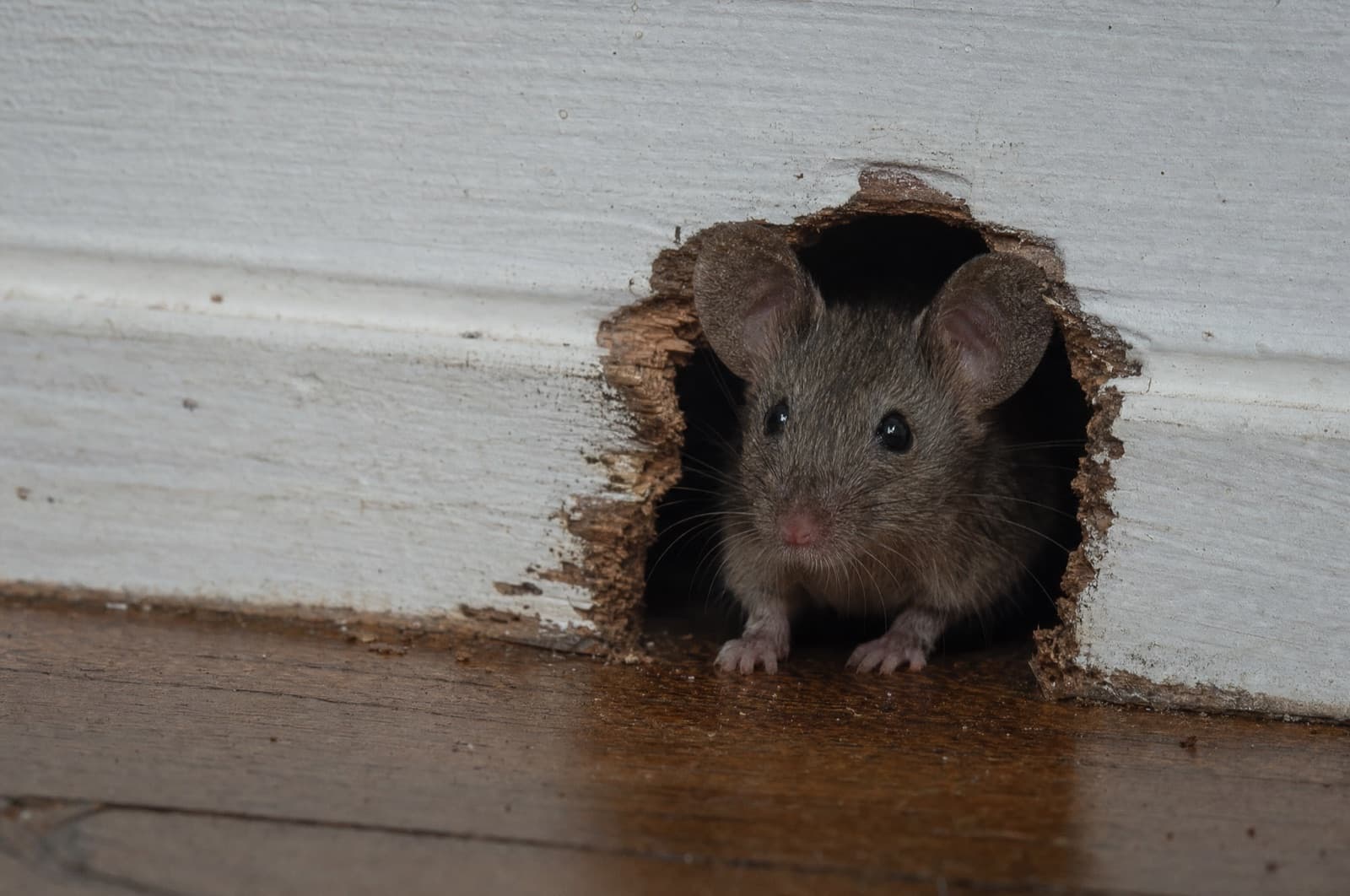
The size of the gap an animal used to get in is a strong clue: Penn State notes a mouse fits through a hole about the size of a dime or pencil (roughly ¼ inch), while a rat needs one about the size of a quarter (roughly ½ inch). Sound weight helps too — light, fast scratching and faint squeaks point to mice; heavier scrambling, louder gnawing, and occasional thumps point to rats. None of these clues is definitive alone, but two or more together settle it.
Bottom line — Match at least two independent clues — dropping size plus gnaw-mark width is the strongest pairing — before committing to a control plan. Getting the species wrong means the wrong trap size, the wrong bait, and wasted effort.
Still not sure what you're dealing with?
Anchor's licensed NH technicians confirm the species on-site from droppings, gnaw marks, and travel signs — no guesswork.
Why this matters in New Hampshire
In NH, a positive "rat" read is almost always a Norway rat, since roof rats are generally absent from the Northeast per Cornell. A "mouse" read may be a house mouse or a hantavirus-relevant deer mouse or white-footed mouse, so handle any droppings per CDC guidance: air out the space for 30 minutes, then wet-clean — never sweep or vacuum dry droppings.
Key local data
Manchester first hard frost ~Oct 19 (50%) / Oct 29 (80%), NOAA 1991–2020 — the seasonal window when sign reports climb.
- NH-licensed applicator · #782664
- Same-day service
- Family-owned since 2017
Service Area Map
Southern New Hampshire
Frequently asked
Sources (4)
- [1]
- [2]
- [3]
- [4]
Written & reviewed by
VerifiedDaniel Brady
NH-Licensed Pesticide Applicator · License #782664 (NHDAMF, RSA 430)
Daniel Brady is the New Hampshire–licensed applicator behind Anchor Pest Services, a family-owned pest control company serving the Manchester area since 2017.
Professional Rodent Control
We Read the Evidence Before We Set a Single Trap
Anchor Pest Services inspects droppings, gnaw marks, and entry points to confirm mouse or rat before building your control plan — right-sized from the start. Family-owned since 2017, NH license #782664.
- Same-day service across southern NH
- NH-licensed applicators (#782664)
- Free inspection — no flat-price guesswork
NH License #782664 · No obligation · We answer in person
Your next step
- Book a NH pro
Rodent Control
Book now - Next step
How can I protect my attic from mice and rats during winter?
Read the answer - Related guide
What Is the Difference Between a Mouse and a Rat?
Read the answer - Related guide
What Are the Signs of a Mouse Infestation?
Read the answer - Related guide
What Are the Signs of a Rat Infestation?
Read the answer - Related guide
How Small of a Hole Can a Mouse Get Through?
Read the answer