
Where Do Wasps Go in the Winter? NH Wasp Timing Guide
At a glance
- Colony timeline: Queen founds Apr–May, workers by mid-June, peak late summerAnnual colony cycle — UMass Extension
- Aggression peak: August–SeptemberLargest colonies switch from insect protein to scavenging sugar — UMass Extension
- Frost collapse: Whole colony dies at ~Oct 19 frostOnly fertilized queens survive — UMass / Missouri Dept. of Conservation; NOAA
- Overwintering survivors: Only mated queensLeaf litter, bark, soil cavities, wall voids, attics — extension entomology
Colony timeline
Queen founds Apr–May, workers by mid-June, peak late summer
Annual colony cycle — UMass Extension
Aggression peak
August–September
Largest colonies switch from insect protein to scavenging sugar — UMass Extension
Frost collapse
Whole colony dies at ~Oct 19 frost
Only fertilized queens survive — UMass / Missouri Dept. of Conservation; NOAA
Overwintering survivors
Only mated queens
Leaf litter, bark, soil cavities, wall voids, attics — extension entomology
The short of it
Wasp colonies are expanding fast right now and turn largest and most aggressive in August–September; the whole colony then dies at the first hard frost (~Oct 19), and only mated queens survive winter.
When are they active — the whole year at a glance
A wasp colony in New Hampshire lives and dies within a single year — dormant queens in winter, explosive growth through summer, and total collapse at the first hard frost.
Best window to act · April–June — watch for lone founding queens and small starter nests around eaves, sheds, and playsets; early removal is low-risk. Reduce attractants like covered garbage and fallen fruit. Treat nests at night or dusk, when the workers are inside.
Peak months reflect peak colony size AND peak sting aggression (Aug–Sep). The colony dies completely at Manchester's first hard frost (~Oct 19, 50% probability — NOAA 1991–2020); only mated queens survive.
Winter behavior
'Where do wasps go in the winter?' is this page's number-one query — and the honest answer is that almost all of them die.
Colony dies · queens overwinter
At the first hard frost, all workers, males, and the old queen die — the colony is annual and does not survive winter. Only newly mated queens survive, hibernating in leaf litter, under loose bark, in soil cavities, and in human structures like wall voids and attics.
Move in
New queens are produced and disperse to overwintering sites in September–October, just before frost.
Colony dies · queens overwinter
At the first hard frost, all workers, males, and the old queen die — the colony is annual and does not survive winter. Only newly mated queens survive, hibernating in leaf litter, under loose bark, in soil cavities, and in human structures like wall voids and attics.
Spring exit
Each surviving queen emerges in late April–May and starts an entirely new nest from scratch. Old nests are not reused — removing a spent winter nest is about aesthetics and debris, not preventing next year's colony, which will be built somewhere new.
A year in the life
Wasp colonies in New Hampshire follow one of the most dramatic annual cycles of any pest in this cluster — from a single queen to thousands of workers, and back to nothing.
- 01
Spring
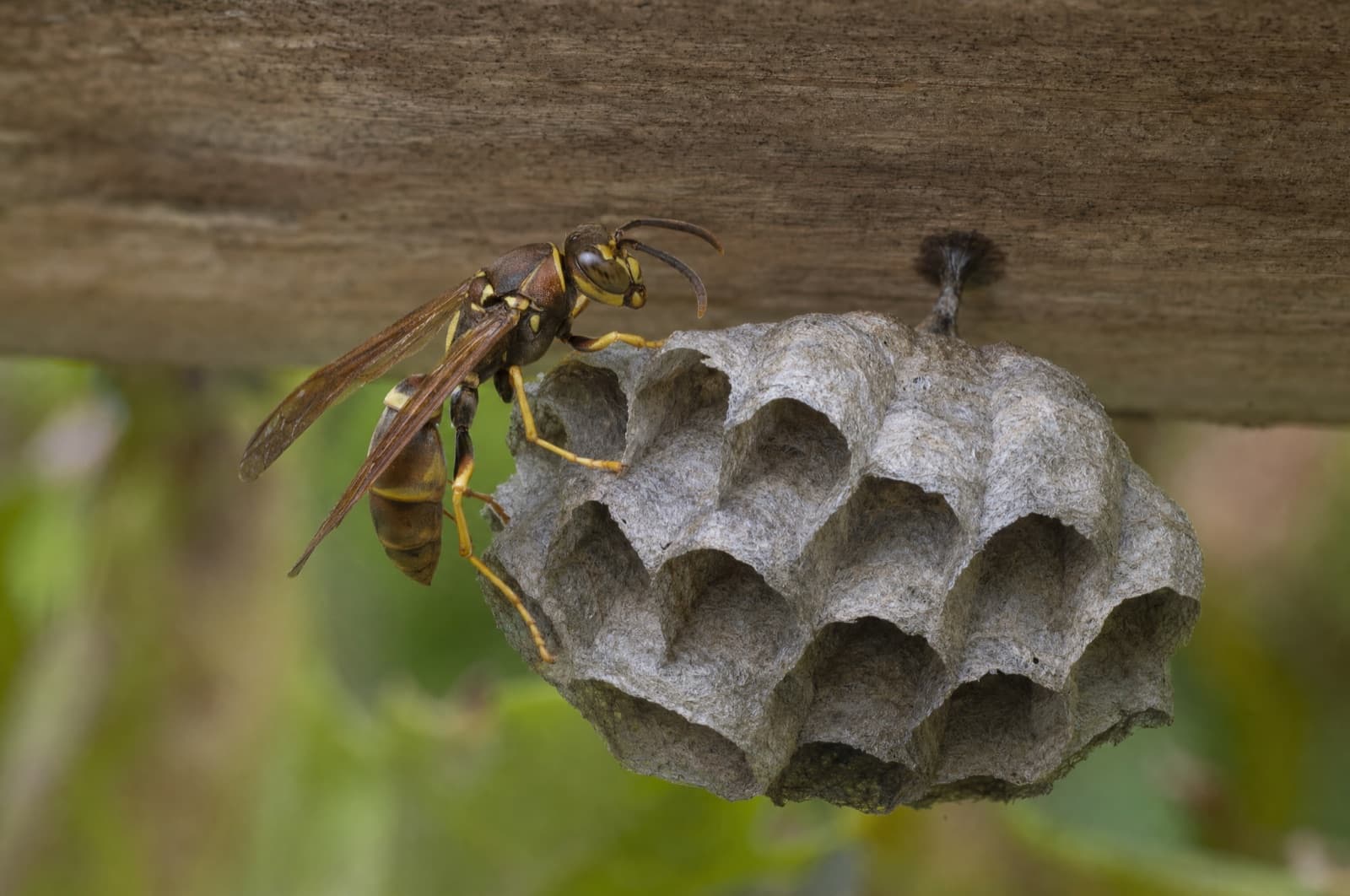
A lone founding queen emerges in late April and builds a golf-ball-sized starter nest, laying eggs and rearing the first brood alone. This is the easiest, safest time to remove a nest — populations are tiny and the queen has not yet been joined by defensive workers.
- 02
Summer
Workers emerge by mid-June and rapidly expand the nest through foraging and construction. By August the colony is huge and defensive, food-stressed, and aggression climbs as natural insect prey becomes scarcer.
- 03
Fall
Peak aggression and sugar-scavenging continue into September, then the colony collapses abruptly at the first hard frost, typically mid-to-late October in Manchester. New queens are produced beforehand and disperse to find overwintering sites.
- 04
Winter
No active colony exists. Mated queens hibernate in leaf litter, bark, and structural voids. Occasionally one 'wakes' inside a heated home during a warm spell and appears indoors, which can alarm homeowners who assume a colony survived — it did not.
Wasps in southern New Hampshire
Yellowjackets, paper wasps, and bald-faced hornets all follow the same annual clock in NH: a spring queen, a summer buildup, an August–September aggression peak, and total collapse at frost. Because only queens overwinter and never reuse a nest, a wall or attic nest found in fall will be empty by winter — but a queen may shelter in the same structure and start fresh nearby next spring.
Key local data
The entire wasp colony dies at Manchester's first hard frost, averaging October 19 (50% probability); only mated queens survive — NOAA 1991–2020 / UMass Extension.
We serve these communities
- NH-licensed applicator · #782664
- Same-day service
- Family-owned since 2017
Service Area Map
Southern New Hampshire
Timing your treatment
Timing changes everything with wasps: a spring nest is a golf ball you can handle cheaply; an August nest is thousands of defensive wasps. The cheapest, safest window is early — escalate fast once colonies are large.
Wasp Removal
Free inspection and same-day wasp removal across southern New Hampshire. NH-licensed #782664.
Learn more about this pestFrequently asked
Sources & references
- UMass Extension — Yellowjackets
colony timeline, Aug–Sep aggression peak, queens overwinter, no nest reuse
- UMD Extension — Social Wasps (Yellowjackets, Hornets, Paper Wasps)
species differences, annual colony cycle, new nest each spring
- Missouri Dept. of Conservation — Yellowjackets
colony collapse at frost, only queens survive
- NDSU Extension — Hornets/Yellowjackets
colony dies at frost, daytime activity, treat nests at night
- NOAA/NWS Gray — Frost/Freeze Program
frost anchor (~Oct 19 Manchester) that collapses the colony
- The Old Farmer's Almanac — NH Frost Dates (Manchester)
Manchester first-frost date (NOAA 1991–2020)
Editorial disclaimer: This content is provided for informational purposes only and does not constitute pest control advice. Every property is unique — consult a licensed professional for guidance specific to your situation. Anchor Pest Services is licensed in New Hampshire (#782664).
Written & reviewed by
VerifiedDaniel Brady
NH-Licensed Pesticide Applicator · License #782664 (NHDAMF, RSA 430)
Daniel Brady is the New Hampshire–licensed applicator behind Anchor Pest Services, a family-owned pest control company serving the Manchester area since 2017.
Last updated Jul 2026
Anchor Pest Services
Whatever the season — we handle the timing for you.
Same-day service across Southern New Hampshire. NH-licensed #782664, family-owned since 2017. We track the local calendar so you don't have to guess the right window.
- NH-licensed applicator
- Same-day service
- Pet & family-conscious
NH License #782664 · No obligation · We answer in person
Your next step
- Book a NH pro
Wasp Nest Removal in New Hampshire
Late-season nests are at their largest and most defensive. Safe, professional removal.
Book now - Next step
How to Get Rid of Paper Wasps
Read the answer - What to do next
How Long Do Wasps Live? Lifespan, Life Cycle & the NH Season
Read the answer - What to do next
Do Wasps Die After Stinging? Why Wasps Sting Again (Unlike Bees)
Read the answer - What to do next
Why Do Wasps Become More Aggressive When Tackled in Late Summer?
Read the answer - What to do next
Ground Wasps in NH — What's Nesting in Your Lawn?
Read the answer