
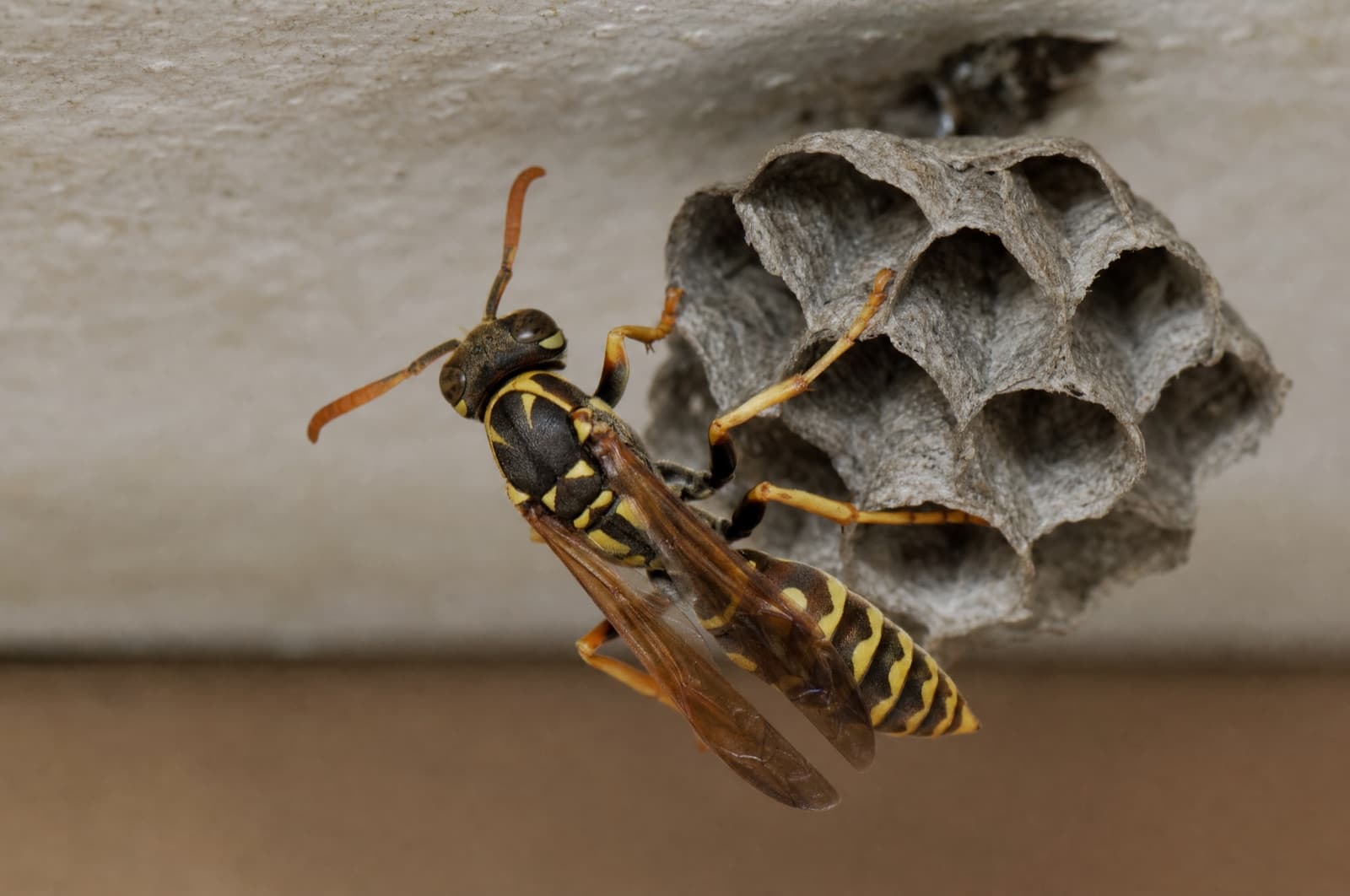
How to Get Rid of Paper Wasps
At a glance
- Difficulty: Intermediate
- Time: 10–20 minutes at dusk, plus a follow-up check
- Cost: Low — a labeled aerosol product and basic gear
- Success: Good for a small, accessible nest treated at dusk; poor once the colony has grown or if attempted mid-day
Can you DIY Paper Wasp?
The verdict on Paper Wasp DIY
Doable with care — but only for a small, early, reachable nest treated at dusk.
Paper wasps build open, umbrella-shaped nests under eaves, railings, and porch ceilings, and multiple extension sources confirm they're "much less aggressive than yellowjackets" when the nest isn't disturbed. That makes a small, low, early-season nest a realistic homeowner job with the right timing and gear. It stops being a DIY job the moment the nest is large, high, near a door or walkway, or anyone in the household has a stinging-insect allergy — those situations call for a pro.
The 5 DIY methods — honestly graded
Every approach graded for this species, in IPM order — prevention first, chemistry late. Pick a method to see how it works, the steps, and what it actually takes.
Prevention / Exclusion
Works wellThe most effective track — a founding queen's inch-wide starter nest in spring is far easier and safer to remove than a mature colony.
A single fertilized queen starts a paper wasp nest each spring. Knocking down that tiny starter nest before workers hatch prevents the colony from ever reaching a size where DIY removal gets dangerous.
Best for: Stopping a nest before it becomes a colony
Inspect in spring
Check eaves, railings, porch ceilings, and outdoor furniture in April–May for a queen and her small, exposed, umbrella-shaped starter nest.
TipA quarter-sized nest with a few cells is a founding-stage nest — the easiest one you'll ever deal with.Knock it down early
Knock down an incipient nest with a broom or a hard water spray before it grows; the queen will usually relocate rather than rebuild in the same spot.
CautionDo this only for a tiny founding-stage nest with one or two wasps present — not a nest that already has visible workers.Seal potential nesting sites
Caulk gaps under eaves and soffits and around porch ceilings where queens like to start nests.
Tools & materials
Why DIY falls short here
Not scare tactics — the specific, proportionate reasons a home attempt can stall for this species.
Height and ladder risk
A mature nest high under an eave invites a ladder-plus-defensive-wasps combination — a fall during a sting response is a far bigger risk than the sting itself.
Hidden or overlooked nests
Nests tucked behind shutters, in grills, or under deck rails get disturbed by accident during yard work, causing unexpected stings with no warning.
Allergy is an emergency, not a DIY variable
A single sting can be a medical emergency for someone with a known stinging-insect allergy — that risk isn't worth gambling on for a nest you could hand off instead.
How risky is it, really?
An honest read — most nuisance species are genuinely low risk, and we say so.
Paper wasps are generally less aggressive than yellowjackets and sting mainly when the nest is directly disturbed. A sting is painful but not typically dangerous for a non-allergic person; the real elevated risk is for anyone with a known stinging-insect allergy, where even one sting warrants fast medical attention.
- Painful sting(s) when the nest is disturbedOccasional
Paper wasps can sting more than once and will defend an actively disturbed nest, though they're less likely to swarm than yellowjackets
University of Maryland Extension
- Anaphylaxis in individuals with a known stinging-insect allergyRare
Genuinely elevated risk for allergic individuals specifically — anyone with a history of severe allergic reaction should carry an epinephrine auto-injector and call 911 for signs of a systemic reaction (throat/tongue swelling, difficulty breathing, dizziness, hives away from the sting site)
CDC / American College of Allergy, Asthma & Immunology
- Fall injury from ladder use during a defensive responseOccasional
A bigger practical risk than the sting itself for nests high under eaves
UNH Cooperative Extension
Not Sure If That Nest Is a DIY Job?
A small, low, early-season paper wasp nest is manageable yourself. A large one, a high one, or one near your door isn't worth the risk. Anchor Pest Services handles stinging-insect nests safely across southern and central New Hampshire. Family-owned since 2017, NH license #782664.
Call a pro when…
- The nest is near an entry, walkway, or play area
- The nest is high under an eave or otherwise hard to reach safely
- The nest has grown large or you're seeing multiple nests
- Anyone in the household has a known stinging-insect allergy
General Pest Control
You can handle a small, low, early paper wasp nest yourself with the right timing. Hand it to Anchor once the nest is large, high, near a door or walkway, hidden in a void, or if anyone in the household has a stinging-insect allergy.
Keep them out
- Check eaves, railings, and porch ceilings in spring for founding-queen nests
- Knock down tiny starter nests before workers hatch
- Seal gaps under eaves and soffits where queens like to start
Paper wasps in New Hampshire
In New Hampshire, mated queens emerge in spring to start new nests under eaves, railings, and porch ceilings, and colonies grow through summer before dying off around the first hard frost — about October 19–29 in Manchester (NOAA). That makes spring the best window to knock down tiny founding-stage nests, and it means an old, empty paper nest you find in winter poses no risk (it won't be reused).
Peak season
Spring founding through late-summer peak colony size
First-frost anchor
Manchester first hard frost ~Oct 19 (50%) / Oct 29 (80%), NOAA 1991–2020
Make sure it's a Paper Wasp
Two quick detours worth taking — confirm the ID, then learn what drew it in so it doesn't come back.
Frequently asked
Sources & further reading(5)
- [1]University of Maryland Extension — Social Wasps: Yellowjackets, Hornets, and Paper Wasps
Paper wasp aggression relative to yellowjackets, nest biology
extensionverified 2026-07-13 - [2]Oklahoma State University Extension — Paper Wasps, Yellowjackets, and Other Stinging Wasps
Nest founding, treatment timing
extensionverified 2026-07-13 - [3]University of Kentucky Entomology (EF620) — Paper Wasps, Yellowjackets, and Other Social Wasps
Nest biology, sting behavior
extensionverified 2026-07-13 - [4]UNH Cooperative Extension — Stinging Insects (Resource000532/Rep554)
NH-specific stinging-insect guidance
extensionverified 2026-07-13 - [5]CDC / American College of Allergy, Asthma & Immunology — Insect Sting Allergies
Allergic reaction prevalence and emergency response
medicalverified 2026-07-13
Written & reviewed by
VerifiedDaniel Brady
NH-Licensed Pesticide Applicator · License #782664 (NHDAMF, RSA 430)
Daniel Brady is the New Hampshire–licensed applicator behind Anchor Pest Services, a family-owned pest control company serving the Manchester area since 2017.
Last updated July 2026
Other species you can tackle
Same category — the dot shows each one's DIY verdict at a glance (green = friendly, amber = doable with care, red = call a pro).
Professional Pest Control
Not Sure If That Nest Is a DIY Job?
A small, low, early-season paper wasp nest is manageable yourself. A large one, a high one, or one near your door isn't worth the risk. Anchor Pest Services handles stinging-insect nests safely across southern and central New Hampshire. Family-owned since 2017, NH license #782664.
- Licensed NH applicators (#782664)
- Safe removal of nests DIY shouldn't touch
- Free inspection — same-day service across southern NH
NH License #782664 · No obligation · We answer in person
Your next step
- Book a NH pro
Wasp Nest Removal in New Hampshire
Late-season nests are at their largest and most defensive. Safe, professional removal.
Book now - Also relevant
Paper Wasp — Quick ID for New Hampshire Homeowners
Read the answer - Also relevant
Wasp & Hornet Prevention: Seal Voids Before Queens Arrive
Read the answer