
American Dog Tick in NH: ID, Disease Risk & Removal
Also called Wood tick
The American dog tick (Dermacentor variabilis) is established and common throughout New Hampshire. It does NOT transmit Lyme disease — that is the deer tick. It does vector Rocky Mountain spotted fever (RMSF) and tularemia, two serious but treatable diseases. The correct removal technique (fine-tipped tweezers, steady upward pull, no twisting or nail polish) is the single most important protective action.
- NH status
- Established and common statewide
- extension.unh.edu
- Lyme?
- No — does NOT spread Lyme disease
- Lyme = blacklegged/deer tick; cdc.gov
- Diseases
- Rocky Mountain spotted fever (RMSF) + tularemia
- cdc.gov/ticks/about/where-ticks-live.html
- Size
- ~5 mm unfed; grape-sized when engorged
- adult female; Ixodidae
- Peak risk
- Spring and summer (adult females)
- cdc.gov/ticks/about/where-ticks-live.html
The common NH tick — and it does not carry Lyme
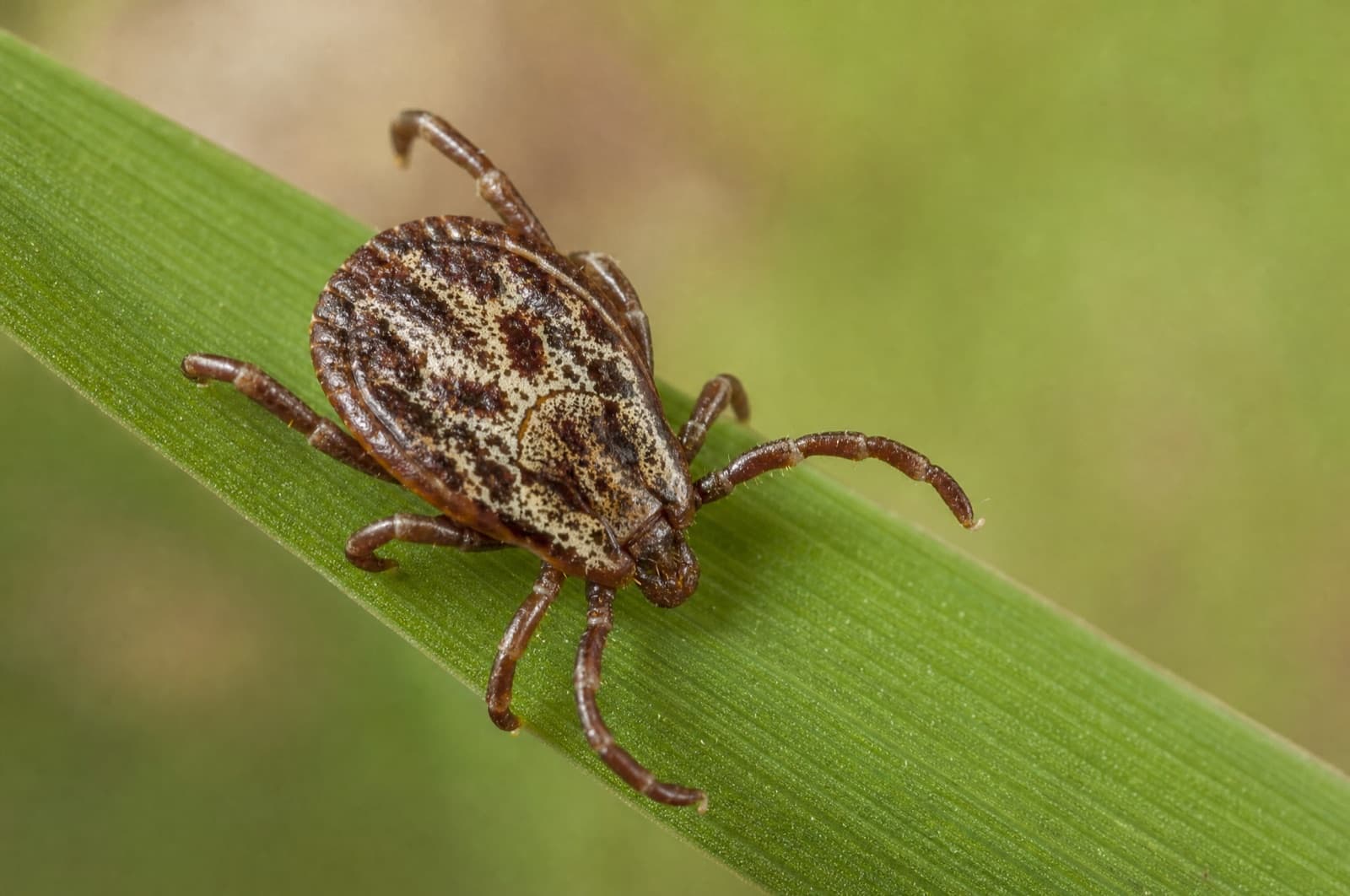
The American dog tick (Dermacentor variabilis) — also called the wood tick — is established and common throughout New Hampshire, found wherever there is tall grass, brush, or trail edges. It is the tick most NH residents encounter in their yards and on their dogs in spring and summer. Its ornate white-and-silver marbling on the back makes it easy to distinguish from the smaller, darker deer tick.
The most important thing to know: the American dog tick does NOT transmit Lyme disease. Lyme is the deer tick's domain; for Lyme depth see /ticks-fleas-faq/. The dog tick does vector Rocky Mountain spotted fever (RMSF) and tularemia — both serious, but both treatable with prompt medical attention. The most protective action any NH resident can take is knowing the correct CDC tick-removal technique: fine-tipped tweezers, grasp close to the skin, steady upward pull, no twisting or folk remedies.
How to identify an American dog tick
The American dog tick's ornate white-and-silver marbling on the scutum (the plate behind the head) is the single best ID feature — no other common NH tick has it. It is larger than the deer tick and has short, blunt mouthparts. A marbled tick on a dog or person after outdoor activity in spring or summer is almost certainly this species.
American dog tick
- Scientific name
- Dermacentor variabilis
- Family
- Ixodidae
- Size
- Adult female ~5 mm unfed; grape-sized when engorged
- Coloration
- Brown with ornate white/silver markings on the scutum; brown legs
- Habitat
- Grassy fields, trail edges, brush, shrubby areas
- Active season
- Spring through late summer; adults peak May–August
- Diet
- Blood — rodents as larvae/nymphs; dogs and humans as adults
- Reproduction
- Female lays several thousand eggs after a blood meal
- Lifespan
- Multi-stage; up to ~2 years
East of the Rocky Mountains; established throughout New Hampshire
The tells — key ID features
- Ornate white/silver marbling on the back (scutum) — the single best visual ID feature; no other common NH tick has this pattern
- Larger than the deer tick — unfed adult about the size of a small watermelon seed (~5 mm)
- Short, blunt mouthparts and a roughly rectangular capitulum (head base)
- Brown legs; body engorges to grape-size when fully fed
- Found questing on tall grass and trail edges in spring and summer, not typically climbing walls or ceilings
Size, to scale
Unfed adult ~5 mm
A small watermelon seed; engorged female swells to grape-sized
Blacklegged tick (deer tick)
How to tell — The deer tick is smaller (~2–3 mm), has dark legs and no ornate marbling — and is the Lyme vector. Full deer-tick depth at /ticks-fleas-faq/.
Lone star tick
How to tell — The lone star tick has a single white dot on the female's back and longer mouthparts; it lacks the ornate all-over marbling of the American dog tick.
Brown dog tick
How to tell — The brown dog tick is plain reddish-brown with no marbling; tends to climb walls and ceilings indoors and is uncommon in NH.
Signs of a problem
The American dog tick quests actively in tick season. These are the signs of activity on your property or pet.
Ticks found questing on tall grass or shrubs along a trail edge in late spring or summer
What it means — American dog tick habitat — peak adult activity season (May–August) in exactly this microhabitat.
A marbled (white-and-brown) tick on a dog or family member after outdoor activity
What it means — American dog tick — confirm the ornate marbling and remove promptly using the CDC technique.
An engorged, grape-sized tick on a pet
What it means — A fed adult female American dog tick; remove carefully and monitor both the pet and the bitten person for fever or rash in the following days.
Multiple ticks found on dogs or people after walking through a brushy or unmowed area
What it means — High tick density — consider perimeter tick treatment and daily full-body checks after outdoor time.
The real risks, calibrated
The American dog tick does not spread Lyme disease. It carries two other serious diseases NH residents should know about.
Rocky Mountain spotted fever (RMSF)
SevereOnset: Fever and headache typically 2–14 days after bite; rash appears 2–4 days after fever onset (wrists/ankles first, spreading)
Serious and potentially fatal if untreated; curable with prompt medical treatment. See a doctor for any fever or rash after a tick bite — do not wait. Route to your doctor and NH DHHS; no dosages here.
Tularemia
ModerateOnset: Symptoms typically 3–5 days after tick exposure
Fever, skin ulcer at the bite site, swollen lymph nodes; treatable with antibiotics with prompt diagnosis. See a doctor for any post-tick symptoms.
DIY — what works, what backfires
The most important DIY action with any tick is correct removal. Here is the CDC-recommended technique — and the mistakes that make things worse.
What actually works
- Use clean fine-tipped tweezers and grasp the tick as close to the skin's surface as possible.
- Pull upward with steady, even pressure — do not twist or jerk.
- After removal, clean the bite area and your hands with rubbing alcohol or soap and water.
- Save the tick in a sealed bag or container for identification if symptoms develop.
- Perform daily full-body tick checks on yourself, children, and pets after outdoor activity — pay particular attention to behind the ears, hairline, underarms, groin, and between the toes.
What backfires
- Do not twist or jerk the tick during removal — this may cause the mouthparts to break off in the skin.
- Do not use nail polish, petroleum jelly, heat (matches), or any folk remedy — these methods do not work and delay correct removal.
- Do not crush the tick with your fingers; dispose of it by sealing in a bag, submerging in alcohol, or flushing.
- Do not assume a tick is safe because it was attached briefly — RMSF transmission can occur with shorter attachment times than Lyme disease.
American dog tick in New Hampshire
The American dog tick is established and among the most common ticks encountered by NH residents, particularly in fields, trail edges, and brushy yards across Rockingham, Hillsborough, Merrimack, and Strafford counties. Adults peak roughly May through August. Manchester, Nashua, Concord, and surrounding communities all have active populations in appropriate habitat.
Peak season
Spring through late summer; adult females most active May–August
You might actually have
- Blacklegged tick (deer tick) — the Lyme vector; see /ticks-fleas-faq/
- Lone star tick — range-expanding, established Merrimack County only
- Brown dog tick — uncommon; can breed indoors
We serve these communities
- NH-licensed applicator · #782664
- Same-day service
- Family-owned since 2017
Service Area Map
Southern New Hampshire
When to call a pro for American dog tick control
Yard tick treatment combined with habitat modification can significantly reduce American dog tick populations on your property. Anchor's Tick Control service targets the tick's preferred questing habitat — grass edges, brush, and transition zones — for seasonal protection across southern NH.
When to call a pro
- Ticks are consistently found on family members or pets after time in the yard.
- Your property has brushy edges, tall grass, or wooded borders that create high-density tick habitat.
- You want seasonal perimeter treatment before peak adult activity in spring.
Keep grass mowed and brush cut back
American dog ticks quest from tall grass and brush edges. Mow regularly and trim shrubs, especially at the boundary between lawn and woods or unmowed areas.
Create a wood-chip barrier at the woods edge
A 3-foot-wide strip of wood chips or gravel between the lawn and a wooded border creates a dry, exposed zone that ticks avoid crossing.
Use EPA-registered tick repellents
Apply DEET to exposed skin and permethrin to clothing and gear for outdoor activity in tick habitat. Follow label directions for all repellents.
Daily tick checks
After any outdoor activity in potential tick habitat, check the whole body — especially behind the ears, hairline, underarms, groin, and behind the knees — on yourself, children, and pets.
Not sure it's a american dog tick?
A licensed NH technician can confirm the species and tell you honestly whether it's a DIY fix or a job for a pro — free inspection, same-day service across Southern New Hampshire.
Frequently asked questions
Sources(6)
- [1]CDC — Where Ticks Live
RMSF and tularemia vectors; spring/summer peak; adult females bite humans
govverified 2026-06-30 - [2]CDC — Rocky Mountain Spotted Fever
RMSF symptoms, onset, severity, treatability
govverified 2026-06-30 - [3]
- [4]UNH Cooperative Extension — Biology and Management of Ticks in NH
established and common NH species; local habitat context
extensionverified 2026-06-30 - [5]
- [6]
Written & reviewed by
VerifiedDaniel Brady
NH-Licensed Pesticide Applicator · License #782664 (NHDAMF, RSA 430)
Daniel Brady is the New Hampshire–licensed applicator behind Anchor Pest Services, a family-owned pest control company serving the Manchester area since 2017.
Last updated 2026-06-30

New Hampshire pest control
Dealing with american dog ticks in your home?
Anchor Pest Services identifies and handles american dog tick problems across southern and central New Hampshire. Family-owned since 2017, NH license #782664.
- NH-licensed applicators (#782664)
- Same-day service · free inspection
- Family-owned since 2017
Your next step
- Book a NH pro
Tick Control in New Hampshire
Adult deer ticks peak in fall. Yard tick control across Manchester and southern NH.
Book now - Next step
Does Baking Soda Work Against Fleas in Carpet?
Read the answer - What to do next
How to Get Rid of American Dog Ticks
Read the answer - What to do next
How to Get Rid of Dog Ticks
Read the answer - What to do next
What Attracts Dog Ticks to Your House?
Read the answer - Related guide
Brown Dog Tick in NH: The Tick That Infests Houses
Read the answer