
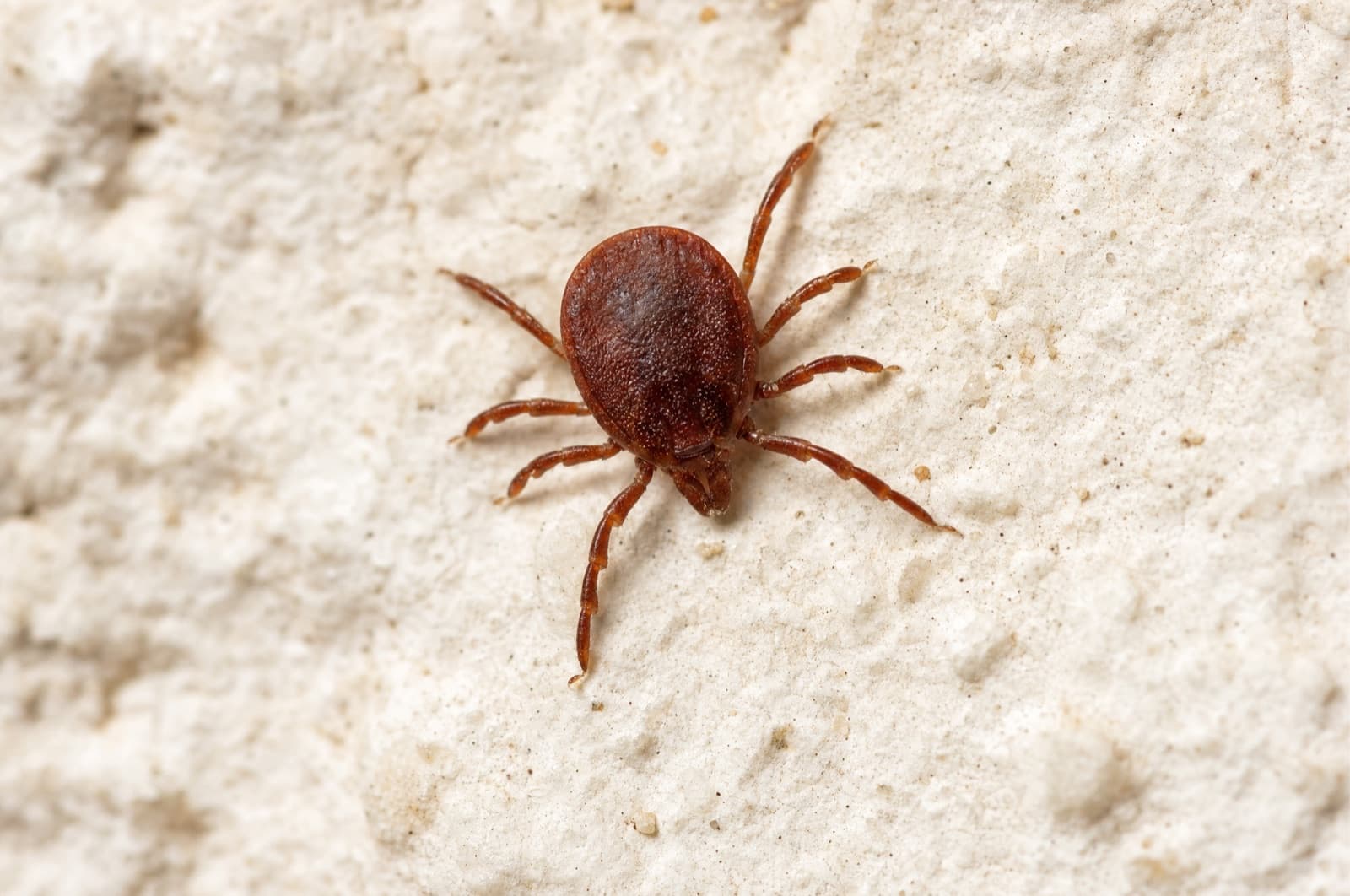
Brown Dog Tick in NH: The Tick That Infests Houses
Also called Kennel tick
The brown dog tick (Rhipicephalus sanguineus) is uncommon in New Hampshire, mostly tied to kennels and dog-keeping homes. Its defining trait — unique among common ticks — is that it can complete its entire life cycle indoors. This means infestations can build inside a heated building without any outdoor exposure. Effective treatment requires addressing both the dog (with a veterinarian) and the indoor environment simultaneously.
- NH status
- Uncommon — mainly kennels and dog homes
- extension.unh.edu
- Unique trait
- Completes full life cycle INDOORS
- ask.ifas.ufl.edu/publication/IN378
- Size
- ~3 mm unfed; ~12 mm engorged
- ask.ifas.ufl.edu/publication/IN378
- Main threat
- Dogs (canine ehrlichiosis/babesiosis)
- rarely bites people; cdc.gov
- Appearance
- Plain reddish-brown — no ornate marbling
- ask.ifas.ufl.edu/publication/IN378
The tick that breeds inside your home — not just in the yard
The brown dog tick (Rhipicephalus sanguineus) — also called the kennel tick — is primarily a dog parasite and is uncommon in New Hampshire, mostly found in kennels and dog-keeping homes. It is plain reddish-brown with no ornate marbling, smaller than the American dog tick, and can be identified by its tendency to climb walls and ceilings and hide in cracks near where dogs rest.
What makes this tick uniquely problematic is its biology: it can complete its entire life cycle indoors — eggs, larvae, nymphs, and adults all developing inside a heated building without outdoor exposure. This is what causes recurrent indoor dog-tick problems that don't respond to yard treatment alone. The fix requires treating both the dog (with a veterinarian) and the indoor environment; addressing only one will result in re-infestation from the other.
How to identify a brown dog tick
The brown dog tick is uniformly reddish-brown with no ornate marbling — the opposite of the American dog tick. Its wall-climbing behavior (found on walls, ceilings, and door frames near dog beds) is a strong diagnostic sign of an established indoor population. Under magnification the hexagonal basis capituli (head base) is distinctive.
Brown dog tick
- Scientific name
- Rhipicephalus sanguineus
- Family
- Ixodidae
- Size
- Adult ~3 mm unfed; ~12 mm engorged
- Coloration
- Uniform reddish-brown; hexagonal basis capituli; no ornate markings
- Habitat
- Dog kennels, homes with dogs, cracks/crevices, ceilings and walls near dog resting areas
- Active season
- Year-round indoors in heated buildings
- Diet
- Dog blood at all life stages; rarely bites people
- Reproduction
- Female lays thousands of eggs in cracks near dog harborage; completes entire cycle indoors
- Lifespan
- ~1 year per generation
Worldwide; uncommon in NH, mainly in kennels and dog-keeping homes
The tells — key ID features
- Uniform reddish-brown with no marbling — the key visual difference from the ornate American dog tick
- Hexagonal base of the mouthparts (basis capituli) visible under magnification
- Tendency to climb upward — found on walls, ceilings, and door frames near dog resting areas (unusual behavior for a tick)
- Found on dogs' ears and between the toes as preferred attachment sites
- Smaller than the American dog tick when unfed (~3 mm vs ~5 mm)
Size, to scale
Unfed adult ~3 mm
A sesame seed; engorged female swells to ~12 mm, about grape-sized
American dog tick
How to tell — The American dog tick has ornate white/silver marbling on its back — the brown dog tick is plain reddish-brown. The American dog tick is established statewide and found outdoors; the brown dog tick is uncommon and usually found indoors.
Blacklegged tick (deer tick)
How to tell — The deer tick is smaller with dark legs; found outdoors in leaf litter and brush. It is the Lyme disease vector — full depth at /ticks-fleas-faq/.
Signs of a problem
Brown dog tick signs are different from other ticks — look for activity indoors near your dog's resting places.
Ticks climbing walls or ceilings, or clustering in cracks near a dog's bed or kennel
What it means — Indoor brown dog tick population — wall-climbing behavior is unique to this species among NH ticks and is a definitive sign of established indoor infestation.
Repeated ticks on an indoor dog that has little or no outdoor exposure
What it means — Indoor breeding — the tick is completing its life cycle inside the home without needing outdoor hosts.
Ticks in and around a dog kennel, especially in cracks and seams
What it means — Established kennel population — requires treating the structure, not just the dog.
Ticks found on the dog's ears or between the toes during grooming
What it means — Preferred attachment sites of the brown dog tick; check these areas carefully during any tick inspection.
The real risks, calibrated
The brown dog tick is primarily a veterinary concern in NH — its disease risk to dogs is higher than its risk to people.
Canine ehrlichiosis and babesiosis (dogs)
ModerateOnset: Days to weeks after tick attachment
Serious illnesses in dogs — fever, lethargy, anemia, low platelet count. Coordinate with a veterinarian for diagnosis and treatment; this is a veterinary, not a pest-control, scope of work.
Rocky Mountain spotted fever (humans — limited NH risk)
ModerateOnset: Days after a rare human bite
Can cause serious illness. RMSF via this species is primarily a concern in the southwestern US and Mexico — in NH where this tick is uncommon and rarely bites people the risk is lower. See a doctor for any fever or rash after a tick bite.
DIY — what works, what backfires
Brown dog tick control requires treating both the dog and the indoor environment simultaneously — addressing just one leads to re-infestation.
What actually works
- Use fine-tipped tweezers to remove attached ticks from the dog: grasp close to the skin, apply steady upward pressure, no twisting (CDC technique; cdc.gov/ticks/after-a-tick-bite).
- Work with your veterinarian immediately to start the dog on an effective tick preventive.
- Vacuum thoroughly — focus on cracks, baseboards, wall-to-floor junctions, and anywhere the dog rests; seal and discard the bag immediately after.
- Launder all pet bedding, blankets, and soft furnishings in hot water.
- Treat harborage areas (cracks, crevices, kennels, baseboards near dog beds) with an appropriate insecticide — a licensed pest management professional is the most effective approach for established infestations.
What backfires
- Do not treat only the dog and ignore the indoor environment — re-infestation will continue from eggs and larvae in wall cracks and harborage areas.
- Do not treat only the yard — this tick breeds indoors; outdoor treatment alone misses the source.
- Do not use nail polish, petroleum jelly, or heat to remove ticks — use the CDC fine-tipped tweezers technique.
- Do not delay veterinary care for the dog; tick preventives and any disease treatment are the veterinarian's domain.
Brown dog tick in New Hampshire
The brown dog tick is uncommon in NH but possible statewide, almost always tied to kennels or dog-keeping homes. NH's heated buildings allow it to remain active year-round indoors — unlike outdoor ticks that become inactive in winter. This makes it a year-round concern for any NH dog-keeping household where it becomes established.
Peak season
Year-round indoors in heated buildings — not seasonally limited like outdoor ticks
You might actually have
- American dog tick — ornate marbling, established statewide (the common NH tick)
- Blacklegged tick (deer tick) — Lyme vector; see /ticks-fleas-faq/
We serve these communities
- NH-licensed applicator · #782664
- Same-day service
- Family-owned since 2017
Service Area Map
Southern New Hampshire
When to call a pro for brown dog tick control
A brown dog tick infestation requires coordinated treatment of the dog (with your veterinarian) and the indoor environment. Anchor's Tick Control team can target harborage areas — cracks, crevices, kennels, and baseboards near dog beds — with residual treatment that breaks the indoor life cycle.
When to call a pro
- Recurring ticks on an indoor dog despite regular grooming — indoor breeding is likely.
- Ticks found climbing walls, ceilings, or door frames — a classic indoor infestation sign requiring professional environmental treatment.
- A kennel or boarding facility with a persistent tick problem despite routine cleaning.
Keep dogs on veterinarian-recommended tick prevention year-round
Because the brown dog tick can breed indoors year-round in NH's heated buildings, tick prevention for your dog should not be seasonal. Work with your veterinarian on a year-round prevention protocol.
Seal cracks near dog resting areas
Caulk baseboards, seams, and crevices near kennels and dog beds where female ticks lay eggs. This removes the primary indoor harborage.
Launder pet bedding weekly in hot water
Hot-water washing kills tick eggs and larvae in bedding and soft furnishings before they can develop into the next life stage.
Inspect dogs after outdoor activity
Even though this tick breeds indoors, the initial introduction usually comes from an outdoor tick on the dog. Daily checks help catch ticks before they establish indoors.
Not sure it's a brown dog tick?
A licensed NH technician can confirm the species and tell you honestly whether it's a DIY fix or a job for a pro — free inspection, same-day service across Southern New Hampshire.
Frequently asked questions
Sources(4)
- [1]University of Florida IFAS — Brown Dog Tick (IN378)
reddish-brown no marbling; size ~3 mm unfed / ~12 mm engorged; canine ehrlichiosis/babesiosis; completes entire life cycle indoors; kennel/residence infestation; indoor biology unique among common ticks
extensionverified 2026-06-30 - [2]UNH Cooperative Extension — Biology and Management of Ticks in NH
uncommon in NH; mainly kennels/dog homes; year-round in heated buildings
extensionverified 2026-06-30 - [3]CDC — Rocky Mountain Spotted Fever
RMSF; primarily SW US/Mexico for this vector
govverified 2026-06-30 - [4]
Written & reviewed by
VerifiedDaniel Brady
NH-Licensed Pesticide Applicator · License #782664 (NHDAMF, RSA 430)
Daniel Brady is the New Hampshire–licensed applicator behind Anchor Pest Services, a family-owned pest control company serving the Manchester area since 2017.
Last updated 2026-06-30

New Hampshire pest control
Dealing with brown dog ticks in your home?
Anchor Pest Services identifies and handles brown dog tick problems across southern and central New Hampshire. Family-owned since 2017, NH license #782664.
- NH-licensed applicators (#782664)
- Same-day service · free inspection
- Family-owned since 2017
Your next step
- Book a NH pro
Tick Control in New Hampshire
Adult deer ticks peak in fall. Yard tick control across Manchester and southern NH.
Book now - Next step
Do Ticks Drop Off Pets and Hide in a House?
Read the answer - What to do next
How to Get Rid of Brown Dog Ticks
Read the answer - What to do next
How to Get Rid of Dog Ticks
Read the answer - What to do next
What Attracts Dog Ticks to Your House?
Read the answer - Related guide
American Dog Tick in NH: ID, Disease Risk & Removal
Read the answer