
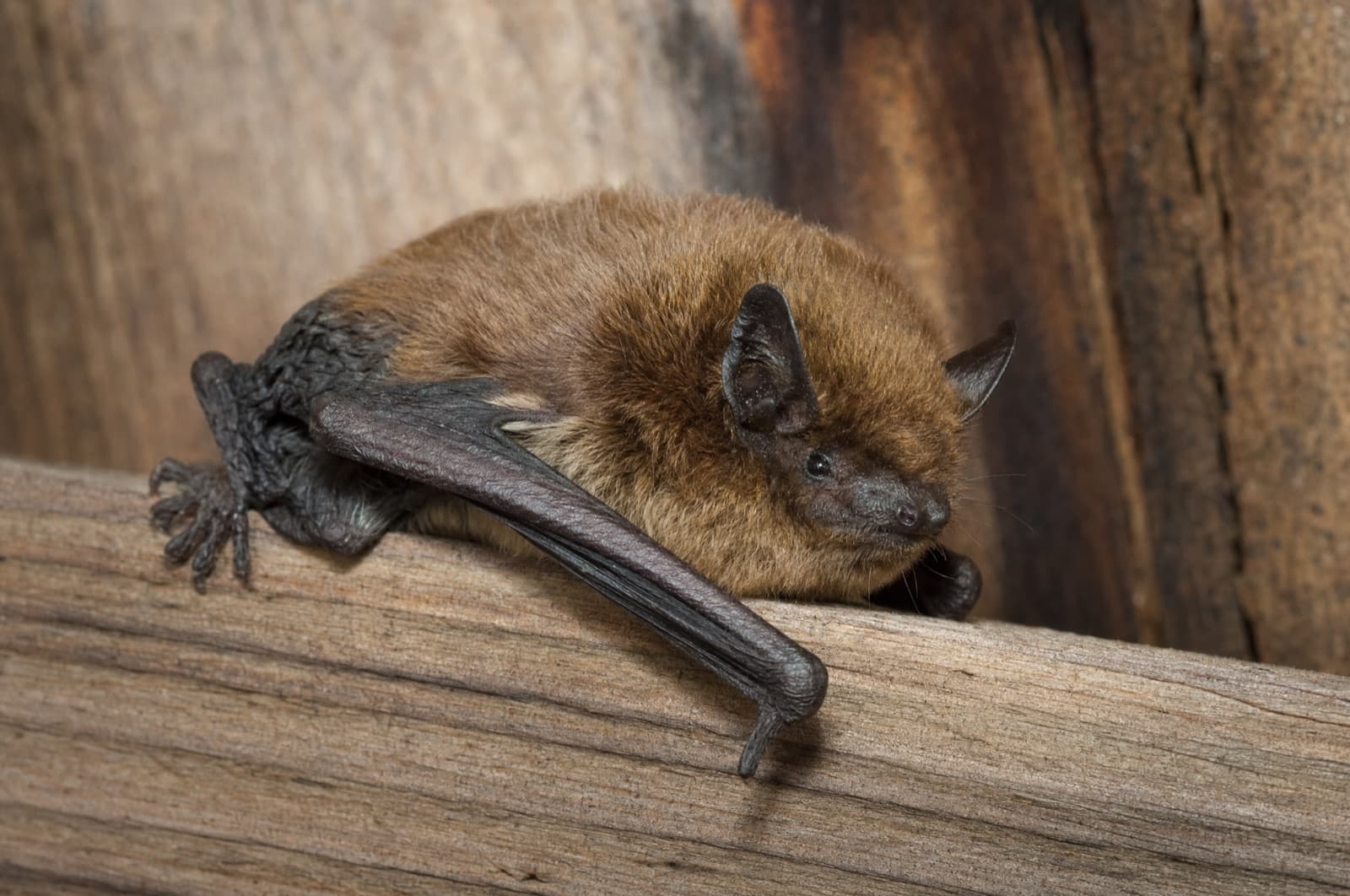
Bats in New Hampshire — ID, Signs & Safe Removal
Also called little brown myotis · big brown bat · house bat
New Hampshire bats (chiefly little brown bat and big brown bat) are protected species of conservation concern. Exclusion is legally and ethically restricted during the June–August maternity season when flightless pups would be trapped. Any bat found in a bedroom is treated as a potential rabies exposure — call NH DHHS at (603) 271-4496 immediately. Colony removal is almost always a licensed Wildlife Control Operator job.
- Little brown bat size
- Body 2.5–4 in, wingspan 9–11 in, 1/8–1/2 oz
- NH Fish & Game
- Reproductive rate
- One pup per female per year, born in June
- UNH Extension
- Lifespan
- Up to 20–30 years
- NH Fish & Game
- WNS crash
- 3,230 bats (2009) fell to 16 (2011) at 4 NH hibernacula — 79–100% mortality
- NH Fish & Game
- Maternity restriction
- No exclusion May–August; use one-way doors in August after pups fly
- NH Fish & Game
- Bedroom contact protocol
- Call NH DHHS (603) 271-4496 immediately for any bedroom bat
- NH DHHS / UNH Extension
The bat in your attic: NH's most legally complex wildlife problem
Bats are some of the most valuable wild animals in New Hampshire — a single little brown bat can consume hundreds of insects per hour — and they are some of the most legally sensitive. Both species commonly found in NH homes (the little brown bat and the big brown bat) are species of conservation concern, and white-nose syndrome (WNS) has devastated NH populations by 79–100% since it first appeared here in the winter of 2008–09.
The single most important fact for any homeowner: you cannot simply seal a bat colony out of your attic whenever you feel like it. Between approximately June and August, female bats form maternity colonies to raise their pups. The pups are flightless for weeks after birth, so sealing during this window traps and kills them — which is both unethical and legally problematic given their protected conservation status. One-way exclusion doors should be installed in August, once pups can fly, then sealed permanently.
The second most important fact: any bat found in a bedroom, or any situation where a bat could have contacted a sleeping person or child, is treated as a potential rabies exposure by NH DHHS — even if no bite was felt, because bat bites can be unapparent. Call NH DHHS Bureau of Infectious Disease Control at (603) 271-4496 immediately. Do not wait and see.
How to identify New Hampshire bats
Two species account for nearly all bat-in-building calls in NH: the little brown bat and the big brown bat. Both have membranous wings and erratic, swooping flight — very different from birds. Seeing one flying at dusk indoors or in the attic, or finding guano below vents and eaves, are the typical first signs.
Little brown bat / Big brown bat
- Scientific name
- Myotis lucifugus (little brown) / Eptesicus fuscus (big brown)
- Family
- Vespertilionidae
- Size
- Little brown: body 2.5–4 in, wingspan 9–11 in, 1/8–1/2 oz; big brown: body 4–5 in, wingspan 12–16 in, 1/2–5/8 oz
- Coloration
- Glossy brown above, lighter buff below; big brown bat slightly larger and paler
- Habitat
- Hot attics, barns, and outbuildings for maternity colonies; caves and mines for winter hibernation
- Active season
- ~mid-April through October; big brown bat may overwinter in buildings; little brown bat migrates to hibernacula
- Diet
- Insectivore — moths, beetles, mosquitoes, midges; can consume hundreds of insects per hour
- Reproduction
- 1 pup per female per year, born in June; pups are flightless for several weeks
- Lifespan
- Up to 20–30 years (one of the longest-lived mammals for their size)
Both species occur throughout New Hampshire; little brown bat is state-endangered; big brown bat is the one most commonly seen in NH neighborhoods
The tells — key ID features
- Tiny body (smaller than a human hand) with a large, membranous wingspan — the combination is unmistakable.
- Erratic, swooping flight at dusk — distinctly different from birds, which have smoother flight paths.
- Glossy dark brown fur; the big brown bat is the species most likely seen in NH backyards and buildings.
- Guano: small, pellet-like, dry, and crumbly — unlike mouse droppings, bat guano turns to powder when crushed.
- Congregate in hot attic spaces and gable vents for maternity colonies May–August.
Size, to scale
Body smaller than a human thumb; wingspan 9–16 in depending on species
Body fits in a closed fist; wingspan about the width of a standard sheet of paper (little brown) to a sheet of legal paper (big brown)
Birds at dusk (swallows, chimney swifts)
How to tell — Birds have smooth, purposeful flight and feathered wings; bats have membranous wings and an erratic, jerky flight pattern.
Little brown bat vs. big brown bat
How to tell — Big brown bat is noticeably larger (wingspan 12–16 in vs. 9–11 in) and is the species most commonly seen flying in NH neighborhoods. Little brown bat is state-endangered.
Signs of a problem
Bat colonies can go undetected for years in NH attics. These are the signs that bats are present and that a maternity colony may have established.
Bats seen flying out from a roofline at dusk (one or many)
What it means — An active roost in the attic, gable vent, or soffit — likely a maternity colony in summer.
Pellet-like guano accumulating below gable vents, behind shutters, or on attic insulation
What it means — A colony above; guano volume indicates colony size and duration.
Dark staining or grease marks at a vent or gap edge
What it means — The entry/exit point the colony uses regularly — their oils and guano build up over time.
Squeaking or fluttering sounds at dusk or dawn from the attic
What it means — Colony activity; pups are especially noisy in June–July before they can fly.
A single bat flying inside the living space at night
What it means — A pup or adult entered through an interior gap; treat as a potential rabies exposure if anyone was sleeping in the room.
Bat bugs (close relatives of bed bugs) found indoors after bats depart
What it means — Bats left or were excluded; their ectoparasites are now seeking a new host.
The real risks, calibrated
Most bats are not rabid. However, the risks associated with bats are high enough — and the legal protections significant enough — that this is rarely a DIY situation.
Rabies exposure
SevereOnset: Any bat-human contact (bites often unapparent)
Rabies is fatal once symptomatic; any bedroom bat contact requires immediate call to NH DHHS (603) 271-4496 for post-exposure protocol guidance.
Histoplasmosis from accumulated guano
ModerateOnset: Days to weeks after disturbing dried guano
Histoplasma capsulatum can grow in accumulated bat (and bird) guano; inhalation of disturbed spores can cause pulmonary illness. PPE required for cleanup.
Illegal exclusion during maternity season
HighOnset: Any exclusion attempt May–August
Sealing bats in during the maternity season traps flightless pups, causing them to die in the structure — and violates the conservation-concern status of NH bat species.
Bat bugs and ectoparasites
Low riskOnset: After bats depart or are excluded
Bat bugs (Cimex adjunctus) closely resemble bed bugs and bite humans when their bat hosts are gone. Mites can also transfer.
DIY — what works, what backfires
Bat situations have hard legal and safety limits that constrain what homeowners should attempt on their own. Here is what is safe and appropriate — and what is not.
What actually works
- If a bat is loose in a room: open all windows and exterior doors, turn off lights, close interior doors, and let it find its own way out — do not swat at it.
- If anyone was in the room while sleeping, or a child or pet was left alone with a bat: capture the bat safely (gloves or container — never bare hands) for rabies testing and call NH DHHS at (603) 271-4496 immediately.
- Cap open chimneys and seal obvious large gaps OUTSIDE of the maternity season (September through April is the safest window).
- Install a bat house on a south- or east-facing pole at least 15 ft high to give displaced bats an alternative roost — good for the ecosystem.
- Hire a licensed Wildlife Control Operator (WCO) for any colony exclusion or any work during or near the maternity season.
What backfires
- NEVER seal bat entry points between approximately May and August — flightless pups will be trapped and die inside your walls or attic.
- Never touch a bat bare-handed under any circumstances — bat bites can be unapparent and rabies is fatal once symptomatic.
- Never use poison or lethal control on bats — they are protected species of conservation concern in New Hampshire.
- Never use a fan or hit at a bat inside the house — you increase the risk of a bite and stress the animal unnecessarily.
- Don't assume a bat isn't rabid because it 'seems fine' — any bat that can be easily approached may be sick per UNH Extension.
Bats in New Hampshire homes and attics
The little brown bat (Myotis lucifugus) is NH's most common bat species but is now listed as state-endangered due to white-nose syndrome devastation — 3,230 bats counted at four of the largest NH hibernacula in 2009 crashed to just 16 by 2011. The big brown bat (Eptesicus fuscus) is more resilient and is the species most often seen flying in NH neighborhoods at dusk. Both species favor hot NH attics and barns for maternity colonies in summer.
NH DHHS tracks rabies closely. The bedroom-contact protocol is firm: any bat found in a room where someone was sleeping (or left alone with a child or pet) must be reported immediately to NH DHHS at (603) 271-4496), as bat bites can be unapparent. The bat should be safely captured (using gloves or a container — never bare hands) for rabies testing if possible, but do not risk a bite.
Peak season
Active ~mid-April through October indoors; big brown bats may overwinter in buildings
We serve these communities
- NH-licensed applicator · #782664
- Same-day service
- Family-owned since 2017
Service Area Map
Southern New Hampshire
When to call a pro for bats in NH
For any bat colony in a NH home, a licensed Wildlife Control Operator (WCO) is the safe, legal path. They know the maternity-season exclusion window, can install one-way bat doors in August, seal every entry point after the colony departs, and handle guano cleanup with appropriate PPE. Anchor Pest Services coordinates with WCOs and can assess the situation, address any ectoparasite (bat bug/mite) concerns after exclusion, and help with prevention.
When to call a pro
- Any bat colony in an attic, barn, or outbuilding — especially if it is May through August (maternity season).
- Any bat found in a bedroom or any room with a sleeping person, child, or pet — call NH DHHS (603) 271-4496 AND a wildlife professional.
- Any guano accumulation requiring remediation (histoplasmosis risk).
- Bat bugs or mites appearing in the home after bats have departed.
- Any situation where the maternity-season window, entry-point sealing, and one-way door timing must be coordinated correctly.
Seal roofline gaps in fall
The safest exclusion window is September through April. Seal every gap 3/8 inch or larger at soffits, gable vents, ridge caps, and around chimneys using galvanized hardware cloth or caulk rated for exterior use.
Cap the chimney
An open chimney is an easy bat roost. Install a chimney cap to block entry while still allowing gas ventilation.
Install a bat house
A properly positioned bat house (south-facing, 15+ ft high, in sun) gives displaced bats an alternative roost and keeps them working on NH's insects.
Not sure it's a little brown bat / big brown bat?
A licensed NH technician can confirm the species and tell you honestly whether it's a DIY fix or a job for a pro — free inspection, same-day service across Southern New Hampshire.
Frequently asked questions
Sources(5)
- [1]NH Fish & Game — Bats in New Hampshire
WNS mortality data, little brown bat state-endangered status, biology
govverified 2026-06-30 - [2]NH Fish & Game — Homeowners and Bats
Maternity-season exclusion restriction, one-way door timing, exclusion protocol
govverified 2026-06-30 - [3]UNH Cooperative Extension — Bats in New Hampshire
Reproductive rate (1 pup/year), 'easily approached bat may be sick' note
extensionverified 2026-06-30 - [4]NH DHHS — Zoonotic Diseases / Rabies
Bedroom bat protocol, NH DHHS contact (603) 271-4496, rabies post-exposure guidance
govverified 2026-06-30 - [5]CDC NIOSH — Histoplasmosis and the Environment
Histoplasmosis risk from bat/bird guano, PPE guidance
govverified 2026-06-30
Written & reviewed by
VerifiedDaniel Brady
NH-Licensed Pesticide Applicator · License #782664 (NHDAMF, RSA 430)
Daniel Brady is the New Hampshire–licensed applicator behind Anchor Pest Services, a family-owned pest control company serving the Manchester area since 2017.
Last updated 2026-06-30

New Hampshire pest control
Dealing with little brown bat / big brown bats in your home?
Anchor Pest Services identifies and handles little brown bat / big brown bat problems across southern and central New Hampshire. Family-owned since 2017, NH license #782664.
- NH-licensed applicators (#782664)
- Same-day service · free inspection
- Family-owned since 2017
Your next step
- Fall guide
Fall Pest Control in New Hampshire
What matters before frost: the fall invader window, mice at the foundation, and what to seal first.
Read the answer - What to do next
How to Get Rid of Bats
Read the answer - What to do next
When Do Bats Leave the Attic? NH Legal Timing Guide
Read the answer - What to do next
Natural Bird & Bat Control in NH: The Legal Limits That Matter
Read the answer - What to do next
Chemical Bird & Bat Control: Why Poison Isn't Legal Here
Read the answer - What to do next
Where Do Bats Go In The Winter?
Read the answer