
Bed Bugs in New Hampshire — ID, Signs & Control
Also called Common bed bug
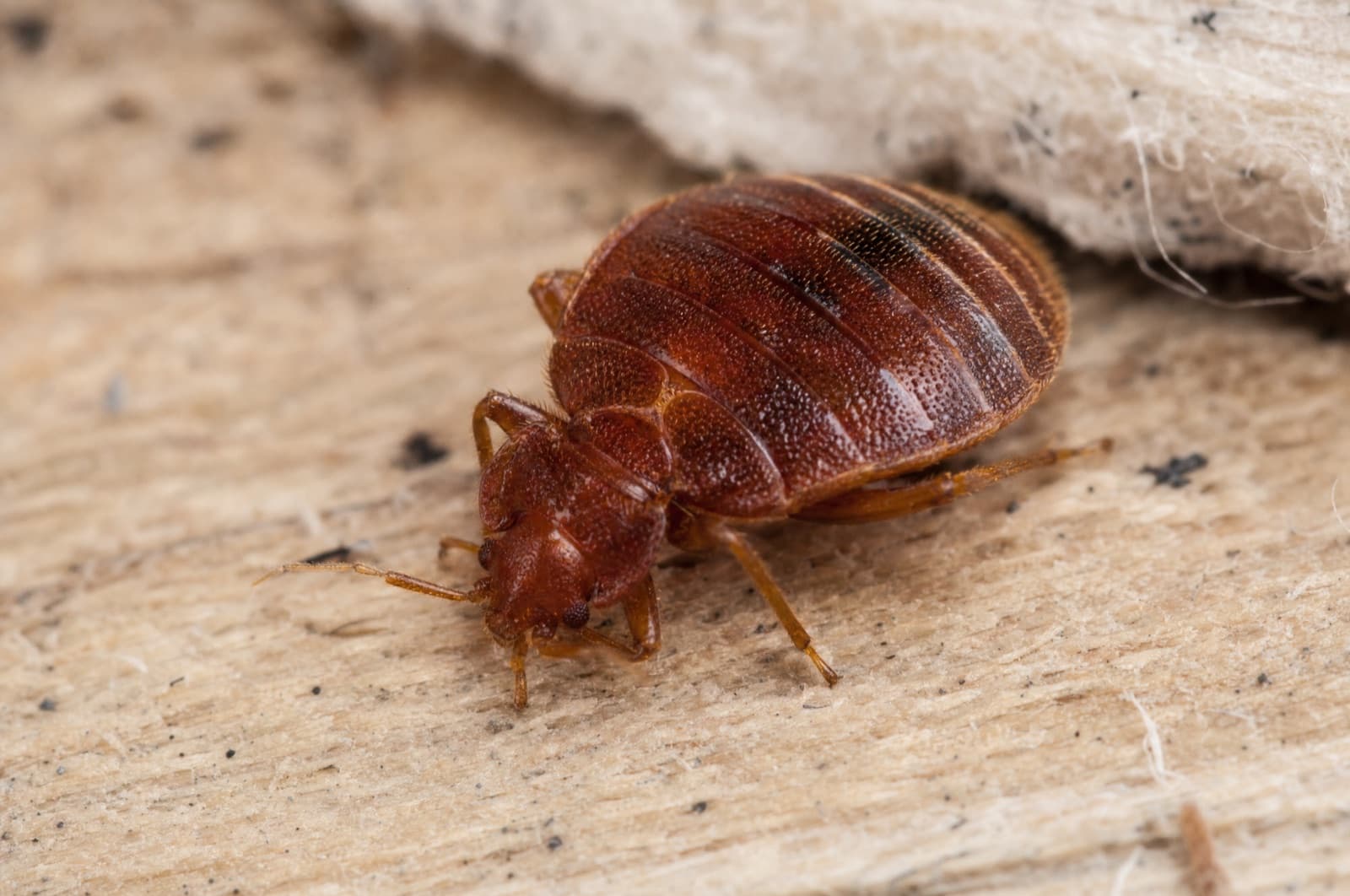
Bed bugs are flat, reddish-brown, apple-seed-sized insects that feed on blood at night and hide near where people sleep. They are NOT known to transmit disease to humans, and getting them has nothing to do with cleanliness — they hitchhike in on luggage and used furniture. DIY control rarely works; professional treatment, often including whole-room heat, is typically required.
- Adult size
- ~¼ in (4–5 mm) — flat and oval like an apple seed
- UNH Cooperative Extension
- Disease transmission
- None documented to humans
- CDC; EPA
- Who can get them
- Anyone — cleanliness does not determine exposure
- CDC; EPA
- Bite reaction onset
- 1 day to ~2 weeks; ~⅓ of people show no reaction at all
- UNH Extension; CDC
- Heat kill threshold
- 118°F held ~90 min kills all life stages including eggs
- UMN Extension; Virginia Tech / VDACS ENTO-583
- DIY verdict
- Usually NO — UNH Extension calls it 'not a do-it-yourself job'
- UNH Cooperative Extension
- Confirm before treating
- 76% of submitted 'bed bug' samples were not bed bugs
- University of Minnesota Extension
What to do if you think you have bed bugs — an honest guide
Finding what you think are bed bugs is stressful. Two things matter most to say up front, because they're both true and both frequently misunderstood.
First: bed bugs are NOT known to transmit disease to humans. The CDC and EPA state this clearly. Bed bugs are a serious nuisance and a real infestation requiring professional treatment — but they are not a disease vector in the way mosquitoes or ticks are. Calm the panic.
Second: getting bed bugs has nothing to do with how clean your home is. Bed bugs are hitchhikers — they move between locations on luggage, clothing, used furniture, and mattresses. Five-star hotels, college dorms, hospitals, and movie theaters all deal with bed bugs. Anyone can get them regardless of income, cleanliness, or the condition of their home. Never assume a bed bug problem says something about the people who have it.
Now the hard truth: bed bugs are extremely difficult to eliminate without professional help. UNH Cooperative Extension states plainly that bed bug control is NOT a do-it-yourself job. Eggs and hidden adults survive homeowner sprays and foggers (which the EPA says don't work on bed bugs). Professional whole-room heat — which kills all life stages including eggs at 118°F held ~90 minutes — is one of the few reliably effective treatments. Confirm the identification first (76% of 'bed bug' samples submitted to University of Minnesota Extension were not bed bugs), then call early: infestations are smallest and most treatable at the start.
How to identify a bed bug
The key features are shape, size, and color: flat, oval, reddish-brown, about the size and color of an apple seed. When unfed, they are almost paper-thin; after a blood meal, they are swollen, darker, and cigar-shaped. Confirm with the damp-cloth smear test: bed bug fecal spots smear rusty brown-black when wiped — lint, mold, and typical dirt do not.
Bed bug
- Scientific name
- Cimex lectularius
- Family
- Cimicidae
- Size
- ~¼ in (4–5 mm) adult; hatchlings ~1 mm (grain of rice dot)
- Coloration
- Reddish-brown when unfed; darker, purplish-red when engorged with blood
- Habitat
- Within a few feet of sleeping and resting areas — mattress seams, box spring, bed frame, headboard, baseboards, behind picture frames and electrical outlets, inside luggage
- Active season
- Year-round indoors; feed primarily at night when a host is stationary
- Diet
- Exclusively blood — primarily human; also other warm-blooded hosts
- Reproduction
- Female lays 2–5 eggs per day; 200–500 over a 6–18 month lifespan
- Lifespan
- Adults ~6–18 months with regular feeding; can survive months without a blood meal
Worldwide distribution; resurgent since the late 1990s; found throughout New Hampshire in all building types and all transport
The tells — key ID features
- Flat, oval, apple-seed-shaped reddish-brown body ~¼ in — so flat it hides where a credit card fits. Best visual tell.
- Wingless — cannot fly or jump; moves by walking.
- After feeding: swollen and cigar-shaped, darker purplish-red.
- Tiny pearl-white eggs (~1 mm), glued in clusters into cracks and fabric seams.
- Translucent cast (shed) skins at each of the 5 nymph molts — look for these in seams before looking for live insects.
Size, to scale
~¼ in (4–5 mm)
The size and color of an apple seed
Bat bug or swallow bug (Cimex adjunctus / Oeciacus vicarius)
How to tell — Nearly identical relatives; distinguished only under magnification by longer hair fringe length. Usually associated with bat roosts or bird nests in the structure, not human beds. If a bat was recently in the home, suspect bat bugs.
Carpet beetle (Anthrenus / Attagenus spp.)
How to tell — Rounder body, patterned scales in black/white/brown, and distinctly different wing covers. They do not bite humans. A common false positive — don't treat for bed bugs until identity is confirmed.
Wood tick / young cockroach nymph
How to tell — UNH Extension notes that adult bed bugs resemble a wood tick; ticks have eight legs. Young cockroach nymphs are similar in size but darker, cylindrical rather than flat, and move faster. Confirm with a magnifying glass: bed bugs have six legs and the distinctive flat oval shape.
Signs of a problem
Bites alone are not reliable proof of bed bugs — many people show no reaction, and other insects cause similar marks. These signs, especially the fecal spot smear test, are more reliable than bite patterns.
Small dark reddish-brown fecal spots on sheets, mattress seams, or nearby walls — smear rusty brown-black when wiped with a damp cloth
What it means — Feeding activity — the damp-cloth smear test is the single most reliable confirmation step. Lint, mold, and ordinary dust do not smear this way.
Reddish blood smears or rusty stains on sheets or pillowcases
What it means — Crushed bugs — a bed bug was feeding and was rolled onto during sleep.
Translucent cast skins (shed exoskeletons) in mattress seams, behind the headboard, and along baseboards
What it means — Growing population — each nymph sheds 5 times before reaching adulthood; multiple cast skins indicate an established infestation.
Tiny pearl-white eggs (~1 mm) glued in clusters in seams, crevices, and piping
What it means — Active breeding; eggs are cemented in place and resist dislodging.
Live bugs in mattress seams, piping, bed frame joints, or behind electrical outlet covers near the bed
What it means — Confirmed active infestation; inspect with a flashlight and a thin card to check seams and frame joints.
Sweet, musty odor — sometimes described as overripe berries — in the bedroom
What it means — Heavy infestation; the smell comes from aggregation pheromones and is only detectable in large populations.
The real risks, calibrated
Bed bugs are not the disease threat that public fear sometimes suggests — but they are a significant quality-of-life and secondary health concern that deserves prompt professional treatment.
Disease transmission
Low riskOnset: None documented
Bed bugs are NOT known to transmit or spread disease to humans. This is confirmed by both the CDC and the EPA. The absence of disease transmission is important to state clearly — it is one of the most commonly misunderstood facts about bed bugs.
Skin reactions and itching
Low riskOnset: Hours to ~2 weeks after a bite; many people show no reaction at all
Bites can produce itchy red welts, but reactions vary enormously — roughly one-third of bitten people develop no visible mark. Bites in a line or cluster on exposed skin during sleep are a common pattern, but are not diagnostic on their own.
Secondary skin infection
Low riskOnset: Days after biting and scratching
Repeated scratching of bite sites can break the skin and introduce bacteria, potentially leading to secondary infections such as impetigo. Keep bites clean and avoid scratching.
Rare allergic reaction
ModerateOnset: Shortly after a bite
A small number of people develop more severe allergic reactions to bed bug saliva, including, very rarely, symptoms resembling anaphylaxis. The EPA acknowledges this risk. If a severe reaction occurs, seek medical attention.
Mental health and sleep disruption
ModerateOnset: Ongoing during infestation
Anxiety, insomnia, and chronic stress are well-documented consequences of bed bug infestations, independent of any physical bites. The psychological burden of a confirmed infestation is real and should not be minimized.
DIY — what works, what backfires
Honest verdict: for an established bed bug infestation, DIY usually fails. UNH Extension states that bed bug control is NOT a do-it-yourself job because effective long-lasting chemicals aren't available to homeowners and professional heat treatment is the most reliable option. The steps below reduce the population and manage spread while you arrange professional treatment — they are not a standalone solution.
What actually works
- Confirm the identification before treating anything: collect a specimen in a sealed bag or take a clear photo. UMN Extension found 76% of 'bed bug' samples were not bed bugs — misidentification wastes money and misses the real problem.
- Wash and hot-dry all bedding, clothing, and curtains from the affected room: dry on HIGH for at least 30 minutes, which reaches temperatures that kill all life stages.
- Install mattress encasements rated for bed bugs on the mattress and box spring; use interceptor traps under each bed leg to catch bugs trying to climb up or down.
- Vacuum thoroughly — mattress surfaces, seams, frame joints, and baseboards — using a bag vacuum; immediately seal and remove the bag outdoors.
- Reduce clutter in the room to eliminate hiding spots and make professional treatment more effective.
- Act early: every week the infestation grows makes treatment harder. Arrange a professional inspection as soon as you have a confirmed ID.
What backfires
- Do NOT use total-release foggers or 'bug bombs.' The EPA and state health agencies explicitly state that bug bombs do not control bed bugs. They disperse pesticide into the air but not into the harborage cracks where bed bugs and eggs hide, and can scatter bugs to new areas of the home.
- Don't use outdoor pesticide products indoors or apply any pesticide at doses or locations not on the label.
- Don't drag an infested mattress through the house to discard it — this spreads bugs to every room you pass through. If discarding, seal it in plastic and cut or mark it so no one takes it.
- Don't assume one professional treatment ends it — eggs and hidden bugs can survive a single treatment; follow-up inspections are standard.
Bed bugs in New Hampshire
UNH Cooperative Extension reports that Cimex lectularius and related species 'infest homes, apartments, schools, camps, movie theaters, office buildings, and all modes of transportation throughout New Hampshire.' Bed bugs are a year-round, statewide issue in NH tied entirely to human travel and shared or used furnishings — not to season, geography, or climate. They are equally likely in Manchester apartments and Bedford single-family homes, in university dormitories and rural inn rooms. There is no off-season.
Peak season
Year-round indoors; no seasonal variation — bed bugs live entirely in human-temperature environments
You might actually have
- Bat bugs — nearly identical; associated with bat roosts in NH homes rather than sleeping areas
- Carpet beetles — similar size; do not bite; often confused on visual inspection alone
We serve these communities
- NH-licensed applicator · #782664
- Same-day service
- Family-owned since 2017
Service Area Map
Southern New Hampshire
When to call Anchor Pest Services for bed bugs
For confirmed bed bugs, the honest answer is: call promptly. The infestation is never smaller or cheaper to treat than it is right now. Anchor's licensed technicians (NH #782664) use professional-grade treatment protocols — which can include whole-room heat reaching temperatures that kill all life stages including eggs in a single session — and follow up to verify the infestation is eliminated. Unlike DIY products, professional heat leaves no pesticide residue and penetrates the cracks, seams, and voids where bugs and eggs hide.
When to call a pro
- Confirmed live bugs, fecal spotting that smears rust-brown, or cast skins in mattress seams — call immediately.
- Unexplained nighttime bites appearing in lines or clusters on exposed skin, especially after travel or acquiring used furniture.
- Recurring bites despite washing bedding and cleaning — the infestation is established and DIY won't reach it.
- Any confirmed bed bug in a multi-unit building — adjacent units should be inspected, as bugs move through wall voids.
Inspect hotel rooms before settling in
Pull back the comforter, check mattress seams and headboard for fecal spots and cast skins. Keep luggage on the rack or in the bathroom — never on the floor or bed. When you return home, unpack outdoors or in the garage and hot-dry clothing immediately.
Inspect used furniture before bringing it inside
Check every seam, joint, and surface of secondhand mattresses, upholstered furniture, and bed frames in good outdoor light. If you find anything suspicious, do not bring it inside — the risk is not worth the savings.
Use mattress and box-spring encasements year-round
Certified bed-bug-proof encasements trap any existing bugs, make inspection far easier, and prevent bed bugs from establishing in mattress fabric. Use them on every bed in your home as an ongoing preventive measure.
Not sure it's a bed bug?
A licensed NH technician can confirm the species and tell you honestly whether it's a DIY fix or a job for a pro — free inspection, same-day service across Southern New Hampshire.
Frequently asked questions
Sources(7)
- [1]UNH Cooperative Extension — Bed Bugs Fact Sheet
adult size comparison to apple seed, egg-laying rate, statewide NH presence, 'not a DIY job' statement
extensionverified 2026-06-30 - [2]UNH Cooperative Extension — Don't Let Bed Bugs Bite
NH infestation locations, bite reaction variability, prevention
extensionverified 2026-06-30 - [3]
- [4]EPA — Bed Bugs: A Public Health Issue
non-vector status; rare allergic reactions; foggers do not control bed bugs
govverified 2026-06-30 - [5]EPA — Introduction to Bed Bugs
identification, cleanliness not a factor, control guidance
govverified 2026-06-30 - [6]University of Minnesota Extension — Bed Bug Prevention and Control
76% of submitted samples not bed bugs; confirm-first guidance
extensionverified 2026-06-30 - [7]Virginia Tech / VDACS — Bed Bug Management (ENTO-583)
heat kill thresholds: 118°F / 90 min; rooms heated to 135–145°F
extensionverified 2026-06-30
Written & reviewed by
VerifiedDaniel Brady
NH-Licensed Pesticide Applicator · License #782664 (NHDAMF, RSA 430)
Daniel Brady is the New Hampshire–licensed applicator behind Anchor Pest Services, a family-owned pest control company serving the Manchester area since 2017.
Last updated 2026-06-30

New Hampshire pest control
Dealing with bed bugs in your home?
Anchor Pest Services identifies and handles bed bug problems across southern and central New Hampshire. Family-owned since 2017, NH license #782664.
- NH-licensed applicators (#782664)
- Same-day service · free inspection
- Family-owned since 2017
Your next step
- Next step
Why do bed bugs hide in furniture seams?
Read the answer - What to do next
How to Get Rid of Bed Bugs
Read the answer - What to do next
Mechanical Control for Fall Invaders, Bed Bugs & Fabric Pests
Read the answer - Also relevant
Do bed bugs cause permanent damage to fabrics?
Read the answer - Also relevant
Can bed bugs stain mattresses and furniture?
Read the answer - Related guide
Can bed bug infestations reduce a home's value?
Read the answer