
Bottle Flies in New Hampshire — ID, Signs & Control
Also called Greenbottle · Bluebottle · Blow fly
Bottle flies — the green bottle (Lucilia sericata) and blue bottle (Calliphora vomitoria) — are blow flies named for their metallic 'bottle-glass' sheen. They breed in carrion, and a sudden indoor swarm, especially in cold months with windows shut, almost always means a hidden dead animal. They are not a 'dirty house' verdict — one dead mouse is enough.
- What it is
- A blow fly
- green/blue 'bottle' species, family Calliphoridae
- Species
- Lucilia sericata (green) / Calliphora vomitoria (blue)
- family Calliphoridae
- Size
- ~10–14 mm (3/8–1/2 in)
- larger than a house fly; Animal Diversity Web
- Breeds in
- Carrion
- indoors = a hidden dead animal
- Eggs
- ~200 per cluster
- on fresh carrion; Animal Diversity Web
- Generations
- 3–4 per year
- temperate climate; Animal Diversity Web
Are bottle flies the same as blow flies?
Yes — 'bottle fly' is the common name for the metallic blow fly species named for their brilliant bottle-glass sheen: the green bottle (Lucilia sericata) and the blue bottle (Calliphora vomitoria), both in the family Calliphoridae. Knowing they are the same family matters because the entire biology and control logic is shared: bottle flies breed in carrion, not in kitchens, and an indoor burst of these shiny flies points to one thing.
A winter swarm of shining green or blue flies indoors, with outdoor fly activity near zero and windows closed, is a near-certain sign of something dead inside a heated NH structure — a mouse in a wall void after rodent season, a bird in a chimney, an animal in the attic. This is not a 'dirty house' verdict. A single hidden mouse produces enough carrion to sustain a full fly emergence. The fix is locating and removing the carcass, not spraying.
One search confusion this page resolves: many readers think 'bottle fly' is a separate pest from 'blow fly.' It is not. The carcass-detective logic applies equally to both.
How to identify a bottle fly
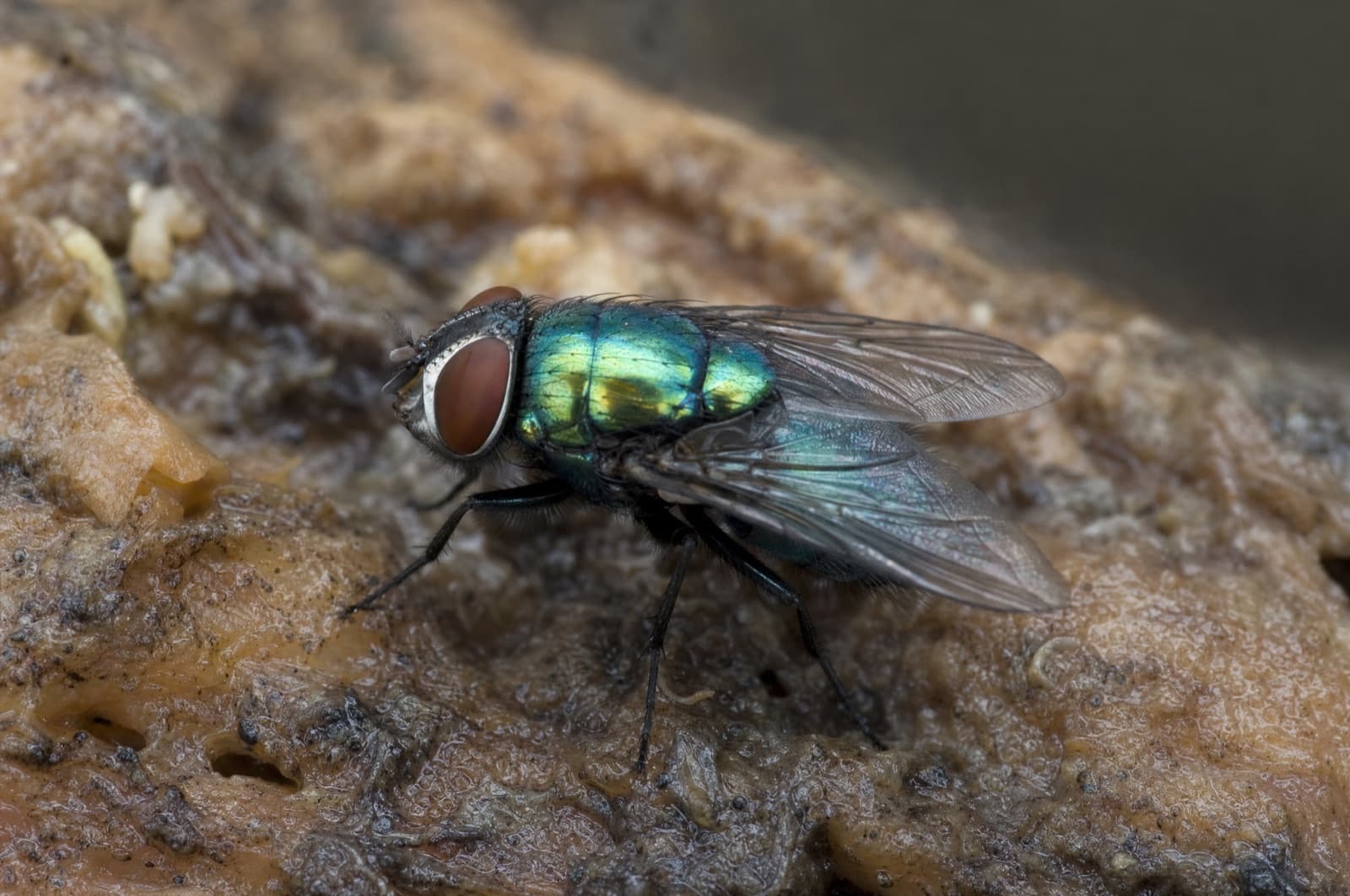
The metallic green or blue sheen is unmistakable. No common NH house fly looks like this. If the fly is shiny green or bright metallic blue, you are looking at a bottle fly — and the carcass-detective logic immediately applies.
Bottle fly
- Scientific name
- Lucilia sericata (green bottle) / Calliphora vomitoria (blue bottle)
- Family
- Calliphoridae
- Size
- ~10–14 mm (3/8–1/2 in)
- Coloration
- Brilliant metallic green (Lucilia) or metallic blue (Calliphora); iridescent in light
- Habitat
- Carrion, garbage, feces; outdoors near dead animals; indoors when a carcass is present.
- Active season
- April–October outdoors in temperate areas; any season indoors near a carcass
- Diet
- Larvae develop in carrion; adults feed on nectar, pollen, and carrion fluids.
- Reproduction
- Female lays ~200 eggs per cluster on fresh carrion; 3–4 generations per year in temperate climate (Animal Diversity Web).
- Lifespan
- Egg-to-adult cycle approximately 2–3 weeks in warm conditions.
Lucilia sericata recorded throughout North America including New Hampshire; cosmopolitan distribution.
The tells — key ID features
- Brilliant metallic green or blue sheen — the signature tell; iridescent and visible even in dim light.
- Slightly larger than a house fly — noticeably stouter.
- Clear wings with light-brown veins (green bottle).
- Loud buzz; bounces against window glass indoors when seeking light.
- Reddish eyes.
Size, to scale
~10–14 mm (3/8–1/2 in)
About 1/2 inch — a shiny green or blue 'bottle' of a fly, clearly larger than a house fly
Other blow flies
How to tell — Bottle flies are a subset of blow flies (Calliphoridae). Bronze or dull-green blow flies (Phormia, Calliphora with duller coloration) share the family but look slightly different; all share the same carcass-breeding logic.
Flesh fly
How to tell — Flesh flies (Sarcophagidae) are dull gray with three thoracic stripes and a checkerboard abdomen — entirely non-metallic. Same carcass-detective logic applies, completely different look.
Common house fly
How to tell — House flies are smaller, dull gray with four thoracic stripes and no metallic sheen. They breed in garbage and manure, not carrion. No overlap in appearance.
Signs of a problem
Bottle flies signal their presence — and the presence of a carcass — by where they appear and when. These are the signs to look for.
Shiny green or blue flies at a window with windows closed
What it means — A hidden carcass is almost certainly inside the structure; adults are seeking light to exit.
Flies or maggots emerging from a wall void, chimney, or vent
What it means — The carcass is in or near that specific location — this is where to begin the search.
Metallic flies appearing indoors in cold months when outdoor flies are absent
What it means — The breeding source is inside the heated structure; outdoor intrusion at those temperatures is essentially impossible.
A sweet-sour decomposition odor accompanying the fly appearance
What it means — Active decomposition; the odor and flies together confirm an actively feeding larval mass on a carcass.
The real risks, calibrated
Bottle flies do not bite or sting. The risks are contamination and the underlying carcass that produced them.
Mechanical food and surface contamination
ModerateOnset: Ongoing while flies are active
Adults move from the carrion source to food-contact surfaces, mechanically transferring bacteria including Salmonella and E. coli.
Flystrike / myiasis (livestock and rare human cases)
Low riskOnset: Uncommon in healthy humans
Lucilia sericata is the primary agent of flystrike in sheep; rare human wound infestation is documented but uncommon in ordinary household situations.
Carcass odor and biohazard
ModerateOnset: Days after death
Active decomposition produces persistent odor and biohazardous material until the carcass is removed and the site sanitized.
DIY — what works, what backfires
Bottle fly control is carcass-detective work. The shiny flies are a symptom; the dead animal is the problem that needs solving.
What actually works
- Locate and remove the dead animal: check wall voids by listening for buzzing and inspecting gaps near electrical outlets and plumbing; check the chimney interior, attic, crawlspace, and behind large appliances.
- Disinfect the site thoroughly with an enzymatic cleaner after removing the carcass to break down residual organic material and reduce odor.
- Use light traps or sticky fly traps to catch remaining adults after the carcass is removed.
- Seal chimney openings with a quality cap and inspect roof-line gaps to prevent animals from entering and dying inside.
- Conduct rodent exclusion before fall to eliminate the most common bottle fly source in NH homes — a mouse dying in a wall void.
What backfires
- Don't spray the room while the carcass remains — it kills the visible adults but has no effect on developing larvae; new adults will keep emerging from the hidden source.
- Don't assume the flies mean your house is dirty — a single hidden mouse is enough to produce a full outbreak; this is a carcass problem, not a housekeeping problem.
- Don't ignore the outbreak hoping it resolves on its own — without carcass removal, adults will keep emerging until development is complete.
- Don't skip rodent exclusion after resolving the immediate carcass — repeat outbreaks next season are common without it.
Bottle flies in New Hampshire homes
The green bottle fly (Lucilia sericata) is recorded across the United States, including New Hampshire, with documented presence across the Northeast. Outdoors, adults are active from roughly April through October in temperate climates. Indoors in NH, bottle flies appear any time of year when a dead animal is present in a heated structure. Manchester, Nashua, and Concord homes that dealt with fall rodents — mice that entered seeking warmth and died in wall voids — can produce bottle fly outbreaks well into winter. The heated interior sustains larval development even when outside temperatures are well below freezing.
Peak season
April–October outdoors; any season indoors near a carcass
You might actually have
- Other blow flies (same family Calliphoridae — the family-level page)
- Flesh flies (gray, checkerboard abdomen, also carcass-breeding)
- House flies (dull gray, garbage/manure breeders, not metallic)
We serve these communities
- NH-licensed applicator · #782664
- Same-day service
- Family-owned since 2017
Service Area Map
Southern New Hampshire
When to call a pro for bottle flies
If a shiny fly swarm keeps going and the dead animal cannot be located — especially in a wall void, ceiling cavity, or attic space that is not safely accessible — a licensed technician can find the source, handle removal, and sanitize the affected area.
When to call a pro
- A metallic fly swarm persists and you cannot locate the carcass after checking accessible areas.
- The suspected carcass is inside a wall void or structural space that requires opening walls or accessing confined spaces.
- Flies keep returning after previous removal — suggesting multiple animals or a recurring attractant.
- You need professional sanitizing and odor remediation for a space you cannot easily clean.
Rodent exclusion before fall
Sealing foundation gaps, utility penetrations, and roof-line entry points before October is the most effective way to prevent bottle fly outbreaks in NH winter — no dead mice in the walls means no carrion, no larvae, no flies.
Cap chimneys and seal roof vents
Birds and squirrels that enter through uncapped chimneys or damaged soffits are a leading second source. Install a chimney cap and inspect for roof-line gaps annually before fall.
Check after any rodent activity
After a season with mouse trapping or signs of rodent activity, do a walkthrough 2–3 weeks later — a dead mouse in a forgotten snap trap or in a void is enough to trigger an outbreak.
Not sure it's a bottle fly?
A licensed NH technician can confirm the species and tell you honestly whether it's a DIY fix or a job for a pro — free inspection, same-day service across Southern New Hampshire.
Frequently asked questions
Sources(5)
- [1]UF/IFAS — Black Blow Fly and Blow Flies (IN903)
biology, family identification
extensionverified 2026-06-30 - [2]Animal Diversity Web — Lucilia sericata
generations per year, eggs per cluster, active season
academicverified 2026-06-30 - [3]UW Insect Diagnostic Lab — Blow Flies Indoors
carcass-detective logic, source-not-spray guidance
extensionverified 2026-06-30 - [4]UNH Cooperative Extension — Managing Small Flies Indoors
NH source-first fly control guidance
extensionverified 2026-06-30 - [5]Iowa State Extension — Blow and Flesh Flies
carcass indicator, indoor fly appearance
extensionverified 2026-06-30
Written & reviewed by
VerifiedDaniel Brady
NH-Licensed Pesticide Applicator · License #782664 (NHDAMF, RSA 430)
Daniel Brady is the New Hampshire–licensed applicator behind Anchor Pest Services, a family-owned pest control company serving the Manchester area since 2017.
Last updated 2026-06-30

New Hampshire pest control
Dealing with bottle flys in your home?
Anchor Pest Services identifies and handles bottle fly problems across southern and central New Hampshire. Family-owned since 2017, NH license #782664.
- NH-licensed applicators (#782664)
- Same-day service · free inspection
- Family-owned since 2017
Your next step
- What to do next
How to Get Rid of Bottle Flies
Read the answer - What to do next
How to Get Rid of Blow Flies
Read the answer - What to do next
Chemical Fly Control: A Supplement, Not the Fix
Read the answer - What to do next
Where Do Flies Go in the Winter? NH Cluster Fly Timing
Read the answer - Related guide
Blow Flies in New Hampshire — ID, Signs & How to Get Rid of Them
Read the answer