
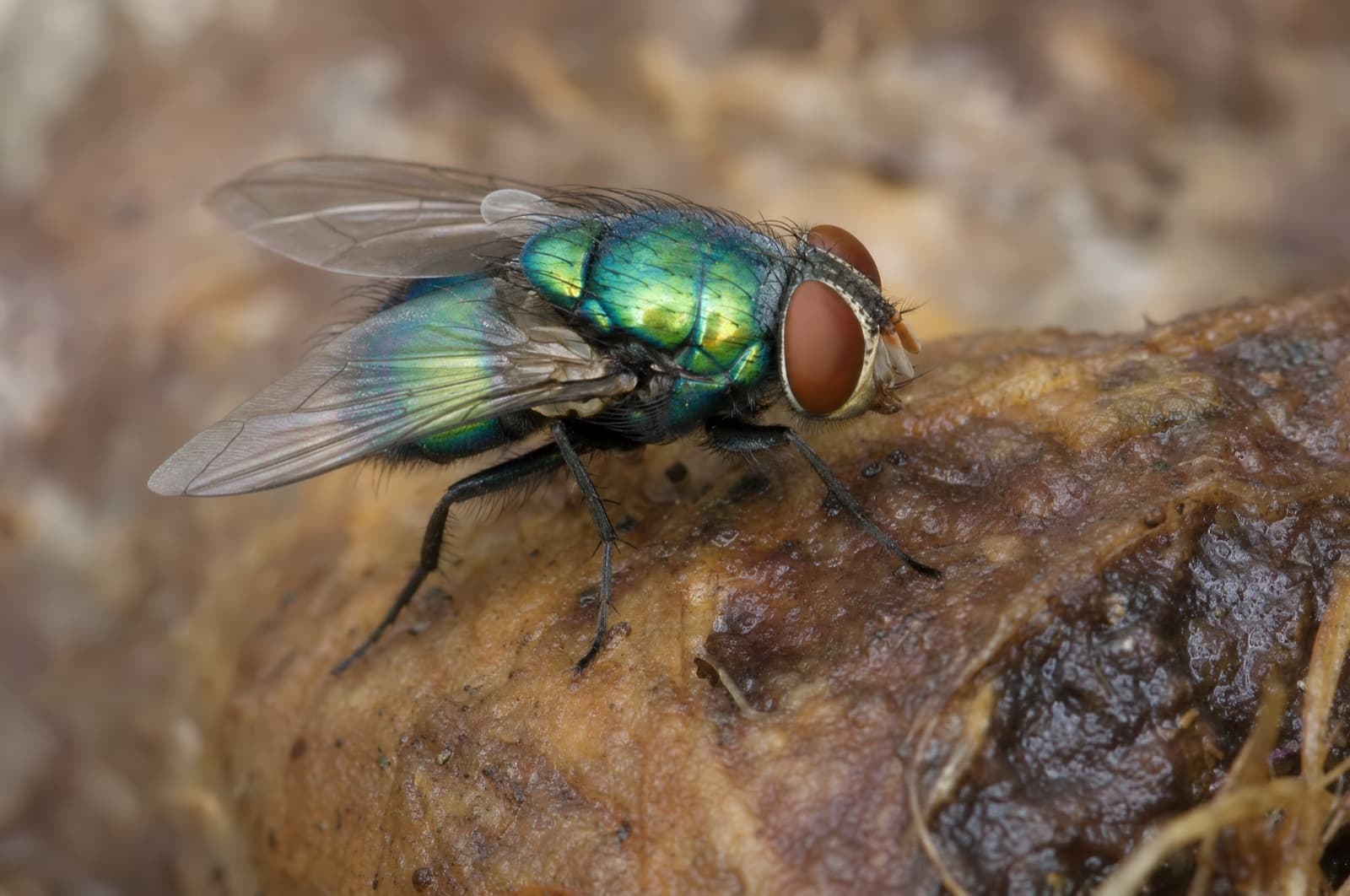
Blow Flies in New Hampshire — ID, Signs & How to Get Rid of Them
Also called Carrion fly · Greenbottle · Bluebottle
Blow flies are metallic blue/green/bronze flies slightly larger than a house fly that breed exclusively in carrion. A sudden indoor burst of these shiny flies — especially with windows shut — almost always means a dead animal is hidden inside the structure. The fix is finding and removing the carcass, not spraying.
- Family
- Calliphoridae
- blow / carrion flies; Calliphora, Lucilia, Phormia
- Size
- ~1/4–3/8 in
- slightly larger than a house fly; UW Insect Diagnostic Lab
- Tell-tale look
- Metallic blue/green/bronze sheen
- the family hallmark
- Breeds in
- Carrion
- indoors = a hidden dead animal; UW Insect Diagnostic Lab
- Indoor meaning
- Often a dead mouse, bird, or squirrel
- UW Insect Diagnostic Lab
- Arrival speed
- Within seconds of death
- UW Insect Diagnostic Lab
Shiny metallic flies indoors? That's a detective clue.
Blow flies (family Calliphoridae) — the metallic blue, green, and bronze flies you may know as greenbottles or bluebottles — are nature's first responders to a dead animal. They locate carrion by scent and can arrive within seconds of death, sometimes from a mile away.
Outdoors, that makes them ecologically essential. Indoors, a sudden cluster of shiny metallic flies, especially when windows are closed, is not a sign of a dirty house — it is a detective clue. Something has died inside the heated structure: a mouse in a wall void after rodent season, a bird down a chimney, a squirrel in the attic.
The University of Wisconsin Insect Diagnostic Lab is direct: blow flies indoors 'often indicates a dead mouse,' and the best remedy is to 'find the root of the issue and clean it up,' not spray. Fogging the room kills the visible adults but does nothing while maggots keep developing on the hidden source. Every blow fly page comes down to one action: find and remove the carcass.
How to identify a blow fly
The metallic sheen is the blow fly family's unmistakable signature. No other common NH house fly has it. If the fly in question is shiny blue, green, or bronze, you are looking at a Calliphoridae — and the carcass-detective logic applies.
Blow fly
- Scientific name
- Family Calliphoridae (Calliphora, Lucilia, Phormia spp.)
- Family
- Calliphoridae
- Size
- ~1/4–3/8 in (6–10 mm)
- Coloration
- Metallic blue, green, or bronze; never dull or gray
- Habitat
- Carrion, garbage, feces; outdoors near dead animals; indoors when a carcass is present in the structure.
- Active season
- Warm season outdoors (spring through fall); any season indoors when a dead animal is present
- Diet
- Larvae feed on carrion and decaying tissue; adults feed on nectar, pollen, and carrion fluids.
- Reproduction
- Female lays batches of eggs directly on fresh carrion; multiple generations per year.
- Lifespan
- Egg-to-adult cycle approximately 2–3 weeks in warm conditions.
Common throughout New Hampshire and the northeastern U.S.; active warm season outdoors, year-round indoors near a carcass.
The tells — key ID features
- Brilliant metallic blue, green, or bronze body — the family hallmark and the single best ID tell.
- Slightly larger and stouter than a house fly.
- Loud, droning buzz; bounces against window glass indoors when seeking light.
- Reddish eyes.
- Strong, fast flier outdoors; clusters near windows indoors.
Size, to scale
~1/4–3/8 in (6–10 mm)
A bit larger than a house fly — roughly the size of a small watermelon seed
Bottle fly
How to tell — Bottle flies are blow flies — specifically the named green-bottle (Lucilia sericata) and blue-bottle (Calliphora vomitoria) species. Same family, same carcass logic. This page covers the whole Calliphoridae family; bottle-fly covers the named species.
Flesh fly
How to tell — Flesh flies are dull gray with a checkerboard abdomen and three thoracic stripes — not metallic at all. Same carcass logic applies, but the look is completely different.
Common house fly
How to tell — House flies are smaller and dull gray with four thoracic stripes. No metallic sheen. House flies breed in garbage and manure, not primarily carrion.
Signs of a problem
Blow flies telegraph their breeding source by where they appear and how they behave. These are the signs — and what each one means.
A sudden cluster of metallic flies indoors with windows closed
What it means — A dead animal is almost certainly hidden inside the structure — a wall void, chimney, attic, or crawlspace.
Flies or maggots near a wall void, chimney, or attic access
What it means — That location is very likely the carcass site. The flies are working their way toward light after emerging.
Loud buzzing at a window on the inside of the glass
What it means — Emerged adults are seeking light to exit — the carcass is somewhere behind them in the structure.
A sweet-sour odor accompanying the fly appearance
What it means — Decomposition odor accompanies active blow fly breeding; the smell and the flies together confirm an active carcass.
Indoor swarm that peaks and then tapers over two to three weeks
What it means — Adult emergence from a single carcass typically runs its course in two to three weeks (UW Insect Diagnostic Lab); tapering means larvae have completed development, not that the problem is gone.
The real risks, calibrated
Blow flies do not bite or sting. Their risks are contamination and the underlying carcass that produced them.
Food and surface contamination
ModerateOnset: Ongoing while flies are active
Adults move directly from the carrion source to food-contact surfaces, mechanically transferring bacteria including Salmonella and E. coli.
Rare myiasis
Low riskOnset: Uncommon
Blow fly larvae can infest open wounds in rare circumstances; this is uncommon in healthy humans but documented in medical literature.
Carcass odor and biohazard
ModerateOnset: Days after death
Decomposition creates a persistent odor and biohazardous material until the carcass is removed and the site disinfected.
DIY — what works, what backfires
Blow fly control is carcass-detective work. The flies are a symptom; the dead animal is the problem. Here is what works — and what wastes time.
What actually works
- Find and remove the dead animal: systematically check wall voids (listen for buzzing, use a flashlight at gaps), chimney interior, attic insulation, crawlspace, and spaces behind appliances — especially after fall rodent activity.
- Disinfect and deodorize the site after removal: use an enzymatic cleaner on the area to break down remaining organic material and reduce lingering odor.
- Use light traps or sticky fly traps for remaining adults after the carcass is removed.
- Cap chimneys and seal gaps in soffit and fascia to prevent birds and squirrels from entering the structure and dying inside.
- Practice rodent exclusion before fall to prevent mice from entering and dying in wall voids.
What backfires
- Don't spray the room while the carcass remains — fogging kills visible adults but does nothing to the larvae developing on the hidden source; the adults will keep emerging.
- Don't pour bleach around hoping to mask the odor — it does not reach or neutralize the actual breeding source.
- Don't assume the flies will 'just leave' — they will keep emerging until the carcass is fully consumed or removed.
- Don't skip the rodent exclusion step after resolving the carcass — a repeat outbreak next season is common without it.
Blow flies in New Hampshire homes
Blow flies are present statewide across New Hampshire through the warm season, but they become an indoor problem any time of year when a dead animal is trapped inside a heated structure. After fall rodent season in Manchester, Nashua, and Concord — when mice seek warmth and sometimes die in wall voids or attic insulation — blow fly outbreaks are among the most common winter fly calls. A sealed, heated NH home is warm enough to sustain larval development even in January, so a metallic swarm in February is not unusual if a mouse died in October.
Peak season
Warm season outdoors; any season indoors near a carcass
You might actually have
- Bottle flies (same family — green/blue-bottle species)
- Flesh flies (gray checkerboard-abdomen carcass flies)
- House flies (dull gray, garbage/manure breeders)
We serve these communities
- NH-licensed applicator · #782664
- Same-day service
- Family-owned since 2017
Service Area Map
Southern New Hampshire
When to call a pro for blow flies
If a metallic fly swarm keeps going and you cannot locate the carcass — especially when it is in a wall void, between floors, or in an attic space you cannot safely access — a licensed technician can use moisture detection and structural knowledge to find and remove it, then sanitize the site.
When to call a pro
- A metallic fly swarm persists and you cannot locate the dead animal after checking obvious areas.
- The suspected carcass is inside a wall void, ceiling cavity, or structural space you cannot safely open.
- Flies keep returning after each previous removal — suggesting multiple animals or an ongoing attractant.
- You need post-removal sanitizing and odor treatment for a difficult-to-reach space.
Rodent exclusion before fall
Sealing entry points around the foundation, utilities, and roof line before October is the single most effective way to prevent winter blow fly outbreaks in NH homes — no dead mice in the walls means no blow flies.
Cap chimneys and seal roof vents
Birds and squirrels entering through uncapped chimneys or damaged soffit vents are a leading cause of blow fly outbreaks. Install a quality chimney cap and inspect roof-line entry points annually.
Inspect after any rodent activity
If you have seen mice or set traps during rodent season, do a thorough inspection 2–3 weeks later — a dead mouse in a snap trap you forgot, or one that died in a void, is enough to start a blow fly infestation.
Not sure it's a blow fly?
A licensed NH technician can confirm the species and tell you honestly whether it's a DIY fix or a job for a pro — free inspection, same-day service across Southern New Hampshire.
Frequently asked questions
Sources(5)
- [1]UW Insect Diagnostic Lab — Blow Flies Indoors
carcass-detective logic, dead-mouse indicator, source-not-spray guidance
extensionverified 2026-06-30 - [2]
- [3]
- [4]UNH Cooperative Extension — Managing Small Flies Indoors
NH source-first fly control guidance
extensionverified 2026-06-30 - [5]
Written & reviewed by
VerifiedDaniel Brady
NH-Licensed Pesticide Applicator · License #782664 (NHDAMF, RSA 430)
Daniel Brady is the New Hampshire–licensed applicator behind Anchor Pest Services, a family-owned pest control company serving the Manchester area since 2017.
Last updated 2026-06-30

New Hampshire pest control
Dealing with blow flys in your home?
Anchor Pest Services identifies and handles blow fly problems across southern and central New Hampshire. Family-owned since 2017, NH license #782664.
- NH-licensed applicators (#782664)
- Same-day service · free inspection
- Family-owned since 2017
Your next step
- What to do next
How to Get Rid of Blow Flies
Read the answer - What to do next
What Attracts Blow Flies to Your House?
Read the answer - What to do next
How to Get Rid of Flesh Flies
Read the answer - What to do next
How to Get Rid of Bottle Flies
Read the answer - Related guide
Bottle Flies in New Hampshire — ID, Signs & Control
Read the answer - Related guide
Flesh Flies in New Hampshire — ID, Signs & Control
Read the answer