
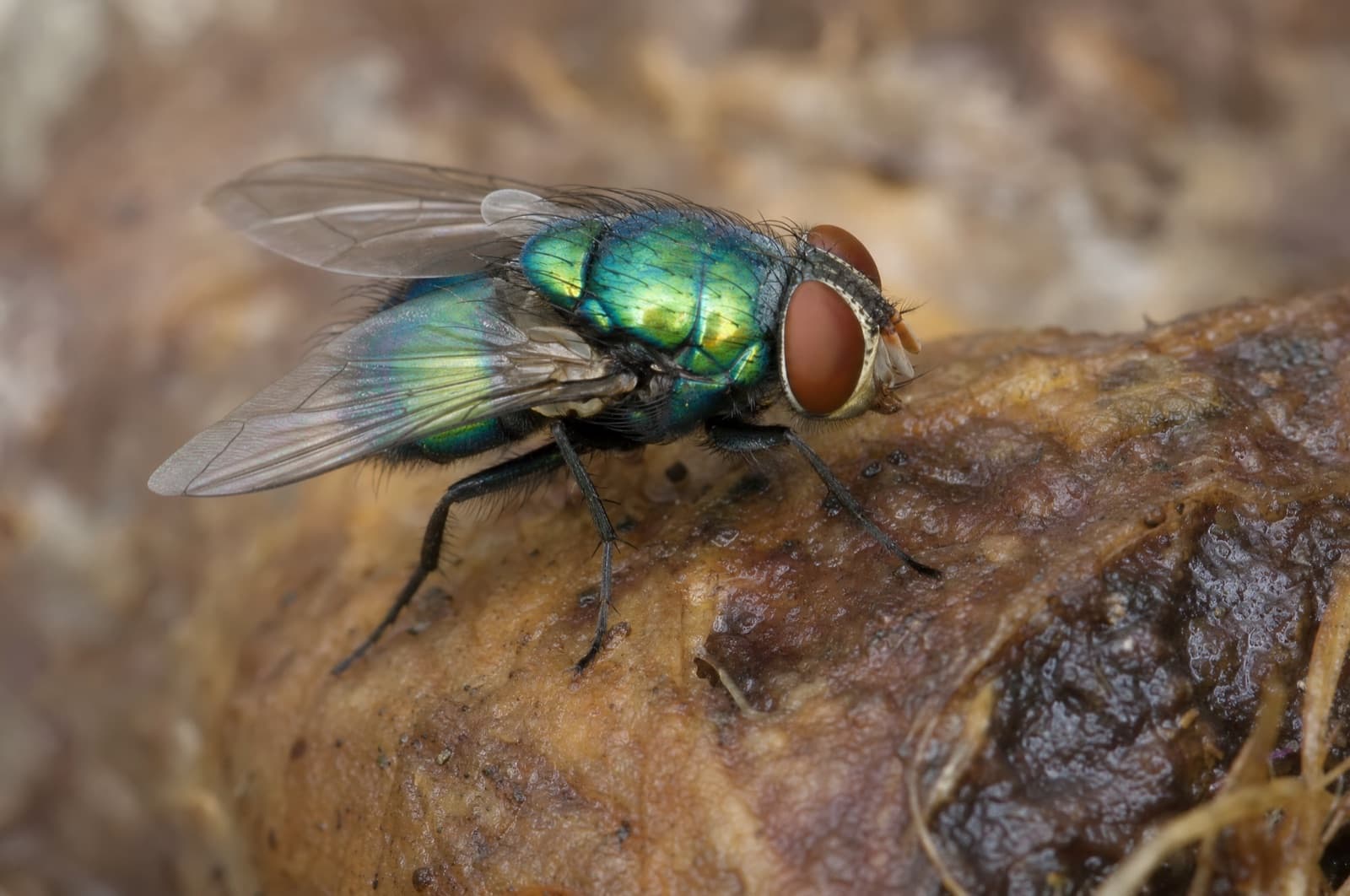
How to Get Rid of Blow Flies
At a glance
- Difficulty: Intermediate
- Time: A few hours to locate and remove the source, longer if access is limited
- Cost: Low — gloves, bags, disinfectant
- Success: High once the carcass is found and removed; low from spraying alone
Can you DIY Blow Fly?
The verdict on Blow Fly DIY
Solvable DIY if you can find the carcass — a wall void or high roofline is where it gets hard.
Blow flies — the shiny metallic blue or green flies that suddenly appear indoors in numbers — almost always mean a dead animal, often a rodent, is decomposing somewhere in the house. "Follow your nose" is the actual method: locate and remove the carcass, double-bag it, and disinfect the area. A homeowner who can access the source (an attic, a crawlspace, an accessible wall panel) can usually handle this. When the carcass is in a wall void or a high roofline you can't safely reach, that's a practical reason to call a pro, not a health emergency.
The 5 DIY methods — honestly graded
Every approach graded for this species, in IPM order — prevention first, chemistry late. Pick a method to see how it works, the steps, and what it actually takes.
Prevention / Exclusion
Works wellRemoving the carcass is the entire fix — everything else is cleanup.
Blow flies are drawn to and breed on decomposing animal tissue. Finding and removing that carcass eliminates the food and egg-laying site the flies depend on.
Best for: Every case — this is the method that actually solves it
Follow the flies and the odor
Track where flies cluster and where the smell is strongest — attics, chimneys, crawlspaces, and wall voids near where rodents commonly enter are the usual spots.
CautionWear gloves and an N95 mask before handling a carcass; some diseases can spread from rodent remains.Remove, bag, and disinfect
Double-bag the carcass and dispose of it in outdoor trash. Disinfect the area where it was found.
Exclude and screen
Once the carcass is gone, seal the rodent entry point that let the animal in, and screen windows and doors to keep new adult flies out.
Tools & materials
Why DIY falls short here
Not scare tactics — the specific, proportionate reasons a home attempt can stall for this species.
Can't find or reach the carcass
A wall void or a high roofline can make source removal impractical for a homeowner — that's a practicality reason to call a pro, not a health emergency.
Spraying without removing the source
Adults keep emerging from the carcass until it's gone; a spray only knocks down what's already flying.
How risky is it, really?
An honest read — most nuisance species are genuinely low risk, and we say so.
Blow flies and their maggots are essentially harmless to people. Like houseflies, they can mechanically carry bacteria from the carcass to nearby surfaces, but the main issue is the odor and nuisance of a decomposing animal, not disease.
- Odor and nuisance from the carcassCommon
The primary complaint — resolves once the carcass is removed
Iowa State University Extension
- Mechanical pathogen transfer from filth to surfacesOccasional
Contamination risk, not a biting or feeding risk
Bug Out Service (pest industry)
A Dead-Animal Fly Problem You Can't Reach?
When the carcass is behind a wall or high on a roofline, DIY access runs out. Anchor Pest Services locates hidden sources and handles rodent exclusion across southern and central New Hampshire. Family-owned since 2017, NH license #782664.
Call a pro when…
- The carcass appears to be in a wall void, attic space, or roofline you can't access
- The odor persists after a thorough search and you can't locate the source
- Repeated rodent entry keeps bringing new carcasses into the structure
General Pest Control
Call a pro when the carcass is somewhere you can't safely or practically reach — deep in a wall void, a high roofline, or a chimney. It's about access, not danger: blow flies themselves pose low risk.
Keep them out
- Seal rodent entry points to prevent animals from dying inside walls or attics
- Screen windows and doors to keep adult flies from entering
- Address any dead-animal odor promptly before flies establish
Blow flies in New Hampshire homes
In NH, blow fly bursts indoors are most common in fall and winter, when mice and other rodents move into wall voids and attics seeking warmth and sometimes die there. A sudden cluster of shiny flies at a window in an otherwise fly-free house is the classic sign of a hidden carcass, not an open-door problem.
Peak season
Fall through winter, tied to rodent activity indoors
Make sure it's a Blow Fly
Two quick detours worth taking — confirm the ID, then learn what drew it in so it doesn't come back.
Frequently asked
Sources & further reading(3)
- [1]Iowa State University Extension — Blow and Flesh Flies
Carcass-source biology, risk, and control
extensionverified 2026-07-13 - [2]Colonial Pest Control — Blow Flies and Carcasses
Practical carcass-location and access guidance
industryverified 2026-07-13 - [3]Bug Out Service — Blow Flies
Mechanical pathogen transfer, nuisance framing
industryverified 2026-07-13
Written & reviewed by
VerifiedDaniel Brady
NH-Licensed Pesticide Applicator · License #782664 (NHDAMF, RSA 430)
Daniel Brady is the New Hampshire–licensed applicator behind Anchor Pest Services, a family-owned pest control company serving the Manchester area since 2017.
Last updated July 2026
Other species you can tackle
Same category — the dot shows each one's DIY verdict at a glance (green = friendly, amber = doable with care, red = call a pro).
Professional Pest Control
A Dead-Animal Fly Problem You Can't Reach?
When the carcass is behind a wall or high on a roofline, DIY access runs out. Anchor Pest Services locates hidden sources and handles rodent exclusion across southern and central New Hampshire. Family-owned since 2017, NH license #782664.
- NH-licensed applicators (#782664)
- Free inspection — same-day service across southern NH
NH License #782664 · No obligation · We answer in person
Your next step
- Book a NH pro
Pest Control Services
Licensed, family-owned pest control across southern NH.
Book now - What to do next
Blow Flies in New Hampshire — ID, Signs & How to Get Rid of Them
Read the answer - What to do next
Bottle Flies in New Hampshire — ID, Signs & Control
Read the answer - Also relevant
Blow Flies in New Hampshire — ID, Signs & How to Get Rid of Them
Read the answer - Also relevant
Filth Fly Prevention: Sanitation Stops Flies at the Source
Read the answer - Also relevant
What Attracts Blow Flies to Your House?
Read the answer