
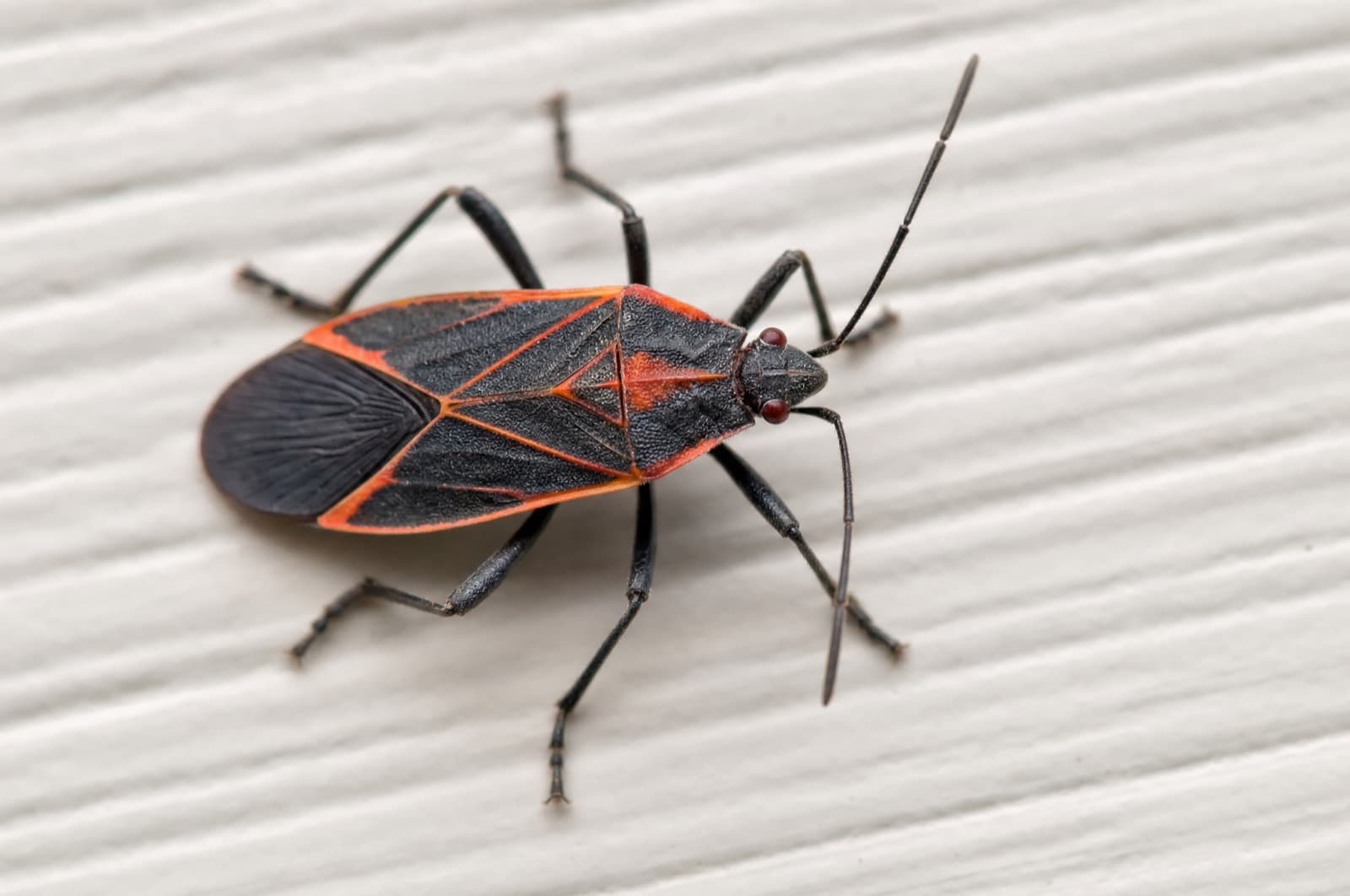
Box Elder Bugs in the House in Winter — NH Timing Guide
At a glance
- Peak entry: Late Sept–early OctBoxelder and stink bugs mass on sunny south walls before the first frost.
- Winter location: Wall voids & atticsStink bugs are usually inside walls; boxelder bugs in voids and casings; seed bugs under siding.
- Spring exit: Late March–mid-MayBrown marmorated stink bugs emerge from shelters late March through mid-May.
- Breeds/damages indoors?: NoAll three sit in diapause; no biting, breeding, or structural damage occurs indoors.
Peak entry
Late Sept–early Oct
Boxelder and stink bugs mass on sunny south walls before the first frost.
Winter location
Wall voids & attics
Stink bugs are usually inside walls; boxelder bugs in voids and casings; seed bugs under siding.
Spring exit
Late March–mid-May
Brown marmorated stink bugs emerge from shelters late March through mid-May.
Breeds/damages indoors?
No
All three sit in diapause; no biting, breeding, or structural damage occurs indoors.
The short of it
Boxelder, brown marmorated stink, and western conifer seed bugs seen indoors in winter are overwintering adults that entered last fall — harmless and dormant.
When are they active — the whole year at a glance
Boxelder bugs, western conifer seed bugs, and brown marmorated stink bugs all follow the same broad New Hampshire pattern: outdoors on host plants all summer, a hard fall entry window, then winter dormancy indoors.
Best window to act · Summer through early September — UNH Extension recommends sealing boxelder bug entry points before roughly September 10 — by caulking and screening gaps on south/west walls, repairing screens, and adding door sweeps.
Peak reflects the late-September through October entry window, anchored to Manchester's first frost (~Oct 19, 50% probability — NOAA 1991–2020 Climate Normals).
Winter behavior
All three of these bugs answer the 'where do they go in winter' question the same way: into the walls, not away from the property.
Hides indoors
All three overwinter as dormant, diapausing adults in wall voids and attics — brown marmorated stink bugs are usually found inside the walls themselves, boxelder bugs settle into voids and door or window casings, and western conifer seed bugs hide under siding and in other protected cavities. None feed, breed, or lay eggs while overwintering.
Move in
Late September through October, favoring warm south- and west-facing walls, concentrated around the first frost.
Hides indoors
All three overwinter as dormant, diapausing adults in wall voids and attics — brown marmorated stink bugs are usually found inside the walls themselves, boxelder bugs settle into voids and door or window casings, and western conifer seed bugs hide under siding and in other protected cavities. None feed, breed, or lay eggs while overwintering.
Spring exit
Warmth triggers movement out through baseboards, trim, and light fixtures. Stink bugs emerge late March through mid-May, boxelder bugs as buds open, and both then head back outside to host plants.
A year in the life
Boxelder bugs, western conifer seed bugs, and brown marmorated stink bugs share one seasonal story in New Hampshire even though they're unrelated species.
- 01
Spring
Overwintered adults leave the walls — stink bugs emerge late March through mid-May, boxelder bugs slightly later as buds open in late April and May — and return to host plants outdoors to feed and lay eggs.
- 02
Summer
All three are entirely outdoors on host plants: boxelder bugs on female boxelder and maple trees, seed bugs on conifer cones, and stink bugs on a wide range of fruit, vegetable, and ornamental plants. Nymphs develop through the warm months.
- 03
Fall
The invasion season. Cooling nights drive heavy aggregation on sunny walls from late September through October and entry into voids just ahead of the first frost. Western conifer seed bugs may buzz loudly in flight, and all three can release a defensive odor if disturbed.
- 04
Winter
Dormant in walls and attics. Warm days and indoor heating cause occasional sightings — usually one or a few seed bugs at a time, but larger numbers for boxelder and stink bugs.
Boxelder, seed, and stink bugs in southern New Hampshire
In Manchester, Nashua, and Concord, these three species converge on homes for the same architectural reason: sun-exposed south and west walls warm up fastest on cool fall afternoons, making them the preferred staging ground before bugs squeeze into gaps around siding, windows, and rooflines. Boxelder bugs are tied to the relatively uncommon boxelder maple locally, while brown marmorated stink bugs — first confirmed in New Hampshire in Portsmouth in 2010 — have since spread and are also a significant agricultural pest outdoors, even though indoors they're strictly a nuisance.
Key local data
Manchester's first hard frost averages October 19 (50% probability), the point by which most fall wall-massing and entry has occurred (NOAA 1991–2020 Climate Normals).
We serve these communities
- NH-licensed applicator · #782664
- Same-day service
- Family-owned since 2017
Service Area Map
Southern New Hampshire
Timing your treatment
Because all three species enter as adults through the same kind of exterior gaps, one seasonal sealing effort addresses all of them at once.
General Pest Control
Free inspection and same-day service across southern New Hampshire. NH-licensed #782664.
Learn more about this pestFrequently asked
Sources & references
- UNH Extension — Boxelder Bug Fact Sheet
~Sept 10 seal-by date, south-wall massing behavior
- UNH Extension — Brown Marmorated Stink Bug (BMSB)
September massing timing, late-March–mid-May spring exit, no indoor damage
- Maine Dept. of Agriculture, Conservation & Forestry — Western Conifer Seed Bug (NH)
life cycle, buzzing flight, late-fall entry
- Penn State Extension — Western Conifer Seed Bug
host conifers, overwintering behavior, don't-crush guidance
- University of Minnesota Extension — Boxelder Bugs
no indoor breeding, small-numbers seed bug behavior
- EPA — Brown Marmorated Stink Bug
does not bite, breed, or damage buildings
- NC State Extension — Brown Marmorated Stink Bug
diapause biology, no winter feeding
- Garden.org — Manchester, NH Frost Dates
~Oct 19 Manchester first-frost anchor (NOAA 1991–2020)
Editorial disclaimer: This content is provided for informational purposes only and does not constitute pest control advice. Every property is unique — consult a licensed professional for guidance specific to your situation. Anchor Pest Services is licensed in New Hampshire (#782664).
Written & reviewed by
VerifiedDaniel Brady
NH-Licensed Pesticide Applicator · License #782664 (NHDAMF, RSA 430)
Daniel Brady is the New Hampshire–licensed applicator behind Anchor Pest Services, a family-owned pest control company serving the Manchester area since 2017.
Last updated Jul 2026
Anchor Pest Services
Whatever the season — we handle the timing for you.
Same-day service across Southern New Hampshire. NH-licensed #782664, family-owned since 2017. We track the local calendar so you don't have to guess the right window.
- NH-licensed applicator
- Same-day service
- Pet & family-conscious
NH License #782664 · No obligation · We answer in person
Your next step
- Related guide
Where Do Flies Go in the Winter? NH Cluster Fly Timing
Read the answer - Related guide
When Are Asian Lady Beetles Active? NH Ladybug Timing
Read the answer - Related guide
When Do Crickets Come Inside? NH Cricket Timing Guide
Read the answer - Also relevant
Boxelder Bugs in New Hampshire — ID, Why They Invade & Control
Read the answer - Also relevant
Where Do Bugs Go In The Winter?
Read the answer - Also relevant
Western Conifer Seed Bug in New Hampshire — ID & Control
Read the answer