
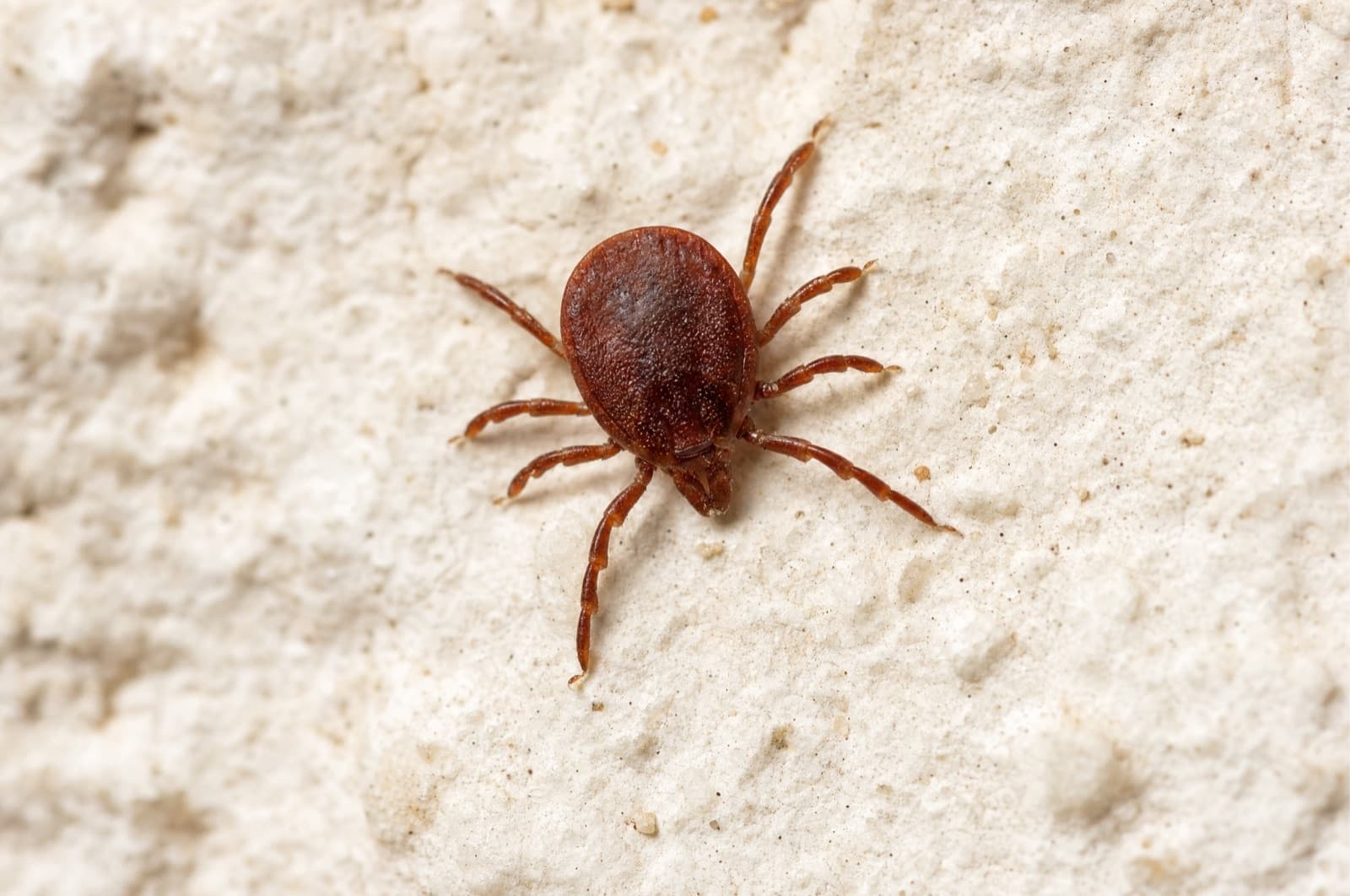
How to Get Rid of Brown Dog Ticks
At a glance
- Difficulty: Advanced
- Time: Weeks to months for full eradication, even with correct simultaneous pet and premises treatment
- Cost: Low for prevention (pet preventives, vacuuming); a full indoor infestation is where cost and effort escalate
- Success: Low for DIY once an indoor population is established; year-round pet preventives and early detection meaningfully improve odds
Can you DIY Brown Dog Tick?
The verdict on Brown Dog Tick DIY
The one hard tick that can live its whole life indoors — this behaves like an indoor pest explosion, not a yard problem.
The brown dog tick (Rhipicephalus sanguineus) is the only hard tick species that can complete its entire life cycle indoors, hiding in cracks behind moldings, ceiling and wall gaps, and under rugs and curtains between blood meals. A female lays 1,000-3,000 eggs, and the indoor cycle can finish in as little as two to three months, so early low-level infestations are usually missed until the population has already built up. Simultaneous pet and whole-premises treatment is required, and that scale of eradication is genuinely difficult to execute yourself once established.
The 5 DIY methods — honestly graded
Every approach graded for this species, in IPM order — prevention first, chemistry late. Pick a method to see how it works, the steps, and what it actually takes.
Prevention / Exclusion
Works wellYear-round pet preventives and early inspection are the best defense against this species ever establishing indoors.
Keeping ticks off your dog in the first place and catching a stray tick before it lays eggs indoors prevents the indoor life cycle from ever starting.
Best for: Every dog owner, as ongoing prevention
Use year-round vet-prescribed preventives
Keep dogs on a vet-prescribed tick preventive year-round, not just in summer.
Inspect after high-exposure settings
Check your dog thoroughly after kennels, groomers, or dog parks, where brown dog ticks are more likely to be picked up.
Vacuum and launder pet areas routinely
Vacuum and launder pet bedding routinely, even without a known tick problem, as a preventive habit.
Tools & materials
Why DIY falls short here
Not scare tactics — the specific, proportionate reasons a home attempt can stall for this species.
Treating the dog only
Most of the population is off-host in the environment — hiding behind moldings, in ceiling/wall cracks, behind curtains, under rugs — so simultaneous pet and premises treatment is the actual success requirement (UF/IFAS).
Rapid, hidden buildup
A female lays 1,000-3,000 eggs, and indoors at warm temperatures the egg-to-adult cycle can finish in about two to three months, so early low-level infestations are usually missed until the population is already established.
Underestimating the scale of the job
Because this species can complete its full life cycle indoors, an established infestation behaves more like a structural pest problem than a typical tick encounter, which is beyond what most DIY cleaning and spot-treatment can fully resolve.
How risky is it, really?
An honest read — most nuisance species are genuinely low risk, and we say so.
Brown dog ticks rarely bite humans and aren't a major human-disease vector in New Hampshire, but they're a significant canine-disease vector, and the difficulty of fully eradicating an indoor infestation is itself a real practical stake, not just a health one.
- Bites to humansRare
Mainly in heavy infestations or when dogs are absent as a host
University of Saskatchewan WCVM
- Canine disease transmission (ehrlichiosis, babesiosis)Common
Common in established infestations; also implicated in Rocky Mountain spotted fever transmission
WCVM; CDC
- Difficulty of full eradication once establishedCommon
A practical, not medical, stake — the indoor life cycle and hidden hiding spots make DIY eradication genuinely hard
UF/IFAS EENY-221
Brown Dog Tick Infestation Won't Clear Up?
This is the one tick that can live its whole life cycle indoors — full eradication needs simultaneous pet and premises treatment reaching hidden cracks. Anchor serves southern and central New Hampshire. Family-owned since 2017, NH license #782664.
Call a pro when…
- Ticks found indoors away from your dog (on walls, curtains, or moldings)
- An infestation that persists despite treating your dog
- You want professional-grade premises treatment reaching hidden hiding spots
General Pest Control
This is one of the harder species in the hub to fully DIY: an established indoor infestation needs simultaneous pet and whole-premises treatment reaching hidden cracks and crevices, which is where professional application earns its keep.
Keep them out
- Keep dogs on year-round vet-prescribed tick preventives
- Inspect dogs after kennels, groomers, and dog parks
- Vacuum and launder pet bedding routinely as a preventive habit
Brown dog ticks in New Hampshire homes
Unlike deer ticks and American dog ticks, which NH homeowners mostly encounter outdoors, brown dog ticks are typically introduced by a dog that picked one up at a kennel, groomer, dog park, or from another infested home, and then the indoor life cycle takes over. Because NH homes are heated through the cold months, indoor conditions stay warm enough year-round for the tick's cycle to continue even in winter, unlike outdoor tick species whose activity drops with the cold.
Peak season
Year-round once established indoors, due to heated homes; introduction risk peaks with kennel, groomer, or dog-park exposure
Make sure it's a Brown Dog Tick
Two quick detours worth taking — confirm the ID, then learn what drew it in so it doesn't come back.
Frequently asked
Sources & further reading(3)
- [1]UF/IFAS — Brown Dog Tick (EENY-221 / IN378)
Indoor life cycle, egg counts, cycle length
extensionverified 2026-07-13 - [2]University of Saskatchewan WCVM — Rhipicephalus sanguineus
Human bite rarity, canine disease vector status
academicverified 2026-07-13 - [3]Oklahoma State University Extension — Brown Dog Tick
Hiding behavior indoors, simultaneous treatment need
extensionverified 2026-07-13
Written & reviewed by
VerifiedDaniel Brady
NH-Licensed Pesticide Applicator · License #782664 (NHDAMF, RSA 430)
Daniel Brady is the New Hampshire–licensed applicator behind Anchor Pest Services, a family-owned pest control company serving the Manchester area since 2017.
Last updated July 2026
Other species you can tackle
Same category — the dot shows each one's DIY verdict at a glance (green = friendly, amber = doable with care, red = call a pro).
Professional Pest Control
Brown Dog Tick Infestation Won't Clear Up?
This is the one tick that can live its whole life cycle indoors — full eradication needs simultaneous pet and premises treatment reaching hidden cracks. Anchor serves southern and central New Hampshire. Family-owned since 2017, NH license #782664.
- Whole-premises treatment for indoor tick infestations
- NH-licensed applicators (#782664)
- Free inspection — same-day service across southern NH
NH License #782664 · No obligation · We answer in person
Your next step
- Book a NH pro
Tick Control
Book now - What to do next
Brown Dog Tick in NH: The Tick That Infests Houses
Read the answer - What to do next
How Do I Safely Remove a Tick From a Dog?
Read the answer - Also relevant
Brown Dog Tick in NH: The Tick That Infests Houses
Read the answer - Also relevant
Tick Prevention in NH: Tickscaping + Personal Protection
Read the answer - Related guide
How to Get Rid of Dog Ticks
Read the answer