
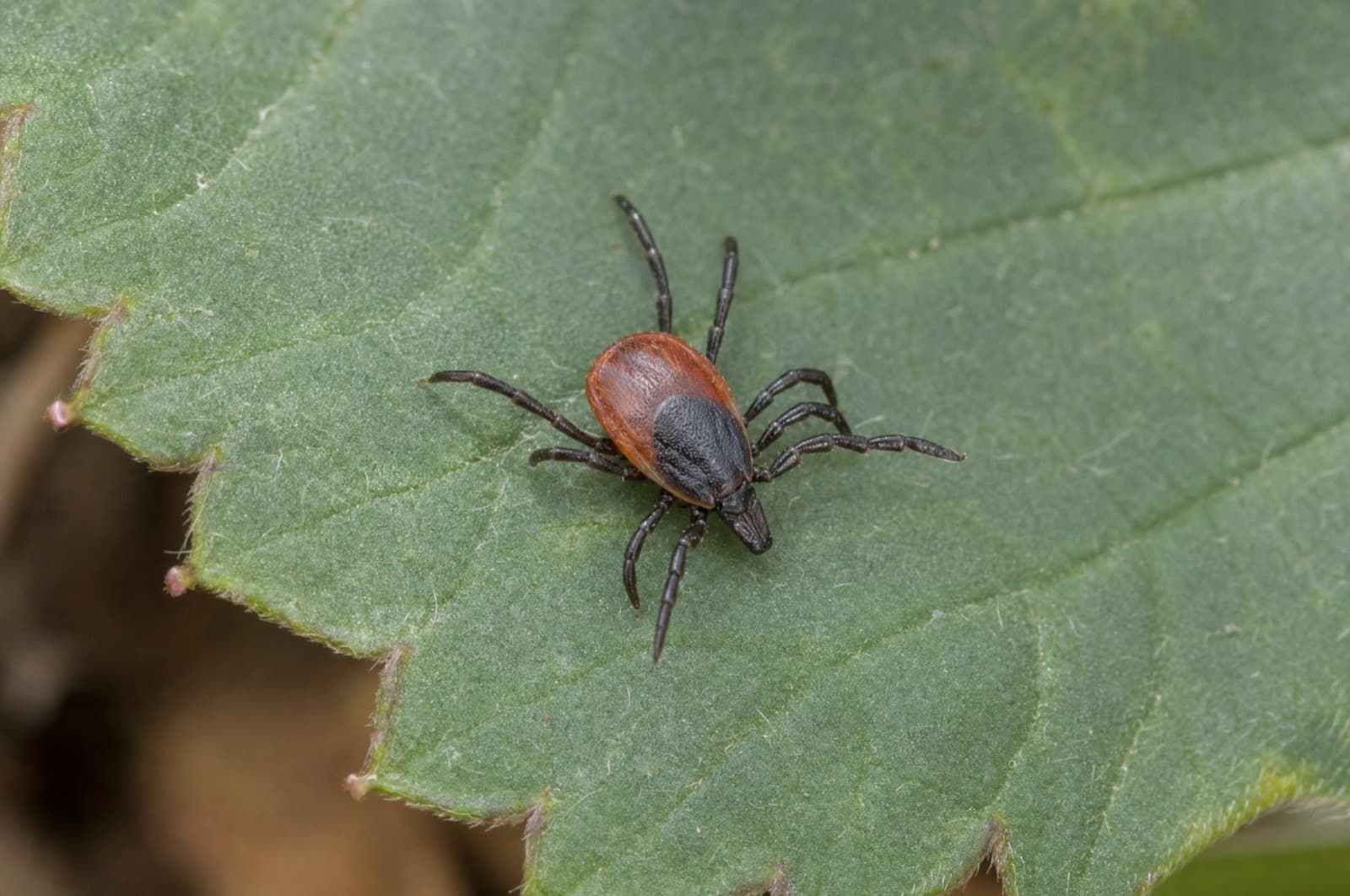
Deer Tick — Quick ID for New Hampshire Homeowners
Also called Blacklegged tick
The deer tick (blacklegged tick) is New Hampshire's primary Lyme disease vector — tiny, reddish-orange with a dark shield and no white markings. Nymphs in summer are poppy-seed sized and easy to miss. New Hampshire is a high-incidence Lyme state. This is the fast identifier with a brief safe-removal pointer; for prevention and yard control, see the full Ticks and Fleas guide.
- Size
- 1–3 mm unfed
- nymph = poppy seed; adult = sesame seed
- Color
- Orange-red body, dark shield, black legs
- no white markings — key vs. dog tick
- Lyme risk
- Primary vector in NH
- NH is a high Lyme-incidence state
- Active season
- Year-round
- active even in cool months above freezing
Is it a deer tick?
The deer tick is New Hampshire's most medically significant biting pest — the primary vector of Lyme disease in a state that consistently ranks among the highest in the country for Lyme incidence. Its tiny size and dark coloration make it easy to miss on skin and clothing, and midsummer nymphs are barely poppy-seed sized.
This page is a fast identifier. For the full picture — Lyme prevention, safe tick removal, yard barrier treatment, and NH disease resources — read the complete Ticks and Fleas guide linked above.
Quick deer tick ID
Size, color, and the absence of white markings are the three features that identify a deer tick on the spot.
Deer tick
- Scientific name
- Ixodes scapularis
- Family
- Ixodidae
- Size
- ~1 mm (nymph unfed) to ~3 mm (adult unfed); engorged adults expand several times
- Coloration
- Orange-red body with a dark dorsal shield (scutum) and black legs; no ornate white markings
- Habitat
- Leaf litter, tall grass, brushy woodland edges, stone walls, garden borders — anywhere deer or rodent hosts travel
- Active season
- Year-round; active whenever temperatures are above freezing, including mild winter days
- Diet
- Blood from wildlife, domestic animals, and humans at all life stages
- Reproduction
- Three life stages: larva, nymph, adult — each requires one blood meal
- Lifespan
- 2-year life cycle across three life stages
Widespread throughout New Hampshire, including urban and suburban yards near woodland edges. NH is one of the highest Lyme-incidence states in the U.S.
The tells — key ID features
- Tiny — much smaller than the common dog tick; nymphs are poppy-seed sized and easily overlooked.
- Orange-red body with a dark dorsal shield (scutum) and black legs — no white or ornate markings anywhere.
- No white markings is the key separator from the American dog tick (which has white/silver patterning on the shield).
- Active in cool months — deer ticks quest for hosts even in near-freezing temperatures, making year-round vigilance important in NH.
American dog tick
How to tell — American dog ticks are larger (3–5 mm), brown with distinctive white or silver markings on the shield (females) or body (males) — deer ticks are smaller and have no white markings.
Brown dog tick
How to tell — Brown dog ticks are uniformly reddish-brown with no dark shield and no white pattern; they are primarily indoor dog pests and do not commonly bite humans.
Signs of a problem
Deer ticks leave two signs — an attached tick and a potential rash.
A tiny dark-and-reddish tick attached to skin after time outdoors in grass, woods, or brush
What it means — Possible deer tick — remove promptly with fine-tipped tweezers, save the tick, and monitor for symptoms. See the removal pointer below.
An expanding circular or bull's-eye rash (erythema migrans) at the bite site, appearing days to weeks after a tick bite
What it means — A potential sign of Lyme disease — see a doctor promptly. Route all medical questions to your physician, NH DHHS, or CDC.
Tick control in New Hampshire
New Hampshire's high Lyme incidence makes tick management around the home a genuine health priority. Yard barrier treatments targeting the leaf litter and brush edge where deer ticks quest significantly reduce exposure. The full Ticks and Fleas guide covers tick prevention, safe removal, and the full yard treatment program. Brief removal pointer: use fine-tipped tweezers, grasp as close to the skin as possible, and pull steadily upward — do not twist, burn, or squeeze the body. Clean the bite site afterward and save the tick for identification. Watch for rash or fever. For full removal guidance and Lyme resources, see the guide.
When to call a pro
- Deer ticks are found on people or pets regularly in the yard.
- The property has a brushy yard edge, stone walls, or woodland border that is a tick habitat.
- You want a seasonal tick barrier program for high-exposure properties (children, pets, wooded lots).
Not sure it's a deer tick?
A licensed NH technician can confirm the species and tell you honestly whether it's a DIY fix or a job for a pro — free inspection, same-day service across Southern New Hampshire.
Frequently asked questions
Sources(3)
- [1]NH DHHS — Lyme Disease
NH Lyme incidence, deer tick as primary vector, tick removal guidance
govverified 2026-06-30 - [2]CDC — Lyme Disease
36-48 hour transmission window, erythema migrans description, tick removal protocol
govverified 2026-06-30 - [3]Anchor Pest — Ticks and Fleas Guide
full NH tick prevention, yard treatment, and removal guide
industryverified 2026-06-30
Written & reviewed by
VerifiedDaniel Brady
NH-Licensed Pesticide Applicator · License #782664 (NHDAMF, RSA 430)
Daniel Brady is the New Hampshire–licensed applicator behind Anchor Pest Services, a family-owned pest control company serving the Manchester area since 2017.
Last updated 2026-06-30

New Hampshire pest control
Dealing with deer ticks in your home?
Anchor Pest Services identifies and handles deer tick problems across southern and central New Hampshire. Family-owned since 2017, NH license #782664.
- NH-licensed applicators (#782664)
- Same-day service · free inspection
- Family-owned since 2017
Your next step
- Book a NH pro
Tick Control in New Hampshire
Adult deer ticks peak in fall. Yard tick control across Manchester and southern NH.
Book now - Next step
Do Ticks Drop Off Pets and Hide in a House?
Read the answer - What to do next
How to Get Rid of Deer Ticks
Read the answer - Also relevant
How Dangerous Are Tick Bites to Pets?
Read the answer - Related guide
Deer Mouse in New Hampshire — Hantavirus & Safe Cleanup
Read the answer - Related guide
American Dog Tick in NH: ID, Disease Risk & Removal
Read the answer