
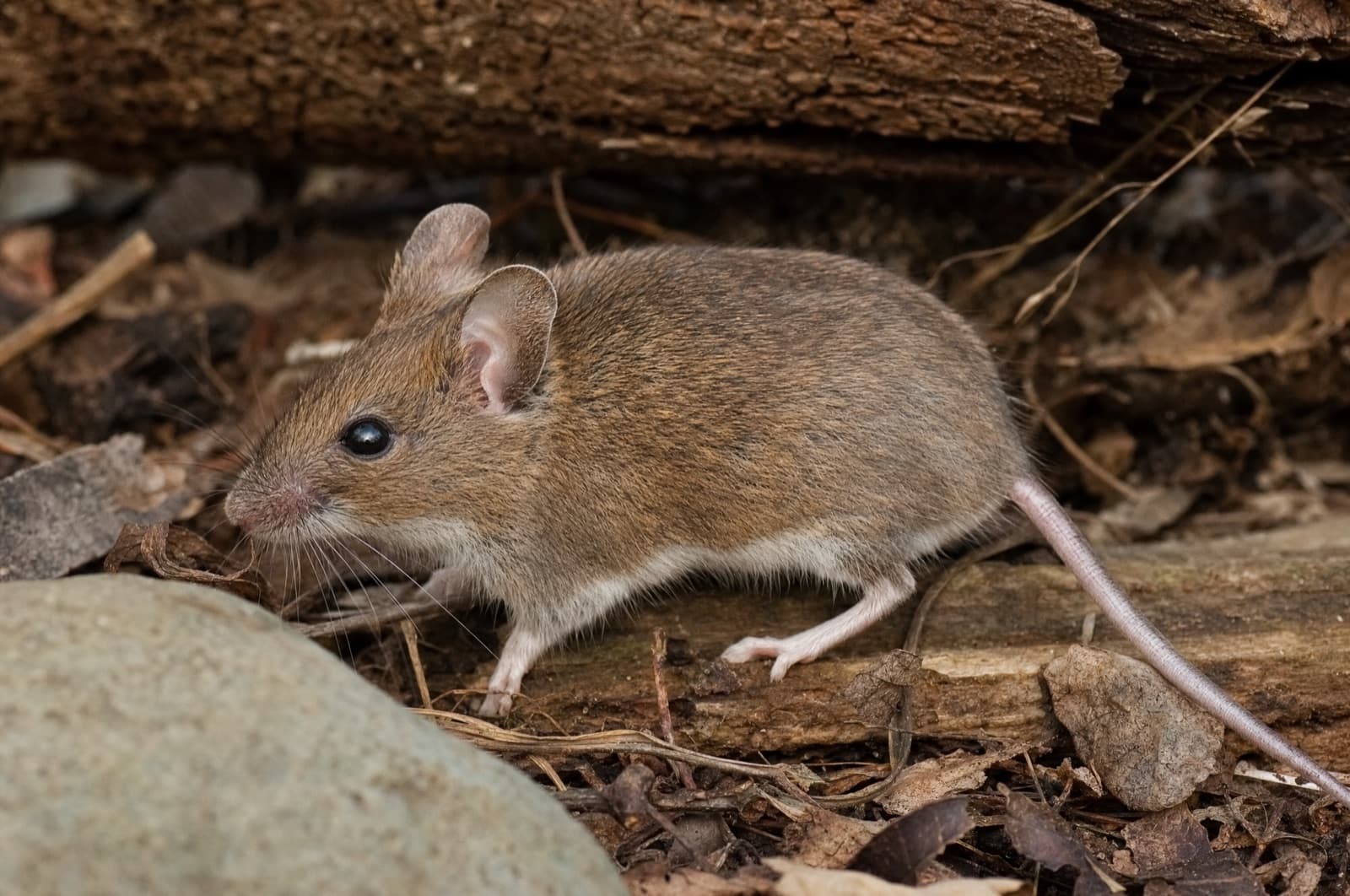
Deer Mouse in New Hampshire — Hantavirus & Safe Cleanup
Also called Eastern deer mouse
The deer mouse (Peromyscus maniculatus) is a native New England woodland mouse and the primary North American carrier of Hantavirus Pulmonary Syndrome (HPS). It is told from the house mouse by its sharply bicolor tail — dark above, white below — and clean white belly. Droppings must be wet-cleaned with diluted bleach and an N95; never sweep or vacuum dry droppings, which can aerosolize the virus.
- Best tell
- Sharply bicolor tail — dark above, crisp white below
- Animal Diversity Web
- Total length
- 119–222 mm total; tail 45–105 mm; 10–24 g
- Animal Diversity Web
- Disease
- Primary U.S. hantavirus (HPS) carrier
- CDC
- Carrier estimate
- ~15% estimated; field surveys range 0–~51%
- WSU EH&S / CDC
- HPS onset
- 1–8 weeks post-exposure; potentially fatal
- CDC
- Reproduction
- 2–4 litters/yr of 3–5 young, March–October
- Virginia DWR
- NH presence
- Native; common in rural and wooded NH
- UNH Cooperative Extension
The mouse that carries hantavirus — and how to clean up safely
The deer mouse (Peromyscus maniculatus) is a native New England woodland mouse — and the primary North American carrier of the hantavirus that causes Hantavirus Pulmonary Syndrome (HPS). The CDC is direct: 'The most common hantavirus that causes HPS in the United States is spread by the deer mouse.'
Fast visual ID: the single most reliable tell is the sharply bicolor tail — dark gray-brown on top, crisp white underneath — paired with a clean white belly and feet, large dark eyes, and large ears. No musky house-mouse odor. The house mouse, by contrast, has a uniformly gray-brown, hairy tail with no sharp color contrast and carries a distinct ammonia smell.
The cleanup rule that saves lives: never sweep or vacuum dry deer mouse droppings. That action aerosolizes virus particles that can then be inhaled. The correct protocol is to first ventilate the space for 30+ minutes, then wet-down droppings with a 1:10 bleach solution, wait 5 minutes, and wipe up with disposable gloves while wearing an N95. Route any illness concern — particularly sudden fever, muscle aches, or breathing difficulty 1–8 weeks after known exposure — to a doctor and NH DHHS immediately. This page does not provide medical dosages.
How to identify a deer mouse
The sharply bicolor tail is the defining field mark — dark gray-brown on the dorsal surface, crisp white on the ventral surface — combined with a clean white belly and feet, large dark eyes, and large ears. No musky ammonia odor (which is characteristic of the house mouse). If you see a bicolor tail in a rural NH shed or cabin, treat the space and its droppings as hantavirus-relevant.
Deer mouse
- Scientific name
- Peromyscus maniculatus
- Family
- Cricetidae
- Size
- 119–222 mm total length; tail 45–105 mm; 10–24 g
- Coloration
- Grayish to reddish-brown above; clean white belly and feet; sharply bicolor tail (dark above, white below)
- Habitat
- Woodlands, fields, outbuildings, cabins, sheds, woodpiles, stone wall gaps
- Active season
- Year-round; enters structures in fall as temperatures drop
- Diet
- Seeds, nuts, berries, insects
- Reproduction
- 2–4 litters per year of 3–5 young, primarily March–October
- Lifespan
- Rarely more than 2 years in the wild
Native throughout North America; common across rural and wooded New Hampshire
The tells — key ID features
- Sharply bicolor tail — dark gray-brown above, crisp white below — the single best identification tell.
- Clean white belly and feet with a reddish-brown to gray back.
- Large dark eyes and large ears (larger relative to head than the house mouse).
- No musky ammonia odor (the house mouse has a characteristic urine smell).
- Smaller and more delicate build than the house mouse at the larger end of the size range.
Size, to scale
119–222 mm total; tail 45–105 mm; 10–24 g
Body roughly the length of a AA battery; the bicolor tail is nearly as long again.
House mouse
How to tell — Uniform gray-brown coat with no sharp bicolor tail; hairy (not two-toned) tail; pronounced musky ammonia odor; does NOT carry hantavirus.
White-footed mouse
How to tell — Nearly identical to the deer mouse but tail is shorter and less sharply bicolor — both are disease-relevant; white-footed mouse is the primary NH Lyme reservoir.
Signs of a problem
Deer mouse signs in rural NH spaces are the same as house mouse signs — with one critical difference: the safe cleanup protocol is not optional.
Rice-grain droppings in a cabin, shed, garage, or outbuilding
What it means — Active feeding in a rural NH structure; treat all droppings as hantavirus-relevant and use wet-cleanup protocol before disturbing.
Seed and nut caches in drawers, wall voids, or equipment storage
What it means — Established nest nearby — deer mice cache food for winter and do not leave their territory willingly.
Shredded nesting material (plant fibers, insulation) in concealed areas
What it means — A nesting site is established; the nest itself and surrounding droppings require extra caution during cleanup.
Activity concentrated in fall — droppings appear after a camp or cabin has been closed
What it means — Frost-driven fall invasion; deer mice move into unoccupied structures at the NH first-frost window.
A mouse with a distinctly two-toned tail is sighted
What it means — Bicolor tail = deer or white-footed mouse — treat as hantavirus-relevant; not the house mouse.
The real risks, calibrated
The deer mouse's primary risk is hantavirus. The cleanup protocol is more important than any control measure — getting it wrong is the main risk vector for people.
Hantavirus Pulmonary Syndrome (HPS)
SevereOnset: 1–8 weeks after exposure to infected droppings, urine, or saliva (via inhalation)
Potentially fatal respiratory disease. Symptoms include fever, muscle aches, and rapid breathing difficulty. Route any illness concern to a doctor and NH DHHS — do not seek medical dosages here.
Secondary Lyme and anaplasmosis reservoir
ModerateOnset: Seasonal peak May–August
Deer mice (along with white-footed mice) feed larval ticks and can maintain Lyme and anaplasmosis pathogens locally. Controlling mice and tick habitat together reduces risk.
DIY — what works, what backfires
Trapping and exclusion are legitimate DIY steps — but the cleanup is where the risk lives. Follow the CDC wet-cleanup protocol before any disturbance of droppings or nests.
What actually works
- Ventilate the affected space for at least 30 minutes (open windows and doors; leave the space) before beginning any cleanup.
- Wet down all droppings and nesting material with a 1:10 bleach-to-water solution (or disinfectant labeled for hantavirus); let it soak for 5 minutes.
- Wipe up with disposable gloves; bag all waste in double plastic bags; seal and dispose in an outdoor trash container.
- Wear an N95 (not a dust mask) during cleanup — a fitted N95 filters the aerosolized particles that spread hantavirus.
- After cleanup, seal entry gaps (¼ inch or larger) with copper or steel mesh and caulk; set snap traps along walls.
What backfires
- Never sweep or vacuum dry droppings or nesting material — this aerosolizes virus particles and is the most common exposure route for HPS.
- Never handle mice or nests bare-handed — even a dead mouse can harbor virus in tissues.
- Don't treat deer mouse droppings the same way as house mouse droppings — the cleanup protocol is critically different.
- Don't ignore unusual illness 1–8 weeks after a known cleanup in a rural NH space — contact a doctor and mention the potential exposure. This page does not provide medical advice.
Deer mice in New Hampshire
The deer mouse is native and common across rural and wooded New Hampshire. Fall invasions into cabins, sheds, garages, and outbuildings are tied to the first-frost window (Manchester ~Oct 19–29; Concord ~Oct 3; Keene ~Oct 1, per NOAA 1991–2020) — deer mice seek winter shelter in woodpiles, wall voids, and the gaps of fieldstone and granite-block foundations common in older NH homes and camps. They are far more common in rural Merrimack, Rockingham, and Strafford County properties near wood edges and stone walls than in dense urban areas.
Peak season
Year-round in rural wooded NH; fall invasion surge at first frost
You might actually have
- White-footed mouse (near-identical; shorter, less bicolor tail — also disease-relevant; the primary NH Lyme reservoir)
- House mouse (uniform gray, hairy tail, musky odor — does NOT carry hantavirus)
We serve these communities
- NH-licensed applicator · #782664
- Same-day service
- Family-owned since 2017
Service Area Map
Southern New Hampshire
When to call Anchor Pest Services for deer mice
A licensed rodent control technician can handle the trapping and exclusion safely, and for large accumulations of droppings or nesting material in confined spaces — where DIY cleanup risk is highest — professional remediation is the right call.
When to call a pro
- Large accumulations of droppings or nesting material in a cabin, attic, or crawl space — professional remediation minimizes exposure risk.
- Recurring fall invasions despite exclusion attempts in rural or wooded NH properties.
- Any uncertainty about the cleanup protocol — when in doubt, call a licensed pro rather than risk an exposure.
Seal before the fall frost push
Inspect and seal every gap ¼ inch or larger in cabins, sheds, and outbuildings before October — the first-frost window is when deer mice seek winter shelter.
Eliminate harborage near structures
Store firewood at least 20 feet from the structure; clear woodpile, brush, and debris that gives deer mice shelter near the entry points.
Secure food storage
Store all food in sealed hard-sided containers in affected cabins and outbuildings; remove accessible seed, grain, and pet food.
Not sure it's a deer mouse?
A licensed NH technician can confirm the species and tell you honestly whether it's a DIY fix or a job for a pro — free inspection, same-day service across Southern New Hampshire.
Frequently asked questions
Sources(7)
- [1]Animal Diversity Web — Peromyscus maniculatus
body size, tail dimensions, coloration
academicverified 2026-06-30 - [2]
- [3]CDC — Hantavirus Clinical Overview (HPS)
HPS onset 1–8 weeks post-exposure; potentially fatal
govverified 2026-06-30 - [4]CDC — Hantavirus Prevention
wet-cleanup protocol; N95 recommendation; never sweep dry droppings
govverified 2026-06-30 - [5]Washington State University EH&S — Hantavirus Factsheet
~15% deer mouse carrier estimate
academicverified 2026-06-30 - [6]Virginia DWR — Deer Mouse
reproduction: 2–4 litters/yr of 3–5 young, March–October
govverified 2026-06-30 - [7]
Written & reviewed by
VerifiedDaniel Brady
NH-Licensed Pesticide Applicator · License #782664 (NHDAMF, RSA 430)
Daniel Brady is the New Hampshire–licensed applicator behind Anchor Pest Services, a family-owned pest control company serving the Manchester area since 2017.
Last updated 2026-06-30

New Hampshire pest control
Dealing with deer mouses in your home?
Anchor Pest Services identifies and handles deer mouse problems across southern and central New Hampshire. Family-owned since 2017, NH license #782664.
- NH-licensed applicators (#782664)
- Same-day service · free inspection
- Family-owned since 2017
Your next step
- Book a NH pro
Rodent Control in New Hampshire
Mice and rats move indoors every fall. We trap, seal entry points and keep them out.
Book now - Next step
What Cleaning Products Kill Rodent Bacteria and Viruses?
Read the answer - What to do next
How to Get Rid of Deer Mice
Read the answer - Related guide
House Mouse in New Hampshire — ID, Signs & Control
Read the answer - Related guide
Deer Tick — Quick ID for New Hampshire Homeowners
Read the answer - Related guide
White-Footed Mouse — NH's Key Lyme Disease Reservoir
Read the answer