
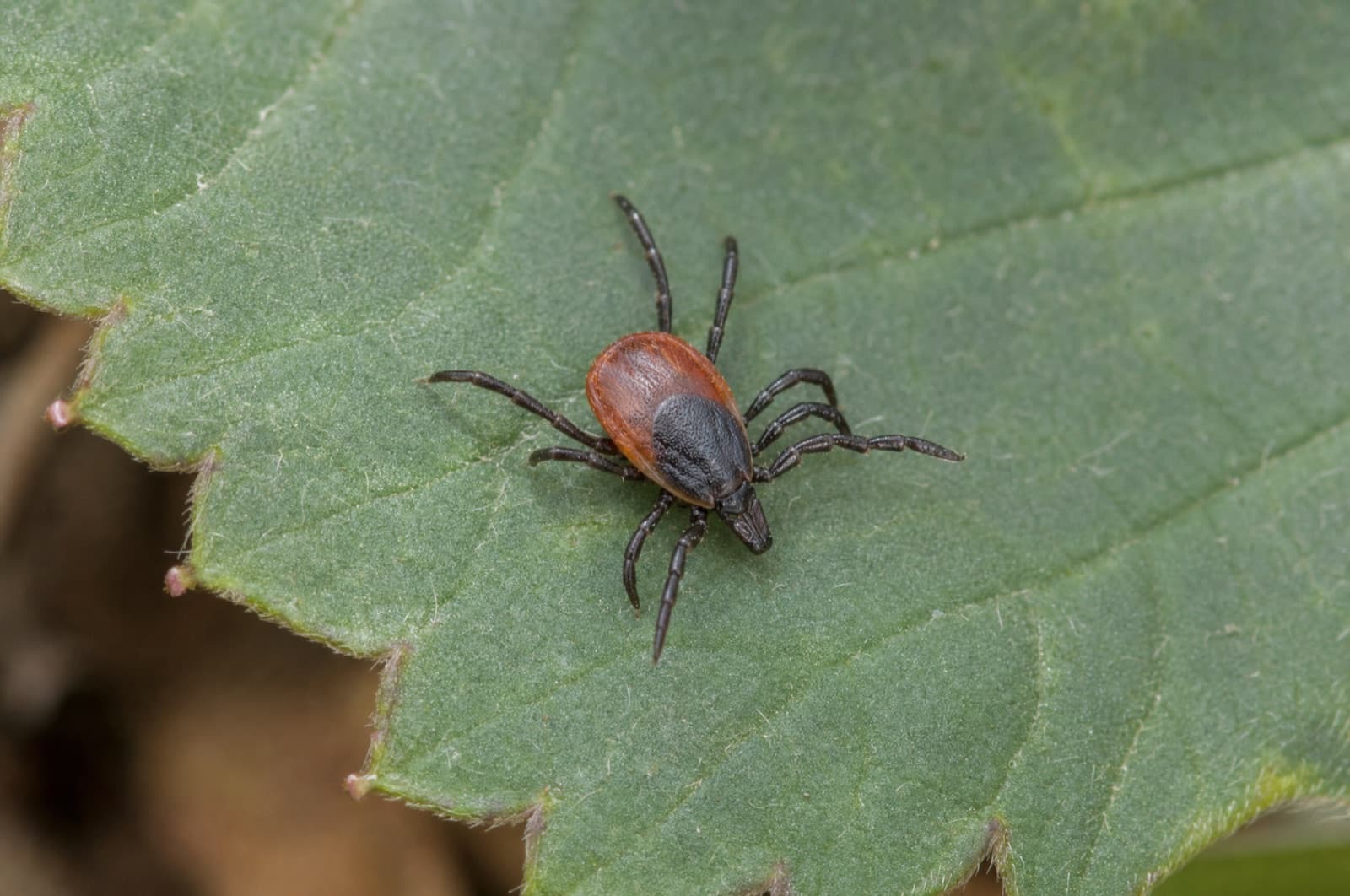
How to Get Rid of Deer Ticks
At a glance
- Difficulty: Advanced
- Time: Ongoing through the tick season (spring through fall, with year-round activity above freezing)
- Cost: Low for personal protection; moderate if adding professional yard suppression
- Success: Good for reducing personal risk with consistent habits; property-wide elimination isn't realistic given surrounding wooded habitat
Can you DIY Deer Tick?
The verdict on Deer Tick DIY
Personal protection and yard management are genuinely DIY — and, alongside the lone star tick, this is the hub's highest genuine health-stakes species. We won't understate it.
The deer tick, or blacklegged tick (Ixodes scapularis), is the primary vector for Lyme disease in New Hampshire, which NH DHHS reports has the third-highest Lyme incidence rate in the US. A 2025 Dartmouth-led regional analysis found roughly 50% of adult blacklegged ticks and up to 25% of nymphs carry the Lyme bacterium. Daily tick checks, prompt correct removal, personal repellents, and yard management genuinely reduce risk and are within a homeowner's ability — but you cannot 'get rid of' deer ticks from surrounding woods and fields, only manage your exposure and your immediate property.
The 5 DIY methods — honestly graded
Every approach graded for this species, in IPM order — prevention first, chemistry late. Pick a method to see how it works, the steps, and what it actually takes.
Prevention / Exclusion
Works wellYard management and habitat measures meaningfully reduce tick exposure — a genuine, CDC-backed DIY win.
Deer ticks need humid, shaded leaf litter and brush to survive; removing that habitat and creating a dry barrier between lawn and woods reduces the number of ticks questing where you actually spend time.
Best for: Every household on or near wooded property in NH
Clear leaf litter and brush
Rake and remove leaf litter, tall grass, and brush from around the house and yard edges, where ticks wait for a host.
Build a dry barrier
Create an 18-24 inch mulch or gravel barrier between your lawn and adjoining woods or stone walls to slow tick movement into the yard.
Do daily tick checks
Check yourself, kids, and pets daily during tick season, focusing on behind the knees, armpits, groin, scalp, and behind ears.
Tools & materials
Why DIY falls short here
Not scare tactics — the specific, proportionate reasons a home attempt can stall for this species.
Missing the nymphs
Nymphs are poppy-seed-sized and responsible for most Lyme transmission — many patients never recall being bitten, which is why daily full-body checks matter more than trying to 'spot' ticks outdoors.
Relying on an 'attachment clock' as a safety guarantee
In most cases a tick must be attached over 24 hours to transmit Lyme, and risk rises with attachment time, but a partially-fed tick moved from a pet or clothing can transmit faster — there's no guaranteed-safe window, so prompt removal always matters.
Expecting yard management to eliminate ticks
Clearing leaf litter and building a dry barrier reduces exposure on your own property, but it can't remove ticks from adjoining woods, fields, or a neighbor's yard — this is risk reduction, not elimination.
How risky is it, really?
An honest read — most nuisance species are genuinely low risk, and we say so.
This risk is correctly elevated, not under-stated. NH DHHS states that CDC reports New Hampshire has the third-highest Lyme disease incidence rate in the US, behind only Delaware and Connecticut, and a 2025 Dartmouth-led regional analysis found roughly 50% of adult blacklegged ticks and up to 25% of nymphs carry the Lyme bacterium. Deer ticks also transmit anaplasmosis, babesiosis, and rarely Powassan virus. This should never be graded low.
- Lyme diseaseCommon
NH DHHS reported confirmed and probable Lyme cases rising from 262 in 2002 to 1,710 in 2019; roughly 50% of adult ticks and up to 25% of nymphs are infected regionally per the 2025 Dartmouth-led analysis
NH DHHS; Price et al., Parasites & Vectors, 2025
- Anaplasmosis / babesiosisOccasional
Locally acquired cases documented in NH
NH DHHS
- Powassan virusRare
Can transmit in as little as 15 minutes of attachment, far faster than Lyme; CDC logged a record 76 US cases in 2025, including an NH fatality that year
CDC; Kaur et al. 2025
NH's Lyme Risk Is Real — Reduce Your Exposure
Personal protection is yours to own, but property-wide tick suppression is where Anchor adds real value. We apply correctly-timed perimeter treatment across southern and central New Hampshire. Family-owned since 2017, NH license #782664.
Call a pro when…
- Recurring tick encounters on your own property despite personal protection and yard management
- A wooded or brushy lot where DIY yard treatment isn't keeping pace
- You want a correctly-timed perimeter acaricide treatment rather than DIY broadcast spraying
General Pest Control
Personal protection and daily tick checks are genuinely yours to own — that's the core defense against Lyme disease. Where a pro adds real value is property-wide yard suppression for recurring on-property encounters.
Keep them out
- Maintain a mulch or gravel barrier between lawn and woods
- Keep grass mowed and leaf litter cleared through tick season
- Do a full-body tick check every day during tick season, not just after hikes
Deer ticks and Lyme disease in New Hampshire
Blacklegged (deer) ticks occur in all ten NH counties but are most abundant in the southeast and coastal areas, according to UNH Extension. NH DHHS's Health Alert Network cites CDC data showing New Hampshire has the third-highest Lyme disease incidence rate in the country — a case rate of about 63 per 100,000 population, behind only Delaware and Connecticut. Confirmed and probable Lyme cases rose from 262 in 2002 to 1,710 in 2019.
Peak season
Nymphs peak late spring through summer; adults are active spring and fall, with some activity whenever temperatures are above freezing
Make sure it's a Deer Tick
Two quick detours worth taking — confirm the ID, then learn what drew it in so it doesn't come back.
Frequently asked
Sources & further reading(5)
- [1]CDC — Lyme Disease Causes and How It Spreads
Lyme transmission mechanism, attachment-time guidance
govverified 2026-07-13 - [2]NH DHHS — Health Alert Network (Lyme/tick data)
NH's third-highest Lyme incidence rate, case counts
govverified 2026-07-13 - [3]Price et al., Parasites & Vectors (2025), via Dartmouth
Regional infection rates in adult/nymph blacklegged ticks
academicverified 2026-07-13 - [4]UNH Extension — Biology and Management of Ticks in New Hampshire
County distribution, tick biology
extensionverified 2026-07-13 - [5]
Written & reviewed by
VerifiedDaniel Brady
NH-Licensed Pesticide Applicator · License #782664 (NHDAMF, RSA 430)
Daniel Brady is the New Hampshire–licensed applicator behind Anchor Pest Services, a family-owned pest control company serving the Manchester area since 2017.
Last updated July 2026
Other species you can tackle
Same category — the dot shows each one's DIY verdict at a glance (green = friendly, amber = doable with care, red = call a pro).
Professional Pest Control
NH's Lyme Risk Is Real — Reduce Your Exposure
Personal protection is yours to own, but property-wide tick suppression is where Anchor adds real value. We apply correctly-timed perimeter treatment across southern and central New Hampshire. Family-owned since 2017, NH license #782664.
- Correctly-timed perimeter tick treatment
- NH-licensed applicators (#782664)
- Free inspection — same-day service across southern NH
NH License #782664 · No obligation · We answer in person