
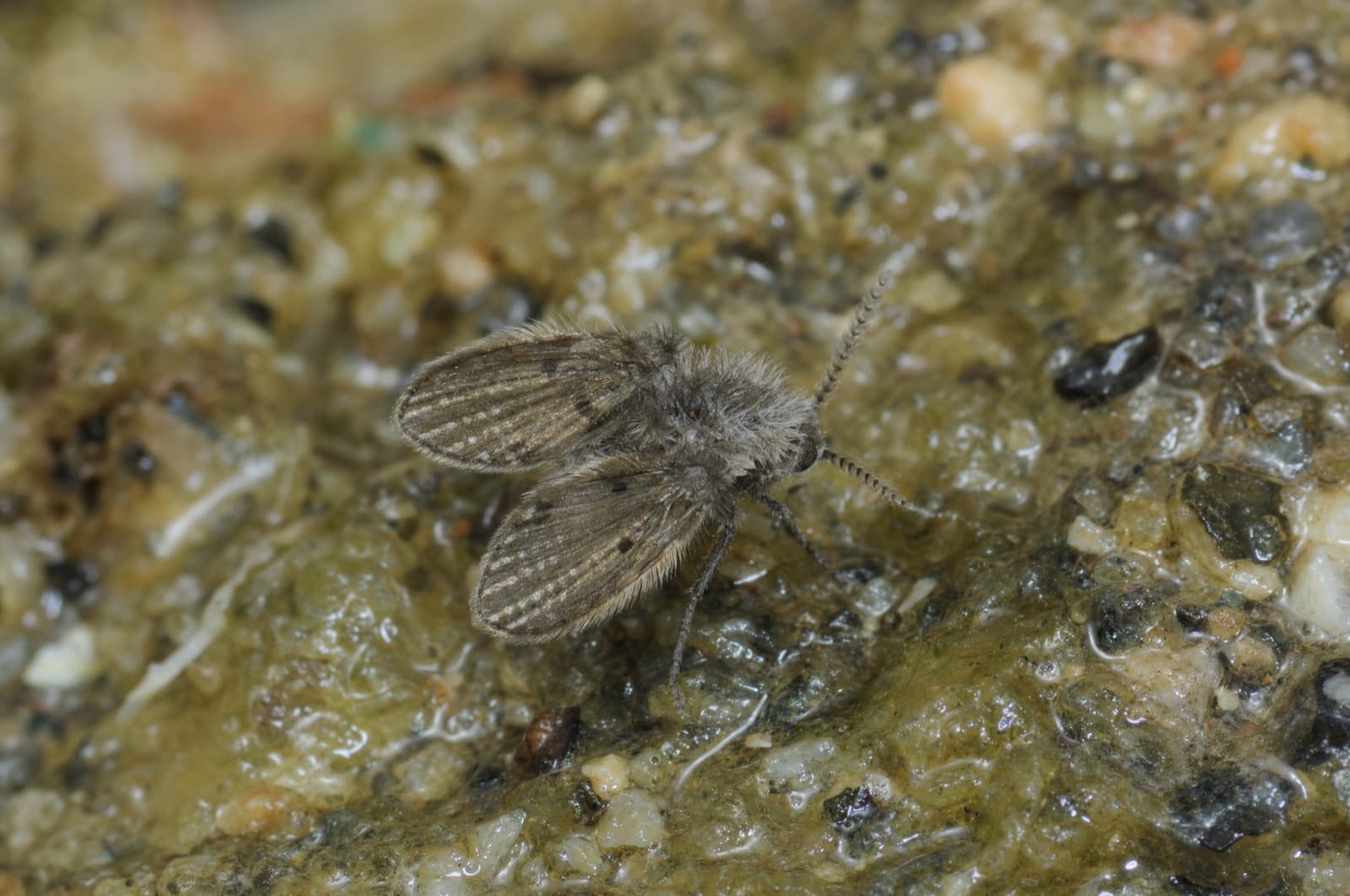
Drain Flies in New Hampshire — ID, Signs & How to Get Rid of Them
Also called Moth fly · Filter fly · Sewer fly · Bathroom fly
Drain flies (moth flies) are tiny, fuzzy, moth-like flies that rest on walls near sinks and tubs. They breed in the gelatinous organic film — biofilm — coating the inside of drains, not in standing water alone. The lasting fix is mechanically removing that film. The cup-or-tape-over-the-drain test, verified by University of Arkansas Extension, pinpoints exactly which drain is producing them.
- Family
- Psychodidae
- moth flies / filter flies; Clogmia albipunctata, Psychoda spp.
- Size
- ~1/8 in (2–5 mm)
- Texas A&M AgriLife; University of Arkansas Extension
- Best tell
- Fuzzy, moth-like; rests on walls near drains
- the only small fly that looks like a tiny moth
- Breeds in
- Biofilm inside drains
- not standing water alone; Texas A&M AgriLife
- Bite / disease
- Non-biting; no known pathogen transfer
- UF/IFAS
- Bti effect
- 79% fewer emerging adults
- UF/IFAS, citing Houston et al. 1989
Fuzzy flies on your bathroom wall? The source is inside the drain.
Drain flies — also called moth flies or filter flies (family Psychodidae) — are one of the four small flies that people constantly confuse with each other. The easy tell: a drain fly is the only one that looks like a tiny moth. It is fuzzy, with broad leaf-shaped wings it holds tent-like over its body, and it rests motionless on walls and ceilings near drains rather than hovering or scuttling.
They breed in one precise medium: the gelatinous organic film (biofilm) that coats the inside surfaces of drains, not in standing water alone. This distinction changes everything about how you treat them. Bleach, boiling water, and chemical drain cleaners dissolve or disinfect, but they do not physically strip the biofilm layer — the larvae live embedded in it, and bleach does not reach them reliably.
The lasting fix is mechanical biofilm removal: a stiff drain brush scrubbing the pipe walls, followed by a bacterial or enzyme drain gel that digests the remaining organics. And before you clean anything, you need to know exactly which drain is producing the flies — because it may not be the one nearest the flies. The University of Arkansas Extension documents an extension-verified test to do exactly that: tape a clear cup or plastic bag over each suspect drain overnight.
How to identify a drain fly
Drain fly is the only small fly in New Hampshire homes that looks like a tiny moth. The fuzzy body, broad moth-like wings held roof-like at rest, and the habit of sitting motionless on walls near drains are definitive. No hovering. No scuttling. No long legs. Just a tiny fuzzy moth on the bathroom wall.
Drain fly
- Scientific name
- Family Psychodidae (Clogmia albipunctata, Psychoda spp.)
- Family
- Psychodidae
- Size
- ~1/8 in (2–5 mm)
- Coloration
- Dark gray to black, densely hairy (fuzzy); wings are moth-like and leaf-shaped
- Habitat
- The gelatinous biofilm inside drains, sewage, and filter beds; any moist organic film in plumbing.
- Active season
- Year-round indoors
- Diet
- Larvae feed on the organic material in biofilm; adults feed minimally.
- Reproduction
- Egg masses contain 30–100 eggs (Texas A&M AgriLife); cycle approximately 1–3 weeks.
- Lifespan
- Adults live approximately 1–2 weeks.
Found throughout New Hampshire and worldwide wherever drains with organic buildup exist; indoor populations are independent of outdoor season.
The tells — key ID features
- Fuzzy, moth-like body with broad leaf-shaped wings held tent-like (roof-like) at rest — the single best tell; no other common small fly looks like this.
- Sits motionless on walls and ceilings near drains, not hovering or scuttling.
- Weak flier — travels only a few feet at a time.
- Most active in the evening.
- ~1/8 inch, dark gray.
Size, to scale
~1/8 in (2–5 mm)
About the size of a sesame seed with fuzzy moth-like wings — like a tiny ash fleck that sits on the wall
Fruit fly
How to tell — Fruit flies are smooth (not fuzzy), tan/brown with red eyes in many specimens, and hover around fermenting fruit, spills, and recycling. They do not sit motionless on walls. Drain fly = fuzzy moth on the wall; fruit fly = red-eyed hoverer at the fruit bowl.
Phorid fly
How to tell — Phorid flies have a distinctive humped thorax when viewed from the side and scuttle rapidly across surfaces on foot. They are not fuzzy and do not look like moths. Both can share drain biofilm as a breeding source, so the behavior and shape tell them apart.
Fungus gnat
How to tell — Fungus gnats are dark, delicate, long-legged, and associated with overwatered houseplant soil — not drains. They fly weakly but do not sit on walls the way drain flies do.
Signs of a problem
Drain flies announce themselves by location and the cup/tape test. These signs help you find not just the fly but the specific drain producing it.
Fuzzy moth-like flies on bathroom or kitchen walls near a drain
What it means — Drain fly — the source is almost certainly that drain or one nearby. Begin the cup/tape test to confirm exactly which one.
Gelatinous dark slime visible inside a drain when you look with a flashlight
What it means — Active biofilm — this is the breeding medium. This drain is a likely source.
Flies persist after surface cleaning of kitchen or bathroom
What it means — The biofilm inside the drain was not removed; the larvae are still developing and adults keep emerging.
Flies appearing from a seldom-used basement floor drain
What it means — A dry trap in an unused drain allows flies from a connected sewer line to travel through and establish. Running water weekly refills the trap and often eliminates the source.
Cup/tape test: adults trapped under a cup placed over a specific drain overnight
What it means — Confirmed breeding drain — University of Arkansas Extension documents this as an effective extension-verified source test. Test every drain, not just the nearest one.
The real risks, calibrated
Drain flies are a nuisance pest with low direct health risk — but a persistent infestation can signal a plumbing problem worth addressing.
Nuisance — non-biting, low direct health risk
Low riskOnset: Ongoing while present
Drain flies do not bite and are not known to transmit pathogens to humans (UF/IFAS). The primary concern is annoyance from their presence.
Potential respiratory irritation from shed scales
Low riskOnset: With heavy populations
Drain flies shed fine scales from their bodies and wings; UF/IFAS notes that in large infestations, these scales may irritate the respiratory tract if inhaled, particularly in sensitive individuals.
Plumbing defect indicator
ModerateOnset: Persistent infestation
Drain flies that persist after thorough biofilm cleaning may indicate a cracked sewer line, a drain defect, or a subsurface organic accumulation that is outside normal plumbing — worth a plumbing assessment.
DIY — what works, what backfires
Drain fly control is biofilm removal, not spraying. The larvae live in the biofilm; get rid of the biofilm and they stop. Here is the extension-recommended process.
What actually works
- Run the cup/tape test first: place a clear cup or jar coated inside with petroleum jelly over each suspect drain overnight. Adults emerging from the drain are trapped on the inside surface, confirming that drain as the source. University of Arkansas Extension documents this as a reliable extension-verified method — test every drain, not just the most obvious one.
- Scrub the drain interior with a stiff-bristled drain brush, working the brush around the inside of the pipe to physically remove the gelatinous biofilm coating the walls. This mechanical step is essential — no liquid treatment replaces it.
- Follow with a bacterial or enzyme drain gel: these products digest the remaining organic material in the drain rather than simply disinfecting or masking it. Apply as directed and repeat weekly until the infestation is resolved.
- Run water through dry or seldom-used drains (especially basement floor drains) weekly — this refills the trap seal that prevents sewer access and often eliminates that source entirely.
- If a cracked sewer line or drain defect is suspected (flies persist after thorough cleaning), schedule a plumbing inspection.
What backfires
- Don't rely on bleach or boiling water alone — these disinfect or kill surface bacteria but do not physically remove the biofilm layer the larvae are embedded in. The University of Arkansas Extension is explicit: bleach alone does not reliably eliminate drain fly larvae living in the biofilm.
- Don't spray the adult flies — spraying kills visible adults but has no effect on the larvae in the drain; new adults will emerge as long as the biofilm is present.
- Don't assume it is just one drain — test every drain in the affected area, including basement floor drains and laundry room floor drains, before treating.
- Don't pour chemical drain cleaners (liquid plumber-type products) into the drain — these can damage older plumbing and still do not remove biofilm the way mechanical scrubbing does.
Drain flies in New Hampshire homes
Drain flies are a year-round indoor problem across New Hampshire because heated homes keep drains warm and moist regardless of the season. They are especially common in Manchester, Nashua, and Concord homes with basement floor drains, older cast-iron plumbing with rough interior surfaces that accumulate biofilm faster, and seldom-used drains whose trap water evaporates (a dry trap allows flies from a connected sewer to travel through and establish). A winter drain fly outbreak is not unusual and does not indicate anything unique about the cold season — it simply means a drain has enough biofilm to sustain them.
Peak season
Year-round indoors in NH heated homes regardless of outdoor temperature
You might actually have
- Fruit flies (smooth, tan, red-eyed, hover at fruit — often confused with drain flies)
- Phorid flies (humped back, scuttles — can also use drain biofilm)
- Fungus gnats (delicate, long-legged, near houseplants)
We serve these communities
- NH-licensed applicator · #782664
- Same-day service
- Family-owned since 2017
Service Area Map
Southern New Hampshire
When to call a pro for drain flies
If drain flies persist for more than two to three weeks after thorough mechanical cleaning of all identified drains, the source may be a cracked sewer line, a subsurface drain break, or an accumulation in a section of plumbing that is not accessible for home cleaning. A licensed technician can assess and address these hidden sources.
When to call a pro
- Flies persist for more than two weeks after thorough biofilm removal from all accessible drains — possible cracked sewer line or subsurface defect.
- A sourceless swarm in a ground-floor or basement area with no obvious drain source (possible broken sewer line under the slab).
- A commercial kitchen or food-service location with a drain fly problem facing a health inspection.
- Infestation in a multi-drain plumbing system (e.g., a restaurant, older building, or property with a grease trap) where drain access is limited.
Weekly drain maintenance
Running a stiff brush through sink and floor drains weekly — or using a bacterial/enzyme drain gel on a regular schedule — prevents biofilm accumulation and eliminates the breeding medium before drain flies can establish.
Keep unused drains wet
Seldom-used floor drains in basements, laundry rooms, and garages lose their trap seal through evaporation. Run a cup of water through them weekly to maintain the trap and prevent sewer access.
Inspect NH homes with older plumbing
Older cast-iron drains in Manchester and Nashua homes can develop rough interior surfaces that accumulate biofilm faster than modern PVC plumbing. An annual plumbing inspection in older homes can catch drain defects and heavy buildup before they become a fly source.
Not sure it's a drain fly?
A licensed NH technician can confirm the species and tell you honestly whether it's a DIY fix or a job for a pro — free inspection, same-day service across Southern New Hampshire.
Frequently asked questions
Sources(5)
- [1]University of Arkansas Extension — Drain Flies
cup/tape source test (extension-verified), biofilm as breeding medium
extensionverified 2026-06-30 - [2]Texas A&M AgriLife Extension — Drain Flies (E-184)
ID, size, biofilm breeding medium, egg masses 30–100
extensionverified 2026-06-30 - [3]UF/IFAS — Moth/Drain Flies (IN1226)
non-biting, no known pathogen transfer, Bti 79% reduction
extensionverified 2026-06-30 - [4]PMC — Drain Fly / Psychodidae Study
biology and distribution corroboration
academicverified 2026-06-30 - [5]UNH Cooperative Extension — Managing Small Flies Indoors
NH source-first fly control guidance
extensionverified 2026-06-30
Written & reviewed by
VerifiedDaniel Brady
NH-Licensed Pesticide Applicator · License #782664 (NHDAMF, RSA 430)
Daniel Brady is the New Hampshire–licensed applicator behind Anchor Pest Services, a family-owned pest control company serving the Manchester area since 2017.
Last updated 2026-06-30

New Hampshire pest control
Dealing with drain flys in your home?
Anchor Pest Services identifies and handles drain fly problems across southern and central New Hampshire. Family-owned since 2017, NH license #782664.
- NH-licensed applicators (#782664)
- Same-day service · free inspection
- Family-owned since 2017
Your next step
- What to do next
How to Get Rid of Drain Flies
Read the answer - What to do next
What Attracts Drain Flies to Your House?
Read the answer - What to do next
Mechanical Filth Fly Control: Find the Source, Not Just the Fly
Read the answer - What to do next
Where Do Flies Go in the Winter? NH Cluster Fly Timing
Read the answer - What to do next
Chemical Fly Control: A Supplement, Not the Fix
Read the answer