
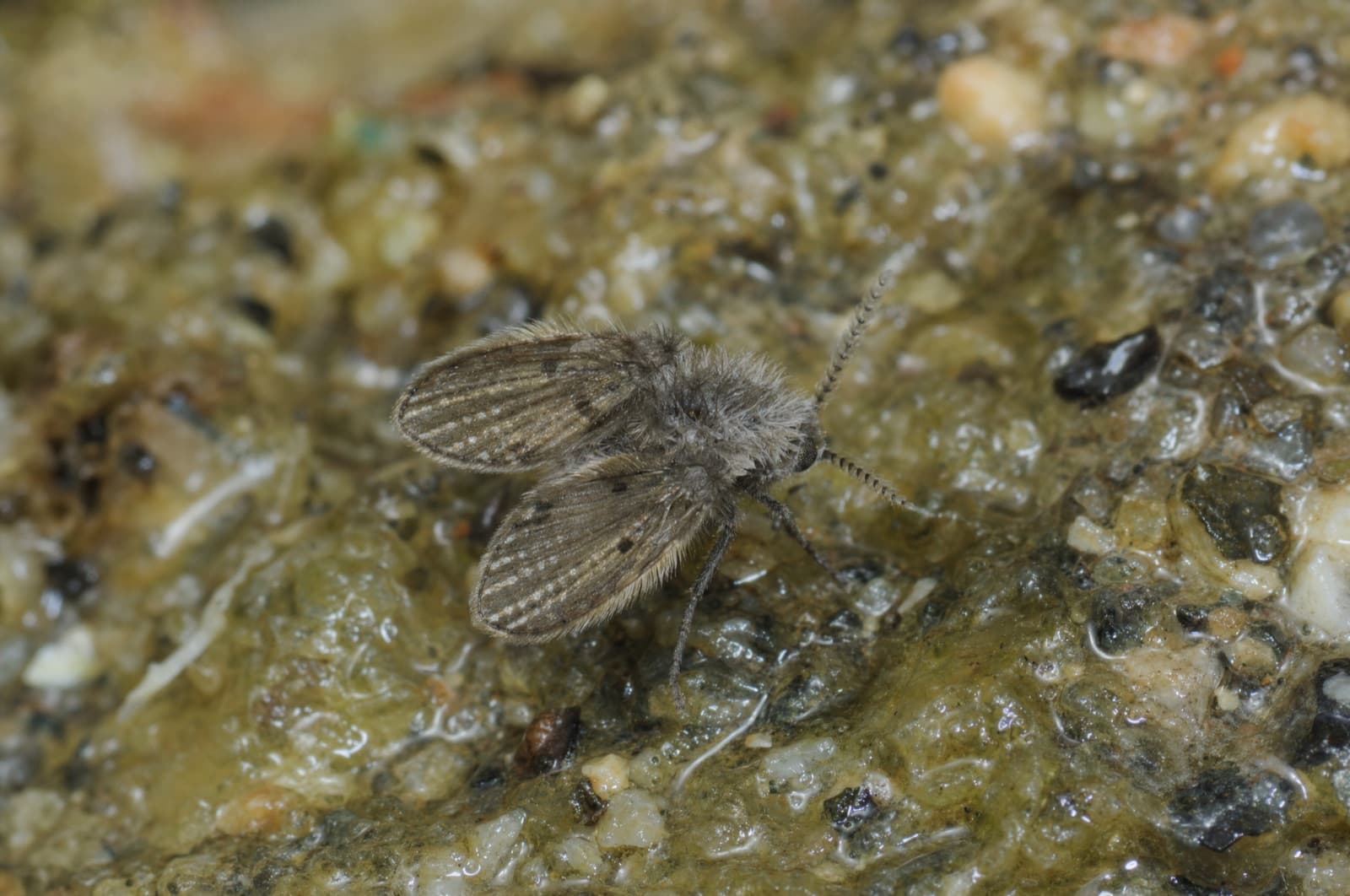
What Attracts Drain Flies to Your House?
At a glance
- Short answer: Drain flies grow in the gunk lining your drains, not in the air around them — the slime film is both nursery and food.
- The verdict: Something specific
The attractant verdict
Four possible answers to why this species turned up. Three stay unlit — and that's the argument: the honest answer could have been any of them, and for this species it wasn't.
Drain flies grow in the gunk lining your drains, not in the air around them — the slime film is both nursery and food.
Most advice, including our own previous page, describes drain flies as drawn indoors "mainly because of the moisture and organic matter found in drains, sinks, and other damp areas," which is close but leaves the mechanism vague enough to sound like a general dampness problem rather than one specific film.
Drain flies (also called moth flies) breed in the slimy, gelatinous organic film that coats the inside of drains, overflow pipes, and infrequently used traps. Females lay eggs directly on the surface of that film, and larvae feed on the decaying organic matter, bacteria, and fungi living in it. The film itself — not the room's general humidity, and not a wet floor — is both the nursery and the food source, which is why an infestation can persist in an otherwise clean bathroom or kitchen as long as that specific film is intact.
“Drain flies grow in the gunk lining your drains, not in the air around them — the slime film is both nursery and food.”
The gelatinous organic biofilm that coats the inside of a drain, overflow pipe, or infrequently used trap, made up of decaying organic matter, bacteria, and fungi.
It means the room being clean has little bearing on the problem, because the breeding source is inside the pipe itself, on the film, not on visible surfaces. Killing adult flies does nothing if the film that produces new ones is left intact.
Calibrated from: Virginia Cooperative Extension, Alabama Cooperative Extension System, and University of Florida IFAS: drain fly larvae develop in the organic film lining drains, and eggs are laid directly on that film's moist surface.
Why it's here, in full
The film is the source — the room isn't
Drain flies are a good example of how a real, sourced attractant can be much narrower than "moisture and organic matter" suggests. Virginia Cooperative Extension describes the larval habitat directly: eggs are laid on the surface of the moist, gelatinous organic film that develops inside drains, overflow pipes, and infrequently used traps, and larvae feed on the decaying matter, bacteria, and fungi within that film. Alabama Cooperative Extension System and University of Florida IFAS describe the same mechanism.
That detail matters because it means the room's general humidity or cleanliness is not really the deciding factor — a spotless bathroom can still have a drain-fly problem if one rarely used drain has an intact film coating its interior. It also explains why the problem so often concentrates around one specific fixture: a floor drain that's rarely run, an overflow opening on a tub, or a shower drain used infrequently, rather than spreading evenly to every damp surface in the house.
How to tell it's actually this species
Real signs only — a species with four honest tells gets four, and stops. Where a sign is weak on its own, we say so.
A thick, dark, sticky residue coating the inside walls of a drain, most visible with a flashlight or by running a finger just inside the opening
Small, fuzzy-looking gray or tan flies resting on a bathroom wall or near a sink, rather than actively flying most of the time
Flies appearing repeatedly near one specific drain — a rarely used floor drain, an overflow, or a shower drain — rather than scattered evenly through the house
Want drain fly gone?
This page only answers why it's here. Every removal step for this exact species — what to seal, what to set, what actually works — lives on its own dedicated guide.
Two questions, two pages
Here: why it turned up at all — the honest answer, blame removed.
There: the step-by-step removal guide for this exact species.
Key takeaways
- The specific attractant is the organic film lining a drain, not general room dampness.
- That film is both where eggs are laid and what larvae feed on.
- Activity concentrated at one specific drain, rather than spread out, is the useful clue.
- Removal steps for the film itself are covered at /top-diy-methods/drain-fly.
Cleaned the bathroom and still seeing drain flies?
This page is about why they're there. Clearing the drain film itself is covered at /top-diy-methods/drain-fly.
Frequently asked
Sources(3)
- [1]Virginia Cooperative Extension — Drain Flies (ENTO-414)
Drain fly eggs are laid on the organic film lining drains; larvae feed on that film
extensionverified 2026-07-17 - [2]Alabama Cooperative Extension System — Drain Flies in the Home
Drain fly identification and the organic-film breeding mechanism
extensionverified 2026-07-17 - [3]University of Florida IFAS Extension — Drain Flies
Drain fly biology and drain-biofilm breeding habitat
extensionverified 2026-07-17
Written & reviewed by
VerifiedDaniel Brady
NH-Licensed Pesticide Applicator · License #782664 (NHDAMF, RSA 430)
Daniel Brady is the New Hampshire–licensed applicator behind Anchor Pest Services, a family-owned pest control company serving the Manchester area since 2017.
Last updated Jul 2026
It's the film, not the room
We find which drain is the source
Inspections across southern and central New Hampshire that trace a drain fly problem to the specific fixture.
- Family-owned in Manchester since 2017
- NH commercial applicator #782664, category F1
- We will tell you when the answer is do nothing
NH License #782664 · No obligation · We answer in person
Your next step
- What to do next
Drain Flies in New Hampshire — ID, Signs & How to Get Rid of Them
Read the answer - Also relevant
How to Get Rid of Drain Flies
Read the answer - Also relevant
Mechanical Filth Fly Control: Find the Source, Not Just the Fly
Read the answer - Also relevant
How to Get Rid of Phorid Flies
Read the answer - Related guide
What Attracts Cluster Flies to Your House?
Read the answer