
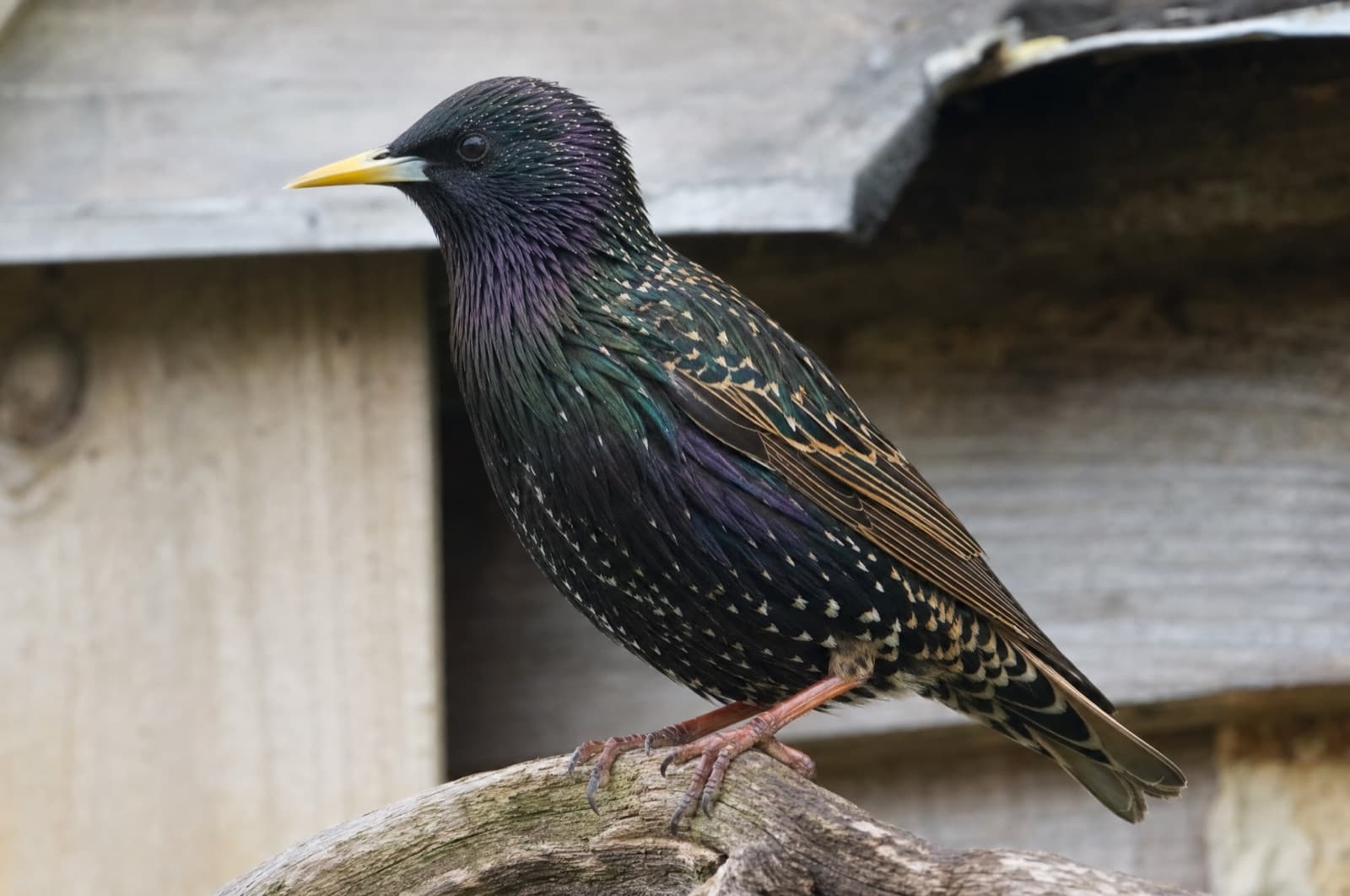
European Starling in New Hampshire — ID, Signs & Control
Also called Common starling · Starling
The European starling is a non-native, federally unprotected bird that invades dryer vents, gable vents, and building cavities across New Hampshire. Accurate ID matters: native cavity nesters sharing the same habitat ARE protected under the MBTA. Exclusion and deterrents come first; accumulated droppings carry histoplasmosis and require PPE and wet-cleaning.
- Length
- 8–9 in
- wingspan 12–16 in; about 2–3 oz (Wildlife Illinois)
- MBTA status
- Not protected
- USFWS 2020 Federal Register — non-native introduced species exempt
- Introduced
- 1890
- ~60 birds released in Central Park by Eugene Schieffelin, American Acclimatization Society
- Broods per year
- 2–3
- 4–6 eggs per clutch; secondary cavity nester
- Disease risk
- Histoplasmosis
- from accumulated droppings; wet-clean with PPE — never dry-sweep
- Lookalike risk
- Juvenile starling vs. native birds
- Juveniles are plain gray-brown; confirm ID before touching any nest
The invasive cavity nester jamming your vents
The European starling (Sturnus vulgaris) is one of New Hampshire's most disruptive non-native birds — and one of the most misunderstood. Homeowners often assume that any dark bird nesting in a vent is protected by federal law. It is not: under the USFWS 2020 Federal Register ruling, the Migratory Bird Treaty Act does not apply to non-native, human-introduced species, and the starling is at the top of that list.
That legal clarity comes with a critical responsibility: native cavity-nesting birds — bluebirds, tree swallows, chickadees, and others — share the same habitat and ARE fully protected. Misidentifying a native nest and disturbing it is a federal violation. Accurate ID before any intervention is non-negotiable.
Starlings were introduced to North America deliberately. In March 1890, Eugene Schieffelin of the American Acclimatization Society released roughly 60 starlings in New York's Central Park, and another 40 or so in 1891. From that founding event, the species spread continent-wide. Today they displace native cavity nesters, jam building vents with nesting material, and leave accumulated droppings that carry histoplasmosis. Exclusion — sealing cavities and installing deterrents — is the right first move, not eviction of birds you haven't positively identified.
How to identify a European starling
Starlings shift dramatically with season and age — breeding adults are glossy iridescent purple-green; winter adults are speckled white; juveniles are plain gray-brown. The body silhouette (triangular pointed wings, short squared tail, pot-bellied shape) and the scurrying, ground-walking foraging style are consistent year-round.
European starling
- Scientific name
- Sturnus vulgaris
- Family
- Sturnidae
- Size
- 8–9 in length; wingspan 12–16 in; weight 2–3 oz
- Coloration
- Breeding adult: iridescent purple-green with yellow bill. Winter adult: same base plumage covered in white speckle tips. Juvenile: plain gray-brown, darker below.
- Habitat
- Building vents, barn eaves, utility cavities, tree cavities, nest boxes — any secondary cavity it can usurp.
- Active season
- Year-round; nesting March–July; winter flocking November–February
- Diet
- Omnivore — insects, earthworms, berries, seeds, and scraps; forages on lawns and open ground.
- Reproduction
- 2–3 broods per season; 4–6 eggs per clutch; both parents incubate ~12 days; young fledge at ~21 days.
- Lifespan
- Wild average 2–3 years; up to 15 years recorded
Common across all of New Hampshire year-round; range expanding; one of the most abundant birds in North America.
The tells — key ID features
- Triangular pointed wings and short squared tail — the classic starling silhouette in flight.
- Pot-bellied, short-tailed shape when perched; walks with a waddling strut on the ground.
- Iridescent purple-green gloss on breeding adults; white speckles in fall and winter.
- Yellow bill in breeding season; dark bill in winter.
- Loud, rambling, mimicking song — squeaks, whistles, rattles, and imitations of other birds.
- Juveniles are plain gray-brown and often confused with other species — check size and bill shape.
Size, to scale
8–9 inches
About the same length as a robin, but stockier and shorter-tailed
Common grackle
How to tell — Grackles are noticeably larger with a long, keel-shaped tail and bright yellow eye. Both are dark and iridescent, but the grackle's tail shape and larger size separate them. Grackles ARE protected under the MBTA.
Native blackbirds (red-winged, rusty, Brewer's)
How to tell — All native blackbirds are protected under the MBTA. Red-winged blackbirds have shoulder patches; Brewer's and rusty blackbirds have longer tails and different eye colors. When in doubt, do not disturb the nest.
Juvenile starling vs. native sparrows
How to tell — Juvenile starlings are much larger (8–9 in) and have a longer, straighter bill than any native sparrow (5–6 in). Native sparrows are protected; starlings are not. Size and bill shape are the fastest check.
Signs of a problem
Starlings are noisy and messy — the signs of an active infestation show up in multiple places at once.
Nesting material (grass, feathers, trash) packed into dryer or bathroom exhaust vents
What it means — Active or recent starling nest in the vent — a fire and blockage hazard that needs immediate attention.
Heavy white dropping accumulations on ledges, under rooflines, or on vehicles below a roost
What it means — Active roosting or nesting site above; droppings carry histoplasmosis and are corrosive — use PPE for cleanup.
Large, noisy, swirling flocks on utility lines or building rooflines — especially in fall and winter
What it means — Starling roost forming; numbers can reach hundreds to thousands.
Native birds (bluebirds, swallows, chickadees) abandoning nest boxes they previously used
What it means — Starlings may be actively evicting them — a sign of territorial takeover in progress.
Loud, rambling, squeaky song mixed with mimicry of other birds from inside or near a vent
What it means — Breeding pair in residence; nesting likely underway.
Scratching, rustling, or chirping from inside a wall cavity or vent opening
What it means — Nesting inside the building envelope; young may be present.
The real risks, calibrated
The primary risks from European starlings are health-related (droppings) and structural (vent blockage, native bird displacement). The bird itself is not aggressive toward people.
Histoplasmosis from accumulated droppings
HighOnset: Risk increases with accumulation volume
Histoplasma capsulatum fungus grows in bird and bat droppings. Disturbance — especially dry-sweeping — releases spores that can cause lung infection. Large accumulations should be wet-cleaned with respirator (N95+) and gloves, or remediated professionally.
Cryptococcosis (secondary risk)
ModerateOnset: Less common than histoplasmosis
Cryptococcus neoformans can also be associated with bird droppings and is a concern for immunocompromised individuals. Same PPE and wet-cleaning precautions apply.
Ectoparasites and bird mites entering the home
ModerateOnset: After birds leave or are excluded from a roost
Bird mites that fed on nesting starlings will seek a new host when the birds depart. They can infest living spaces and bite humans. See the bird mite page for identification and control.
Vent blockage and fire risk
ModerateOnset: Within weeks of nesting start
Nesting material jammed into dryer, bathroom, or stove vents blocks exhaust airflow. A clogged dryer vent is a leading residential fire hazard. Carbon monoxide risk applies to stove and furnace exhausts.
Displacement of native cavity nesters
ModerateOnset: During nesting season
Starlings aggressively usurp nest boxes and tree cavities from bluebirds, tree swallows, and chickadees — sometimes killing the occupants. Native species loss has documented ecological consequences for insect control and pollination.
DIY — what works, what backfires
Exclusion and deterrents are the correct first step — not removal. The legal line between starlings (unprotected) and native birds (protected) means you must confirm species before touching any nest. Start by denying access.
What actually works
- Install vent covers with mesh (1/4-inch hardware cloth or commercial vent guards) over all exhaust vents — dryer, bathroom, stove, gable — before nesting season begins (February in NH).
- Use ledge spikes, wire coils, or sloped covers on building ledges and rafters where starlings roost.
- Confirm the cavity is empty and the species is a starling before sealing any opening.
- Wet-clean droppings with water and a disinfectant solution; wear an N95 or P100 respirator and gloves. Never dry-sweep accumulated droppings.
- Protect native bird nest boxes with starling-resistant hole sizes (1.5 in diameter admits bluebirds; excludes starlings at 1.5 in only marginally — use 1-9/16 in for bluebird boxes).
- Remove starling nesting material from cavities after confirming vacancy — this discourages re-nesting.
What backfires
- Don't dry-sweep or vacuum heavy dropping accumulations without PPE — the aerosol risk for histoplasmosis is real.
- Don't assume federal bird protections do not apply just because the bird is dark-colored — native blackbirds and grackles are protected. Confirm the species is a starling before any nest intervention.
- Don't remove or disturb any nest without first confirming it is not a protected native species — this is a federal violation under the MBTA.
- Don't rely on visual deterrents (reflective tape, plastic owls) alone — starlings habituate to them quickly.
- Don't use poisons — they are not approved for this use, can kill non-target species including raptors via secondary poisoning, and are not a durable solution.
European starlings in New Hampshire homes and buildings
Starlings are year-round New Hampshire residents. They nest in dryer vents, bathroom exhaust vents, gable vents, barn eaves, and utility cavities across Manchester, Nashua, Concord, Derry, Bedford, and Salem. In winter, large flocks roost on commercial buildings, under bridges, and along ledges — leaving heavy dropping accumulations that require professional cleanup. Vent-nesting complaints peak in spring (March–May) during the first brood. Because NH also hosts native cavity nesters competing for the same sites — tree swallows and bluebirds especially — positive ID before any nest removal is required.
Peak season
Year-round resident; nesting complaints peak March–June; winter roost complaints November–February
You might actually have
- House sparrow (also unprotected — usurps the same vents and nest boxes)
- Native tree swallows (protected — same vent and box habitat)
- Native bluebirds (protected — often evicted by starlings from nest boxes)
We serve these communities
- NH-licensed applicator · #782664
- Same-day service
- Family-owned since 2017
Service Area Map
Southern New Hampshire
When to call a pro for European starling control
When starlings have established a roost in a building's vent system, on commercial ledges, or in hard-to-reach structural cavities — or when a dropping accumulation is large enough to require hazmat-level cleanup — professional exclusion and remediation is the right call. A licensed technician can confirm species ID, safely remove nesting material, and install lasting physical exclusion.
When to call a pro
- Starlings have nested inside a dryer, stove, or bathroom vent and you cannot safely clear and seal it yourself.
- Dropping accumulations are heavy (more than a light coating) — professional wet-remediation with appropriate PPE is warranted.
- Large roosts on commercial buildings or multi-unit properties where ledge deterrents need to be installed at height.
- You are unsure whether the nesting birds are starlings or a protected native species.
- Bird mites have entered the living space after a starling roost was vacated — the infestation needs to be treated alongside the exclusion.
Cap vents before February
Starlings scout nest sites in late winter. Install 1/4-inch hardware cloth or commercial vent guards on all exhaust vents before nesting begins.
Install ledge deterrents proactively
Ledge spikes, wire systems, and sloped covers prevent roosting before it starts. Deterrents installed post-roost are less effective because birds are already habituated to the site.
Use starling-resistant nest boxes for native birds
Hole size is the primary exclusion tool for nest boxes. Proper diameter selection protects native cavity nesters while excluding starlings.
Inspect and clear vent covers annually
NH's freeze-thaw cycle can shift or damage mesh covers. Check every fall and re-secure before starling nesting season.
Not sure it's a european starling?
A licensed NH technician can confirm the species and tell you honestly whether it's a DIY fix or a job for a pro — free inspection, same-day service across Southern New Hampshire.
Frequently asked questions
Sources(6)
- [1]
- [2]USFWS Federal Register 2020 — MBTA Applicability
non-native species MBTA exemption
govverified 2026-06-30 - [3]Cornell Lab — All About Birds MBTA Explainer
MBTA protections and exemptions
academicverified 2026-06-30 - [4]PAWS — Pigeons, Starlings & Sparrows
nesting behavior, secondary cavity nesting, displacement of native birds
industryverified 2026-06-30 - [5]Maine DACF — Starling and House Sparrow Fact Sheet
nesting biology, broods, native bird displacement
govverified 2026-06-30 - [6]CDC NIOSH — Histoplasmosis and the Environment
histoplasmosis risk from bird droppings, PPE guidance
govverified 2026-06-30
Written & reviewed by
VerifiedDaniel Brady
NH-Licensed Pesticide Applicator · License #782664 (NHDAMF, RSA 430)
Daniel Brady is the New Hampshire–licensed applicator behind Anchor Pest Services, a family-owned pest control company serving the Manchester area since 2017.
Last updated 2026-06-30

New Hampshire pest control
Dealing with european starlings in your home?
Anchor Pest Services identifies and handles european starling problems across southern and central New Hampshire. Family-owned since 2017, NH license #782664.
- NH-licensed applicators (#782664)
- Same-day service · free inspection
- Family-owned since 2017
Your next step
- What to do next
How to Get Rid of European Starlings
Read the answer - What to do next
When Do Birds Nest? NH Timing & Legal Guide
Read the answer - What to do next
Bird & Bat Prevention: Legal, Humane Exclusion in NH
Read the answer - Also relevant
Can starlings or pigeons clog vents or drains?
Read the answer - Also relevant
Do birds nesting in vents cause problems?
Read the answer