
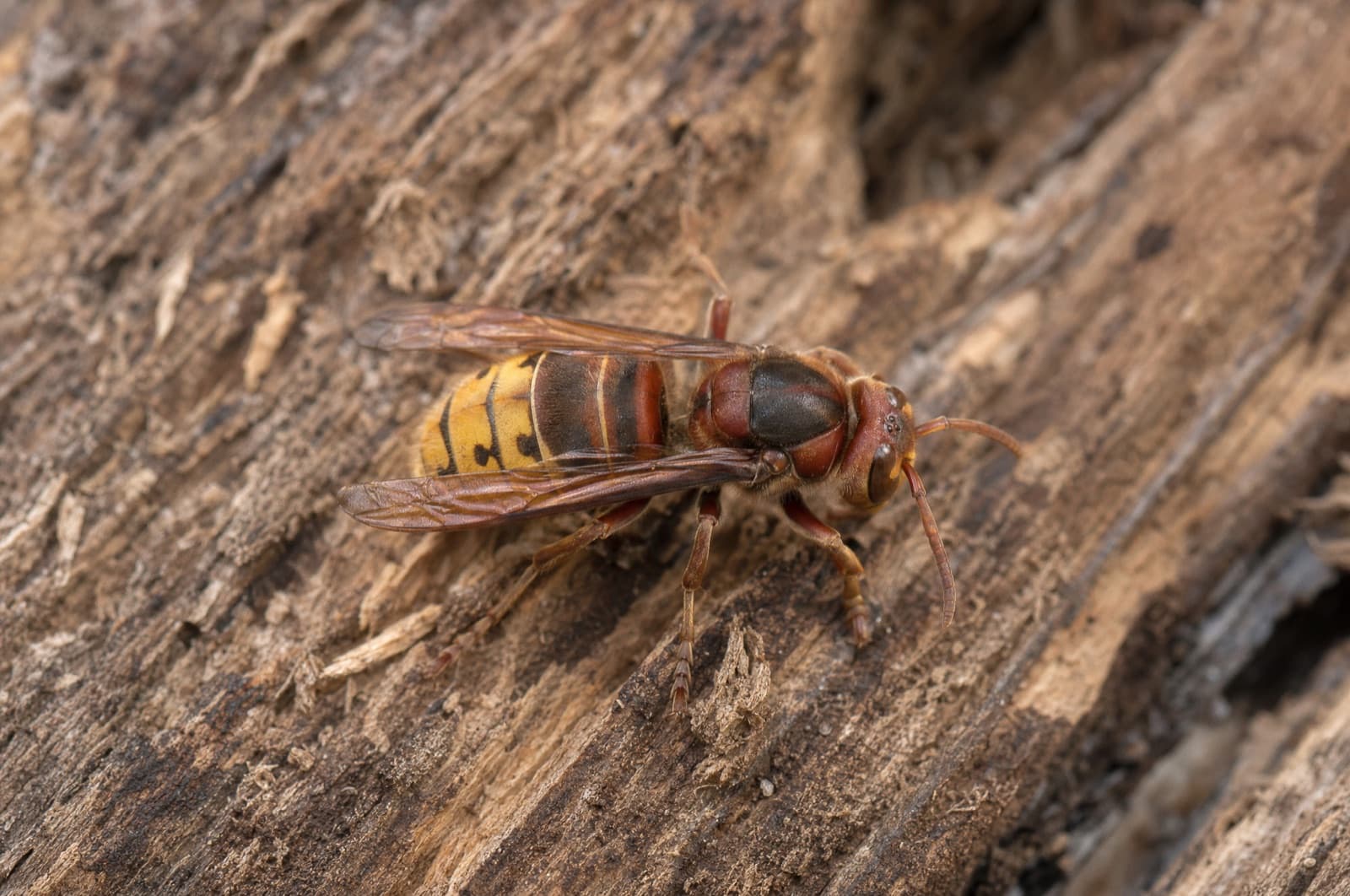
European Hornet — Quick ID for New Hampshire Homeowners
Also called Giant hornet · Brown hornet
The European hornet is the only true hornet found in New Hampshire — a large brown-and-yellow insect with a reddish thorax that flies after dark and is often spotted bumping porch lights and windows. The 'murder hornet' (Asian giant hornet) is not established in the Northeast. This is the fast identifier; for the full wasp-vs-hornet comparison and removal, see the complete guide.
- Size
- 25–35 mm
- NH's largest colonial stinging insect; Vespa crabro
- Color
- Brown and yellow
- reddish-brown thorax; NOT the crisp black-and-yellow of yellowjackets
- Behavior
- Nocturnal
- active at night; attracted to lights
- NH status
- Only true hornet in NH
- Asian giant hornet not established in Northeast
Is it a European hornet?
The European hornet is New Hampshire's only true hornet and the largest colonial stinging insect in the state. It stands out by flying at night and striking lit windows — a behavior no other common NH wasp exhibits regularly.
This page is a fast identifier. For nest type, removal options, and the wasp-vs-hornet comparison, see the complete guide linked above.
Quick European hornet ID
Brown coloring and nighttime activity immediately distinguish the European hornet from every other stinging insect in New Hampshire.
European hornet
- Scientific name
- Vespa crabro
- Family
- Vespidae
- Size
- 25–35 mm
- Coloration
- Reddish-brown thorax, yellow abdomen with brown teardrop markings — duller and browner than a yellowjacket
- Habitat
- Hollow trees, wall voids, attics, barns, and dense wooded settings near homes; nests in cavities rather than aerially or in the ground
- Active season
- Late spring through first hard frost; uniquely active at night
- Diet
- Large insects (beetles, crickets, flies); also tree bark sap; larvae fed protein, adults also drink nectar
- Lifespan
- Colony lives one season; only fertilized queens overwinter in protected spots
Established across eastern North America including New Hampshire; less common than yellowjackets but encountered statewide, especially near mature wooded areas.
The tells — key ID features
- Large and brown-toned — reddish-brown thorax distinguishes it from the crisp black-and-yellow of yellowjackets.
- Nocturnal activity: flies after dark and thuds against lit windows and porch lights — no other NH stinger does this regularly.
- Cavity nester: builds a papery brown nest deep inside a hollow tree, wall void, or attic space.
- The only true hornet (genus Vespa) in New Hampshire; the Asian giant hornet ('murder hornet') is not found in the Northeast.
Cicada killer wasp
How to tell — Cicada killers are slightly larger, more rusty-amber, are day-active ground-burrowers, and are solitary — not colonial cavity nesters.
Yellowjacket
How to tell — Yellowjackets are much smaller (10–16 mm), crisp black-and-yellow (not brown), and day-active; they also build concealed nests in voids or the ground.
Signs of a problem
Nighttime activity is the key tell.
Large hornets repeatedly bumping lit windows, porch lights, or interior lights after dark
What it means — European hornets — the only common NH stinger that forages at night.
A brown papery nest found deep inside a hollow tree, wall void, or attic cavity
What it means — European hornet colony — cavity-nesting, not an aerial open or ground nest.
European hornet removal in New Hampshire
European hornet nests inside wall voids, attics, or trees near the home are best handled professionally. Night activity and cavity nesting make DIY treatment difficult and potentially dangerous. The full guide covers nest types, treatment timing, and the wasp-vs-hornet comparison.
When to call a pro
- A nest is suspected in a wall void, attic, or tree on or near the home.
- Repeated nighttime bumping of windows or interior lights suggests an active nearby colony.
- ID is uncertain — confirm it's a European hornet rather than a cicada killer or bald-faced hornet before any treatment.
Not sure it's a european hornet?
A licensed NH technician can confirm the species and tell you honestly whether it's a DIY fix or a job for a pro — free inspection, same-day service across Southern New Hampshire.
Frequently asked questions
Sources(3)
- [1]Penn State Extension — European Hornet
biology, nocturnal behavior, NH presence
extensionverified 2026-06-30 - [2]
- [3]
Written & reviewed by
VerifiedDaniel Brady
NH-Licensed Pesticide Applicator · License #782664 (NHDAMF, RSA 430)
Daniel Brady is the New Hampshire–licensed applicator behind Anchor Pest Services, a family-owned pest control company serving the Manchester area since 2017.
Last updated 2026-06-30

New Hampshire pest control
Dealing with european hornets in your home?
Anchor Pest Services identifies and handles european hornet problems across southern and central New Hampshire. Family-owned since 2017, NH license #782664.
- NH-licensed applicators (#782664)
- Same-day service · free inspection
- Family-owned since 2017
Your next step
- Book a NH pro
Wasp Nest Removal in New Hampshire
Late-season nests are at their largest and most defensive. Safe, professional removal.
Book now - Next step
Do hornets damage homes or just sting?
Read the answer - What to do next
How to Get Rid of European Hornets
Read the answer - Full species guide
Wasp vs Hornet — How to Tell Them Apart (New Hampshire Guide)
Read the answer - Also relevant
Wasp vs Hornet — How to Tell Them Apart (New Hampshire Guide)
Read the answer - Also relevant
Is It Dangerous to Remove a Hornet Nest Without Professional Help?
Read the answer