
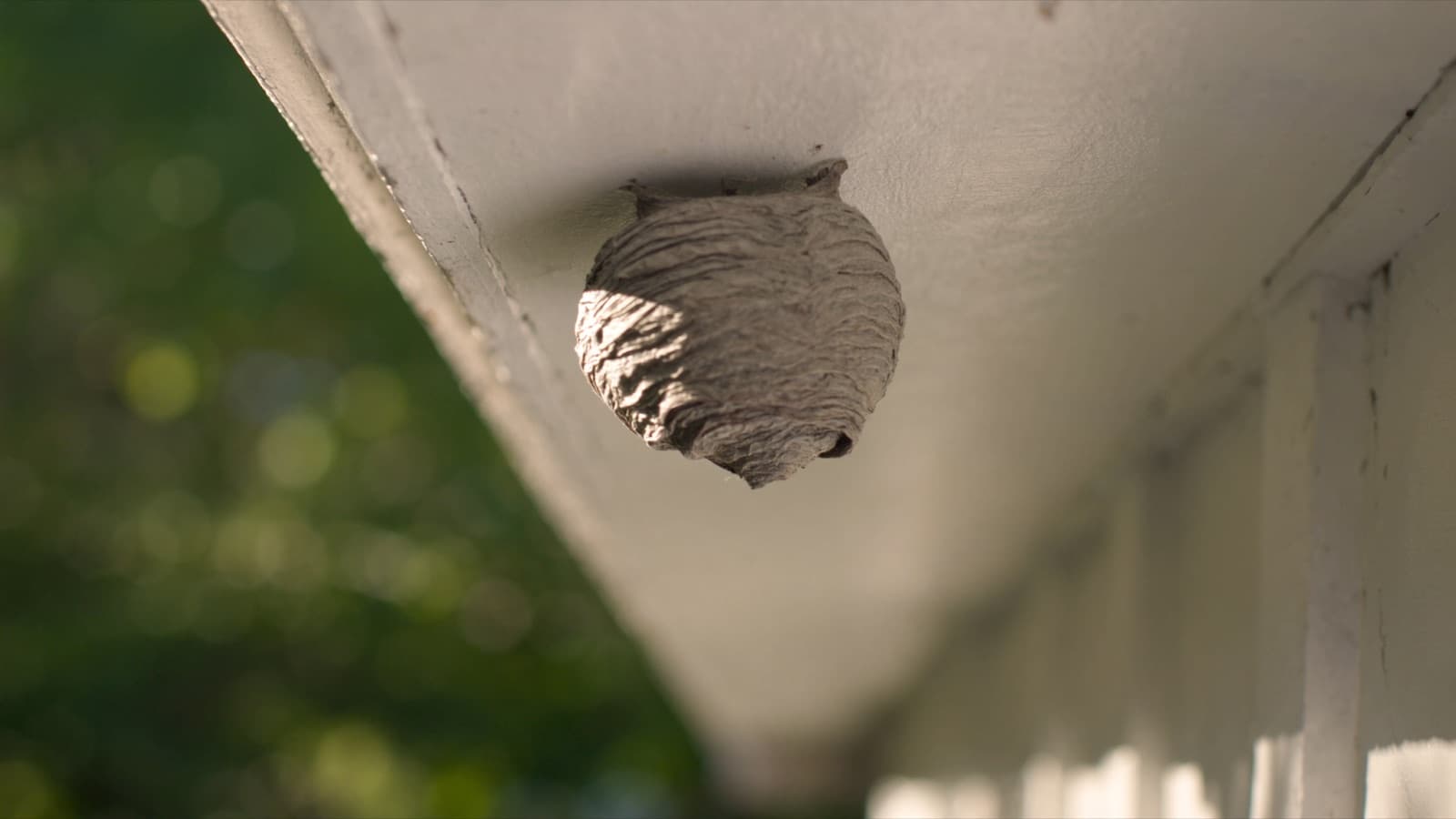
Is It Dangerous to Remove a Hornet Nest Without Professional Help?
At a Glance
- The call: Yes, genuinely. Bald-faced and European hornet colonies are large, socially defended, and often hard to fully reach — the entomological case for a pro is real, not marketing.
- Your nest: Bald-faced hornet
Should you do this? It depends entirely on which nest
The generic question has no generic answer. Your nest is one row below — the others are the argument that this page isn't just selling you a “no.”
One question, six honest answers — one per nest.
- Mud dauber (solitary)
Solitary — no colony to defend, essentially no swarm response. Not on the router's danger end at all.
Go - Paper wasp — small, exposed, early-season nest
Low-to-moderate risk before workers hatch and while the nest is reachable — gear and timing genuinely earn their keep here.
Go with gear - Yellowjacket (aerial, ground, or unknown)
Large, coordinated colony defense; ground nests add vibration triggers and concealment.
No-go - Bald-faced hornetYour nest
Large aerial colony, aggressive when disturbed, often high off the ground.
No-go - European hornet
Concealed cavity nests plus nighttime activity defeat the usual safe-timing rule other species allow.
No-go - Any species, in October
By the time a sustained hard freeze has come through, the colony is already finished and the nest will never be reused.
Do nothing
“Is it safe to remove a wasp nest?” has no answer. “Is it safe to remove THIS nest?” has six.
Derived from: /top-diy-methods per-species verdicts (mud-dauber diy_friendly, paper-wasp doable_with_care, yellowjacket / bald-faced-hornet / European hornet pro_recommended) + /winter-pests-shift/wasps (colony dies at a sustained hard freeze; the nest is never reused).
Why you should doubt us on this
We make money when you call us — so here is a test that doesn't depend on trusting our word.
We make money whenever the answer to a nest-removal question is 'call a professional,' and this page's honest answer is close to that — worth being skeptical of on its own.
If it's a mud dauber, we say do it yourself, no gear required, on our own DIY page — that's not a hornet, but it shows this hub doesn't default to 'call us' for everything. A small, exposed, early-season paper wasp nest is also a genuine DIY case with basic gear.
See the proof on Mud DauberHornets are a different animal from either exception. Bald-faced hornet colonies can reach several hundred workers in an aerial nest that's often high off the ground, adding a fall risk to the sting risk. European hornets nest in concealed cavities and stay active after dark, which removes the safe-timing window that helps make other species more approachable.
The full picture
Bald-faced hornets: scale and height
Bald-faced hornet colonies can grow to roughly several hundred workers in a single aerial, football-shaped nest, and that nest is often built well above head height — in trees, under eaves, or on structures that require a ladder to reach. That combination stacks a fall risk on top of a genuine sting risk from a colony capable of a coordinated, aggressive defense once disturbed.
European hornets: concealment and timing
European hornet nests are typically built in hollow trees, wall voids, or other enclosed cavities rather than out in the open, which makes them harder to locate, assess, and fully treat. They also remain active later into the evening than most other social wasps, which defeats the after-dark timing advantage that helps make some other species' nests more approachable for careful DIY work.
Why the honest answer here isn't gear or timing
The usual tools that make some nests more manageable — protective gear, standing distance, working after dark — genuinely help, but they don't neutralize the underlying issue with either hornet species: colony scale, concealment, or a timing window that doesn't exist the way it does elsewhere. That's the entomological basis for treating hornet nests as a professional job, consistent with /top-diy-methods' own published verdict.
The honest line — Yes, genuinely. Bald-faced and European hornet colonies are large, socially defended, and often hard to fully reach — the entomological case for a pro is real, not marketing.
Key takeaways
- Bald-faced hornet colonies can reach several hundred workers in an aerial nest often high off the ground.
- European hornet nests are typically concealed in cavities and stay active later into the evening than most social wasps.
- Both defeat the tools (height access, safe timing) that make some other nests more DIY-manageable.
- This matches /top-diy-methods' pro_recommended verdict for both species.
Where to go next
Identification, sting treatment, per-species DIY viability, and nest-reuse facts each live on the hub that owns them. We route, we don't rebuild.
DIY viability by species
The router's source of truth — which nests are DIY-able.
Go thereIdentify the species
Tell the wasps, hornets, and lookalikes apart.
Go thereSting & allergy treatment
What to do about a sting or a reaction.
Go thereNest reuse & winter
The colony dies at frost; the nest is never reused.
Go there
Found a large aerial or concealed nest?
If it might be a bald-faced or European hornet, a licensed technician can confirm it and handle the removal safely.
Frequently asked questions
Sources(3)
- [1]Penn State Extension — Getting Rid of Paper Wasps, Yellowjackets and Other Stinging Insectsextensionverified 2026-07-17
- [2]UNH Cooperative Extension — Bees, Wasps and Hornetsextensionverified 2026-07-17
- [3]Purdue Extension — Stinging Insects (E-253)extensionverified 2026-07-17
Written & reviewed by
VerifiedDaniel Brady
NH-Licensed Pesticide Applicator · License #782664 (NHDAMF, RSA 430)
Daniel Brady is the New Hampshire–licensed applicator behind Anchor Pest Services, a family-owned pest control company serving the Manchester area since 2017.
Last updated 2026-07-17
Before you touch it
Hornets are one of the clear no-go categories
Let a licensed technician confirm the species and take it from there.
- Family-owned since 2017
- NH License #782664, category F1 (RSA 430, NHDAMF)
- Member, NEPMA
Your next step
- Next step
Can yellowjackets build nests inside walls?
Read the answer - What to do next
How to Get Rid of European Hornets
Read the answer - What to do next
How to Get Rid of Bald-Faced Hornets
Read the answer - Also relevant
Hornet Nest vs Wasp Nest — Telling Them Apart in New Hampshire
Read the answer - Also relevant
Wasp vs Hornet — How to Tell Them Apart (New Hampshire Guide)
Read the answer - Related guide
How Big Can Hornet Nests Get Before They Become a Serious Threat?
Read the answer