
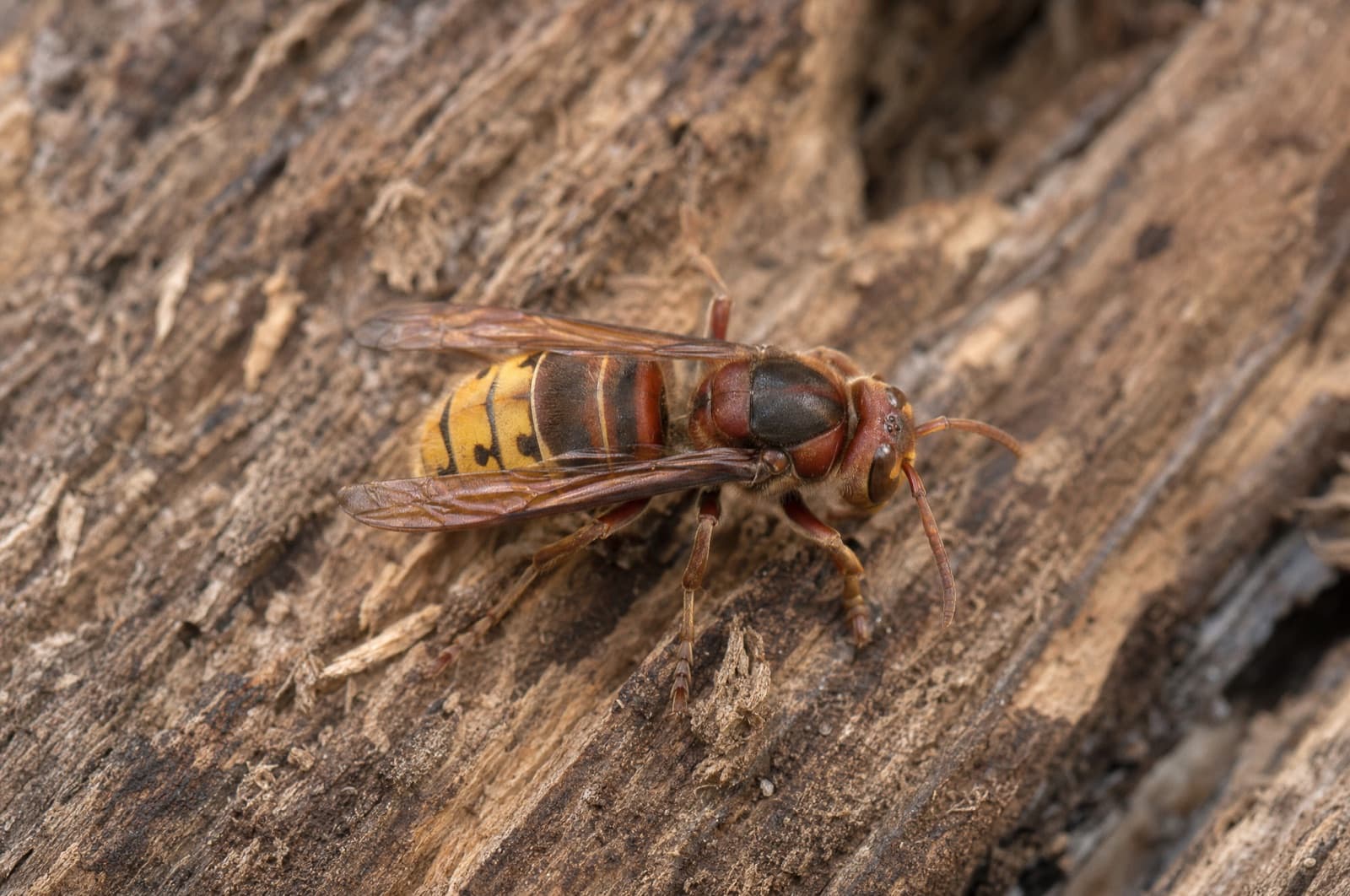
How to Get Rid of European Hornets
At a glance
- Difficulty: Pro only
- Time: N/A — handled by a pro
- Cost: N/A — free inspection from Anchor
- Success: Low as a DIY attempt given concealed nest sites; high with professional cavity-access equipment
Can you DIY Hornet (European Hornet)?
The verdict on Hornet (European Hornet) DIY
Pro-recommended — concealed cavity nests plus nighttime activity defeat safe DIY timing.
The European hornet (Vespa crabro) is the only true hornet established in the U.S., first reported in New York around 1840 and now spread across most of the eastern U.S. It nests in enclosed cavities — hollow trees, wall voids, attics — that are genuinely hard to locate and reach. It's also unusual among stinging insects in foraging at night and being drawn to porch lights after dark, which undermines the standard "treat at dusk when the colony is inactive" safe-timing rule other species allow. That combination of concealment and nocturnal activity is why this species is a pro job rather than a homeowner one.
The 5 DIY methods — honestly graded
Every approach graded for this species, in IPM order — prevention first, chemistry late. Pick a method to see how it works, the steps, and what it actually takes.
Prevention / Exclusion
ModerateSealing potential cavity entry points BEFORE nesting season helps prevent a new colony; reduce attractant lighting to cut nighttime activity near the house.
European hornets look for existing cavities — hollow trees, wall gaps, attic vents — to start a nest. Closing those openings before spring nesting season, and dimming the porch lights that draw foraging hornets after dark, reduces the odds of a colony settling in.
Best for: Reducing the odds of a new cavity nest and cutting nighttime nuisance activity
Seal cavity entry points early
In late winter or early spring, before nesting begins, seal gaps in siding, soffits, and attic vents that could serve as a cavity nest entrance.
CautionNever seal an opening you suspect already has activity — trapped hornets will chew their way inward instead of just dying off.Reduce night lighting
Switch exterior lighting near doors and windows to yellow "bug" bulbs or motion-activated fixtures, since European hornets forage at night and are drawn to light.
Tools & materials
Why DIY falls short here
Not scare tactics — the specific, proportionate reasons a home attempt can stall for this species.
Concealed nest sites
Wall-void and tree-cavity nests are hard to locate and reach — a partial DIY treatment attempt often just leaves an active colony behind.
Nighttime activity defeats standard timing
The usual dusk/dawn 'colony is inactive' timing rule other stinging insects allow doesn't hold for a species that forages into the night, raising the odds of an unplanned encounter.
Sealing hazard
Sealing a suspected active cavity entrance traps hornets inside, and they can chew their way through drywall into living space rather than simply dying off.
How risky is it, really?
An honest read — most nuisance species are genuinely low risk, and we say so.
For a non-allergic person, a European hornet sting is painful but not medically significant on its own — this species is somewhat less aggressive away from the nest than a bald-faced hornet. The genuine elevated risk is for anyone with a known stinging-insect allergy, and the concealed nest location adds a practical risk of an unexpected encounter during yard work or home maintenance.
- Painful sting, possibly multiple, if the nest is disturbedOccasional
Not typically medically significant for non-allergic individuals, per extension entomology sources
NC State Extension / Ohio State Extension
- Unexpected encounter with a concealed cavity nestOccasional
During yard work, tree trimming, or home renovation — the nest location itself is the practical hazard
NC State Extension
- Anaphylaxis in individuals with a known stinging-insect allergyRare
Genuinely elevated for the allergic subset specifically — carry a prescribed epinephrine auto-injector and call 911 for signs of a systemic reaction
CDC MMWR (mm7227a6) / ACAAI
Concealed Nests Call for a Pro
A European hornet nest hidden in a wall void or tree cavity, active into the night, isn't a project you can safely finish yourself. Anchor Pest Services locates and treats these nests across southern and central New Hampshire. Family-owned since 2017, NH license #782664.
Call a pro when…
- Any suspected active nest in a wall void, attic, or tree cavity — this species is pro-recommended at baseline
- Hornets foraging near porch lights or windows after dark in numbers
- A nest near an entry, walkway, or play area (added urgency)
- Anyone in the household has a known stinging-insect allergy (added urgency)
General Pest Control
Concealed cavity nests and nighttime activity make this species a professional job at baseline. Anchor's licensed technicians locate and treat European hornet colonies in wall voids, attics, and tree cavities safely.
Keep them out
- Seal likely cavity entry points (siding gaps, attic vents) before spring nesting season
- Switch exterior lighting near doors and windows to yellow bug-light bulbs
- Never seal an opening you suspect already has activity
European hornets in New Hampshire
European hornet colonies in New Hampshire build through spring and summer and, unusually for a stinging insect, stay active foraging into the evening and night, often around porch lights and windows. Like other social wasps here, colonies die off — except for new queens — around the first hard frost, roughly October 19–29 in Manchester (NOAA). Reducing exterior night lighting through the active season cuts down on nuisance activity near entries.
Peak season
Summer through early fall, with nighttime foraging activity
First-frost anchor
Manchester first hard frost ~Oct 19 (50%) / Oct 29 (80%), NOAA 1991–2020
Make sure it's a Hornet (European Hornet)
Two quick detours worth taking — confirm the ID, then learn what drew it in so it doesn't come back.
Frequently asked
Sources & further reading(5)
- [1]NC State Extension — European Hornets
Species history, cavity nesting, aggression relative to other species
extensionverified 2026-07-13 - [2]Ohio State University Extension (ENT-0102) — European Hornet
Nest biology, sting significance
extensionverified 2026-07-13 - [3]Bug of the Week — European Hornet Winter Survival
Colony annual cycle, nocturnal foraging
academicverified 2026-07-13 - [4]UNH Cooperative Extension — Stinging Insects (Resource000532/Rep554)
NH-specific stinging-insect guidance
extensionverified 2026-07-13 - [5]CDC MMWR — Deaths from Hornet, Wasp, and Bee Stings (mm7227a6)
National sting-fatality data
govverified 2026-07-13
Written & reviewed by
VerifiedDaniel Brady
NH-Licensed Pesticide Applicator · License #782664 (NHDAMF, RSA 430)
Daniel Brady is the New Hampshire–licensed applicator behind Anchor Pest Services, a family-owned pest control company serving the Manchester area since 2017.
Last updated July 2026
Other species you can tackle
Same category — the dot shows each one's DIY verdict at a glance (green = friendly, amber = doable with care, red = call a pro).
Professional Pest Control
Concealed Nests Call for a Pro
A European hornet nest hidden in a wall void or tree cavity, active into the night, isn't a project you can safely finish yourself. Anchor Pest Services locates and treats these nests across southern and central New Hampshire. Family-owned since 2017, NH license #782664.
- Licensed NH applicators (#782664)
- Cavity and wall-void nest access equipment
- Free inspection — same-day service across southern NH
NH License #782664 · No obligation · We answer in person
Your next step
- What to do next
European Hornet — Quick ID for New Hampshire Homeowners
Read the answer - What to do next
Is It Dangerous to Remove a Hornet Nest Without Professional Help?
Read the answer - What to do next
Wasp vs Hornet — How to Tell Them Apart (New Hampshire Guide)
Read the answer - Also relevant
What Attracts European Hornets to Your House?
Read the answer