
Lone Star Tick in NH: Range-Expanding & Alpha-Gal
The lone star tick (Amblyomma americanum) is range-expanding northward into New Hampshire. UNH Extension (May 2026) considers it established in only one NH county — Merrimack — not statewide like the American dog tick. It does NOT transmit Lyme disease but is associated with alpha-gal syndrome (a delayed red-meat allergy), ehrlichiosis, and STARI. The honest NH verdict: watch and report, not yet a common backyard tick.
- NH status
- Range-expanding; established Merrimack County only
- UNH Extension, May 2026; extension.unh.edu/blog/2026/05/tick-talk
- ID tell
- Female's single white 'lone star' dot
- cdc.gov/ticks/about/where-ticks-live.html
- Confirmed in NH
- Since 2020 (CDC)
- Tick Free NH / NHDAMF; tickfreenh.org/identify/
- Signature risk
- Alpha-gal syndrome (delayed red-meat allergy)
- cdc.gov; nejm.org/doi/full/10.1056/NEJMp1911661
- Lyme?
- No — does NOT spread Lyme disease
- cdc.gov
The range-expanding tick with a white dot — and an honest NH verdict
The lone star tick (Amblyomma americanum) is moving northward into New Hampshire — but its status here is precisely bounded. CDC confirmed its presence in NH in 2020, and the tick is "moving north and westward" (Tick Free NH / NHDAMF). However, UNH Extension (May 2026) is explicit: "It is here. It's only considered established in one county, in Merrimack County." Some NH specimens may have hitchhiked from farther south rather than overwintering here. It is not as established as the American dog tick.
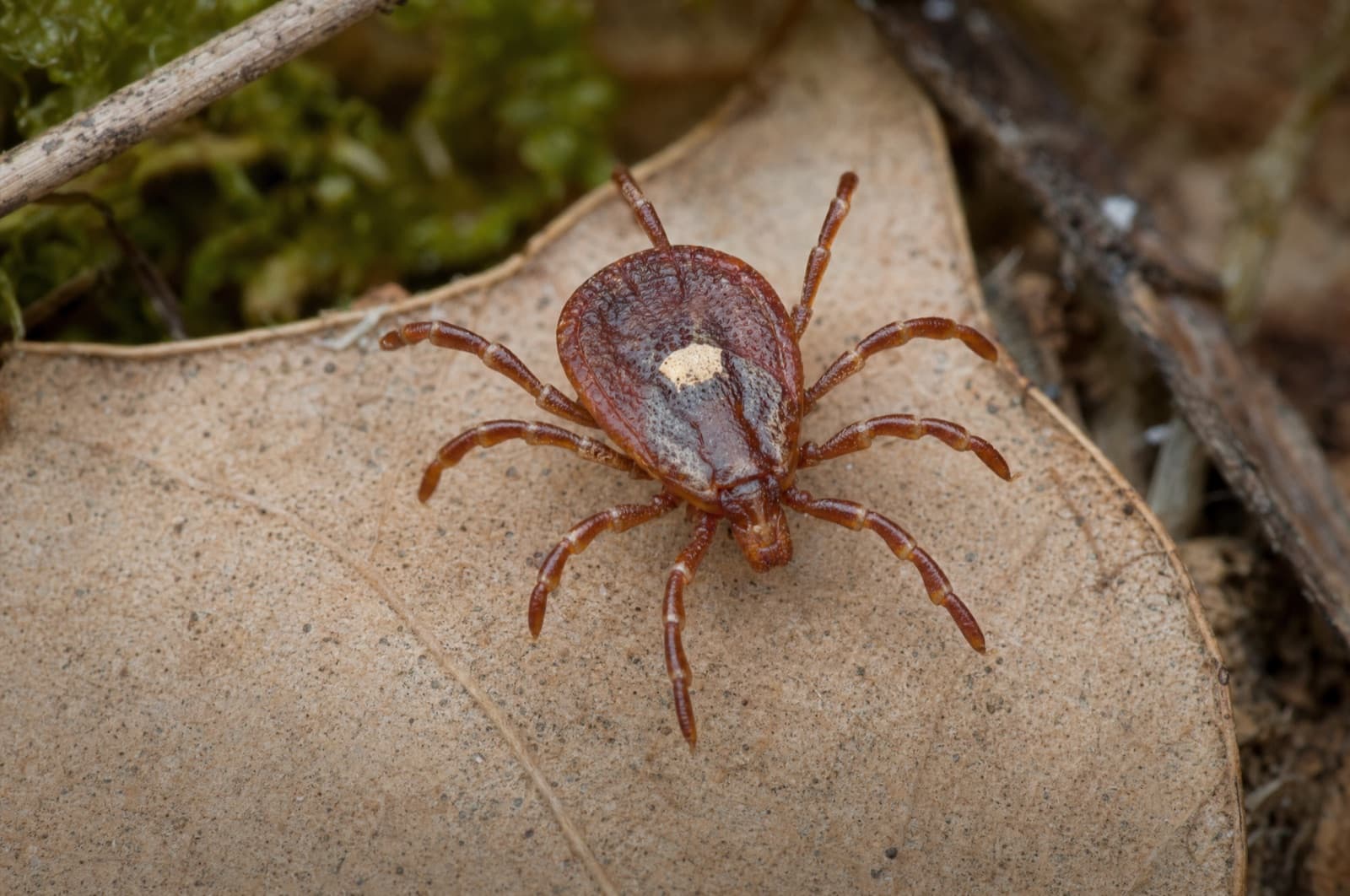
The female's single white "lone star" dot in the center of her back is the definitive ID feature. Unlike the American dog tick — which waits on vegetation — the lone star tick is an aggressive, fast, active hunter that moves toward hosts. It carries distinct risks: alpha-gal syndrome (a delayed red-meat allergy), ehrlichiosis, and STARI — but does NOT transmit Lyme disease. If you find a lone star tick in NH, consider submitting it to Tick Free NH (NHDAMF) to support state surveillance.
How to identify a lone star tick
The female lone star tick's single white dot in the center of her back is the definitive identification feature — no other common NH tick has this. The tick is also behaviorally distinctive: it is an aggressive, fast, active hunter that moves toward hosts rather than waiting on vegetation. Longer mouthparts distinguish it from the American dog tick under magnification.
Lone star tick
- Scientific name
- Amblyomma americanum
- Family
- Ixodidae
- Size
- Adult ~4–6 mm unfed
- Coloration
- Reddish-brown; female has a single white dot in the center of the back
- Habitat
- Woodland understory, fields, brushy areas, and even mowed lawns — a habitat generalist
- Active season
- Spring through late summer
- Diet
- Blood — deer are a major host; also feeds on dogs, humans, and other mammals
- Reproduction
- Female lays thousands of eggs after a blood meal
- Lifespan
- Multi-stage; up to ~2–3 years
Established further south; range-expanding northward; established in Merrimack County, NH only (UNH Extension May 2026)
The tells — key ID features
- Female's single white 'lone star' dot in the center of the back — the definitive ID feature
- Aggressive, fast, active hunter — moves toward hosts rather than waiting on vegetation (unlike the American dog tick)
- Longer mouthparts (hypostome) than the American dog tick
- Habitat generalist — found in forest, field, and even mowed lawns; hard to avoid by habitat type alone
Size, to scale
Unfed adult ~4–6 mm
A sesame seed; near-invisible larvae ('seed ticks') can attach in clusters
American dog tick
How to tell — The American dog tick has ornate white/silver all-over marbling on its back — not a single dot. It is established statewide; the lone star tick is established in only one NH county.
Blacklegged tick (deer tick)
How to tell — The deer tick is smaller with dark legs — the Lyme disease vector. Full depth at /ticks-fleas-faq/.
Brown dog tick
How to tell — The brown dog tick is plain reddish-brown with no dot or marbling; uncommon in NH and mainly an indoor dog parasite.
Signs of a problem
Lone star tick signs differ from the American dog tick — the aggressive behavior and seed-tick bites are the distinctive tells.
A fast tick with a single white dot on the female's back that actively moves toward you rather than waiting on vegetation
What it means — Lone star tick — its aggressive host-seeking behavior is a behavioral signature distinct from the questing American dog tick.
Multiple simultaneous bites on the legs or body, including very small 'seed tick' bites
What it means — Possible lone star tick activity, including larvae (seed ticks) that bite in large numbers from one location.
Tick encounters in or near Merrimack County in woodland edges or brushy fields
What it means — The area of established NH presence per UNH Extension (May 2026); consider submitting confirmed finds to Tick Free NH / NHDAMF for surveillance.
Unexplained delayed allergic reaction to red meat hours after eating, following outdoor tick exposure
What it means — Possible alpha-gal syndrome triggered by a prior lone star tick bite — see a doctor promptly.
The real risks, calibrated
The lone star tick does not spread Lyme disease. Its distinct risks — especially the alpha-gal red-meat allergy — set it apart from other NH ticks.
Alpha-gal syndrome (red-meat allergy)
ModerateOnset: Delayed — typically hours after eating red meat, following prior tick-bite sensitization
A delayed allergic reaction to red meat (and sometimes other mammalian products) that can develop after lone star tick bites. Ranges from mild hives to severe reactions. See a doctor if you develop unexplained food-related allergic symptoms after tick exposure. No dosages here.
Ehrlichiosis
ModerateOnset: Flu-like symptoms typically 1–2 weeks after bite
Fever, headache, muscle aches; can be serious if untreated. See a doctor for any flu-like illness after a tick bite.
STARI (Southern tick-associated rash illness)
Low riskOnset: Days after bite — a bull's-eye-like rash may appear
A Lyme-like rash and symptoms; not caused by the same bacterium as Lyme and not associated with the same complications. See a doctor for any post-tick rash.
DIY — what works, what backfires
The lone star tick is an aggressive biter — correct removal and thorough tick checks are the key protective steps.
What actually works
- Use fine-tipped tweezers, grasp as close to the skin as possible, and pull upward with steady, even pressure — the standard CDC removal technique.
- After removal, clean the bite area with rubbing alcohol or soap and water.
- Save the tick in a sealed bag or container; consider submitting it to Tick Free NH (NHDAMF) for free identification and state surveillance.
- Perform thorough daily tick checks after outdoor activity in or near Merrimack County or woodland/brushy areas.
- Apply DEET to exposed skin and permethrin to clothing before outdoor activity in known tick habitat.
What backfires
- Do not twist, jerk, or use nail polish, petroleum jelly, or heat — these methods do not remove the tick safely and delay proper treatment.
- Do not ignore post-bite symptoms — fever, rash, or an unexplained allergic reaction after eating red meat should prompt a doctor visit.
- Do not assume lone star ticks are everywhere in NH — be accurately informed: established in Merrimack County only per current UNH Extension guidance.
- Do not confuse STARI (a lone star tick rash) with Lyme disease — see a doctor for diagnosis; do not self-treat.
Lone star tick in New Hampshire: an honest status
CDC-confirmed present in NH since 2020 and moving north and westward (Tick Free NH / NHDAMF). UNH Extension (May 2026 Tick Talk): 'It is here. It's only considered established in one county, in Merrimack County.' Some specimens may have hitchhiked from farther south rather than overwintering here. Not as established as the American dog tick, which is common statewide.
Peak season
Spring through late summer
You might actually have
- American dog tick — established statewide (the common NH tick)
- Blacklegged tick (deer tick) — Lyme vector; see /ticks-fleas-faq/
- Brown dog tick — uncommon; indoor breeder
We serve these communities
- NH-licensed applicator · #782664
- Same-day service
- Family-owned since 2017
Service Area Map
Southern New Hampshire
When to call a pro for lone star tick control
If you are seeing lone star ticks in or near Merrimack County, Anchor's Tick Control team can assess your property and apply targeted treatment. Submit any confirmed lone star tick finds to Tick Free NH / NHDAMF to support NH surveillance.
When to call a pro
- Aggressive, fast-moving ticks with a white dot are found on family members or pets in or near Merrimack County.
- Multiple simultaneous tick bites or seed-tick infestations after outdoor activity in the Concord/Hooksett/Loudon area.
- A confirmed lone star tick find on your property and you want perimeter treatment to reduce exposure risk.
Submit ticks to Tick Free NH for identification
Tick Free NH (NHDAMF) accepts tick submissions for free identification and surveillance. Submitting lone star ticks helps track the expansion across NH — an important public health contribution.
Thorough tick checks after outdoor time near Merrimack County
If you spend time outdoors in or near Merrimack County — woodland edges, brushy fields, or areas with deer activity — do a thorough full-body tick check afterward. The lone star tick actively pursues hosts rather than waiting, so it may not be in the typical 'questing' location.
Permethrin on clothing and DEET on skin
Treat clothing and gear with permethrin before outdoor activity in known tick habitat. Apply EPA-registered DEET repellent to exposed skin. Follow label directions for all repellents.
Keep grass mowed and brush cleared
While the lone star tick is a habitat generalist, reducing tall grass, brush, and leaf litter at the lawn edge lowers tick questing habitat and reduces overall exposure risk.
Not sure it's a lone star tick?
A licensed NH technician can confirm the species and tell you honestly whether it's a DIY fix or a job for a pro — free inspection, same-day service across Southern New Hampshire.
Frequently asked questions
Sources(7)
- [1]CDC — Where Ticks Live
lone star tick range; single white dot; disease vectors (ehrlichiosis, STARI); does not transmit Lyme
govverified 2026-06-30 - [2]NEJM — Alpha-Gal Allergy and the Lone Star Tick
alpha-gal syndrome; delayed red-meat allergy linked to lone star tick bites
medicalverified 2026-06-30 - [3]UNH Extension — Tick Talk (May 2026)
established in Merrimack County only; direct quote 'It is here. It's only considered established in one county'
extensionverified 2026-06-30 - [4]UNH Cooperative Extension — Biology and Management of Ticks in NH
rarely turns up in NH; hitchhiker caveat; Merrimack County establishment
extensionverified 2026-06-30 - [5]Tick Free NH / NHDAMF
CDC-confirmed in NH since 2020; moving north and westward; NH surveillance program
govverified 2026-06-30 - [6]
- [7]NH DHHS — Tickborne Diseases
NH tickborne disease context; ehrlichiosis and STARI in NH
govverified 2026-06-30
Written & reviewed by
VerifiedDaniel Brady
NH-Licensed Pesticide Applicator · License #782664 (NHDAMF, RSA 430)
Daniel Brady is the New Hampshire–licensed applicator behind Anchor Pest Services, a family-owned pest control company serving the Manchester area since 2017.
Last updated 2026-06-30

New Hampshire pest control
Dealing with lone star ticks in your home?
Anchor Pest Services identifies and handles lone star tick problems across southern and central New Hampshire. Family-owned since 2017, NH license #782664.
- NH-licensed applicators (#782664)
- Same-day service · free inspection
- Family-owned since 2017
Your next step
- Book a NH pro
Tick Control in New Hampshire
Adult deer ticks peak in fall. Yard tick control across Manchester and southern NH.
Book now - Next step
When Are Fleas Most Common in Homes?
Read the answer - What to do next
How to Get Rid of Lone Star Ticks
Read the answer - Also relevant
How Dangerous Are Tick Bites to Pets?
Read the answer - Related guide
American Dog Tick in NH: ID, Disease Risk & Removal
Read the answer - Related guide
Deer Tick — Quick ID for New Hampshire Homeowners
Read the answer