
Opossum in New Hampshire — ID, Signs & Honest Facts
Also called Common opossum · Possum
The Virginia opossum is North America's only marsupial and is now common across southern and central New Hampshire. Two viral claims are wrong: opossums are not immune to rabies (their lower body temperature reduces — not eliminates — risk), and a 2021 peer-reviewed study debunked the '5,500 ticks per week' figure as a caged-lab artifact. Opossums are mostly harmless nuisances, but denning under your structure and any bite or scratch warrants professional attention.
- Only marsupial
- North America's only marsupial
- Didelphis virginiana; carries young in a pouch
- Body temperature
- ~94–97°F
- Lower than most mammals, reducing but not eliminating rabies risk
- Weight
- 4–14 lb
- ~2–3 ft including naked prehensile tail
- Tick claim
- 5,500 ticks/week — DEBUNKED
- 2021 Hennessy & Hild study found zero tick parts in wild opossum stomach contents
- Rabies status
- Not immune — rare but documented
- Nebraska DHHS; rabid opossums on record
- Burrows
- Does not dig its own
- Reuses old groundhog burrows and other cavities
North America's only marsupial — and its most misunderstood
The Virginia opossum (Didelphis virginiana) is a creature wrapped in mythology. Two claims spread everywhere online — that opossums are immune to rabies, and that each one eats 5,500 ticks per week — have shaped how homeowners respond to them. Both claims are wrong, and the corrections matter.
On rabies: an opossum's body temperature (~94–97°F) is lower than most mammals, which makes it harder for the rabies virus to establish. But every mammal is susceptible to rabies, and rabid opossums have been documented. The risk is genuinely low — but 'low' is not 'zero,' and any bite or scratch still warrants a call to NH DHHS at (603) 271-4496.
On ticks: a widely circulated figure of ~5,500 ticks consumed per opossum per week traces back to a 2009 laboratory study in which opossums were caged with ticks. A 2021 peer-reviewed study by Hennessy and Hild (Eureka College) examined stomach contents of 32 wild opossums and found no tick parts at all. The lab number is now considered an artifact of caged conditions, not a real-world feeding behavior.
None of this makes opossums dangerous. They are slow-moving, nocturnal scavengers that bluff and play dead rather than fight. The practical concerns are denning under structures, raiding pet food and trash, and the small but real disease risk from feces and any physical contact.
How to identify a Virginia opossum
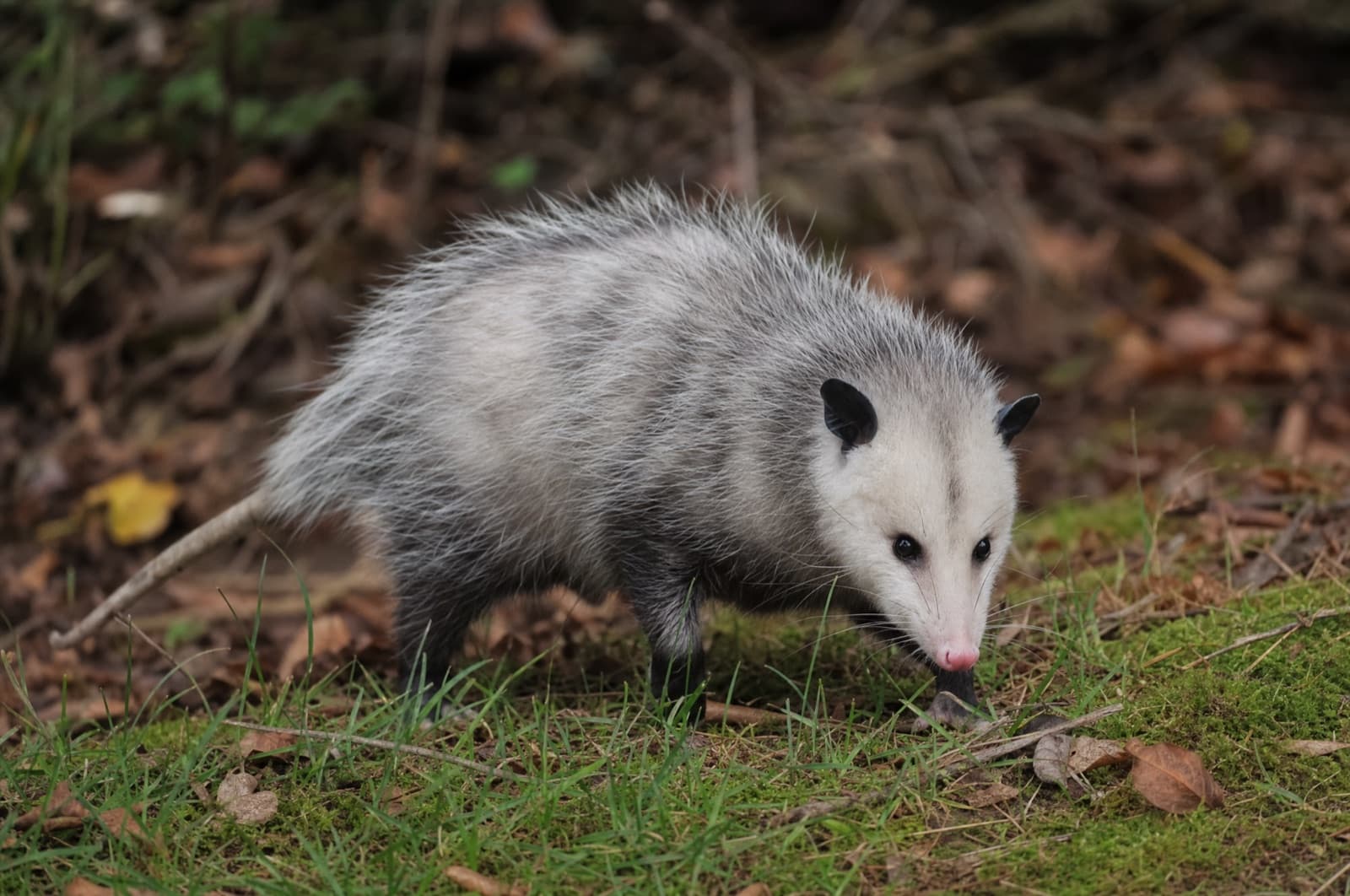
Opossums are large enough to be unmistakable once seen clearly — but in dim light or at a distance they get confused with large rats or even small raccoons. Key markers are the pointed white face, naked hairless tail, and grizzled gray-white fur.
Virginia opossum
- Scientific name
- Didelphis virginiana
- Family
- Didelphidae
- Size
- ~2–3 ft total length including tail; 4–14 lb
- Coloration
- Grizzled gray-white body; pointed pink-white face; naked, scaly prehensile tail; black ears
- Habitat
- Woodland edges, suburban yards, under decks and sheds, along stream corridors; reuses groundhog burrows and other existing cavities.
- Active season
- Nocturnal and year-round; less active in severe NH cold (not a true hibernator)
- Diet
- Omnivore/scavenger — carrion, fruit, insects, eggs, small vertebrates, trash, pet food
- Reproduction
- 1–3 litters per year; gestation ~13 days (shortest of any North American mammal); young complete development in the pouch
- Lifespan
- ~1–2 years in the wild
Established across southern and central New Hampshire; range expanding northward.
The tells — key ID features
- Pointed white face with a pink nose — the single clearest field mark.
- Naked, hairless, scaly prehensile tail — used to grip branches (not to hang by).
- Grizzled gray-white fur giving a coarse, almost shaggy appearance.
- Rear feet have an opposable 'thumb' with no claw — unique among NH mammals.
- Star-shaped hand tracks (five long fingers spread wide) in mud or snow.
- Size of a large house cat; much larger than any rat.
Size, to scale
4–14 lb; 2–3 ft including tail
Roughly the size of a large house cat
Large rat
How to tell — Rats are much smaller, with a rounded pink face, no white facial fur, and a thin cylindrical tail. Opossums have a distinctly pointed white face and a thicker, prehensile tail.
Raccoon
How to tell — Raccoons have a black facial mask, ringed tail, and chunky build. Opossums have a plain pointed white face and a naked unringed tail.
Signs of a problem
Opossums are nocturnal and secretive, so most encounters are indirect — raided food, tracks, or a dark shape disappearing under a structure.
Overturned or raided trash cans and pet food bowls overnight
What it means — Opossums are opportunistic scavengers and will reliably hit unsecured food sources after dark.
Denning under a deck, porch, or shed
What it means — Opossums do not dig; they move into existing voids — often old groundhog burrows or gaps under structures.
Star-shaped hand tracks (five splayed fingers) in mud, snow, or soft soil
What it means — The opposable rear 'thumb' produces a distinctive print not made by any other NH mammal.
An animal lying motionless and unresponsive in the yard
What it means — This is 'playing dead' (thanatosis) — an involuntary reflex, not a health crisis. The animal will recover and leave on its own.
No fresh earth disturbance near the den entrance
What it means — Confirms the hole was pre-existing; an opossum moved in but did not excavate it.
Hissing or drooling when cornered
What it means — Normal opossum bluffing behavior — not a sign of rabies. Do not handle.
The real risks, calibrated
Opossums are among the least aggressive wildlife species in New Hampshire. Their risk profile is real but modest — and dominated by the debunked claims that need correcting.
Rabies — rare but not impossible
ModerateOnset: Only if bitten or scratched
Opossums have among the lowest rabies-positivity rates of tested wildlife species, but they are not immune. Rabid opossums have been documented. Any bite or scratch: call NH DHHS at (603) 271-4496 immediately.
Denning nuisance under structures
Low riskOnset: Once established
An opossum under a deck or shed can cause odor, minor damage to insulation or vapor barrier, and attract other wildlife. The animal itself is not aggressive but should be encouraged to leave before the entry point is sealed.
Leptospirosis and parasites via feces
ModerateOnset: Contact with feces
Opossum feces can carry leptospirosis and intestinal parasites. Avoid direct contact; wear gloves if cleaning an area where an opossum denned.
Aggression — bluffing only
Low riskOnset: Only when cornered
Opossums hiss, bare teeth, and drool when cornered but almost never follow through with a bite. Their first response is always to play dead. Leave them alone and they will leave.
DIY — what works, what backfires
Most opossum encounters resolve on their own once you remove the attractants. The goal is to make your property less hospitable rather than to trap or handle the animal.
What actually works
- Secure trash cans with bungee cords or locking lids — opossums are persistent but not strong.
- Bring pet food inside at night; do not leave bowls outdoors after dusk.
- Seal entry points under decks, porches, and sheds — but ONLY after confirming the animal has left (check for tracks or movement over 2–3 nights).
- If you find an opossum playing dead, leave it alone and give it 1–4 hours to recover and move on — it is not injured.
- Call NH DHHS at (603) 271-4496 immediately if any person or pet is bitten or scratched.
- Contact USDA Wildlife Services NH at (603) 223-6832 for guidance on conflict situations.
What backfires
- Do not rely on opossums for tick control — the '5,500 ticks per week' claim was debunked by a 2021 peer-reviewed study (Hennessy & Hild); wild opossums showed no tick parts in stomach content analysis.
- Do not handle an opossum with bare hands under any circumstance.
- Do not assume an opossum is rabid because it drools, hisses, or bares its teeth — these are normal defense behaviors.
- Do not seal an entry point while the animal may still be inside; a trapped opossum will cause damage and die.
- Do not disturb an opossum with any potential rabies exposure without proper PPE — call a professional.
Opossums in southern and central New Hampshire
Opossums are found across Anchor's entire service area — Manchester, Nashua, Concord, Derry, Bedford, Salem, Hudson, Amherst, Auburn, Goffstown, Hooksett, Litchfield, Milford, and surrounding communities. Their NH range is actively expanding northward as winters moderate. In southern NH, the most common encounters are opossums denning beneath porches, decks, and sheds (often in old groundhog burrows), raiding unsecured trash and outdoor pet food bowls at night, and occasionally being found 'playing dead' in a yard. They do not construct their own burrows, so an opossum under your deck has simply found an existing void — a gap that should be sealed after the animal has left.
Peak season
Year-round; most visible fall through spring when ground cover is sparse
We serve these communities
- NH-licensed applicator · #782664
- Same-day service
- Family-owned since 2017
Service Area Map
Southern New Hampshire
When to call a pro for opossum removal
Most opossum encounters don't require professional removal — but persistent denning under a structure, multiple animals, or any situation involving a bite or potential rabies exposure does. A licensed wildlife control operator confirms the animal is out before sealing, and can assess whether the void poses risks to other wildlife moving in.
When to call a pro
- An opossum has denned under your deck, porch, or shed and you cannot confirm it has left.
- Multiple opossums are present (a mother with young, or multiple adults).
- Any person or pet has been bitten or scratched — call NH DHHS (603) 271-4496 first, then a WCO.
- The animal appears injured, disoriented, or is active in daylight with unusual behavior.
- You need the entry point professionally excluded and sealed to prevent re-entry.
Eliminate food attractants
Secured trash lids and no outdoor pet food overnight are the two changes that most reduce opossum activity around NH homes.
Exclude entry points before fall
Inspect the perimeter of decks, porches, sheds, and crawl spaces each fall — before opossums seek winter denning sites — and seal gaps with hardware cloth or pressure-treated lumber.
Fill in groundhog burrows
Opossums do not dig their own dens; they move into existing cavities. Collapsing and filling abandoned groundhog burrows near your foundation removes a primary opossum den site.
Not sure it's a virginia opossum?
A licensed NH technician can confirm the species and tell you honestly whether it's a DIY fix or a job for a pro — free inspection, same-day service across Southern New Hampshire.
Frequently asked questions
Sources(5)
- [1]Wildlife Illinois — Debunking the Opossum Tick Myth
Debunking the 5,500 ticks per week claim; wild vs. caged study distinction
govverified 2026-06-30 - [2]Snopes — Opossum Pest Control Fact Check
Fact-check on tick consumption figures; 2009 lab study critique
newsverified 2026-06-30 - [3]Horse Sport — Opossums and Ticks: Old Myth Debunked
2021 Hennessy & Hild study; zero tick parts in wild opossum stomach contents
newsverified 2026-06-30 - [4]Nebraska DHHS — Rabies Guidelines
Opossum susceptibility to rabies; documented rabid opossum cases
govverified 2026-06-30 - [5]Exotic Pet Wonderland — Opossums and Rabies
Body temperature mechanism; not immune vs. lower risk distinction
industryverified 2026-06-30
Written & reviewed by
VerifiedDaniel Brady
NH-Licensed Pesticide Applicator · License #782664 (NHDAMF, RSA 430)
Daniel Brady is the New Hampshire–licensed applicator behind Anchor Pest Services, a family-owned pest control company serving the Manchester area since 2017.
Last updated 2026-06-30

New Hampshire pest control
Dealing with virginia opossums in your home?
Anchor Pest Services identifies and handles virginia opossum problems across southern and central New Hampshire. Family-owned since 2017, NH license #782664.
- NH-licensed applicators (#782664)
- Same-day service · free inspection
- Family-owned since 2017
Your next step
- Fall guide
Fall Pest Control in New Hampshire
What matters before frost: the fall invader window, mice at the foundation, and what to seal first.
Read the answer - What to do next
How to Get Rid of Opossums
Read the answer - What to do next
Where Do Opossums Live in the Winter? NH Timing Guide
Read the answer - What to do next
Where Do Opossum Go In The Winter?
Read the answer