
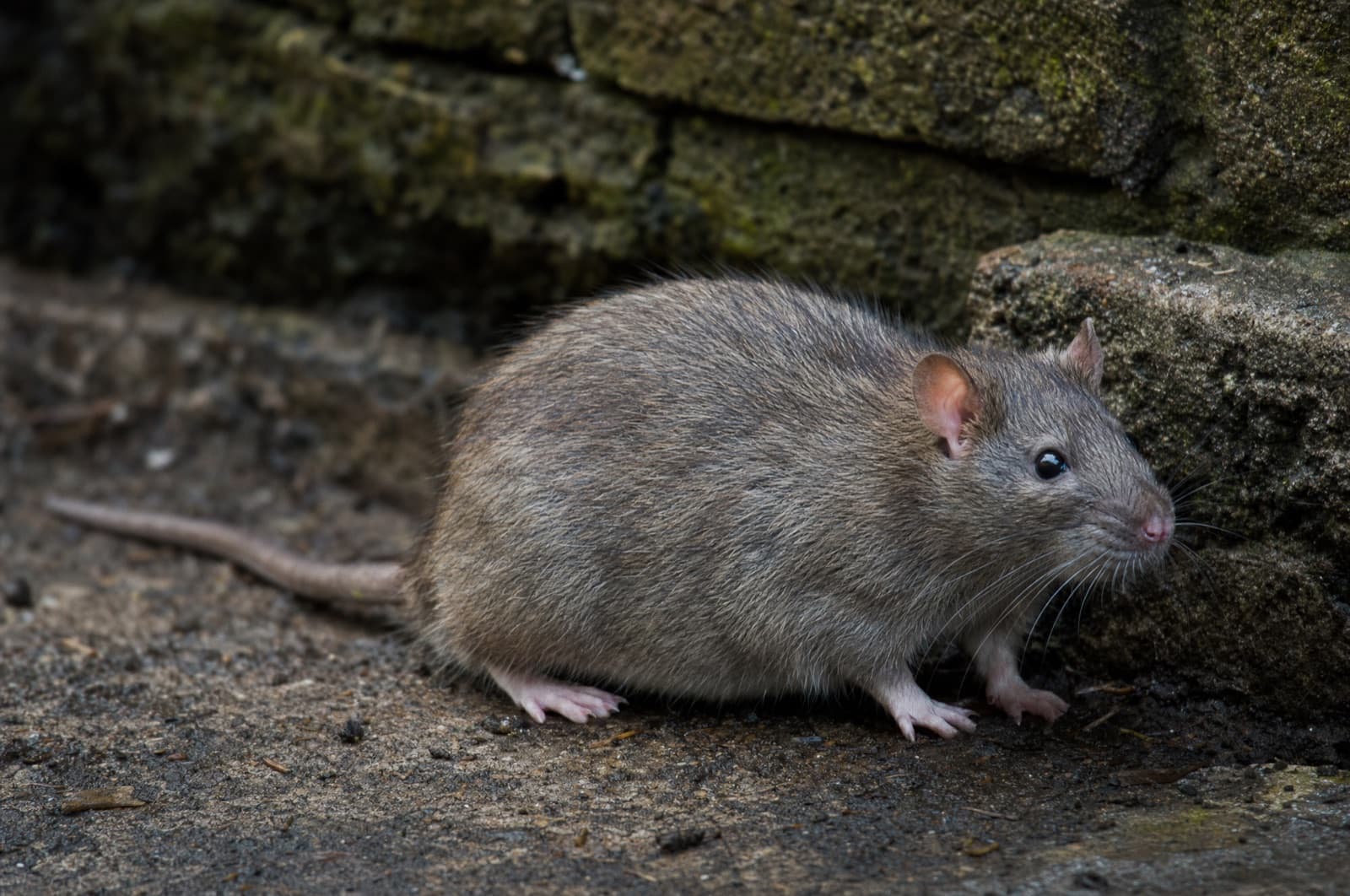
Norway Rat in New Hampshire — ID, Signs & Control
Also called Brown rat · Sewer rat · Street rat · Wharf rat
The Norway rat (Rattus norvegicus) is the rat species you will actually encounter in New Hampshire — stocky, gray-brown, with a blunt nose and a scaly tail shorter than its body. It burrows along foundations and is the primary rat in urban and suburban NH. A female can have up to 7 litters per year, so DIY trapping rarely clears an established colony.
- Body size
- ~10–11 in body + shorter tail; up to ~1 lb (500 g)
- ICWDM — Norway Rats
- Tail
- Scaly, shorter than the body — the inverse of the roof rat
- UNH Extension
- Droppings
- ½–¾ in, blunt-ended
- ICWDM — Norway Rats
- Burrows
- 2–3 in diameter holes along foundations and slabs
- ICWDM — Norway Rats
- Reproduction
- Up to 7 litters/yr; ~8 pups; gestation 22–24 days
- Smithsonian National Zoo
- NH presence
- Established — the dominant rat species statewide
- Colonial Pest Control
The rat you actually have in New Hampshire
The Norway rat (Rattus norvegicus) — also called the brown rat, sewer rat, or wharf rat — is the rat species you will encounter in New Hampshire. Colonial Pest, citing decades of northeastern pest management experience, is unambiguous: 'Our main rat here in most of the Northeast is the brown rat or Norway rat.'
Fast ID: heavy and stocky, coarse gray-brown fur, blunt nose, small ears, and most importantly a scaly tail that is shorter than its body — the inverse of the roof rat. Burrows are the other diagnostic: a clean 2–3-inch hole at ground level along a foundation or slab is a Norway rat burrow, not a chipmunk hole (moundless, ~2 in) and not a groundhog hole (10–12 in with a dirt fan).
Honest DIY-vs-pro verdict: store-bought snap traps catch naïve juvenile rats but rarely clear an established colony — a female can produce up to 7 litters per year. Active burrows, leptospirosis risk from urine-contaminated water, and the potential for foundation undermining make Norway rat infestations a job where professional baiting and exclusion wins far faster than continued DIY. If a homeowner searches 'rats in my attic' in NH, the honest answer is: that is almost always a gray squirrel (daytime noise) or a Norway rat at ground level, not a roof rat.
How to identify a Norway rat
The Norway rat's three best field marks are the blunt nose, the scaly tail that is shorter than the body, and the heavy stocky build — all the inverse of the slender roof rat. Color alone is not reliable: Norway rats can range from brown to dark gray and even black, so a dark rat in NH is still almost certainly a Norway rat, not a black rat.
Norway rat
- Scientific name
- Rattus norvegicus
- Family
- Muridae
- Size
- ~10–11 in body + shorter scaly tail; up to ~1 lb (140–500 g)
- Coloration
- Coarse gray-brown fur; lighter belly; color variable — do not ID on color alone
- Habitat
- Ground burrows along foundations, sewers, basements, woodpiles, under slabs
- Active season
- Year-round; increased pressure indoors in fall
- Diet
- Omnivore — cereals, garbage, meat scraps, garden produce
- Reproduction
- Up to 7 litters per year; average ~8 pups; gestation 22–24 days; young mature in ~3 months
- Lifespan
- ~1 year in the wild; up to 2–3 years in protected indoor settings
Dominant rat species throughout North America; most common rat in New Hampshire
The tells — key ID features
- Blunt nose and small ears — the best single visual tell vs. the roof/black rat's pointed nose and large ears.
- Scaly tail shorter than the body — the reliable tail-to-body ratio test.
- Heavy, stocky build; far heavier than any mouse or squirrel.
- Coarse gray-brown fur (color is NOT reliable — Norway rats can be dark).
- Ground-level burrows: clean 2–3-inch holes at foundation bases, slab edges, or under debris.
Size, to scale
~10–11 in body + shorter tail; up to ~1 lb
Body about the length of a banana; far heavier than any mouse.
Roof rat / black rat
How to tell — Slimmer build, pointed nose, large ears, and tail distinctly longer than the body — not established in New Hampshire.
House mouse
How to tell — Far smaller (AA battery-sized body vs. banana-sized), lighter, hairy tail; uniform gray-brown.
Eastern gray squirrel
How to tell — Bushy tail, diurnal (daytime) noise in attics, gray coat — the actual culprit when 'rats in the attic' are reported in NH.
Signs of a problem
The burrow decoder and dropping size are the two fastest ways to confirm Norway rats and distinguish them from mice or squirrels.
½–¾-inch blunt-ended droppings near food or along walls
What it means — Rat, not mouse — mouse droppings are ⅛–¼ inch and pointed. Quantity and freshness gauge population size.
2–3-inch smooth holes at ground level along foundations or under slabs
What it means — Active Norway rat burrow — chipmunk holes are moundless and ~2 in; groundhog holes are 10–12 in with a dirt fan.
Oily dark rub marks along low runways at the base of walls
What it means — Established travel paths — rats follow the same routes repeatedly and leave grease and fur marks.
Quarter-sized ragged gnaw holes in wood, drywall, or packaging
What it means — Rat-sized gnawing — mouse gnaw marks are only ~1/32 inch and entry holes are dime-sized.
Gnawing or scratching sounds low in the structure at night
What it means — Nesting activity in basement, crawl space, or wall void — Norway rats are ground-dwelling and not attic climbers.
The real risks, calibrated
Norway rats carry real health and structural risks. Leptospirosis in particular is associated with rat urine contaminating standing water or wet surfaces.
Leptospirosis
HighOnset: Days to weeks after contact with contaminated water or surfaces
Bacterial infection spread through rat urine; can cause flu-like illness progressing to liver and kidney damage if untreated. Consult a doctor for any illness following rat exposure.
Rat-bite fever and Salmonellosis
ModerateOnset: Days
Bites and food contaminated with droppings or urine can transmit bacterial disease. Route illness concerns to a doctor or NH DHHS.
Structural and foundation undermining from burrows
HighOnset: Months of active burrowing
Burrows under slabs, patios, steps, and foundation edges can undermine footings over time, particularly in older NH fieldstone construction.
Electrical fire from gnawing
HighOnset: Unpredictable
Rats gnaw wiring insulation continuously; this is a documented cause of residential and commercial fires. Have wiring inspected after any rat infestation.
Rapid colony growth
SevereOnset: Weeks
A female can produce up to 7 litters per year; young mature in ~3 months. An established colony grows faster than DIY trapping can clear it alone.
DIY — what works, what backfires
DIY is a reasonable first response to a fresh sighting — but it rarely clears an established colony. Here is what works and what will stall your progress.
What actually works
- Use heavy-duty snap traps (rat-sized, not mouse traps) placed perpendicular to walls in runways and near burrow openings — bait with peanut butter or nesting material.
- Seal entry points with metal mesh (16-gauge or heavier), concrete mortar, or hardware cloth; focus on foundation gaps, utility penetrations, and slab edges.
- Remove harborage: move woodpiles 20+ feet from the structure, secure compost in rodent-proof bins, eliminate dense ground cover and debris.
- Address food sources: use lidded garbage cans, secure outdoor chicken coop feed, and remove accessible pet food.
What backfires
- Don't rely on scent repellents, ultrasonic devices, or ammonia — none have evidence of effectiveness against established rat colonies.
- Don't ignore active burrows — a burrow with fresh soil at the entrance means an active colony; fill and check it; if refilled within 24–48 hours, the colony is active.
- Don't expect store-bought traps alone to clear a colony — snap traps catch naïve juvenile rats but rarely reach all established adult animals in a burrow system.
- Don't assume rats are only a problem in dirty urban areas — woodpiles, compost, and chicken coops in suburban southern NH attract Norway rats regularly.
Norway rats in New Hampshire
Urban and suburban Manchester, Nashua, and Concord have the highest Norway rat densities in NH, but suburban woodpiles, compost bins, and backyard chicken coops across Rockingham and Hillsborough Counties support them too — this is not only a 'dirty city' problem. The old fieldstone and granite-block foundations common in southern NH provide ideal burrowing sites. Fall cold drives pressure upward as rats consolidate food stores and seek warmth, typically aligning with Manchester's first hard frost (~Oct 19–29, NOAA).
Peak season
Year-round; fall pressure increase as temperatures drop
You might actually have
- House mouse (far smaller, commensal indoors)
- Eastern gray squirrel (daytime attic noise — often misidentified as a rat)
We serve these communities
- NH-licensed applicator · #782664
- Same-day service
- Family-owned since 2017
Service Area Map
Southern New Hampshire
When to call Anchor Pest Services for rats
Norway rat colonies grow faster than DIY can usually address. A licensed rodent control technician can locate the full extent of burrow systems, place commercial-grade bait stations where rodenticides are legal and effective, and confirm through follow-up inspections when the population is cleared — then seal every entry point.
When to call a pro
- Any confirmed rat sighting, droppings, or active burrow — Norway rats breed fast and a single pair becomes a colony quickly.
- Burrows found under foundation edges, slabs, porches, or steps.
- Recurring activity despite DIY trapping — an established colony with multiple burrow chambers is rarely cleared by consumer snap traps alone.
- Gnawed wiring discovered — requires both pest control and an electrical inspection.
Foundation exclusion
Seal all ground-level gaps ¼ inch or larger with concrete mortar, metal flashing, or heavy-gauge hardware cloth — focus on utility pipe penetrations, sill plates, and the base of older fieldstone foundations.
Harborage removal
Eliminate woodpiles, debris, and dense ground cover within 20 feet of the structure. Secure compost bins and outdoor chicken feed in rodent-proof containers.
Sanitation
Use lidded metal or heavy plastic garbage cans; remove fallen fruit and birdseed; keep grills clean.
Not sure it's a norway rat?
A licensed NH technician can confirm the species and tell you honestly whether it's a DIY fix or a job for a pro — free inspection, same-day service across Southern New Hampshire.
Frequently asked questions
Sources(5)
- [1]ICWDM — Norway Rats
body size, weight range, dropping size (½–¾ in, blunt-ended), burrow hole diameter (2–3 in), lifespan
academicverified 2026-06-30 - [2]Smithsonian National Zoo — Norway Rat
litters per year, gestation, pup count
academicverified 2026-06-30 - [3]Colonial Pest — Could That Be a Roof Rat?
Norway rat as dominant NE rat species
industryverified 2026-06-30 - [4]
- [5]
Written & reviewed by
VerifiedDaniel Brady
NH-Licensed Pesticide Applicator · License #782664 (NHDAMF, RSA 430)
Daniel Brady is the New Hampshire–licensed applicator behind Anchor Pest Services, a family-owned pest control company serving the Manchester area since 2017.
Last updated 2026-06-30

New Hampshire pest control
Dealing with norway rats in your home?
Anchor Pest Services identifies and handles norway rat problems across southern and central New Hampshire. Family-owned since 2017, NH license #782664.
- NH-licensed applicators (#782664)
- Same-day service · free inspection
- Family-owned since 2017
Your next step
- Book a NH pro
Rodent Control in New Hampshire
Mice and rats move indoors every fall. We trap, seal entry points and keep them out.
Book now - Next step
Will Rats Go Away Without Food?
Read the answer - What to do next
How to Get Rid of Norway Rats
Read the answer - Related guide
Black Rat in New Hampshire — Is It Even Here?
Read the answer - Related guide
Roof Rat in New Hampshire — Or Is It a Squirrel?
Read the answer - Also relevant
Where Do Rats Build Nests Around Homes?
Read the answer