
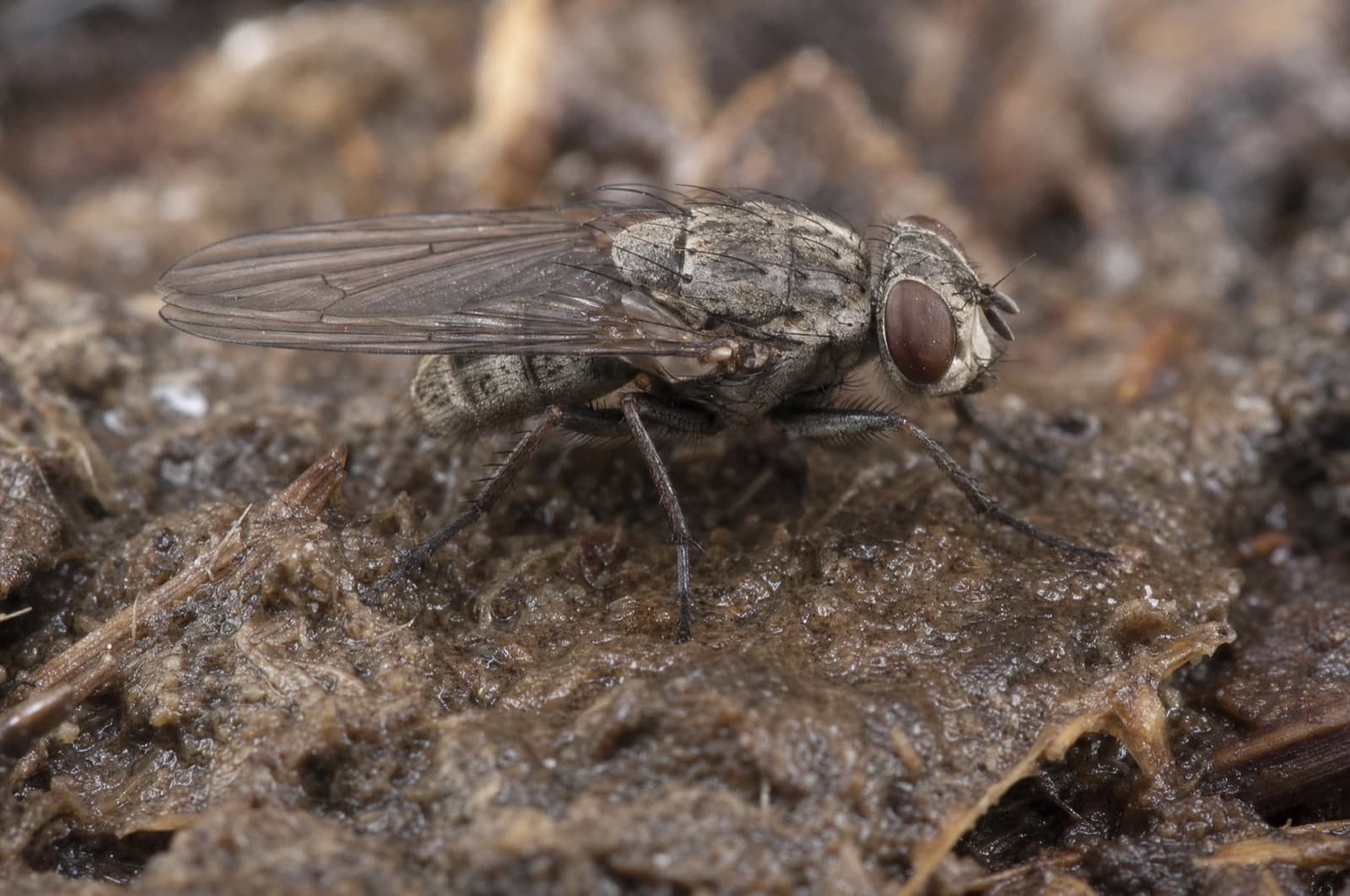
Stable Flies in New Hampshire — The Biting "House Fly"
Also called Biting house fly · Barn fly · Dog fly · Beach fly
The stable fly (Stomoxys calcitrans) looks almost exactly like a house fly — same gray body, same four thoracic stripes — but it carries a forward-projecting bayonet-like piercing proboscis and both sexes actively blood-feed. If a 'house fly' is biting you around the ankles, it is a stable fly. It breeds in wet decaying vegetation, manure, and soiled bedding. The fix is drying out and removing that wet organic matter.
- Species
- Stomoxys calcitrans
- the 'biting house fly'; family Muscidae
- Size
- ~5–8 mm
- house-fly-sized; Merck Veterinary Manual; Animal Diversity Web
- Best tell
- Forward bayonet-like proboscis — it BITES
- visible from the side; Merck Veterinary Manual
- Who bites
- Both sexes blood-feed
- Animal Diversity Web; U. of Saskatchewan
- Breeds in
- Wet manure, soiled straw bedding, rotting vegetation, grass clippings
- Merck Veterinary Manual; U. of Saskatchewan
- Peak in NH
- Late summer–early fall
- rural and livestock properties; cosmopolitan U.S. distribution
If the house fly is biting you, it is a stable fly.
The stable fly (Stomoxys calcitrans, family Muscidae) is the cluster's biting fly — and the one species guaranteed to get your attention. It looks almost exactly like a common house fly: same size, same dull gray body, same four thoracic stripes. The difference is invisible until the fly lands on you, and then you feel it immediately: a sharp, stabbing bite, typically around the ankles and lower legs.
Unlike house flies with sponging mouthparts, the stable fly carries a forward-projecting bayonet-like piercing proboscis. And unlike most blood-feeding insects where only the female feeds, both male and female stable flies blood-feed — making them a persistent nuisance wherever they occur.
Their breeding medium is wet, decaying organic matter: livestock manure, soiled straw bedding, wet grass clipping piles, rotting vegetation, and even seaweed in coastal settings. This makes them a real problem for rural New Hampshire properties with barns, horses, dairy cattle, or chickens, with peak biting pressure in late summer into early fall.
Breeding-source-first applies exactly as it does to house flies: the fix is drying out and removing the wet decaying organic matter they breed in, not killing the adults you see.
How to identify a stable fly
The forward bayonet proboscis is the only reliable tell from the house fly — and if you feel the bite, you have your confirmation. Stable flies are house-fly look-alikes in every other respect. The mouthpart is the ID, not the size.
Stable fly
- Scientific name
- Stomoxys calcitrans
- Family
- Muscidae
- Size
- ~5–8 mm (house-fly-sized)
- Coloration
- Dull gray; four dark thoracic stripes; slightly broader, checkered/spotted abdomen compared to house fly
- Habitat
- Barns, feedlots, stables, and outdoor areas with wet manure, soiled bedding, rotting vegetation, grass clippings, or seaweed.
- Active season
- Late summer–early fall peak; warm season generally
- Diet
- Blood (both sexes); adults require blood meals for reproduction.
- Reproduction
- Females lay eggs in decaying organic matter — wet manure, soiled straw, rotting grass clippings.
- Lifespan
- Egg-to-adult cycle approximately 2–4 weeks; adults active warm season.
Cosmopolitan; present throughout the United States including New Hampshire; particularly relevant on rural and agricultural properties.
The tells — key ID features
- Bayonet-like proboscis projecting forward from the head — the single diagnostic tell vs. the house fly; visible from the side.
- Otherwise identical size and dull gray appearance to a house fly (four thoracic stripes).
- Slightly broader, spotted or checkered abdomen.
- Wings held slightly spread at the tips when at rest (house fly holds wings closer together).
- Bites around the ankles and lower legs — the behavior is diagnostic.
Size, to scale
~5–8 mm (~1/4 in)
House-fly-sized — the bayonet mouthpart is the giveaway, not the size
Common house fly
How to tell — House flies have sponging mouthparts that do not project forward and cannot bite. The stable fly's bayonet proboscis is the separator — and the bite is the ultimate confirmation. If a gray fly bites you, it is a stable fly; house flies cannot bite.
Face fly
How to tell — Face flies (Musca autumnalis) also resemble house flies and can be found near livestock, but they feed on secretions from animal faces rather than blood-biting. Stable fly is the one that actually pierces skin.
Horn fly
How to tell — Horn flies (Haematobia irritans) are considerably smaller than stable flies (~3–4 mm) and primarily feed on cattle, resting on the animal's back and sides. Stable flies are larger and bite people and livestock at the lower legs.
Signs of a problem
Stable fly signs combine the biting behavior with the proximity to their wet organic breeding source. These are the signs and what each one means.
Painful daytime bites around the ankles and lower legs
What it means — Stable fly, not a house fly — the bite is the definitive identification. Stable fly bites are sharp and persistent.
Biting flies near barns, pastures, or piles of wet grass clippings or straw
What it means — The breeding source is nearby — wet decaying organic matter within the immediate area is sustaining the population.
Livestock stamping feet, bunching together, or showing reduced productivity
What it means — Heavy stable fly pressure on the animals; a significant infestation affecting livestock health and production.
Flies resting on fence posts or vegetation near the barn in the morning or evening
What it means — Stable flies rest on structures when not actively feeding; their presence in numbers near livestock areas confirms an active infestation.
The real risks, calibrated
The stable fly's defining risk is its bite — painful, persistent, and sustained by an active breeding population in wet organic material.
Painful bites to people and livestock
ModerateOnset: Immediately upon contact
Stable fly bites are sharp and cause immediate pain, typically at the lower legs and ankles. Both sexes blood-feed. Bites can cause localized inflammation and, in sensitive individuals, more significant reactions. If a bite causes a significant reaction, contact a physician; for severe reactions, call NNEPC 1-800-222-1222.
Livestock economic losses
HighOnset: During peak season
Stable flies cause significant cattle and livestock production losses through reduced weight gain and milk production. Peer-reviewed estimates place annual U.S. cattle-production losses in the high hundreds of millions to over a billion dollars depending on the study (various peer-reviewed sources).
Mechanical pathogen vectoring
Low riskOnset: Uncommon in our region
Stable flies are mechanical vectors of some animal pathogens; disease transmission to humans is low-risk in New Hampshire's context.
DIY — what works, what backfires
Stable fly control centers on the breeding source: wet, decaying organic matter. Remove or dry it out, and the fly population declines. Killing adults you see without addressing the source is temporary at best.
What actually works
- Remove or spread wet manure, soiled straw bedding, and rotting-vegetation piles — these are the primary stable fly breeding sources; spreading thin allows drying and destroys the breeding habitat.
- Keep livestock bedding dry — stable flies cannot successfully breed in dry bedding; regular removal and replacement of wet straw and manure prevents buildup.
- Remove or compost grass-clipping piles promptly — wet clipping piles near the house or barn are a commonly overlooked stable fly source.
- Use sticky fly traps or commercial biting-fly traps near livestock areas to reduce adult populations.
- Drain or fill low-lying wet areas near barns and pastures that accumulate decaying vegetation.
What backfires
- Don't treat a biting stable fly as a harmless house fly — they are not the same insect; the stable fly requires a different response and should prompt you to locate and address the wet breeding source.
- Don't spray adult stable flies as the primary control while wet breeding piles remain — new adults will emerge from the source faster than you kill them.
- Don't pile and leave grass clippings near living areas or near animal housing — a large moist clipping pile is a productive stable fly nursery.
- If a stable fly bite causes an unusual reaction, do not ignore it — wash the bite, monitor for swelling or signs of infection, and contact a physician if symptoms concern you. For severe reactions, call the Northern New England Poison Center at 1-800-222-1222.
Stable flies in New Hampshire
Stable flies are present on rural and agricultural properties across New Hampshire — dairy and horse farms, properties with livestock, and residential properties near barns or with decaying vegetation piles. NH presence is asserted from their cosmopolitan U.S. distribution and well-documented New England livestock relevance; they are common in agricultural settings throughout the Northeast. Peak biting pressure in NH typically occurs in late summer into early fall — August through September. Residential properties adjacent to farmland or with substantial composting and organic material piles can also experience stable fly pressure in late summer.
Peak season
Late summer to early fall; peak biting pressure August–September on rural/livestock properties
You might actually have
- Common house fly (sponging mouthparts, does NOT bite — the primary ID contrast)
- Deer flies and horse flies (also biting; larger; different breeding medium)
We serve these communities
- NH-licensed applicator · #782664
- Same-day service
- Family-owned since 2017
Service Area Map
Southern New Hampshire
When to call a pro for stable flies
Barn, feedlot, and rural-property stable fly infestations often require systematic breeding-source management beyond what an individual homeowner can address alone. A licensed technician can assess breeding conditions and implement a management plan.
When to call a pro
- A persistent biting fly problem on a rural property or near livestock despite your own source-management efforts.
- Heavy infestation pressure affecting livestock health or productivity.
- Breeding source management on a large property or barn complex where the source is extensive or difficult to locate.
- Residential properties with an adjacent farm source that is outside your control.
Manure and bedding management
Remove and spread livestock manure and soiled bedding at least weekly during the active season. Stable flies cannot develop in dry, thin-spread manure — it is the wet, piled, anaerobic condition that enables them.
Drainage and site management
Ensure good drainage around barns, feedlots, and pasture areas to prevent the accumulation of standing water and wet organic material that stable flies require for development.
Vegetation management near the home
Remove rotting vegetation, grass-clipping piles, and decaying garden waste promptly, especially in late summer when stable fly pressure peaks in NH. These materials near a residence create stable fly habitat that bites humans in addition to livestock.
Not sure it's a stable fly?
A licensed NH technician can confirm the species and tell you honestly whether it's a DIY fix or a job for a pro — free inspection, same-day service across Southern New Hampshire.
Frequently asked questions
Sources(6)
- [1]Merck Veterinary Manual — Stable Flies
proboscis description, breeding media, livestock management
industryverified 2026-06-30 - [2]Animal Diversity Web — Stomoxys calcitrans
both-sexes blood-feeding, biology, identification
academicverified 2026-06-30 - [3]University of Saskatchewan (WCVM) — Stomoxys calcitrans
breeding media, both-sexes feeding, biology
academicverified 2026-06-30 - [4]ScienceDirect — Stomoxys calcitrans (economic-loss review)
livestock economic losses (high hundreds of millions to over a billion dollars, study-dependent)
academicverified 2026-06-30 - [5]Texas A&M Insects — House Fly / Stable Fly Contrast
size comparison, house-fly vs stable-fly disambiguation
extensionverified 2026-06-30 - [6]UNH Cooperative Extension — Livestock Fly Management
NH source-first livestock fly management guidance
extensionverified 2026-06-30
Written & reviewed by
VerifiedDaniel Brady
NH-Licensed Pesticide Applicator · License #782664 (NHDAMF, RSA 430)
Daniel Brady is the New Hampshire–licensed applicator behind Anchor Pest Services, a family-owned pest control company serving the Manchester area since 2017.
Last updated 2026-06-30

New Hampshire pest control
Dealing with stable flys in your home?
Anchor Pest Services identifies and handles stable fly problems across southern and central New Hampshire. Family-owned since 2017, NH license #782664.
- NH-licensed applicators (#782664)
- Same-day service · free inspection
- Family-owned since 2017
Your next step
- What to do next
Chemical Fly Control: A Supplement, Not the Fix
Read the answer - What to do next
Natural Filth Fly Control: Source Removal Beats Any Spray
Read the answer - Related guide
House Flies in New Hampshire — ID, Disease Risk & Control
Read the answer - Related guide
Cluster Flies in New Hampshire — Why They're in Your House in Winter
Read the answer - Related guide
Blow Flies in New Hampshire — ID, Signs & How to Get Rid of Them
Read the answer